The Simple View is, at one level, the observation that at the onset of reading instruction, a child knows spoken language (at the level of a 5 or 6 year old) and needs to learn how to use the spellings of words to access knowledge of them gained from using oral language. Reading thus involves print, language, and the connections between them. This aspect of the Simple View accurately describes conditions at the onset of reading. The beginning reader’s initial challenge is indeed to learn how print represents words that are known from spoken language. This observation is consistent with countless studies because it describes the basic problem of beginning to read. It could be falsified only if we discovered a culture in which children learn to read before they learn to talk, or we found that children ignore what they already know about language in learning about print, or equally fanciful events obtained. I will call this the Simple Point of the Simple View. Every account of reading must include both print and language in some manner given that the minimal definition of reading is “comprehending language in written form.” This point is useful for a teacher or other educator coping with colleagues who maintain that instruction about the associations between print and sound–phonics–is unimportant, an impediment to skilled reading, or only relevant for struggling readers.[2]
Discussions of the Simple View frequently note that it is supported by a hundred or more studies as a way to establish its validity and also convey the depth of reading research. To take two examples, according to the Reading League’s guide to the science of reading, “The Simple View of Reading has been empirically validated by over 150 scientific studies.” According to a Reading Rockets blog, “The Simple View is supported by hundreds of studies which have shown decoding and language comprehension are critical to skilled reading.” What these studies support is the Simple Point.
Legislating Literacy: Estimating the Impact of State-Level Science of Reading Reforms on Reading Test Scores
Florence Bason and Christopher Redding:
This study examines the extent to which state adoption of Science of Reading (SoR)-aligned policies was associated with changes in fourth-grade reading achievement. Using longitudinal state-level panel data from 2003-2024 and quasi-experimental difference-in-differences (DiD) methods, the study estimates relationships between SoR policy adoption and NAEP Grade 4 reading outcomes. Findings suggest that SoR-aligned reforms are associated with modest but gradually emerging improvements in reading achievement, with stronger effects observed at longer post-adoption periods. Effects are not uniformly distributed across student groups, with more consistent positive associations observed for White students and students not eligible for free or reduced-price lunch. Results further suggest that coordinated policy environments may matter more than individually adopted literacy policies.
“It’s the Process, Stupid”
But the thing that has perhaps separated the Brewers and Rays from other organizations that have also bought all the technology and tried to be on the forefront of the data revolution is that they’ve always had good process. The insights they gain from the data sourced from the tech they’ve bought are put into action up and down their organization. It takes great communicators to turn all that data into insights that the best coaches can use to improve their players.
Perhaps that’s why both teams have frequently hired analysts in the blogosphere for their baseball operations departments. There are Baseball Prospectus and FanGraphs alumni aplenty in their front offices.
“We should work on our process, not the outcome of our processes” – W. Edwards Deming.
“I was the teacher and the mom who had been trained in the very practices that would later fail my own child”
Lucy Calkins was a huge part of my preservice teacher training at the University of Georgia. I still have my copy of The Art of Teaching Writing. Later, my district introduced me to Fountas and Pinnell’s Guided Reading. Balanced literacy wasn’t something sitting on the fringes of my professional life. It was thoroughly embedded in how I had been taught to think about literacy.
I believed it, and I taught it with fidelity, and then I had a child with dyslexia.
Anyone who has been through that knows that it changes the way you look at everything.
I watched a system that was supposed to teach my child to read cling to practices that didn’t teach him to read. I was actually told that the balanced literacy approaches being used in his school were appropriate for children with dyslexia. I have emails from that time explaining that they weren’t going to focus on sounding words out.
I still get emotional thinking about that.
Now I know what my child needed. I know what the research says. And I know how deeply entrenched this methodology has become in our schools.
So standing in the same physical space as Lucy Calkins at a conference devoted to advancing the science of reading was complicated for me.
For clarity, I don’t have a problem with Lucy Calkins learning.
Everyone should be learning.
If someone discovers that what they believed, taught, promoted, or sold does not align with the evidence, I absolutely want them sitting in the room learning something different.
But learning creates a responsibility to act on your new knowledge.
Lucy and I had a short conversation at the conference. She talked about teachers learning all this information and then having to go back to their districts and figure out how to actually implement it.
And I kept thinking: Teachers have been trying.
Procrastinating

“Milo is quite advanced—he’s already procrastinating at a fifth-grade level.”
Cartoon by Sophia GlockSeptember 7, 2026
[Link]
Wisconsin has tried to improve reading for decades. Will this time be different?
After years of stalled literacy efforts, Wisconsin’s latest reading law offers a fresh test of whether schools, policymakers and the public can stick with reform, Jim Zellmer writes:
In 1998, the Madison School Board adopted an important academic goal: “that all students complete the 3rd grade able to read at or beyond grade level.”
Flash forward 28 years to a July 29 Rotary Club event. Madison Superintendent Joe Gothard highlighted recent improvements in literacy in district schools. But he pointed out that proficiency rates still hovered around just 40% at the elementary, middle and high schools he listed.
“We should not be sitting in a place where we can say 60% of our students are not proficient at their grade level in reading,” Rebecca Kundert, the district’s senior executive director of curriculum and instruction, said in follow-up remarks.
The “Children Are Sponges” Idea Is Harmful to Kids
Do you know about baby sea squirts? These little marine creatures begin life actively swimming around, searching the ocean floor for a good home. When they find their spot, each sea squirt glues itself down and never moves again. Because it no longer needs to be active, it doesn’t need its brain anymore, so it eats it.
Even though mature sea squirts are brainless, they can teach us a big lesson: Brain health requires being active. This lesson is especially relevant for parents and educators, because there are a lot of forces these days that keep kids passive. Media messages don’t help. The internet has over 26 million websites comparing babies and young children to another sedentary marine organism: sponges. Psychologists, pediatricians, and educators are using the kids = sponges comparison to convey that kids are rapid learners who soak up information. That’s true, but the sponge metaphor is a terrible way to get that message across. It implies that babies and children are passive, just absorbing up what goes on around them, like sponges. That idea is not only wrong; it’s harmful.
Time is Precious, and Limited: Application Bloat Edition
Our work developing Fast Lane Literacy – the On-Ramp to Reading – emphasizes making the most of the limited time available and avoiding waste.
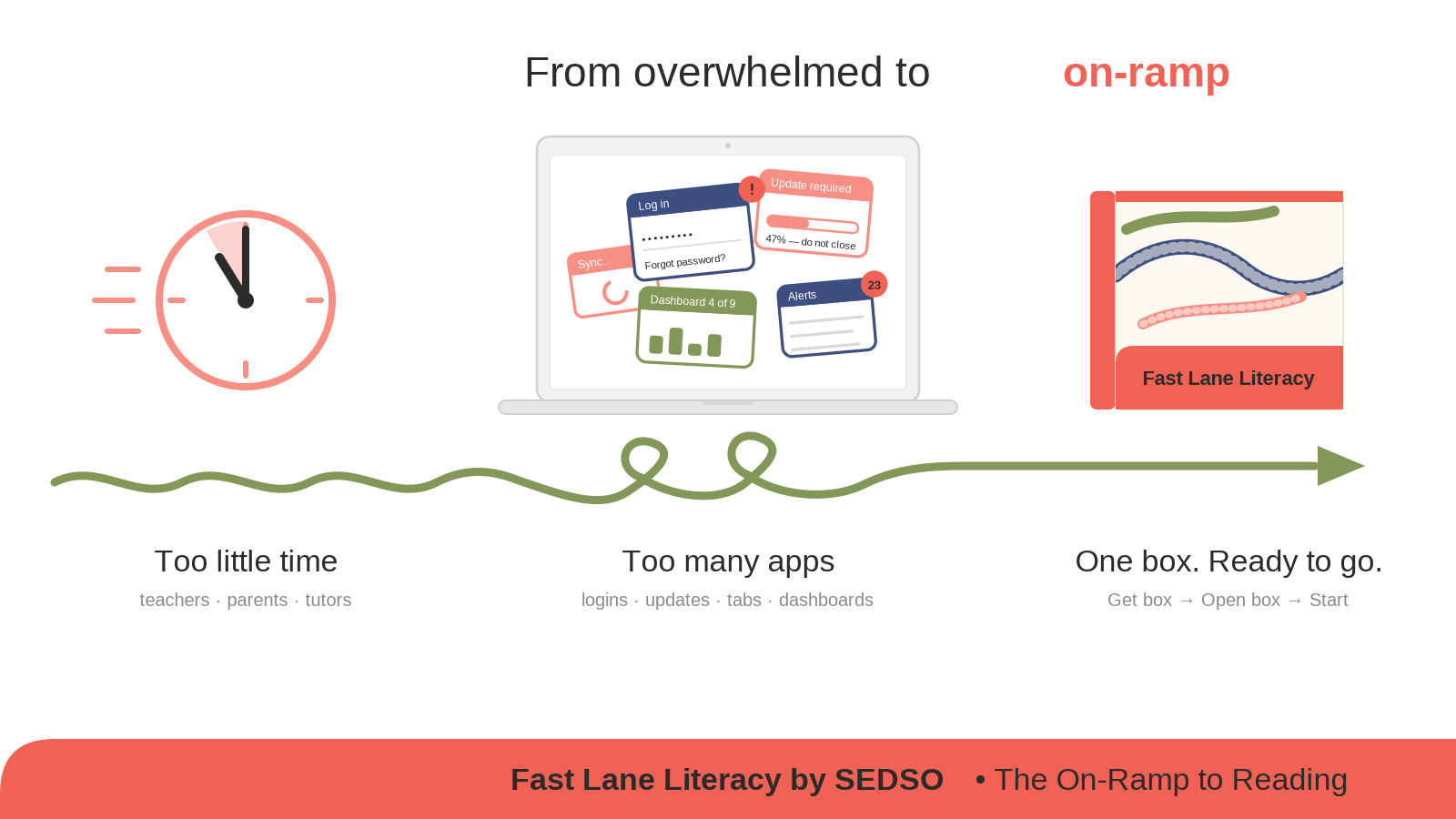
James Barron reported recently that New York City elementary and middle schools have 38 tools with “ai components”. 38 digital products to purchase, learn, maintain, leverage and share (effectively) with students. Season with network access, updates, training and hardware issues.
A recent Madison School District presentation mentioned “application bloat” along with the current 1:1 device policy for K-2 students.
And: NYC and LA are restricting student AI. We used it to expose what school missed—and repair two years of gaps in six weeks.
Notes on Indiana’s Reading Test(s)
I was initially surprised by this question for three reasons. One, it seemed far too easy for 3rd graders. Two, I questioned whether it was assessing reading proficiency in a real way. Three, I wondered why students weren’t expected to read the instructions. At this point, I actually checked to confirm that I was viewing questions written for 3rd graders. I was.
On the other hand, my first ILEARN question presented me with a short passage about “Smithsonian Sleepovers” and three accompanying visuals.
A Tribute to Literacy Advocate Dolly Parton
The world lost a force for good this week when Dolly Parton died.
Dolly contained multitudes and defied the odds to become a force for good in the world. It is difficult to imagine that a child born in a one room cabin that housed 12 children in Appalachia would ascend to the world stage. Her persona was wrapped in rhinestones and glitter but here giving reflected a humble desire to help kids who needed a boost. Her life was impactful on many levels.
Her talent for music and story telling led to success as a performer, writer, business woman and philanthropist. Dolly used everything she built to uplift kids, families and even whole towns.
Some notable philanthropic achievements:
• She launched a program to cover 100% of the cost for all 11,000 Dollywood employees to go to college.
• She started “The Imagination Library” 31 years ago. She worked initially to honor her Dad who could not read or write. A staggering 300,000,000+ books have been gifted since its inception.
3,000,000+ books are gifted to registered children each month.
The program is available in 5 countries.
Dolly was proud to be known as “The Book Lady”.
• School drop out rates in her hometown dropped from 35% to 6% after she started a program to pay kids to stay in school.
Dolly’s example of generosity and the commitment to children’s educational futures makes one think what colossal impact one dedicated wealthy person can make. Like James Barksdale, a tech billionaire, who shared his resources to impact Mississippi literacy, Dolly’s gifts touch the future.
“It’s hard to imagine many people having a bigger impact than Dolly Parton. She was born in a one room cabin, she earned 11 Grammys and an Emmy, built a business empire, helped millions of kids learn to read, and if that wasn’t enough -helped accelerate the research that led to the Moderna COVID vaccine.” Barack Obama