At their simplest, its tests find out how well people can make sense of the instructions on a pill bottle, or work out how much wallpaper they must buy to redecorate a room. At more advanced levels, they explore how well people can draw sound conclusions from complex analysis and charts. Test-takers are divided into five levels of acuity, in each discipline. Level 1 ought to be achievable by a rich-world pupil at the end of primary school, says Andreas Schleicher of the oecd.
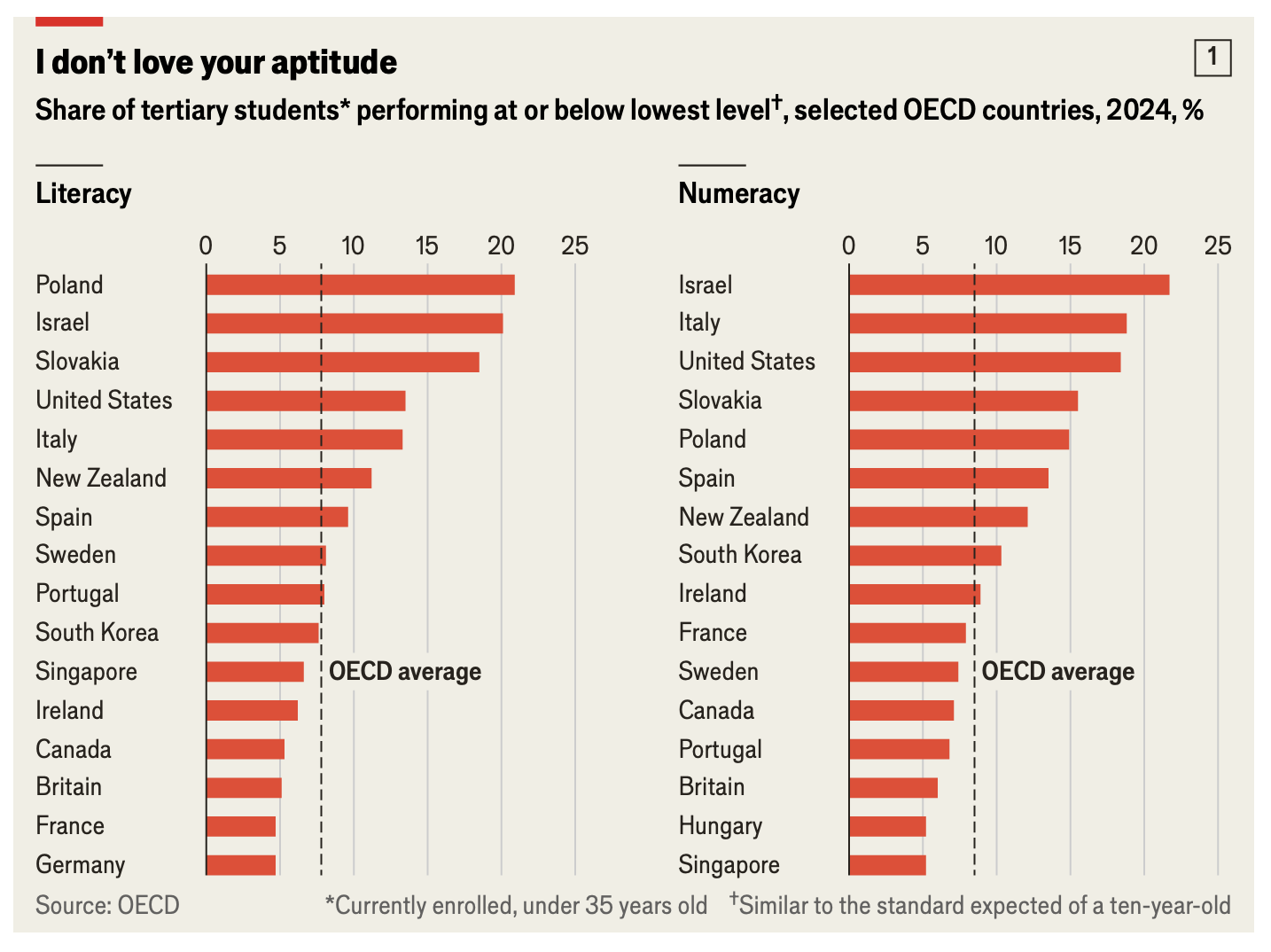
Some 160,000 people of all ages were tested in the last round (the results of which were published at the end of 2024). The Economist asked the oecd for data just of those under 35 who were enrolled in “tertiary” education at the time they took the tests. That includes students in all universities along with learners in most kinds of colleges (but only those taking courses that are in theory more advanced than are offered in high schools).
Many of them do very well—but a striking share perform abysmally (see chart 1). Across rich countries some 8% of students in tertiary education notch up a score in literacy no better than one might expect from a ten-year-old child. The share is about the same for numeracy. Worse, the share at or below this bar has risen since the tests were last run, a little over a decade ago. The share of very poor performers in literacy has more than doubled.