Transcript
Introduction
0:00 I see most of the faces from the class there. Great. Thanks for coming. I am-- It's my pleasure to introduce Rajiv Batra. Uh, you probably know Rajiv already. He's the co-founder of Palo Alto Networks, one of the leading cybersecurity companies in the world. Um, he's also our
graduated from IIT Kanpur before that. Uh, he received, uh, plenty of awards. I don't know about all of the list, but a couple of them is a distinguished alumni award from 0:30 IIT Kanpur in twenty twenty and then from here Um, yeah, and he's gonna talk about his journey as an entrepreneur and of course the, the some tips and tricks on how to build a billion-dollar company I hope some of you are gonna build in the future.
So without further ado, let's welcome Rajiv. 1:00
Why this talk
Time frame, which is not your regular class timing, timing. And what I'm gonna talk a little bit, give you a brief few slides, but basic ideas about what I saw and what I, uh, learned during my startup Uh, then we basically ask questions and we can go from there. Uh, so what I'm also trying to focus on is most of the people might want to ask, know about what, how do I pick an idea maybe or, or like how do I get funding?
1:30 Those are not the areas I want to focus mostly on. I would like to see focus on once you get those things, how do you build the organization? What kind of problems run into? Because most companies after they run, uh, get the funding fail because the organizations basically are either built badly, so as they grow, they collapse, or they have made fundamental mistakes and they let down people.
So those are like the important things somewhere, but besides whether your company will make it or really, uh, just go. Yeah. 2:00
Coming to Wisconsin
So I just wanted to put it there that my, my introduction with, uh, uh, UW Wisconsin started, uh, uh, as, as most of you applied, we applied to a number of schools. I was trying to go to a different school. I got many admissions. Suddenly in April, a letter shows up from Wisconsin. So that's how the letter just about to decide on where to go, it showed up.
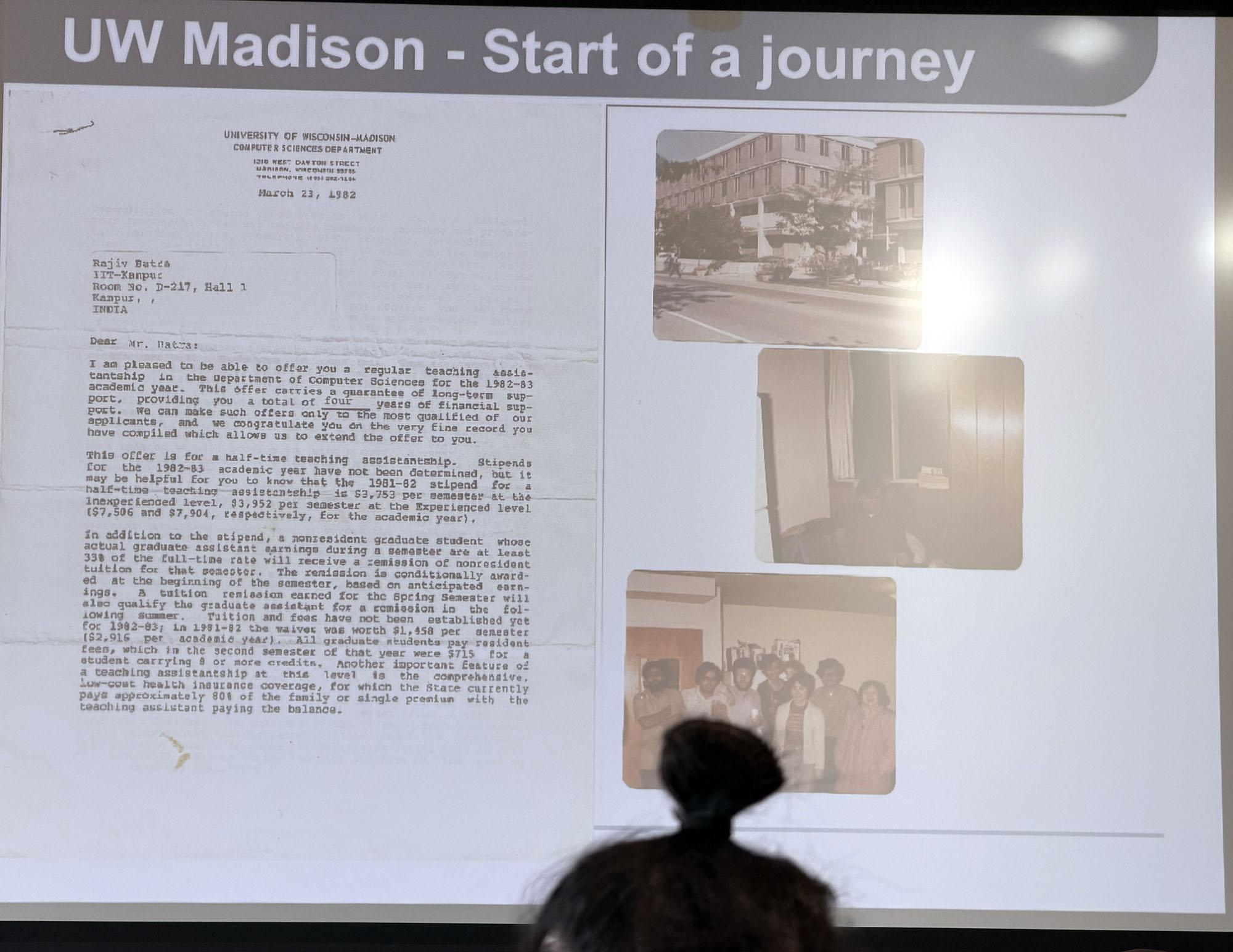
And four months 2:30 later, I was there. The department
ended up getting into a house on the Spring Bay Orchard Unclear in recording . And this was-- this is where I was. This is a group of people who we were in the computer science at that time. Just wanted to give you how the world looked that time, forty-four years back.
Three companies
I did three companies. My first company I started was VitalSigns in, uh, 3:00 ninety-six. And this was my, uh, IRS announcement Unclear in recording . Then I took, took some time off with Peribit. Peribit I was not the founder. Uh, the two founders, two brothers were thinking of starting a company. One was just finishing his PhD in Stanford, and one was working at Intel.
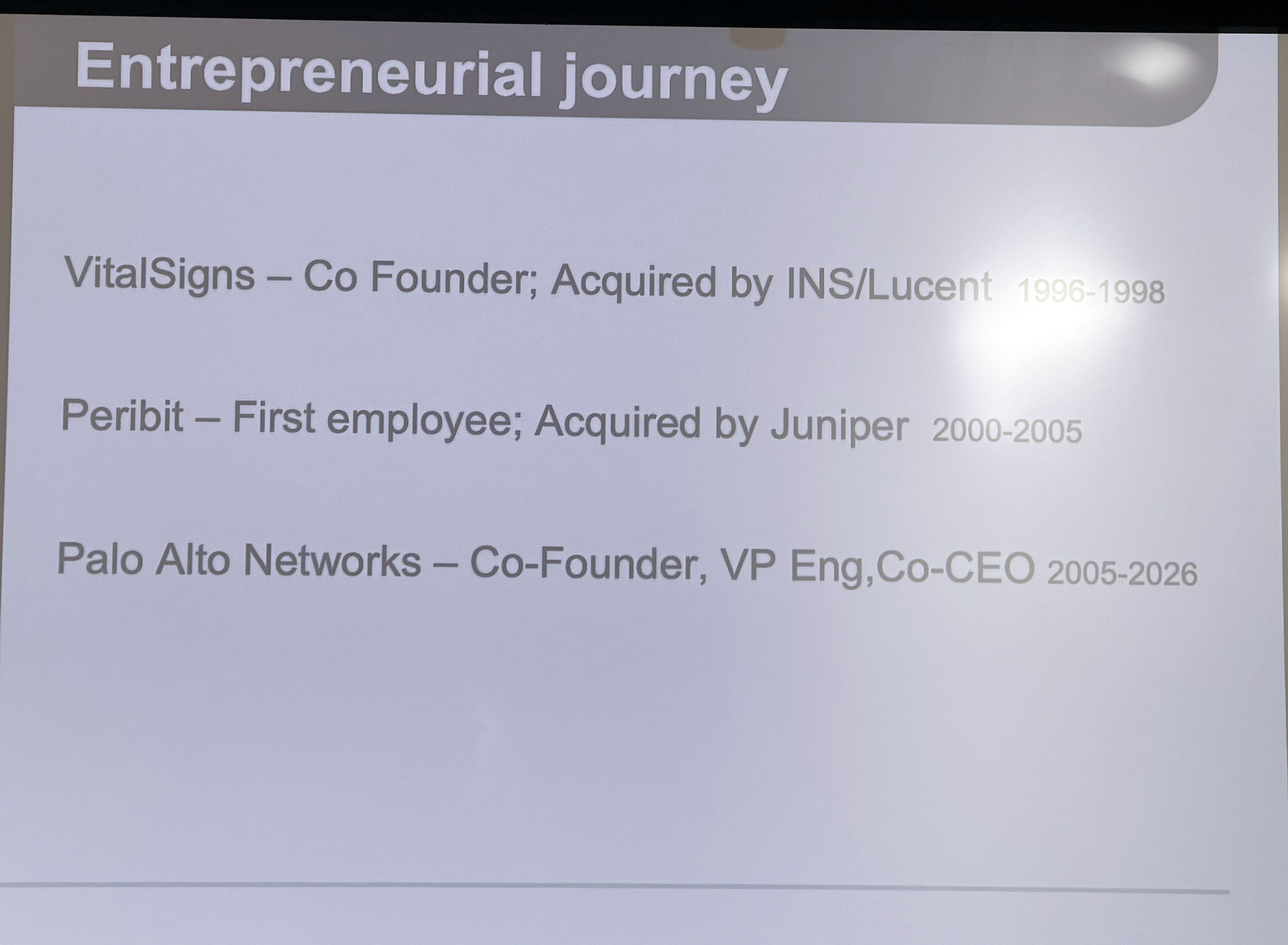
So I was the first employee there, but so pretty much helped them to the whole journey there. Eventually got acquired by Juniper. And finally, in two thousand and five slash six is when I started, uh, Palo Alto Networks. 3:30 Basically met my co-founder, Nir Zuk. And then we started a few other people to join us and started that company, which is what we're doing it now
My back
Oh! Oh
Why start a company at all
Basically, the motivation for starting a company. Why do you want to start a company? 4:00 And if that number three is your motivation, very terrible idea to start a company. You'll make all the wrong calls and which you don't even know what wrong calls you are making and you'll lose. Okay, uh, and doing a startup if you fail, it's one of the most miserable experience you can have because you put your heart in it, you put like eighty, ninety hour weeks in there.
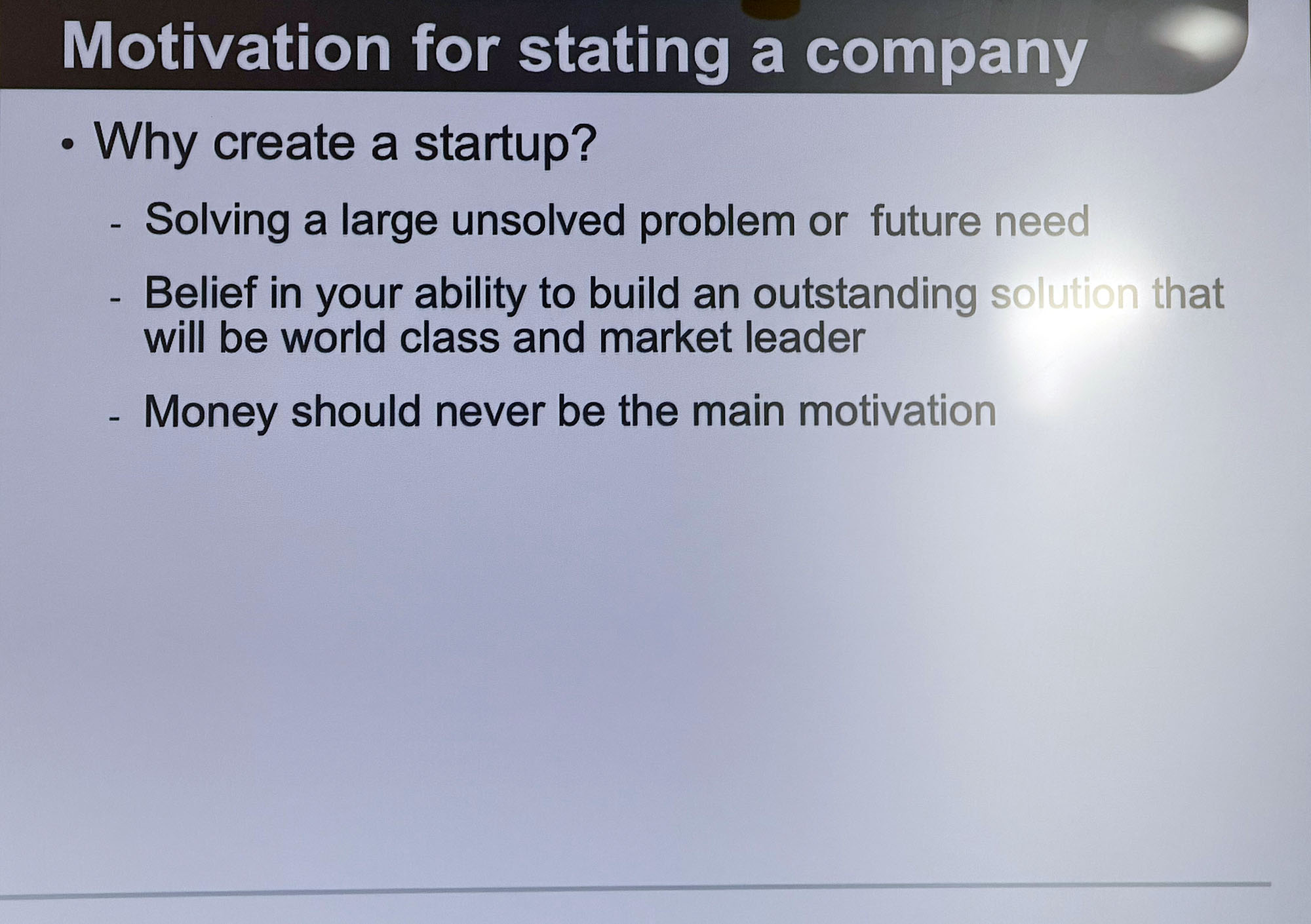
You better want-- You want really your startup to succeed. And whoever has decided generally that money is the main motivation generally does not succeed because the startup's a 4:30 terrible place to be. The reason for starting a company really is that you're working in a field in a particular company, and you see there is a problem, nobody's trying to solve it, and you know that there are lots and lots of people who would like to have this solution.
That's one of the way to do it. Or you're basically looking around, and whether it is like a Facebook or something, you really-- nobody's really asking for it, but you really feel that there is a space which I can build something that can change the way the world works. And it has to be really great. Uh, belief in 5:00 your ability to build a home sharing solution.
So you've got to be very honest with you. If you ca-- If you basically cannot work four people, you don't know how to lead a group of four people, then you think I'm going to suddenly run a company of hundred. It's not really going to work, but I want to be CEO of that company. So you've got to be really, really honest about what your abilities are, technical abilities of building the product, building a team, and keeping the team together.
And look at it, if you don't have those skills, nobody was born with those skills. Go learn them somewhere before 5:30 you suddenly go into a startup and fail there. I would rather go into a, uh, other well-known startup or a big company for a year or two, pick up those, those skills, and then do your startup. Uh, okay
Market validation
Market validation is very, very important. So don't do something if you don't-- can't see a billion dollar in revenue or at least two hundred million dollar in revenue, it's not a business. If you start thinking, you know, I will make this 6:00 tool, and I will sell it to dentists, and the dentist will need it, you know, then you realize that how much are the dentists willing to pay?
Is there a huge market? Because if it's a billion-dollar market, maybe you will get ten, fifteen percent of the market. And if under that, no good entrepreneur will come and work with you. So it has to be a huge market. You can't do it if it, in the, with the wild, wild imagination, it becomes a really, really big company.
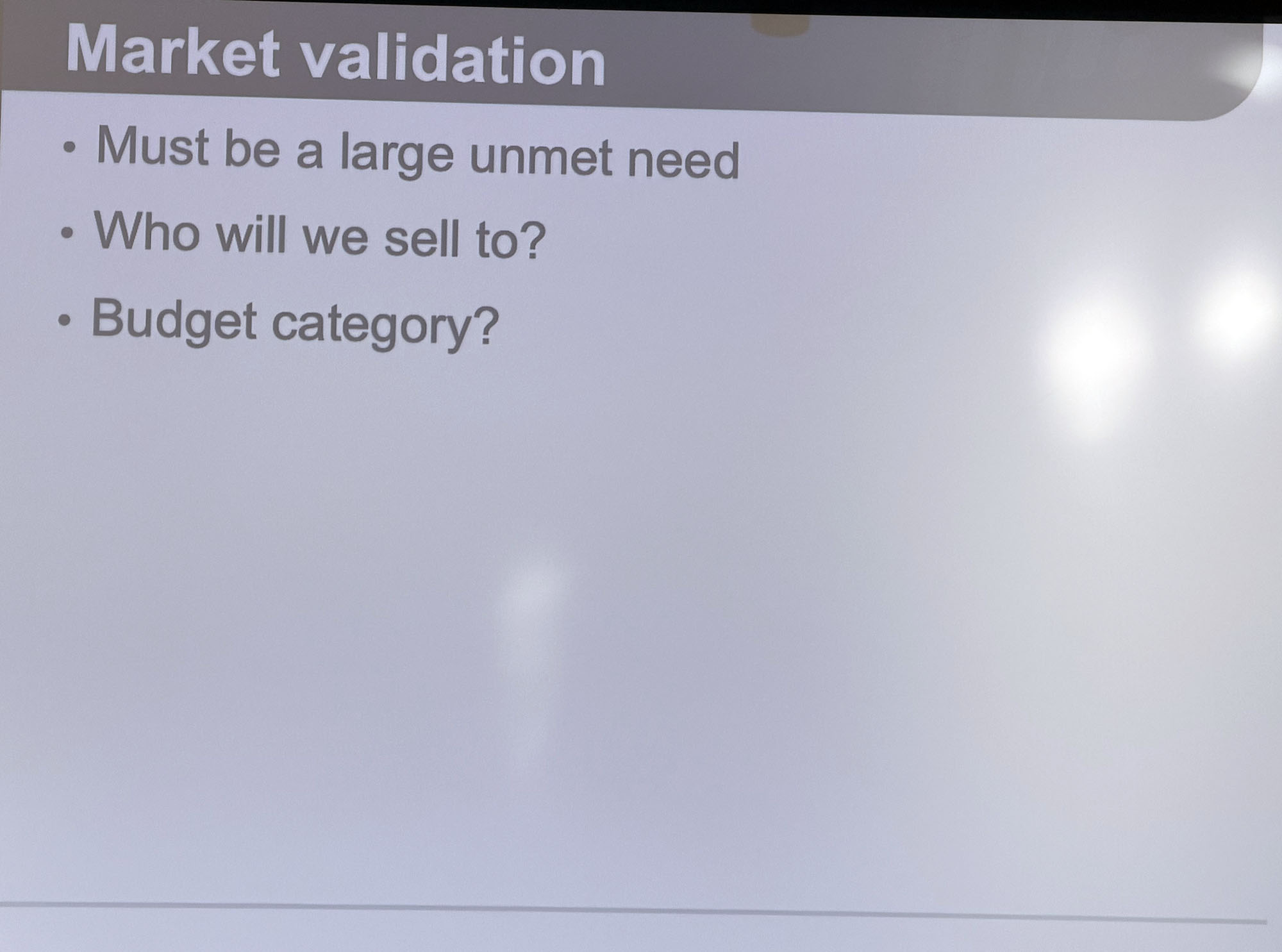
It's very, very difficult. Uh, secondly, like as engineers, we don't really 6:30 think about who do we sell to. Do I sell to CTOs? Do I sell to CIOs? Will I sell to CEOs? Do they have a budget? And then you need to find some people who are familiar with it and say, "Do they have budget items in their companies?" Even if you build a product and they don't have a budget item, it could take them a couple of years just to get that item in their budget, and you won't have those kind of time.
Nobody was born with those skills.
So it's really, really important if you're selling into, uh, uh, companies that you figure out do they have a budget? Do they 7:00 have already a line item? And one of the questions I used to ask people is that if I-- What do you-- What is your major pain point? And if I were to build a product with your main, uh, pain point, would you be willing to write me a PO for a million dollar tomorrow?
And if the answer is yes, we will write you a million dollar PO, and basically, we have the budget, and I have like five million sitting or ten million sitting in my budget, and I will give it to you if you solve this problem, then you got something for you, for you to really build something for. If you don't have that kind of an answer, uh, 7:30 I, I was not much into consumer space.
So consumer space, you know, I did try selling once product, my first company, and our shipping costs were more than the cost of the pro-- what we were getting from the customers, so we had to stop doing that. So we were focused on just, uh, selling into the enterprises.
People are the whole thing
I think people are the most important thing, which is really, uh... Because the thing is, is that in computer science, it's not really a capital-intensive 8:00 thing. Even the people who were raising million dollars when I got company, when I got through, which I started, we raised ten million dollars, and that was enough to really build a product and get out.
Nowadays, I think people just go crazy. Just because they can raise it, they raise it, and then they waste a lot of money. So I think you need-- What you need is a small bunch of A-plus players who are optimistic go-getters. Culture fit is very important because if you don't agree on what kind of company you want to create, how you want to treat your people, what are your value 8:30 system, there are going to be clashes, and there are going to be problems.
Okay. Uh, co-founders do not hire all, like, developers. You need, you need to have a complementary skill set. What do you need? Product managers. You need developer-- eng-engineering managers, engineering developers. You need salespeople. You need marketing people. Try to get as many areas as you can cover.
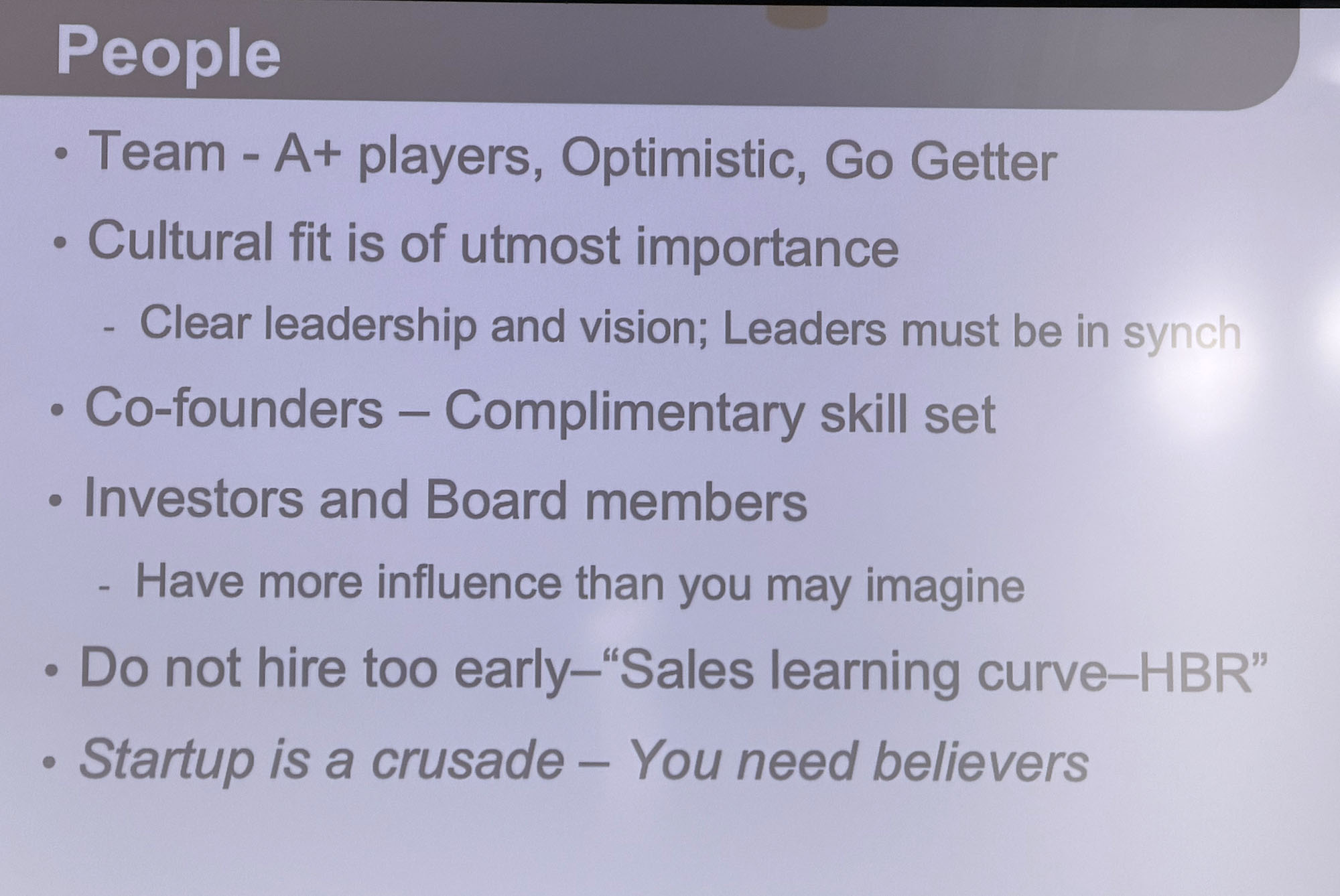
Having, uh, over concentration of one 9:00 field in founders is not really a great idea, but you will have to find good people that can do that role. Uh, investors and board members, if somebody tells you your company was fifty million dollars, but somebody tells you it's seventy million or hundred million dollars, obviously you would go with the, uh, person who's giving you a hundred million dollars.
But it's not, not that obvious analysis. You have to figure out which person is giving you that money. What are-- How did they treat other people before? Or if they are, are they really, like, uh, uh, good decision makers? 9:30 If you get the wrong investors as board members, they can really mess your company up. And I know of so many people, they are feeling so glad, you know, "I only gave this much," when there are persons in the company to get that money, but they got the wrong people, and then they pay over a year, and many times the company doesn't get paid or doesn't succeed.
Very, very important that the people you get board members are people you would like to-- you, when you meet them, you feel like you can respect them, people they have worked with before, they would again go with them. So try to find that out, and 10:00 don't look for, like, some obscure investor who has basically no track record and maybe have a bad reputation, but just because they give you more money.
Salespeople, and when to hire them
Uh, our sales people, basic thing what I can say, there is a HBR article which a lot of companies in, uh, Silicon Valley always show to their, uh, startup founders, is that, you know, do not go and like, like when you have a product suddenly don't go and have six sales teams. Have one or two sales teams to figure out first 10:30 whether your product is working, because each sales teams cost you at least suddenly a half a million dollars a year.
That's on the lower end. It goes to three quarters to a million dollars. So you got to be making sure that, you know, your product is ready. Do not go and splurge just because you raise a hundred million dollars, splurge. It's sensible to splurge. And it's like you said, really, uh, you want those people who are really passionate about what you're trying to build.
If they are not, there'll be so many down, uh, down experiences, 11:00 it's very, very easy to get discouraged and not succeed. So people who are crusaders and they, they really believe they can make it is what will make you through toward the hard times. And by the way, and you, you're like to so many surprises in a startup.
If you knew about it, maybe you wouldn't have started it. So when you go in there, just find energies and anything else in life, and you have to have people who are believers and who say, "Yes, we will, we will, uh, survive it. We will, uh, overcome the challenges." 11:30
Culture, set on day one
Very, very important thing is the culture in the company, and you really, really want to make sure that culture is created in the beginning. You cannot do it after three years. After two or three years, it's already baked in. Whatever your culture is, if your culture is, uh, backbiting, you will have it. Uh, but having said that, the first thing is you need to have a big vision.
What does it mean? There's an article also in, uh, Harvard Business Review about big hairy audacious goals, BHAGs. And what it really talks about is like the NASA had that 12:00 goal where it talked about landing a man on the moon. Similarly, you need to have, for whatever you're building, a BHAG kind of vision, which is like unbelievable faith.
You just tell people a few sentences, they all got bought into it, because eventually you're gonna send it to your investors, you're gonna send it to the juniors you're trying to hire, employees you're trying to hire. That vision is what really keeps you grounded. But getting that right in the first few months of the company is very, very difficult.
Uh, trying to get a culture where people-- 12:30 when you try to reward, where your reward system is if you put company first and not yourself. Typically, most people when they go to big companies, me first, my, my group second, my department third, company fourth. And that's the-- big companies can do it, but they eventually fail.
But if you want a startup to succeed, you have to have the reverse. You know, basically company first, then my department, then me, basically is kind of the thing. And basically, e-eth-ethical behavior cannot be brought in. 13:00 Once you basically get unethical behavior creeping in your contractors, your employees, your investors, you can't suddenly decide in three years, "Now we are going to be honest company."
So you've got to start it from day one. So anybody steps out of line, you bring it head on. Uh, very, very, very important. Uh, if you don't do that in the beginning, there will be all the fires and lawsuits and everything on the line. You don't want to do that. And, uh, politics 13:30 and-- so if you basically the way you do it in India is somebody is very productive, but they are too politics.
They are, you know, uh, alpha players or they're alpha. You want to get rid of those things very, very quickly or fix them very quickly. Otherwise, they spread, and they create a very toxic culture. And toxic culture will attract talent to some form, but eventually it's going to really, really- Uh, if you're going to hire-- empower those people to make decisions.
Don’t micromanage
If you become a 14:00 micromanager, startup will be-- If you're a founder, your life will be hell. You will most probably have, uh, twenty percent success on the burn, and you're a micromanager, you won't be sleeping at night or daytime. So you do want to make sure that you, uh, empower people, let them make decisions, and that's the long-term success of a company also.
I strongly believe it depends on that also, is that how much you empower people, how much you-- the ideas are coming from the bottom up rather than top down. And the more you are able to do it, the more you are, 14:30 I think, uh, likely to succeed
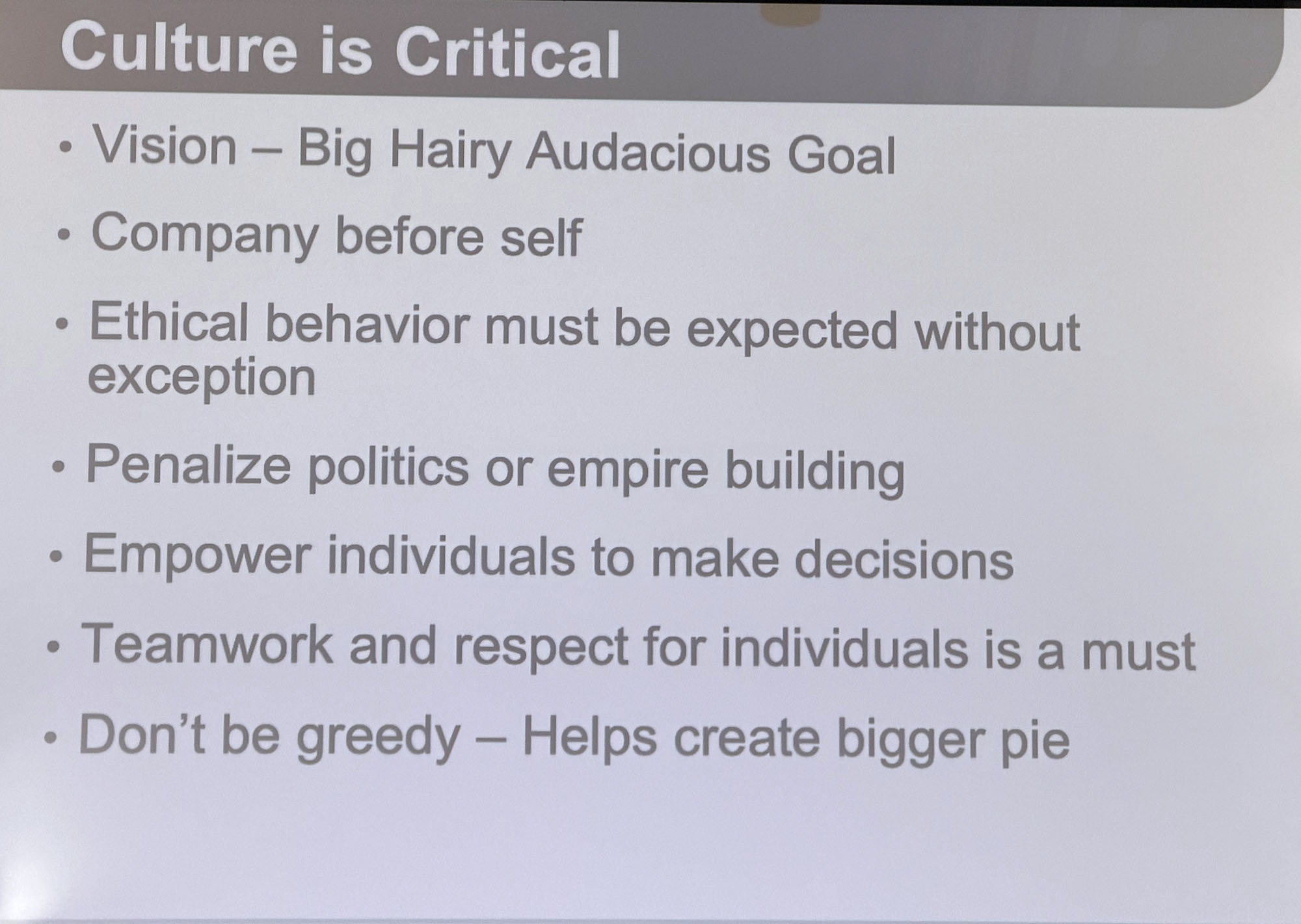
Uh, so dealing with individuals and respect for individualism is so basically this is, uh, pardon my saying, but like we were called as assholes by one of the stakeholders. However productive you are, people get rid of you if you do not change with the age of treating people right. Your co-workers, your juniors, your seniors, and we did get rid or fired a few 15:00 people, but it gets the message that culture becomes much more of respect.
Doesn't mean-- Respect doesn't mean somebody is not performing, we will not try to correct it or try to find them a different career they could be a good fit or whatever through the foundation. But treat people with respect, don't insult people. Second last point is very interesting. Everybody, you know, as founder you want to generally say, "I want to get as a share of the pie as possible."
But remember this, if you have as big a, big pie or part of the pie, other people don't feel 15:30 ownership of the company. It's all depending on you. But if you are able to spread out the cake, everybody feels the owner of the company. In, uh, Tata Elxsi management, we are now twenty-one years. There are people who joined the day one and in senior positions because they still feel that they are owner of the company.
That was a very big, uh, point between me and them, that everybody should feel the owner of the company. And you'd rather than two people making all the money or five people up there making all the money. If you spread it out, you do get more because you're founder, 16:00 but if you spread it more and you get the right people, you have many, many stakeholders in success of your organization, and life becomes much easier.
Like I was just talking to a, uh, uh, to a company, and they have just put the bonuses on how much is the efficiency of the organization, how much you reduce the cost. And suddenly everybody's worried about, you know, if you spend more money, it's fine, my bonus will decrease. So that's the kind of things we are talking about.
Stakeholders, who basically believe that they do something right, 16:30 they have some-- they gain from it, rather than some few founders are the ones who take it all.
Hire the best, don’t compromise
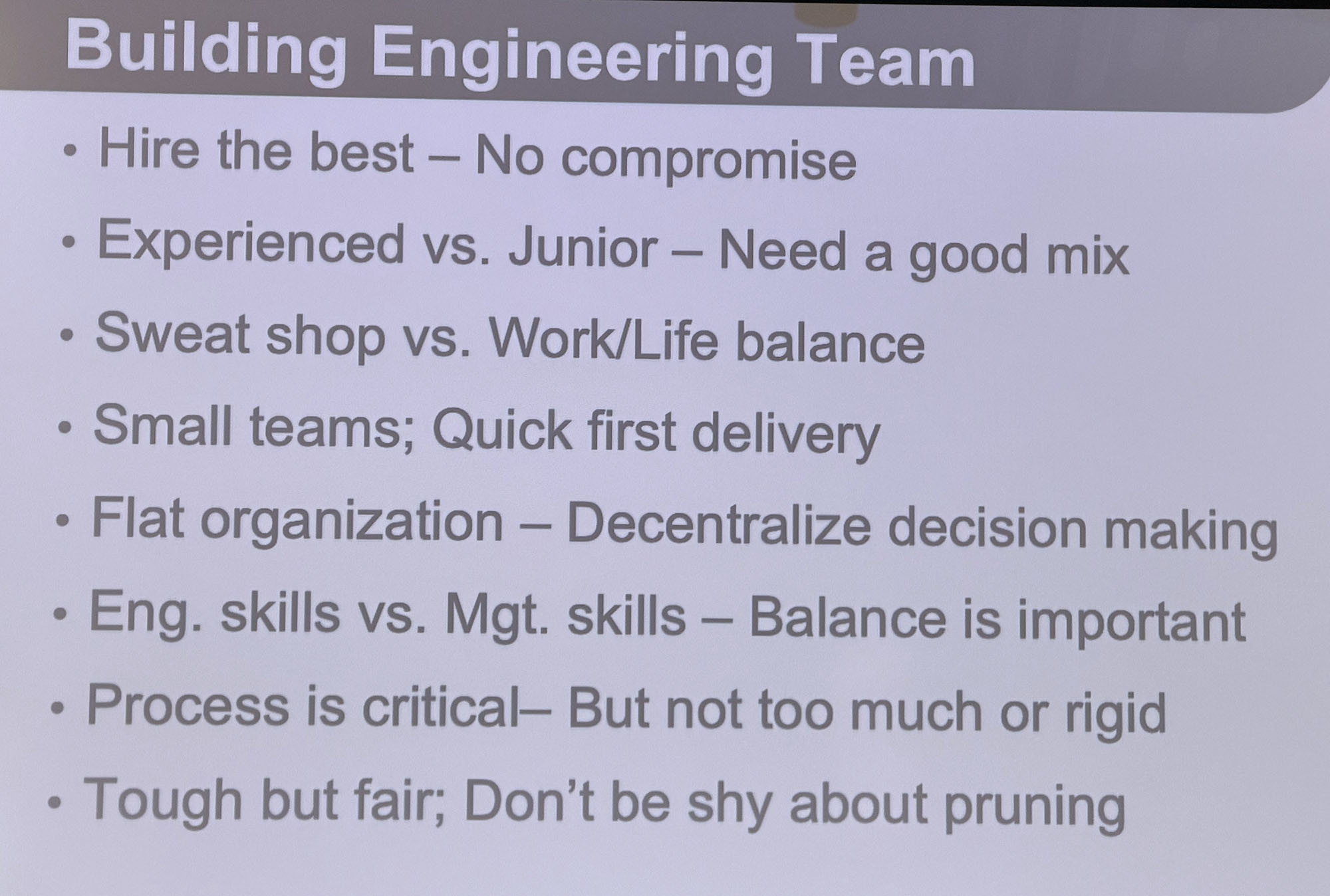
Okay. Hire the best. Don't compromise. In this type of usually you cannot ha-have, have average people or unmotivated people. You want to hire the very best. So the very best possible. And that is the difference why a company like this kind of a company, Palo Alto Networks, with thirty, thirty 17:00 engineers, we made at least three to four thousand engineer companies who are better.
Because the thirty engineers, we try to hire the best of the best. We build products, build better products than companies with two hundred engineers in two to three years. So you really want to hire the best. If you hire too many people, on average the support productivity goes down and because you are, um, uh, not able to perform at, everybody is not able to perform at the highest level.
So this 17:30 is really, really critical. Do not compromise in the first at least forty, fifty hires, you know. And even then after that, try to maintain that in hires if you can. Experienced, junior, I think we need both kind of people, es-especially in cybersecurity because the field is changing so fast. Somebody who went to school ten years back is kind of outdated, and you want to bring in new ideas.
People who start thinking new. Otherwise, you will build stuff based on the old technologies, and you will fail. So I think having a good combination of 18:00 people who bring in new ideas, people who are experienced in that field is most probably the best mix there. Uh, stretch out but, uh, most of the companies become stretch shops in my mind, mostly because they are inefficient.
Meetings, size and structure
They have, uh, meetings which goes on for hours, attended by almost half the company because they think this is expected of them. I think, you know, if you manage to run the company well, uh, in my opinion, a com-- you can succeed in a company by working fifty plus, fifty, fifty-five 18:30 hours a week. You can really succeed.
Now, I know of companies with eighty, ninety hours, and they are half the day, whole day they're-- all they're doing is meetings, and they're working in the night. It's really not a very efficient way. And people get tired, and people are really not having their family life well with it. So finding a good balance where it's really efficient, lot of control is being passed down, people can work flexibly, some from, some hours from their home, some hours together.
Working completely from home doesn't work because the team spirit doesn't really get formed. So 19:00 you need to have a good kind of a mix there. Uh, I think, uh, small teams are really important. I-- What I found was that if you, if you-- if there is a job which requires ten people, and you hire eight or nine, everybody's very appreciated, everybody's trying to become the best way.
If you hire fifteen people, five people don't have a job. All they have to do is do a little intro. I know that classically, and everything is like everybody is jobbing to, "Can I do th-- Can, can I have this kind of project? Can I do this?" Hire a little 19:30 bit less, so everybody is kind of stretched, and everybody basically...
Less people means everybody gets richer too.
And remember, it's a startup, so stocks, sharing is, you know, it's pool of stock. Less people means everybody gets richer too. Uh, flat organization I think works much better where you-- one level of management maybe like VP and a few people something like that. Uh, you need to get people with good management skills also.
Just pure engineers will not do it or pure managers won't do it. Managers need to be really good people managers and 20:00 try to do, uh, get feedback often continuously to see how they are performing to make sure that they're good people instead
Enough process, not too much
One of the things which happen is most, most of the people when they start a, start a business, no process, everybody just starts doing whatever they want. And one of the things that's really important is to get some basic processes, how you build the product, how you test the product, where would you release the product.
Getting some of basics as quickly as possible is really important, otherwise you will pay at around two years when the expenses are really high, 20:30 and you will get into trouble. And so that's very important that you write some process, but the problem is you don't want to make process like really big bureaucratic companies where it's thousands of pages.
And finally, the thing is this, while I talked about respecting, you think that somebody is not working or is putting the whole, whole, uh, project or whole enterprise in danger because of their capability and their work in the team or their ability or their capabilities, you need to improve. But your job as a leader
The recording changes files here
A brief gap between the two recordings falls at this point, mid-thought. Timestamps continue without interruption.
21:00 90% of the time they don't actually fire people or even give bad reviews. We had to do it and, uh, so because they don't want to, uh, either get into lawsuits or don't want to basically be the bad person, they let bad people continue on and then they uphold culture, which is really, really important. If you are the founder or you are the leader of the company, then you know people will not stay in.
But you've got to a-question yourself, why am I doing it? Am I being fair? Ask yourself continuously, 21:30 and if after a long time, after doing it for a few weeks, if you can realize that you are right and you've got to do that, people will do what you want
Product and architecture
Never make a project which is really like people, uh, it's like, it's really great in winning a deal. Nobody cares whether you win a deal, but they care whether you can provide solution. Like even kids are talking about AI right now, right? That there's a solution, but there's no, uh, efficiency 22:00 gain or people are not doing their job.
People were basically not thinking really that people are doing their job. Only because the practical usage of that is still not there. That's why you hear about China really focusing on narrow pieces of AI and trying to find solutions. Similarly, if you're building a company, eventually you've got to make life easier or more efficient, and they're willing to pay for it.
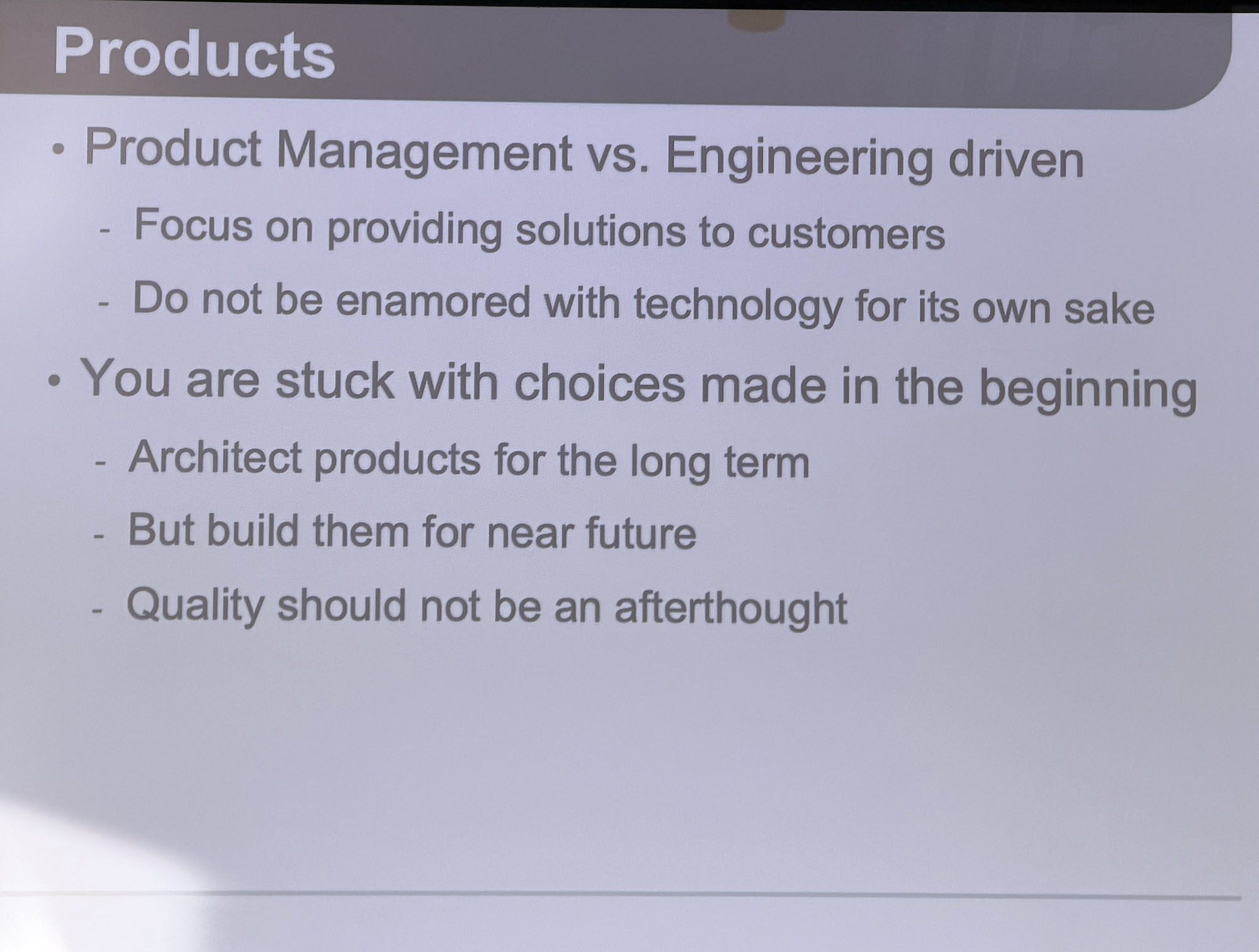
If that doesn't happen, it doesn't really make sense. And you got to have, uh, architect the products well, think for 22:30 long term. And I mean long term, ten, fifteen years. You know, if you do-- if you decide like, "You know, I'll just build it today and I'll go and fix it," you know, and back to government issue. Uh, so having said that, once you have the right architecture, do not boil the ocean.
Try to basically figure out a narrow solution which you can go out to the market and make a difference, do business power Unclear in recording , and try to do that, but you have the big long-term architecture. And one of the mistakes which I made a lot of things, that you kind of shortchange the 23:00 quality because there's no food to test everything in the beginning.
And then when you try to retrofit it later, it's very, very difficult. I think very, very critical is that higher the quality you provide, the value you have higher. That's the thing. And hire senior people who have experience, so they build that infrastructure right. Otherwise, after three or four years, you'll be swamped with customer issues and the whole thing starts going south. 23:30
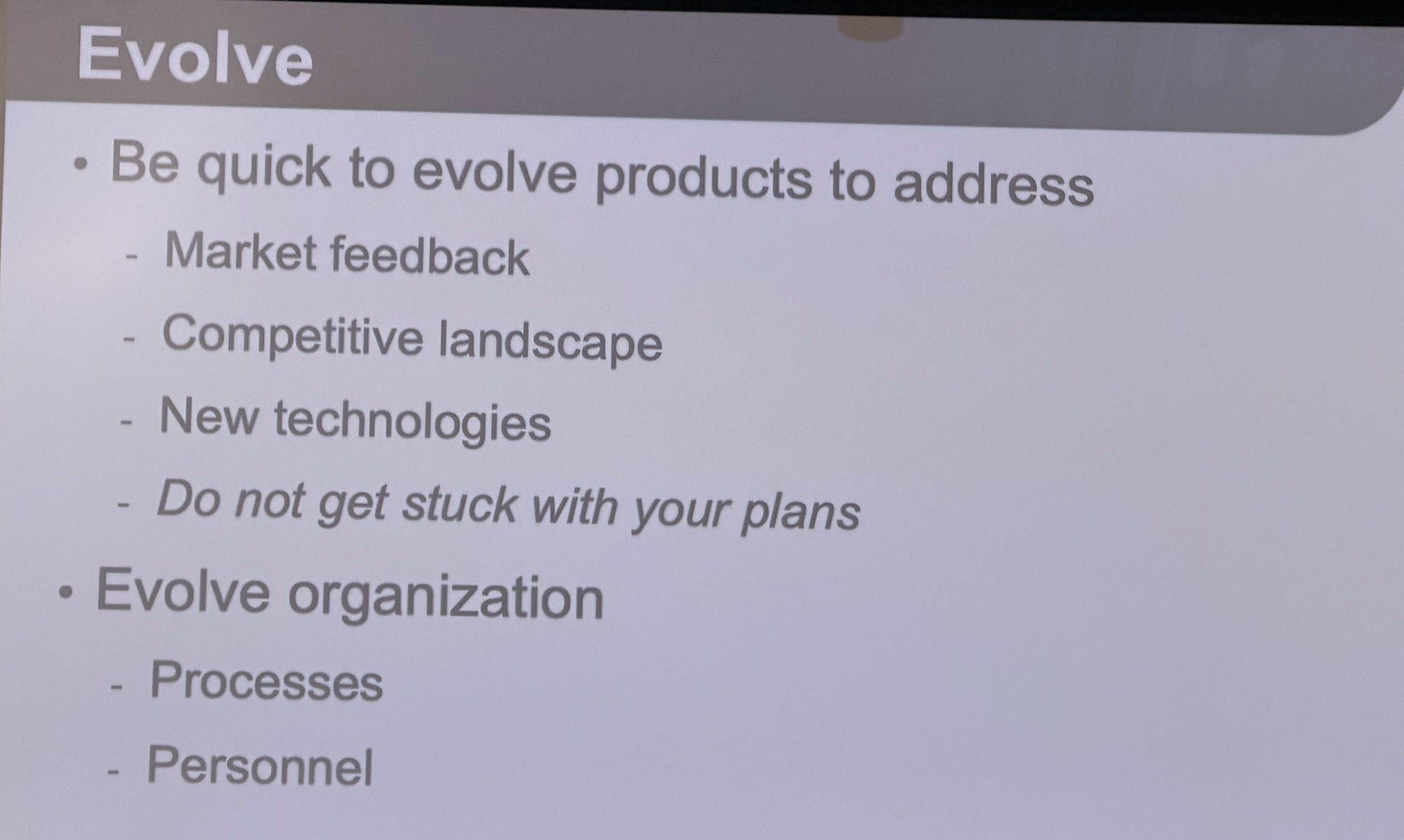
Always look for market feedback, even if you are going, going in a particular direction. If market wants you to change, please change. Because most of the times really are not really actually success-successing building the product they have in their mind. They look at the market, they evolve with it, and sometimes they are changing one hundred and eighty degrees.
You know, they've been building something, they thought they'll never do that or almost even one thirty-five degrees, you know. They'll never do that, 24:00 and then you realize but market wants this, so you have to build it up. It's, it's really eventually a business. Uh, look at your competitive landscape and look at new technologies because they're coming in so fast.
I have made mistakes like that, you know, we were using operating systems which were old style and then we introduced new versions and then, you know, they got us covered and we had to redo the whole thing. So always keep an eye. That's why I'm doing general engineering science content because they're giving you new ideas, new, new ways of doing things 24:30 And as Europe gets tougher against China as we
Organization processes which are talked about, they are not accessible either by continuously evaluate by the value or just became, you know, somewhat loaded but It is an evolved observation. A person who's great in the first few years of startup evolve 25:00 those ways.
These are the things that we believe is working the best
The living dead company
So one of the things that living-- don't, uh, in a startup, it's very, very easy that you go in the startup, you have really put your heart in it, you know, you put all your money, energy in it, and you think the success is just, yeah, just around the corner. My feel, my advice would be that when you do a startup, write goals at year one, year two, year three.
If you're missing 25:30 those goals, really go question yourself, "Am I just going in a wild goose chase here and wasting all my life?" So there are many, many companies who never really making profit or making a very little profit, continue to grow, and they're ten years into the business, and it hasn't done anything.
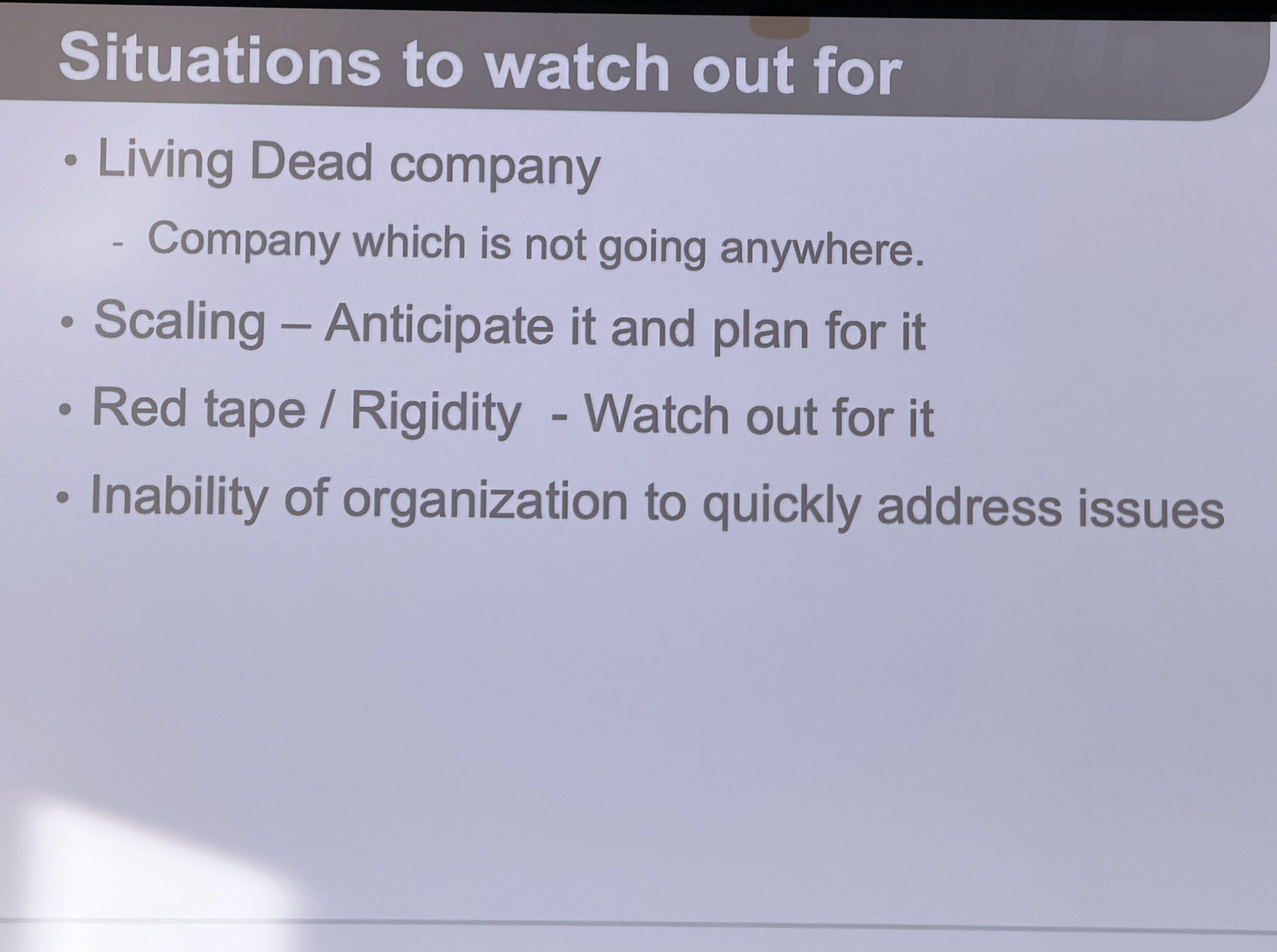
That is a living dead company, and that will sap your energy and struggle. Walk out from that. I like to put twenty-four and twenty-six months goal, and if I miss both of them for sure, I'm getting out of it. I don't care what 26:00 anybody says. And investors don't care then because they have fifteen companies.
You have only one company. So they will say, "No, no, we are there. How can you do that to the people?" It's not getting there. I'm trying it, okay? Move on to something else. Uh, scaling. People don't scale, scale for organization, product development. Think it's gonna come-- If you succeed, it's gonna come faster than you can imagine, and it will come at a breakneck speed if you succeed.
Scaling, and the creep of red tape
So plan 26:30 on scaling, how, what management look like. Keep on doing those kind of thoughts. What will it look like when I triple my size, when I have... Right now, like, the company I started with fourteen, thirty, forty people, we can be forty thousand people. Totally different structure. But you continuously think about two years, three years ahead where you want to be.
Uh, as the company grows, there will be lawyers coming in, HR coming in. "You can't do this. You can't ask that question in the interview." Lots of red tape, lots of fear of things. I 27:00 think you got to, if you are a founder of a company and people listen to you, you got to look everything with a grain of salt, what you get feedback on, and try to do the right thing.
Or people will keep on coming with manuals, which really don't add value. More and more processes. That is actually about after five to ten years, if your company is still there, that's what will kill your company or basically make it safe, because people have gone through what you have written, the process and bureaucracy.
So people who really don't care, they, uh, 27:30 if, if there are too many rules and, you know, I don't know, maybe people can harbor those little rules like a, an intricate bureaucracy. So be watch out for that. Uh, have-- be able to pivot the organization. One of the best pivots I saw was, uh, be-- uh, recently, the AI pivots of all the companies which are doing.
The previously, Microsoft was not into internet in ninety-six, ninety-seven timeframe, and, uh, Netscape was becoming successful. So there was a 28:00 memo written by Bill Gates, and they totally pivoted the company, and it was probably saved the company. Otherwise, we wouldn't be hearing- So be willing to change, uh, and address the issues, address new directions quickly, and nothing is cast in stone.
There are no rules
One of the best thing about startups, which you have said, I've understood and said, there's no rule. You are it. Whatever you heard about company, whatever you heard about stuff, forget about it. You are creating a world, and that is a pure vision of the world which you are creating. 28:30 Okay? So believe that you are very powerful.
You can write the HR rules. I wrote an HR rule where these people who say that if you become a director, you need to have forty people. I said, "No, I don't believe in that." I could hire, make a director of two people if they are really making a company, uh, a substantial difference to the company. So it's not really the number of people, it's, it's the amount of impact that we want to make.
So you can-- So I would sit with a red line and keep on cutting things in that direction, 29:00 you know. Many years on, I get telling that there is no founder in the company. Right now, I have a vision in mind, who is the most efficient, who puts the company first. Those are the guys we want to push. And who is to say that's right or wrong?
It's your vision. You really believe in it, make it happen. All right. If you have questions on those things, feel free to ask me as we go around. All right. So, uh, we'll open the floor, uh, for questions. Uh, I have so many 29:30 questions prepared, but I, I want all of you to ask questions, so, uh, I'm a less, um, priority in terms of questions.
There’s no rule. You are it.
Questions from the room
So if there are any questions we can, uh, you know, open the microphone. Hi, sir. Thank you. Um, so in the slide, I saw that you, you said, uh, to hire the best people and like hi-- and you said you hired some of the best engineers around. So, uh, what is the- 30:00
In the interview, you basically tell them, okay, so I, I am a believer in the theory that, you know, I, I, I read some psychology books fifteen years back, and this kind of stick around in my head. So one of the example which I saw was they said that when a chick is born, it starts following the mother hen. If you take away the mother hen, and you put a stick, and you make the stick basically be the mother hen, they follow the stick.
Same exactly as what you do with these when you join the company. First few months or first 30:30 few weeks is when they change from the way they work in the previous company to the way they will work in the new company. If you're clear about what is wanted in the company, that you could work well with each other, and but you've only got a month or two to do it.
But if you keep on repeating that message, it becomes the mantra of the company. So, and when you interview, you always ask for if this kind of situation, how do you deal with it? In your previous company if you had argument with somebody, did you get really mad, angry? How did you handle it? 31:00 So yeah, you start asking questions like that, and then if everybody in the interview is watching out for people who will behave with the culture whichever the company's culture is, you normally don't get it wrong more than ten percent.
You can-- few percent. When you work on ten percent, maybe one or two percent you have to improve, eight percent you modify. 31:30
Or you have to make contracts, you have to make, let's say, LLC, whatever, like all the legal stuff. When do you decide
Setting the company up
That is a, uh, great question. I, I, I 32:00 had the same question when I do my first company, like how do you set up this whole thing? The good news is that in Silicon Valley, there's a complete ecosystem. If you have a good idea, whether if you went to Y Combinator or if you went to an angel investor, there are lawyers who do that.
There, there are people who get all those documents and setting the company. There will-- There are advisors who could tell you whether to open in Delaware or whether to do it in California. What are the advantages, disadvantages? So you do take some 32:30 money or basically you talk to your seniors who have gone there before or people who have already done startup, and they are all very much willing to share their knowledge with you.
So it's really simple. In fact, that is one of the least problems because the ecosystem here is good. I don't know if you were to do it in some other part of the country, how your nature is going to be, but in Silicon Valley, it's really easy. Thank you very much.
Does the big vision change?
Thank you. 33:00 So I had a question. I know you mentioned having the, a big, very audacious like thesis. I know Palo Alto Networks started with a very big thesis on security. Um, and now you have things like AI and quantum computing. So do you think that thesis is gonna-- And, but you also said there's an emphasis on, you know, making changes too.
So do you think that thesis evolves like more on a monthly basis or like a yearly basis or? I think the main goal is, should be a goal which doesn't change very 33:30 often. It's actually the decade, decade long goal, if not more. So like we were basically saying that we're gonna secure the network to support the way it will be applied.
Now, whatever in-uh, in-impinges on it, we try to resolve. Like the quantum computing comes in, we try to do the best way. So having said that, all these problems will come in in every solution problem. And if you are not really putting your head in the sand or saying, "I'm doing it, but you have to come to this thing and stuff," and if your organization is still created, then your chances of succeeding 34:00 are non-trivial.
In the sense that if your organization, if your organization is entirely focused and your vision is... That's what your vision is. Your vision was not to make a desktop firewall or we were basically, uh, improve your fraud prevention system, or we were basically, uh, web filter. Your thing is whatever impinges on it, we will basically focus on it.
That-- Those are the kind of visions you should have. I mean, Google's not better than anywhere in the world kind of thing. So even though things change, but the big vision 34:30 still encompasses that. Or like America vision, you know, that, you know, our pursuit of liberty and happiness and... So what are those things remain longer term.
If it is like a year or two, it's really not a big vision. That's why you target like a large industry, like you're saying. A large industry or even whatever you're doing, you know, whatever space you figure out, you want to basically be something that you, you could be proud of after ten years. And when you say, say to somebody after ten years, if the company succeeded, they get motivated.
"Yes, I want to be 35:00 part of that." Thank you so much. Question?
What startups looked like in 1984
So, so for-- when I started in nineteen eighty-four, startups 35:30 were kind of, okay, I'll tell you some story about it. In late nineteen eighty-two, if you were a good, good engineer coming out of school, and you are in a startup, everybody was so sorry for you. You have to go to a new startup, you know. This is not going to succeed anymore, you know.
You got to go to HPs and AT&Ts and those kind of things, you know. So I, of course, I joined those startups. We-- I worked in big companies. And the more I stayed in the big company, I used to scratch my head and say, "Why do people do this? It doesn't make any sense." The sum of HR policies, the way they were 36:00 building products and they were testing products.
So there was a lot of learning we did with heart ache by watching them. And so we-- when, when I-- So when people ask me, why do you start a company? Of course, you basically want to solve a problem. You can see there's a problem. Nobody's solving it, and it'll be interesting to solve the problem. But it was also to create a work environment which made sense to me.
That's what I was talking about. There's no rules. If you put all, uh, arbitrary rules because this is what people say, this guy says that or this guy says that, you're not creating a world of your own. 36:30 I actually used to say sometimes, the startups are the world I want to live in. I hope you, you guys like to live in it, too.
I'm creating the world I wanted. So that's what we basically said that, you know. Uh, like, uh, one of the lessons that I learned was like, I was talking about, so my second company, Peribit. So we used, uh, uh, VxWorks. It was RTOS those days. And then people would say, "Use Linux." Linux is because I mean, we were a much more experienced people, familiar with RTOS.
So no, 37:00 we're not gonna do this. This is stable. Linux, who knows? You know. This is back in nineteen sixty-eight Unclear in recording . And, uh, four years later, it was the biggest mistake we did because all the open source code was coming around there. And they told me to do it, we had to develop it. It took way longer. And, uh, that's one reason we sold the company to Juniper, because it was becoming too-- We had to totally re, re, restructure all the code, rewrite it over a
Do you have to be in a tech hub?
Linux-based system. 37:30 Um, do you think that there's like a You have to play the game and start your startup in a major tech engineering hub, you know, like in California, Washington, Texas, um, Massachusetts. Um, but it seems like there's a really big area of missed opportunity, particularly like large, very good talent coming out of, uh, state schools like Wisconsin, 38:00 UIUC, Michigan, um, that maybe not being capitalized on just because people don't want to go into these areas which are unsustainable to start families, to live in, um, just because of all that.
That's an unfortunate thing because I think the problem which happens is you can kind of start a startup in, uh, mid-- middle of the country or places where they don't have any places. But you will soon find that, you know, when you hire a great marketing person, they're already living in one of those hubs, 38:30 and you have to be there.
If you're to raise fundraising, you have to basically, you know, you're-- if you want any big risk takers, they're mostly in these, these hubs. So it becomes very difficult. So even the companies I've seen which started not in these hubs, eventually after a year or two move there. If they've been-- need to succeed, whether it was Facebook or most of them, that's what happens.
It's, it's an unfortunate thing. I, I personally left California, not the greatest place to raise a family, frankly 39:00 speaking. Great place to work, though. Great because you work with all the brightest people, and you have the complete ecosystem. The other place in which you spend hours and hours trying to figure out things, and months trying to figure out things.
You can just go into a conversation with somebody on a coffee or something, and you learn a lot of stuff there. So I wish I could tell you that, you know, there's, uh, there's opportunity in a smart thing to do. But I think if a startup company, if a startup sees you, they will come and hunt you if you, if you want to be a big 39:30 mover and shaker.
Yes. Yeah. So then I guess later when you're, like, very successful, you know, um, do you think they're-- like, why do you think that a lot of these people who like maybe come out of like a great school like Wisconsin, um, don't end up maybe returning and offering, um, like a local, uh, thing to maintain that industry and research connection with their alums and that they're just kind of so focused on this playing the game and being in these ecosystems, uh, 40:00 sort of meta?
I think the startup is, is, as I said, it's a crusade. The chances of success are pretty low, and the more hurdles you put into it, the bit more difficult. Let me tell you something. So in Silicon Valley, if you basically go to a VC firm, if they have ten percent of companies succeed, succeed means maybe make five times their money or ten times their money, they are considered the rock stars.
It's like home run companies, ten percent. 40:30 And so what does it mean? Ninety percent companies don't make much money, either they make zero or make small amounts of money. A company which will basically become a few billion dollar is typically already getting to one in a hundred. And somebody making hundreds of million is one in a thousand.
Okay, so the risk is, uh, a lot because there's so many, uh, impediments along the way that the more you make it little, even little bit difficult, the chance of success decreases. 41:00 And, uh, eventually, like if you're not successful, perhaps the best coding is not enough, the best market you have built up, the best you will be able to survive, the CEO, and that'll make it one more step more difficult.
Is it doable? I think I showed you. It's definitely doable, but it's harder, much harder. The whole idea really in startup is because eventually it's not about living somewhere, it's more about it's a business, and you're gonna figure out is 41:30 where can it success, succeed in the business. I understand people.
If you basically wanna do a startup, do a startup. If you do well, nothing prevents you like after ten years of success to sell that company or remotely manage it or move away. And pe- all lot of people have do that. But I think in the beginning in a startup when you're trying to build it and get the structure in there, if you're gonna have the most chance of success, and since the chance of success is typically five percent or so, you really don't want to make it 42:00 two percent.
I know, I, I did not answer your one. I would love to live in Wisconsin and not because I think Silicon Valley is overly expensive and culture is... When you come to
Wisconsin, everything is peop- the people's behavior, people, the stress level in people's face, you know. You see all that stuff. Having said that, starting doing a startup here is a lot more hard work. I would rather do it in, uh, Silicon 42:30 Valley, succeed and then decide, now I move to live there.
Pay, equity and what people sign up for
These were basically salespeople. Generally, you have a change in executive, you will say, "Hey, so they could be great." But having said that, if they were part of the early company, it's your job, if you are the leader of 43:00 the company, to make sure they are really taken care of. So people who got equity in the business, if the company does well, they made a lot of money.
But does-- that does not guarantee them a long-term, like perpetual year stay with the company. So treat people fairly, value them what they have contributed, make sure that, uh, they are really equity owners of the company, and nobody would really leave there. Nobody would basically be upset with you or say-- They will, they will realize that for them it's a lot more important that company to succeed 43:30 than to then be in the company and the company to fail.
Because that's what, what happens in a startup. The biggest difference which you see in, um, other companies is everybody realizes, like, I remember-- It's not true anymore, but I'll tell you my story. In ninety-six when I, I used to make, I'll tell you the number, two fifty thousand dollars LDP of a multi-billion dollar company.
So I decided to do a startup. So what do I do? I take a salary of one twenty K, suddenly reduce the salary by fifty plus percent. For first year I said, "I 44:00 will not take salary until we start getting revenue, a decent revenue." So first year I eat into my savings. My salary is getting low. Okay? And similarly, the, the other people also when they came in there, they also took some cuts.
They also took, uh, a step back in their progress, but what they got was equity. And the whole idea is that this is worthwhile only if the company becomes, uh, very successful. So everybody is very focused. Everybody has a single goal in life: make this company successful. And that's why the politics, the 44:30 infighting goes away, because the infighting is not really good for me, uh, the main goal.
I didn't come here to make salary. I didn't come here because there's going to be a lot of benefits like dry cleaning and massages, you know. It was a startup. You know, uh, we went in there and I remember the first company we went to Costco and bought, uh, uh, desks and chairs. I told the engineers, "First day, first day job is here's a screwdriver and a plier and go assemble your desk and chair to sit on it."
So this is what we are really getting 45:00 into. You're carrying your printer, uh, refrigerator on a trolley over two, two, two floors, you know. Those are kind of things you get after leaving, uh, of being a vice president in a multi-billion dollar company. And you've been there because you want to make something of this.
So everybody's very focused. Everybody will benefit out of it. And, uh, so I think I just-- I have just always believed that, you know, even if I'm a founder, if you are a founder, you should ask a question, "Am I the best fit for this company to become successful?" And if the answer 45:30 is no, you should really figure out who is the best fit to bring them in, and maybe even you step out.
That's okay. You'll be still better off if the, uh, company succeeds than if you stayed there and made the middling company. So that's the mindset is very different. It's not like a regular job kind of a mindset. It's more of a business mindset. Mm-hmm.
We did it almost every week. 46:00 People in one-on-one forums, this is what I believe in, this is what we're going to do. Even you are my best friend, but if basically things don't work out, hey, you got equity. When, when a company becomes a great company, became ten billion dollars, they walked away with tens of millions.
So, but there's nothing wrong with that. You know, we took care of people when we succeeded. We didn't do things like, you know, we let people go into some of the problems
Confidence, and knowing when to stop
Hey, Rajiv, uh, 46:30 great talk. Um, I was just wondering, you mentioned you need to have confidence in your vision and your ability, uh, but also you need to know, like when your company is not going, when you're l-living that company to get out of it. So how do you manage that? And how do you, uh, understand that now is the time to be persevered and now is the time to exit?
When you're in the middle of a battle, there's a fog, and you're all confused. That's not the time to build up like, "Whether I'm doing okay now or not." That is done three, four years when you have all the clarity in the world. That's why I said 47:00 make a goal for twelve months, put it in a calendar. This is the goal at twelve months, and these are the things I'm going to watch out for.
Okay, missed year one, missed year two, missed year three. Why do you think that four and five would be any better?
Hi, sir
Getting hired by a startup
Hi, Sir. My name is Neil. Nice to meet you. Um, my 47:30 question is, uh, if you're trying to get hired by a startup, um, given that Madison is not very close to the Bay Area as well, uh, what is your advice? Like, what is your approach? So general feeling is just that if I were to basically, uh, uh, hire people and that, but I, I don't hire people now.
I'm kind of retired, so don't do that. But the big thing you're looking for is how much passion you have. So, so you-- typically, a question I would ask is, "Tell me the project you are most proud of." And then start with there. You know, why do you like proud of it? What did you get benefit? 48:00 What learned for you?
Did you think deeply into it or you basically put blinders and wrote something and got out, you know? The more you analyze it, the more you have looked at the problem in terms of the whole thing and more passion you show, that's what I'm really looking for. You've not done that particular area of stress, that's really not a problem.
You'll figure it out. If you are sharp, your grades tell you, your, your projects tell you how sharp you are, how much of a passion. So there is a sharpness, there is a passion, and that's what we're really looking for. And then there is eventually the personality 48:30 to work in the groups. These are the three things which I, I would look for.
Hi. Uh, how do you think the process-
Shipping with AI
So I have an idea today. Do I just one shot it using AI to ship faster or- Whatever it took, uh, basically to make a prototype to basically be able to sell to, uh, your partners in the company. Not, not 49:00 like even co-founders, you know. Basically people who want to join you there, investors, right? Angel investors you can show to.
Get something out there as fast as you can, and then try to create something which will attract the best quality people possible. I, I won't care too much really how it comes together 49:30
Will AI replace the software startup?
Thanks for the talk. So I have a question about, um, the modes, um, in the software startups. So, um, there are probably a bunch of, uh, YC companies every year, um, and many of them are overlapped. They're doing the same thing. Um, and if we're in a software era, and we have AI making for those stuff. So essentially, there is no technical moat, and what you're doing could be copied very fast.
Um, 50:00 should we gentle into this good night or, uh, is there anything else we can do? I think humans have so far always figured out a way around figuring out how to basically get a unique product which is difficult to copy. Some of-- Sometimes it is things which machines can't do, and it just requires a lot of human investment.
And I think there always will be. I, I refuse to believe in a world where humans won't be needed. I think to do build the products. Uh, 50:30 do I have da-- uh, data points to prove that? No, but that's my strong belief. So I, I, I will-- for while there's a lot of gloom and doom, there will be nothing there. I actually think about it that, you know, so we are going to say AI is gonna take over the world.
Who's going to interface between humans and AI? People in this room with computer science background. It's not going to be, say, say, somebody who doesn't even understand how the AI even basically works, you know. So there will be always jobs. There will be different kind of jobs. Maybe some volume of 51:00 jobs will not be there because we can think, and people will have to figure out a higher level of thinking to do or do some other area.
But I think if it is universally adopted, there will be universal wealth. Which human individual doesn't have problems which cannot be fixed by himself? That's where the humans come in. And I think that will always be the case.
When the government comes calling
Inevitably, when tech companies grow, it seems government comes calling. Yes. Should go- should tech companies simply capitulate or should they make 51:30 them go to court? I asked Reid Hoffman this question. Me personally, I'll go with
Because I have-- I can tell people who like to do those kind of things. Yes. Deal with the governments and do the lawsuits and all of that. Yeah, yeah. So I would rather do the company for five, six years, get somebody who's good at this, who loves doing that. Right. Yeah, yeah, yeah.
Yes, I think it's a different world, you know, that 52:00 we really enjoy. I basically feel that, you know, the way like Steve Jobs has said in one of his, uh, talks with to the Stanford Business School, that if you get up in the morning and you don't enjoy your work and it continues for a few months, it's time for you to move.
Choosing co-founders
Mm-hmm. Uh, thank you very much. I just had a question about like for budding entrepreneurs when they're looking to find or create a
team, 52:30
a co-founding team. Uh, what sort of advice would you give to them when they're trying to find their team? I think there is, there is a lot of things you need to debate on, but the basic issue when you figure out is that you be very, very open about most of the times when people form teams, they-- everything is all kind of gray and mushy.
Everything is mushy. All they will do is possibility. Somebody says very critical thing which happened, not for you, uh, not with students, but I want to get a job where I get paid very well. I'll work part-time, but I want the equity share as much somebody who gave it up, and those kind of things happen 53:00 a lot.
Having those discussions out in the open, everything to a proper legal work is really, really important. That's number one. Number two is, are these the best people you can find in terms of technology, in terms of value system? If somebody believes succeed by hook or crook, and you believe everything has to be ethical, it's not gonna work, right?
So those kind of discussions are really important. I remember when I talked to Nir Zuk first time before starting Palo Alto also, we talked about it. We, we talked fifteen minutes. He 53:30 explained to me he was at-- he was really a guru in computer security. I was coming from computer networking, and he told me this is the problem.
He said, "That can't be said. This is true. Read a couple of papers." And I said, and basically, yeah, okay, there is a problem. It's not been solved by anybody, and they don't want to solve it because of this storage base. And then we spent seventy, seventy-five percent of time figuring out what kind of company we could build, what values do we believe in, how should we treat people, where should we do development, what kind of tools we want, and that's where 54:00 you want to start.
And then he's going, "Okay, now we see it feels better, like I left twenty-one years and, uh, if I go to work, I'm definitely gonna work with him." Because the value system matched. We believe how we will treat people, what will we do with this thing. And if you have done working companies, you've seen these people who are not treated properly Mm-hmm.
You've got that happen, say, "What do you think about it?" You see what each other says about it. So those are the things which you really figure it out with, that as long as the value system works, you trust each other, and you will 54:30 believe that you will do the right thing even at your own cost. I think that's very, very important.
Everybody is honest when they are gaining things. Question is, are they honest when they are losing things? And that's what you need to figure it out. 55:00
That's just one of the few times, you know, if you are patient, you can hire A. If you, if you have thousand people coming in, say, "I want to get A plus players," I don't think America makes a thousand A plus players a year anyway. Okay? Or even the world around, there's very few A plus plus 55:30 people. So that's the time you really want to take your time on hiring the really, really good people.
And then you get let's say a hundred million dollars, then you want to blow it. But definitely, you're gonna get a t-p-p quality team. There's not enough people if you want to use all that money to hire people. There's not enough people to pay, hire at that time. So the, uh-- And I think the more people you have, the more bureaucracy, the more complexity of so many independent moving parts are becoming, suddenly things slow down.
So I actually am of 56:00 still don't understand why people hire thousands of people before the company is even profitable or... There are a few reasons, uh, situations where you should do that because when you scope and proven, you know, the scale and land grab, and all of that stuff. But most of the time when it's a data-led, you really don't want to hire a lot of people.
Everybody is honest when they are gaining things. Question is, are they honest when they are losing things?
Because I think i-in some ways, the lowest common-- lowest IQ you have in the group kind of puts a bound, puts a bound on the higher, higher, higher IQ would control at what level 56:30 the whole organization can function. So you need to really keep it small, keep it really smart people under one roof only
Building now, thinking ahead
My question was about like thinking back to just the starting of the company. How do you find a 57:00 balance between being like completely immersed in that starting product and also thinking about scaling, thinking about competitors in the future? Was there a structured way that you followed where it's like, oh, we know what this is and we know what the current product is, but we also need to think about where it's going?
So if you are like a leader of a company and you're not spending twenty, thirty percent of time every day thinking about the future, you are doing it wrong and you will fail. So you've got to basically 57:30 figure out, okay, how do you decentralize that decision-making, uh, letting people basically be empowered.
So you can have that twenty percent of the time to think, what do I do next? Where, where do you want to go to next? Well, everybody else is, uh, eyes, eyes on the s-- compute the screen and really trying to get something done. And company needs to have that time, and you have to allocate it. And if you're the leader, who better than you to do it?
Closing
Mike, 58:00 thank you so much for the question
Thank you for your participation all you guys. Great questions and hope you found it somewhat helpful