Transcript
Introduction
0:00 Those of you who don't, he's the Mary Sue and Mike Shannon Distinguished Chair and Professor of Economics here in the department. He's also the former chair of the department. I was asking Ananth, I thought it was more than once. He goes, "He's been the chair four different times under, uh, cir- different circumstances.
COVID, um, people getting-- Karl Scholz getting promoted to a bigger job or whatever, a new job. So, uh, we can't get rid of him, basically. He's-- I hope he's-- I think he's a lifer. I hope he is. But, uh, by training and practice... Oh, I should say also, in addition 0:30 to, uh, being the chair many times, he also directs our master's program in financial economics, and also he's the pro who was, um, involved in tonight's program, the Center for Research on the Wisconsin Economy.
By, um, education and practice, he's a, uh, macro economist as well as a public finance economist, which I think gives him a very good, uh, background for the work he's been doing, either officially or unofficially, for the last few years of giving advice to elected officials here in Wisconsin, uh, public policy analysts in Wisconsin, to talk about 1:00 how we can improve things in the Wisconsin economy as well as the University of Wisconsin.
And so I got a chance to look at the draft of the paper that is the basis of this talk tonight, and, um, I said, "Very clever, um, Ananth, you're using a title about football, which is gonna hopefully get a lot of people in the room." But you're gonna find out this is really not a talk about football. Well, football is a piece of it, but it's-- it has far broader implications, or at least that's what Ananth is gonna try to attempt to convince us tonight.
Um, the thing I love about Ananth, having 1:30 worked with him for probably ten years, is, um, he takes great pride in being provocative. I think that's fair to say. And so he likes to poke the bear, and so I don't think you'll be disappointed with his presentation tonight. So with that, Ananth, it's yours. 2:00
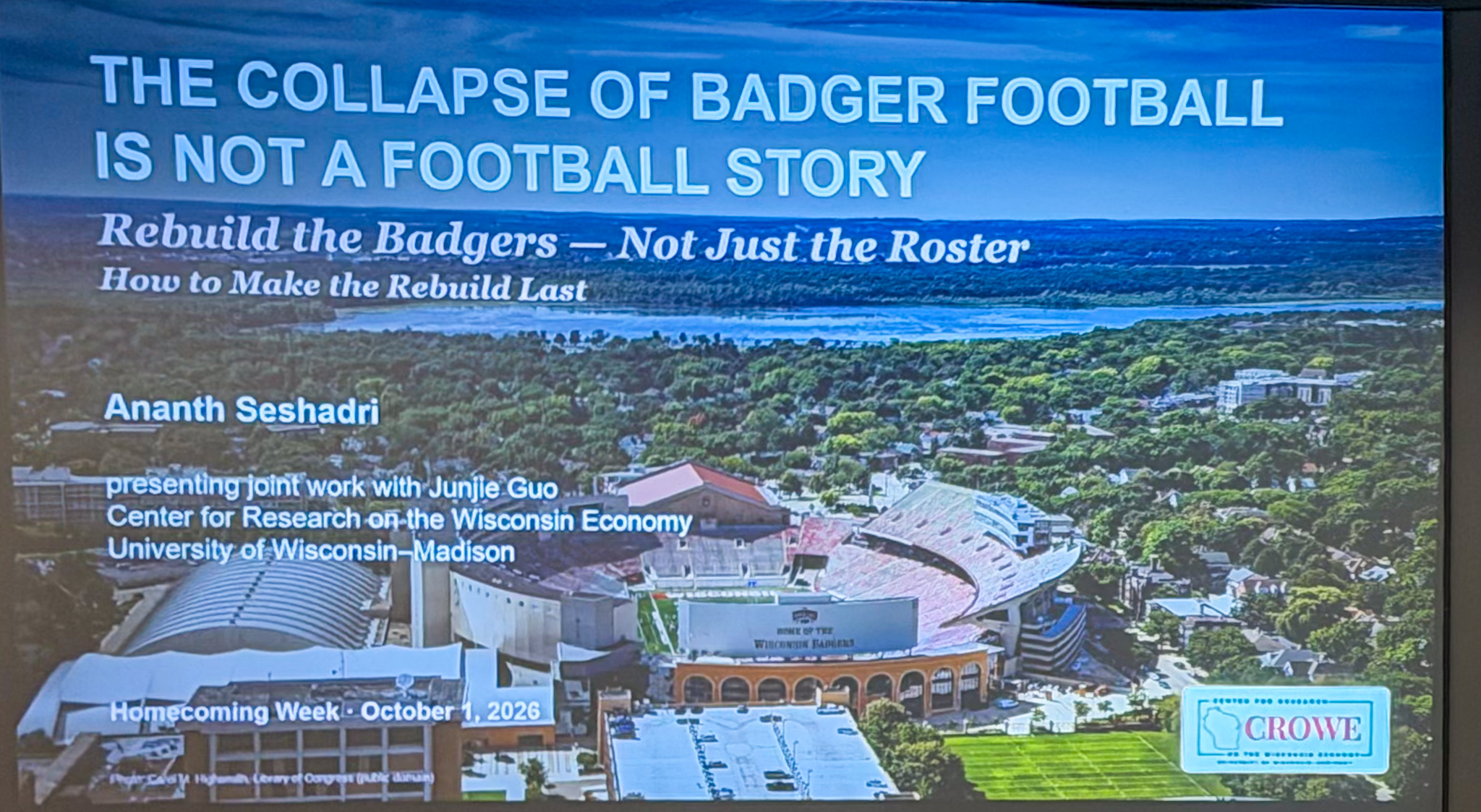
Introduction. Um, hopefully we'll have time for questions. I initially had a hundred and fifty slides. A hundred and twenty or a hundred and ten or so. So, um, this is, as Dick mentioned, an amalgam of two papers. A paper that we wrote in July on the collapse of Badger football, and something we put out just this week titled Rebuild the Badgers.
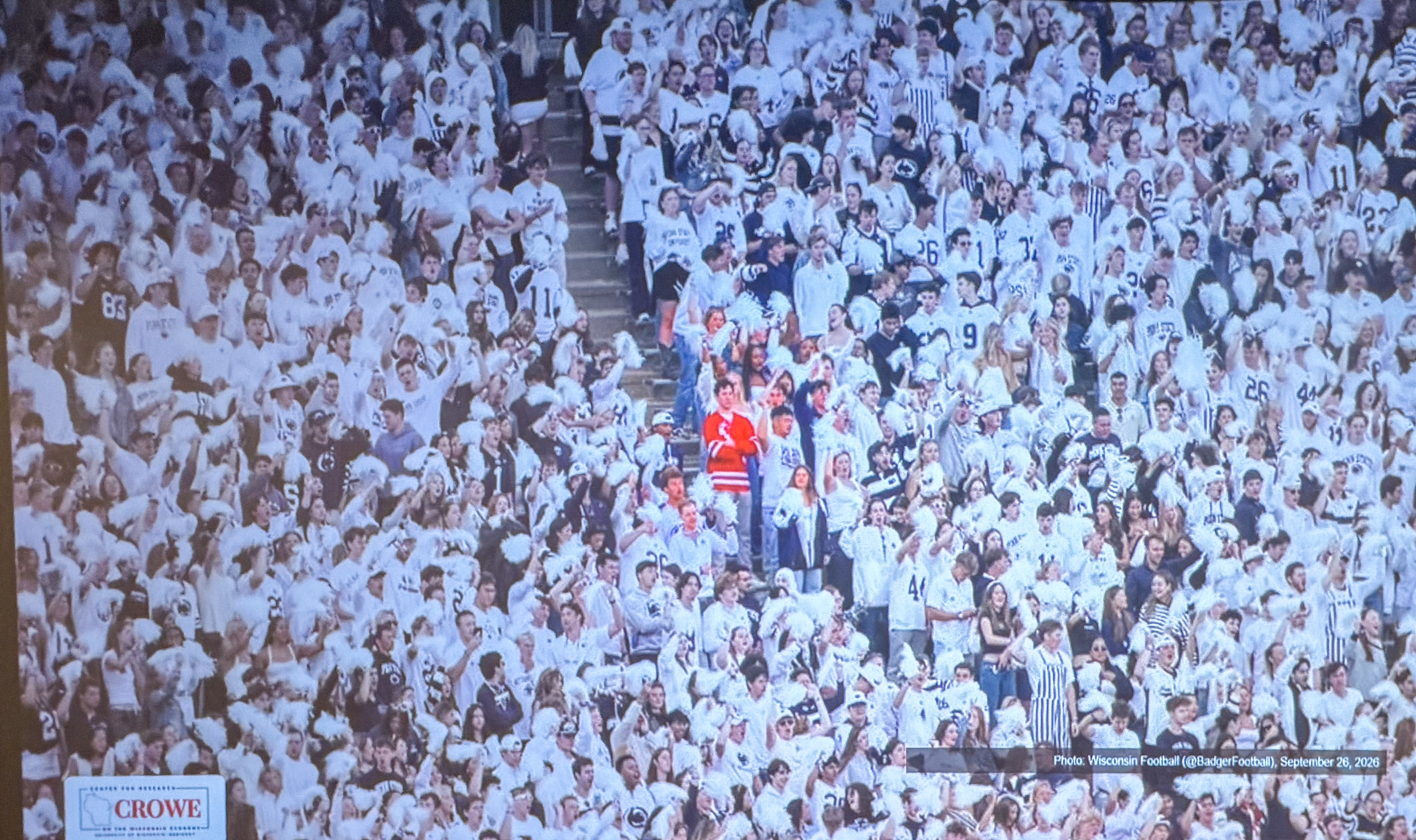
Um, it's hard not to start off with 2:30 this picture. We're gonna take this to our grave. I mean, this is one of the most, uh, you know, iconic, I think, Badger picture. Uh, we picked that day. There was one Badger in a sea of white. Um, and what's- So reports of Wisconsin's collapse are greatly exaggerated. Uh, so fine, we won.
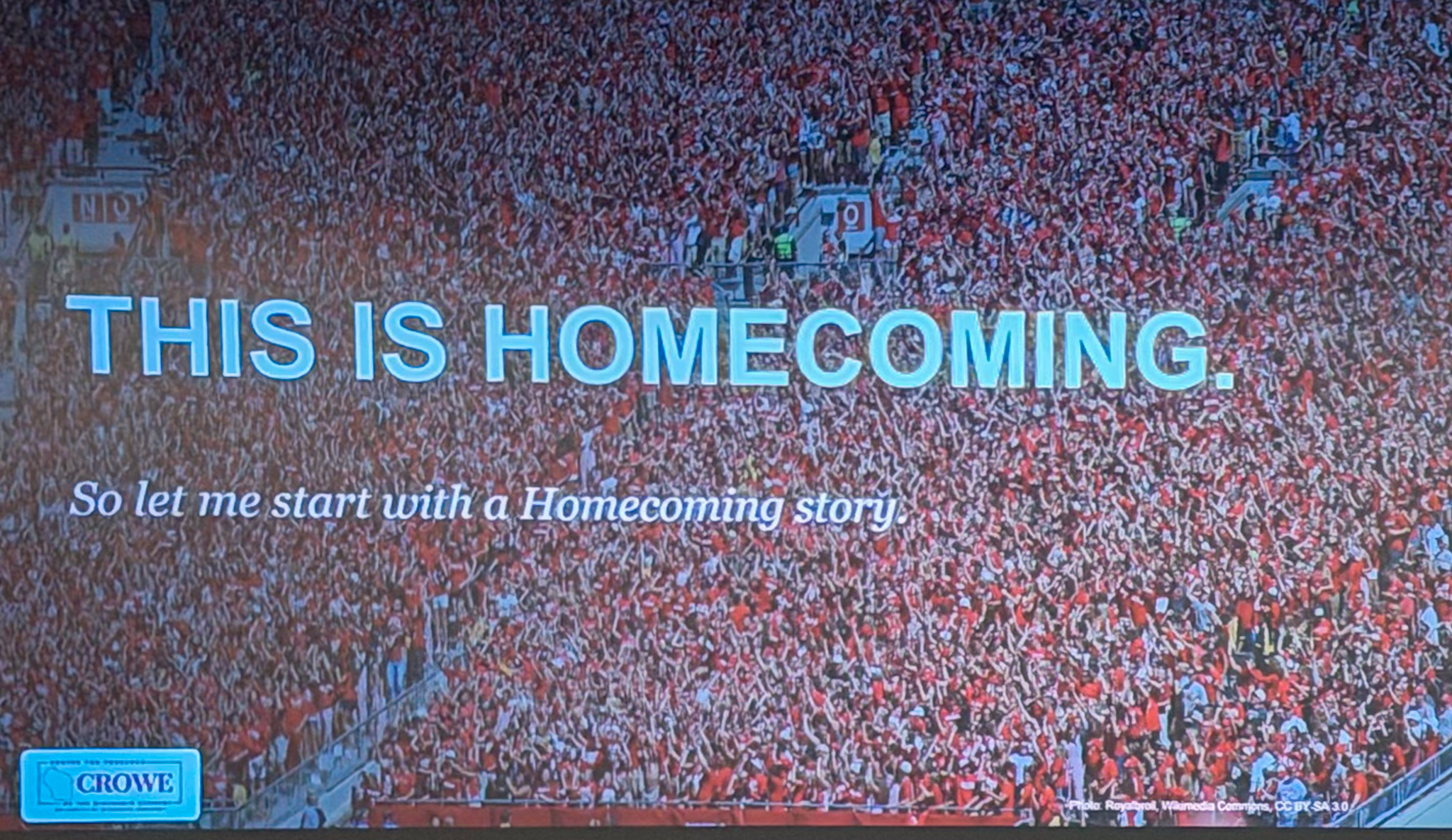
We got a great roster. Uh, I think the key question is, if the rebuild is already underway, could we then be in a position where 3:00 we try to make it last? Like, is this rebuild just something temporary, or is this something that's gonna be a little bit more long-lasting? You're all here for homecoming. So let me start off with a homecoming story.
Jump Around, and the last great rebuild
Um, October tenth, nineteen ninety-eight, that's homecoming. Jump Around begins at that time. Okay, there's a little bit of a historical debate on when exactly Jump Around begins. The swim team claims that they did it in nineteen ninety-three. They assembled a discman and a megaphone, 3:30 and then had the entire room, uh, in, into Camp Randall.
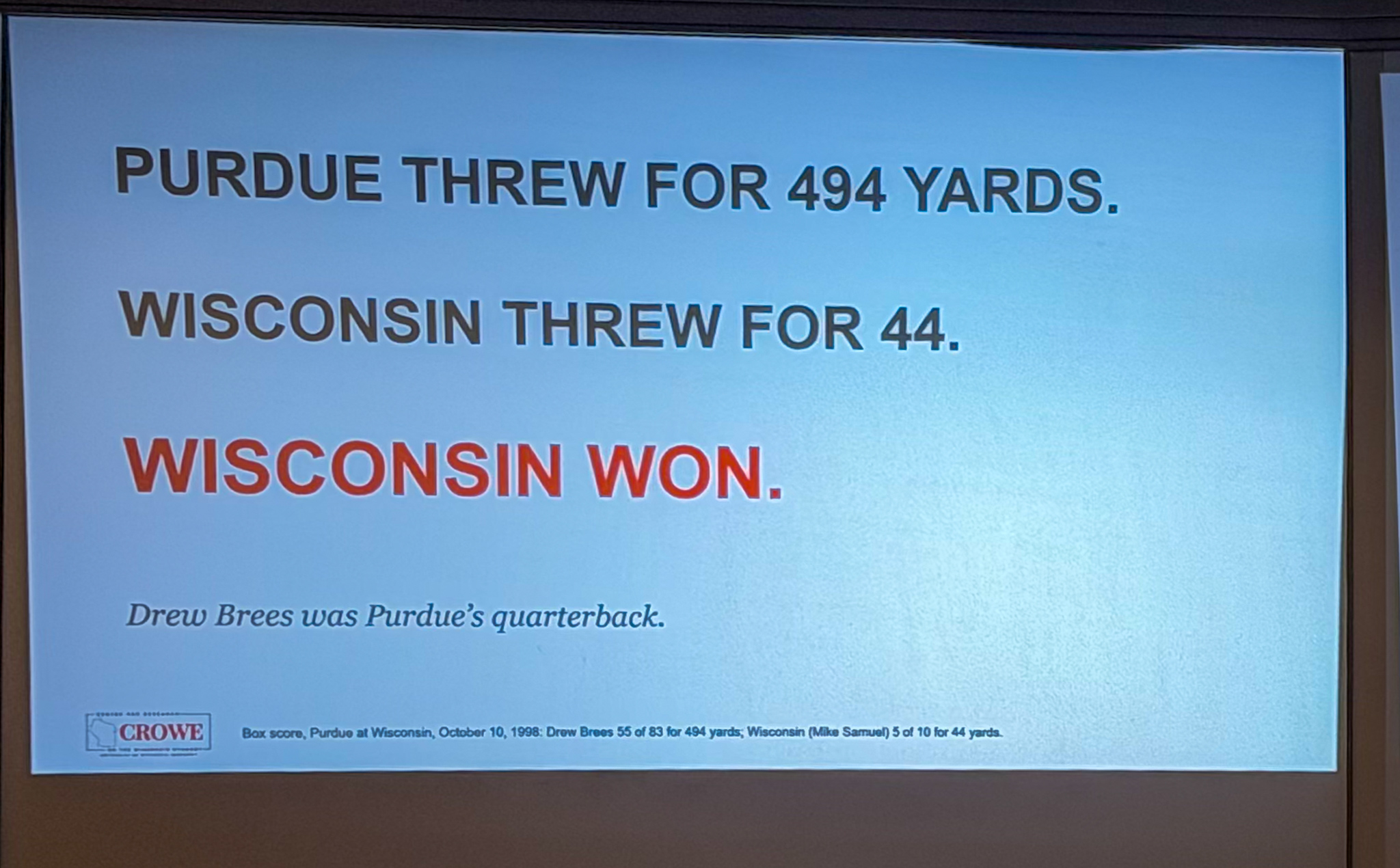
Um, Wisconsin won. Wisconsin thirty-one, Purdue twenty. It, it was a great game. Threw eleven times as many yards as Wisconsin did. Purdue threw four hundred and ninety-three yards. Wisconsin threw forty-three. And Wisconsin won. Who was Purdue's quarterback? Drew Brees. Drew Brees. Drew Brees was Purdue's quarterback.
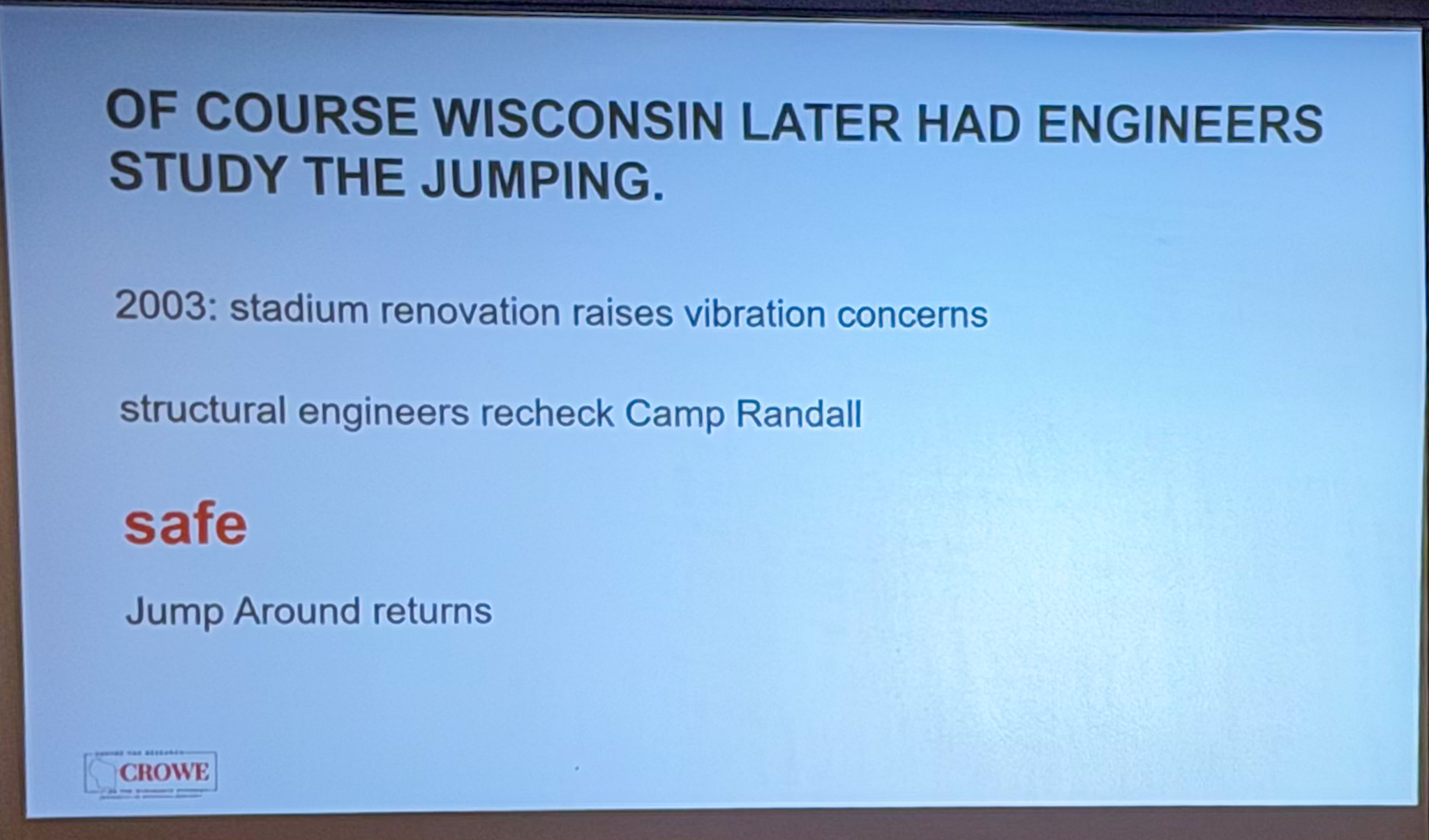
Okay, so those were, those were great 4:00 times. Of course, later on, there were concerns about whether we actually can jump, right? So there was a stadium wi-- uh, renovation that actually raises vibration concerns. So can we actually get away with it? Will the students fall down like they might in one of the frats?
Structural engineers then re-check Camp Randall. It's safe, and Jump Around begins. So that's a tradition. It's, it's we create a tradition, then test whether or not the tradition can actually linger on, and then, and then we 4:30 continue on jumping. Okay? But the story really begins nine years earlier, so quite a bit before that great iconic game.
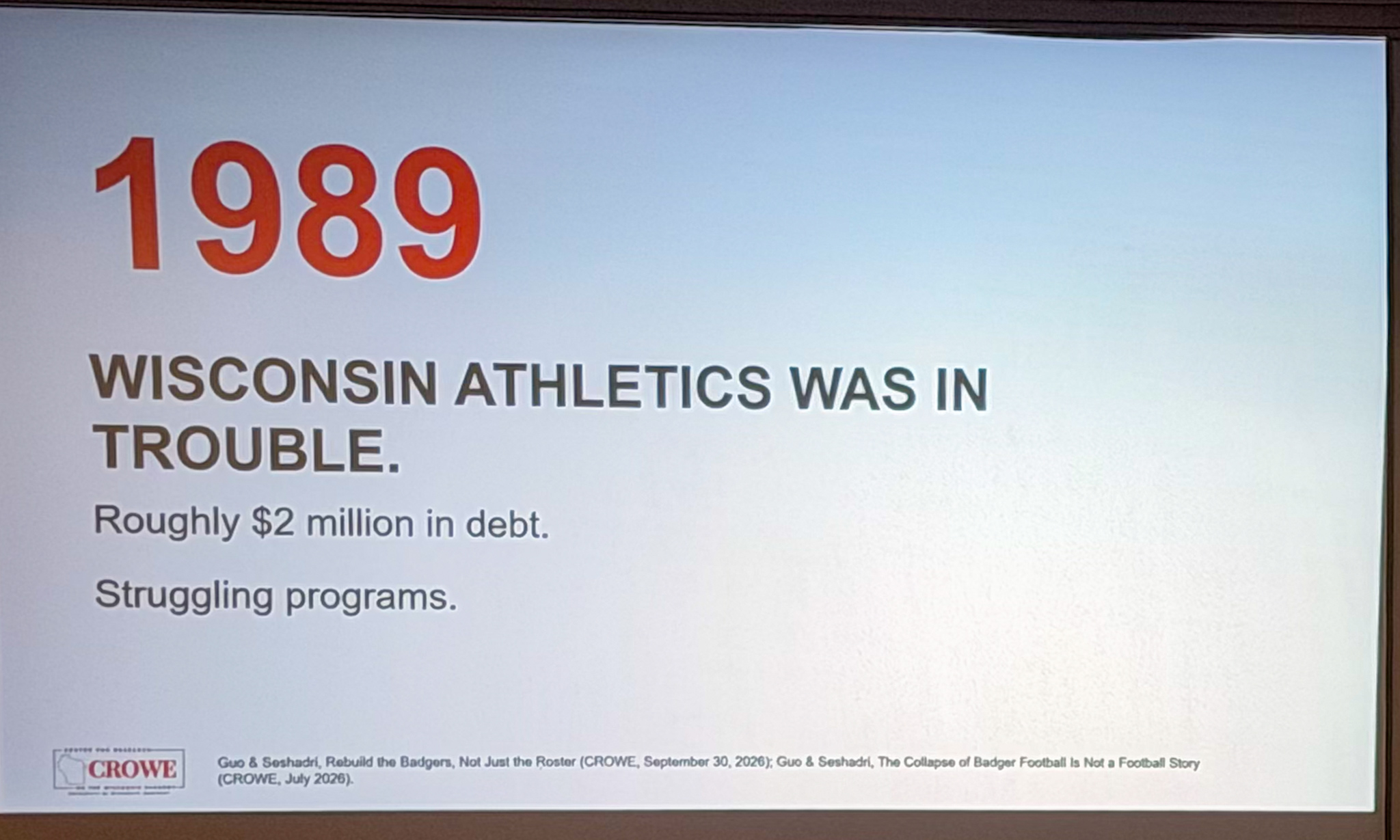
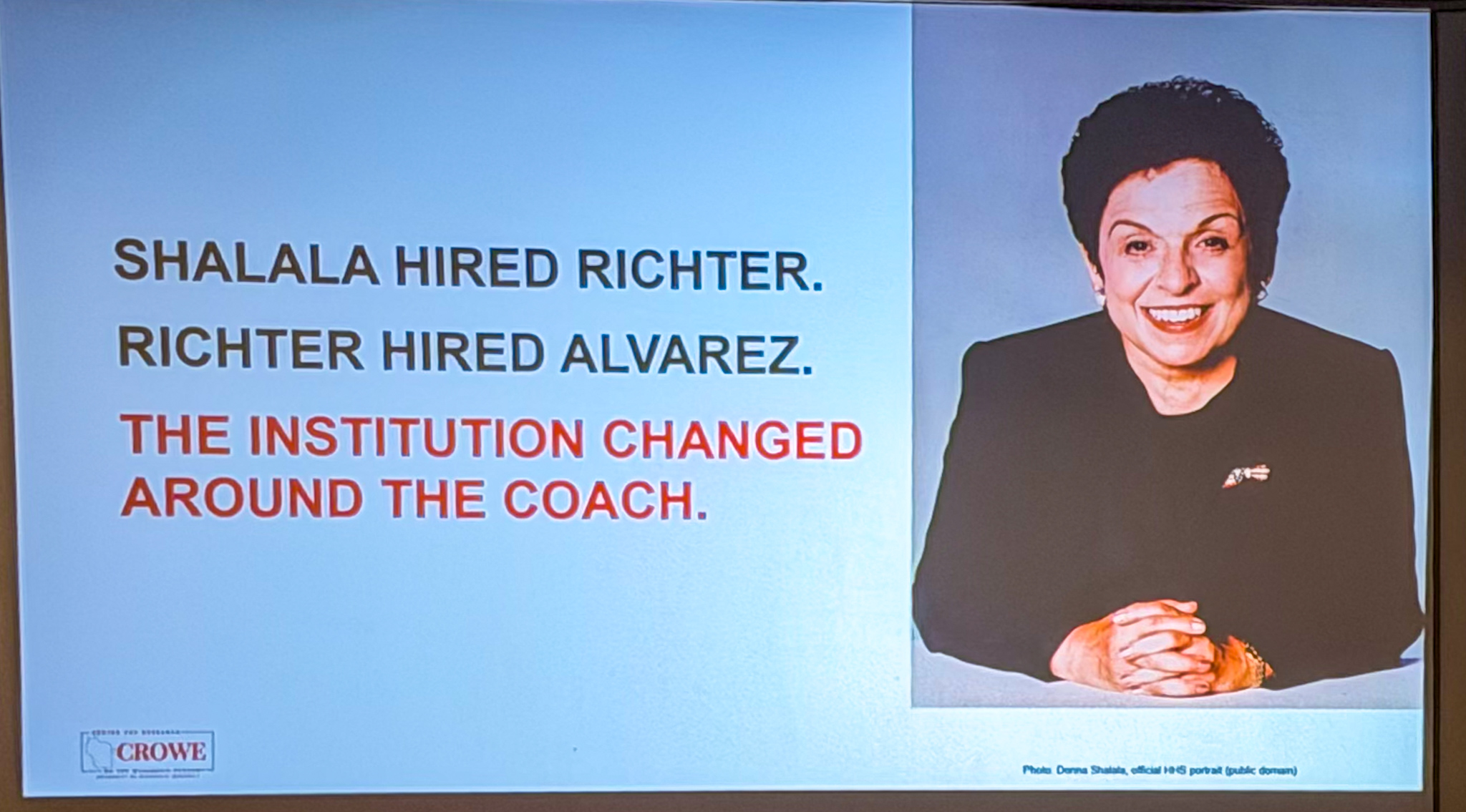
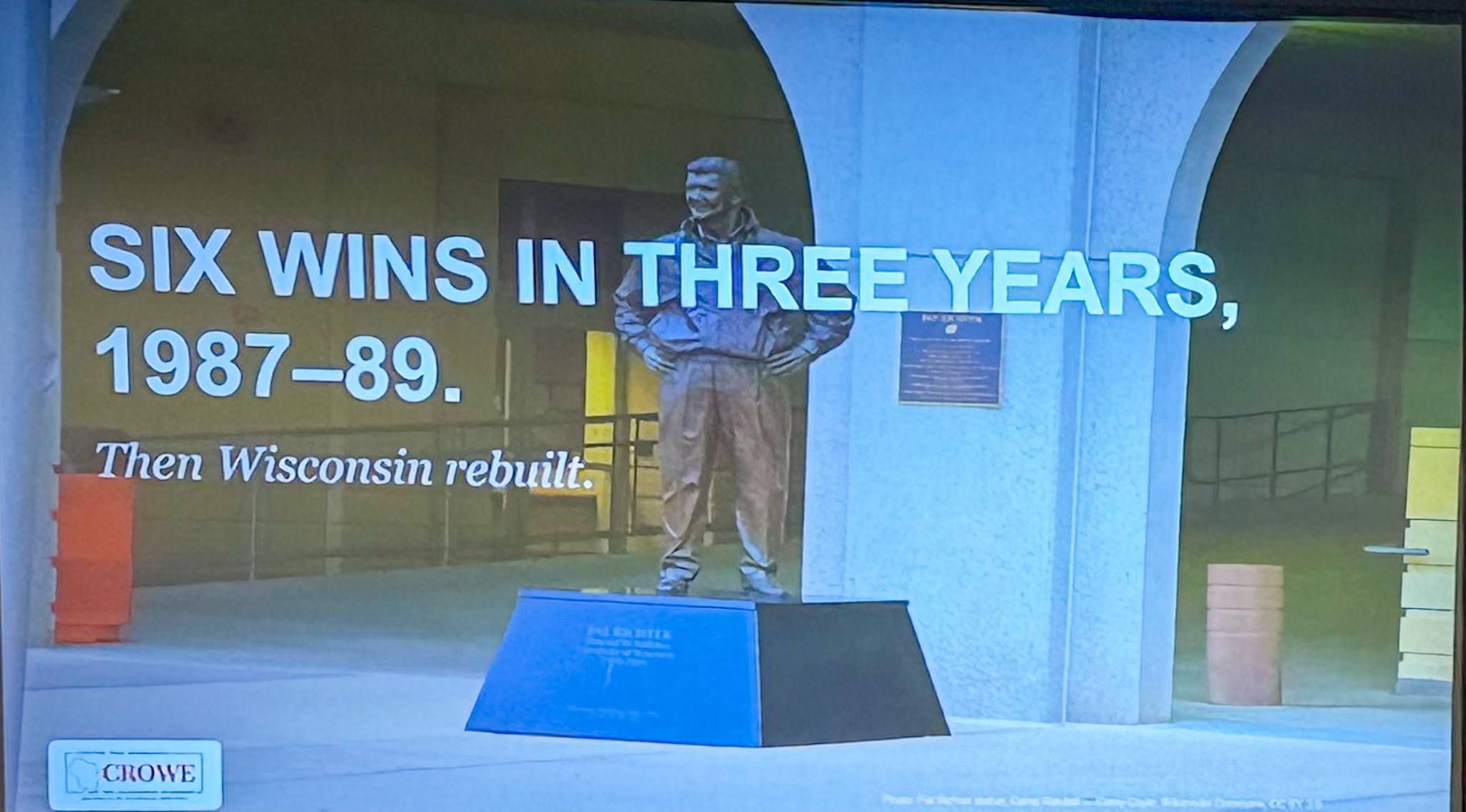
In nineteen eighty-nine, Wisconsin Athletics was in trouble. It, it... with roughly two million dollars in debt, we had several struggling programs, uh, and in comes Don Shalala. The exact sequence is Shalala hires Richter, Richter hires Barry Alvarez, and the whole execution around the coach changes. 5:00 And the whole institution changed.
That's kind of a big theme of what I, what I said. So Wisconsin wins six wins in three years between nineteen eighty-seven and nineteen eighty-nine. Six wins in three years, and then Wisconsin rebuild. Okay, so January nineteen ninety-four, Wisconsin wins the Rose Bowl, Wisconsin twenty-one,
UCLA sixteen. Uh, nineteen ninety-six, Wisconsin saw something others did not. Ron Dayne, 5:30 many programs saw him as a fullback. Barry says, "Nope, run with it." Carry it on the field. So I have, I think, an earlier slide. This is-- we
had a different production function, and Paul you all corrected me. You know, it's just a different input mix slowly.
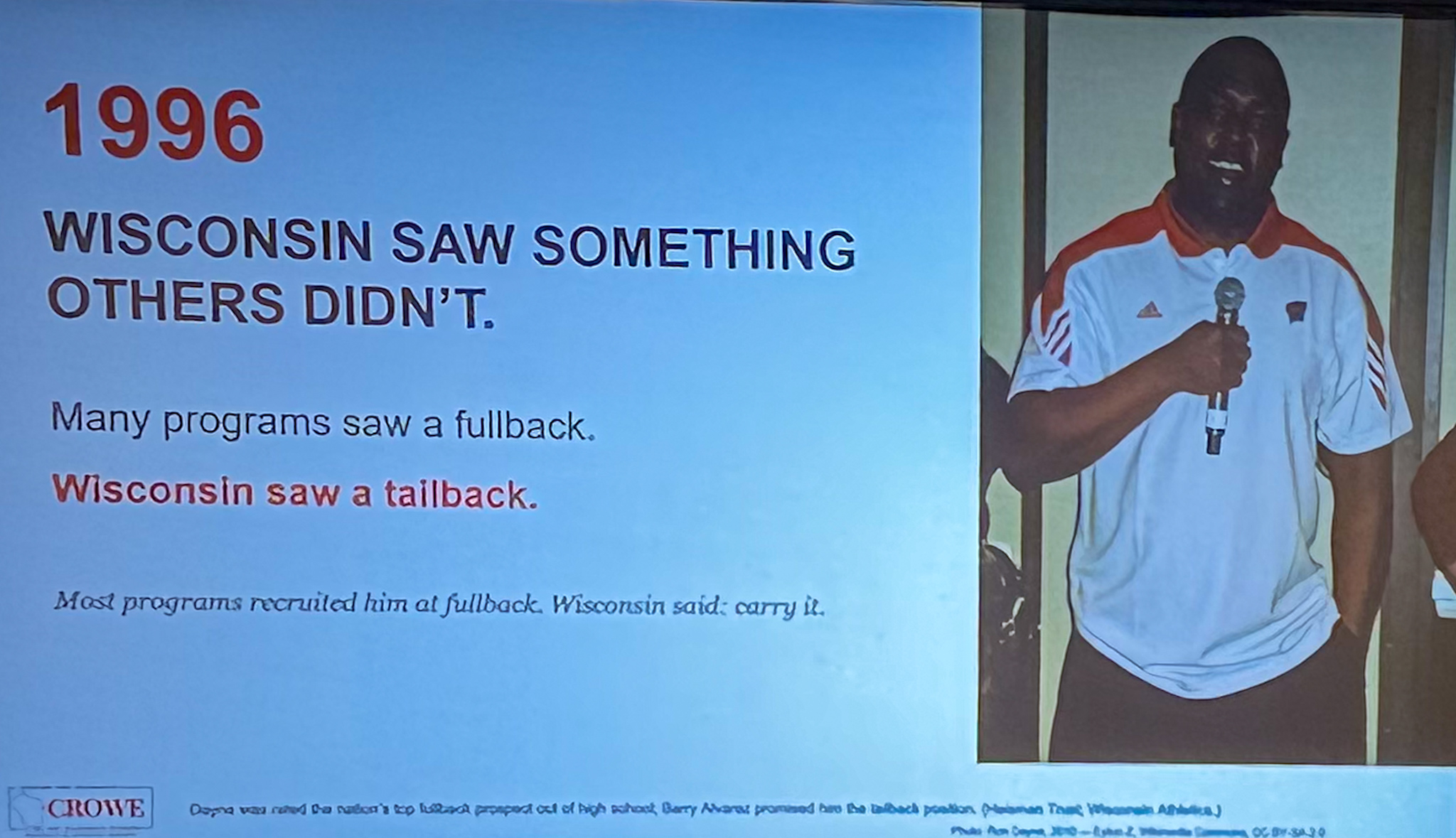
To run name in a few years and wins the Heisman. Seven one two five rushing yards and Toby balls, and sixty-three ninety-seven official NCAA, uh, 6:00 rushing yards with all counting bowl exclusive balls. Rose Bowl MVP in nineteen ninety-nine So that was the Wisconsin law. But something's better. We see value where others miss.
We develop it, we keep it, and then the most important part is just to keep it. So twenty seventeen, not too long ago, thirteen and one 6:30
What happened to Wisconsin football
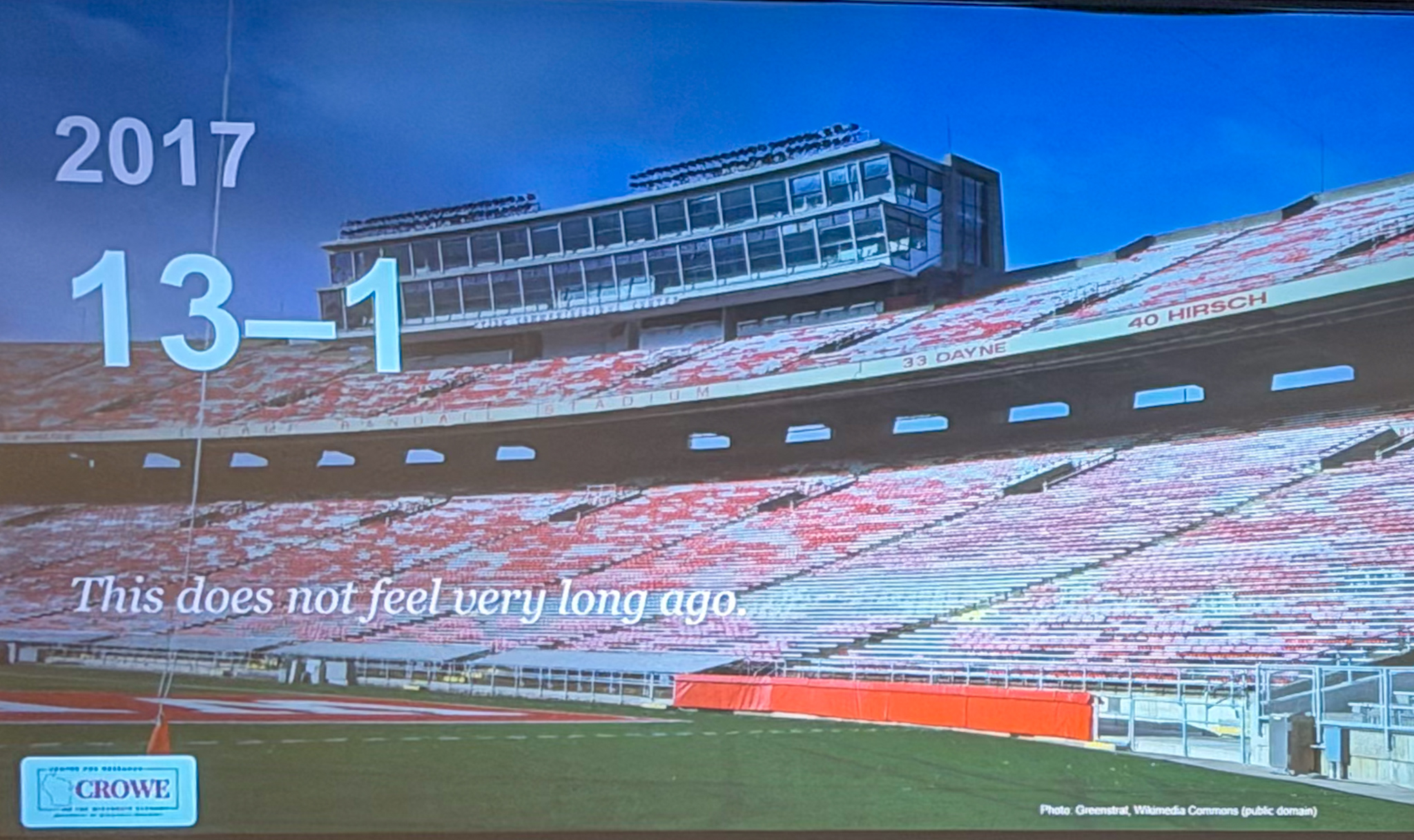
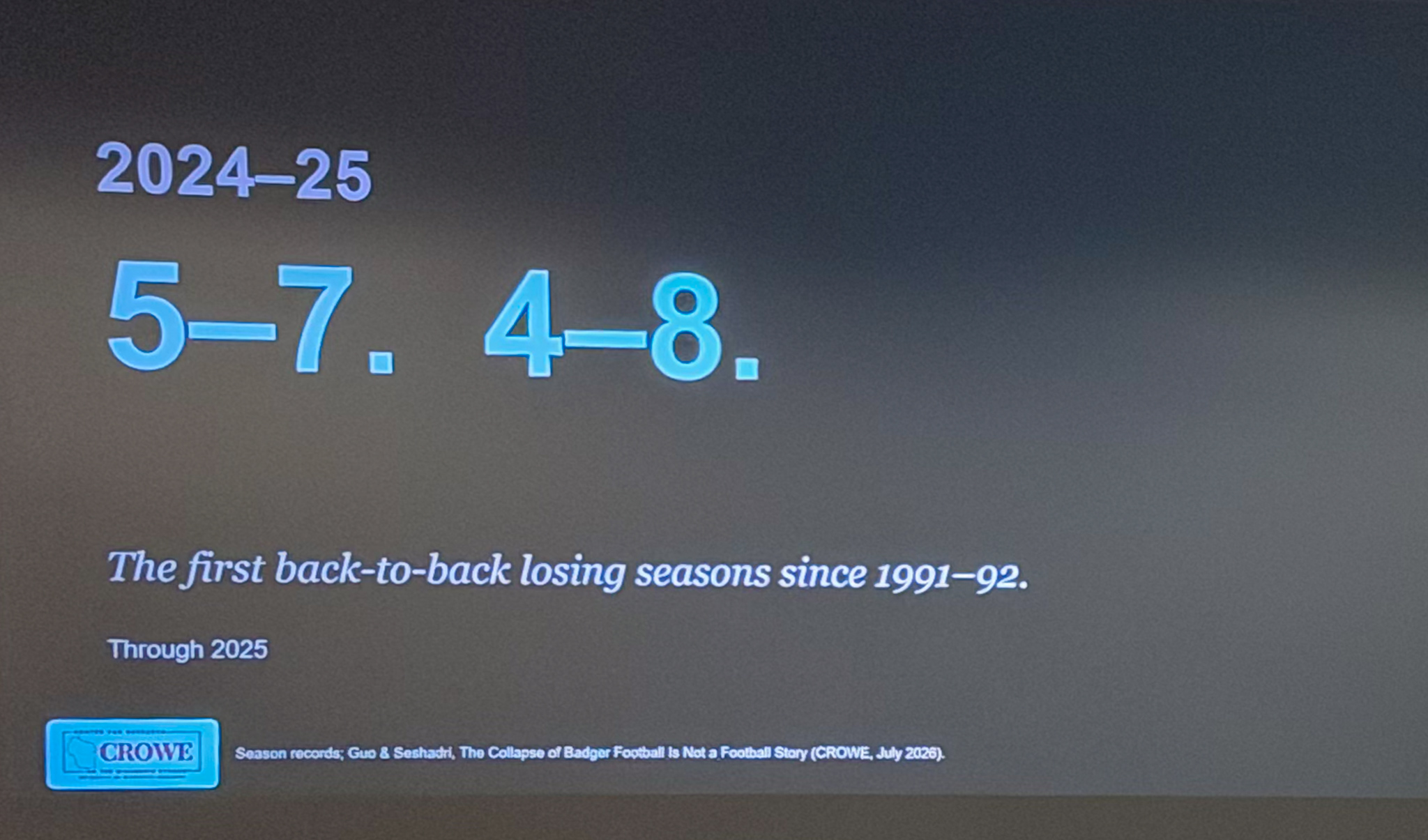
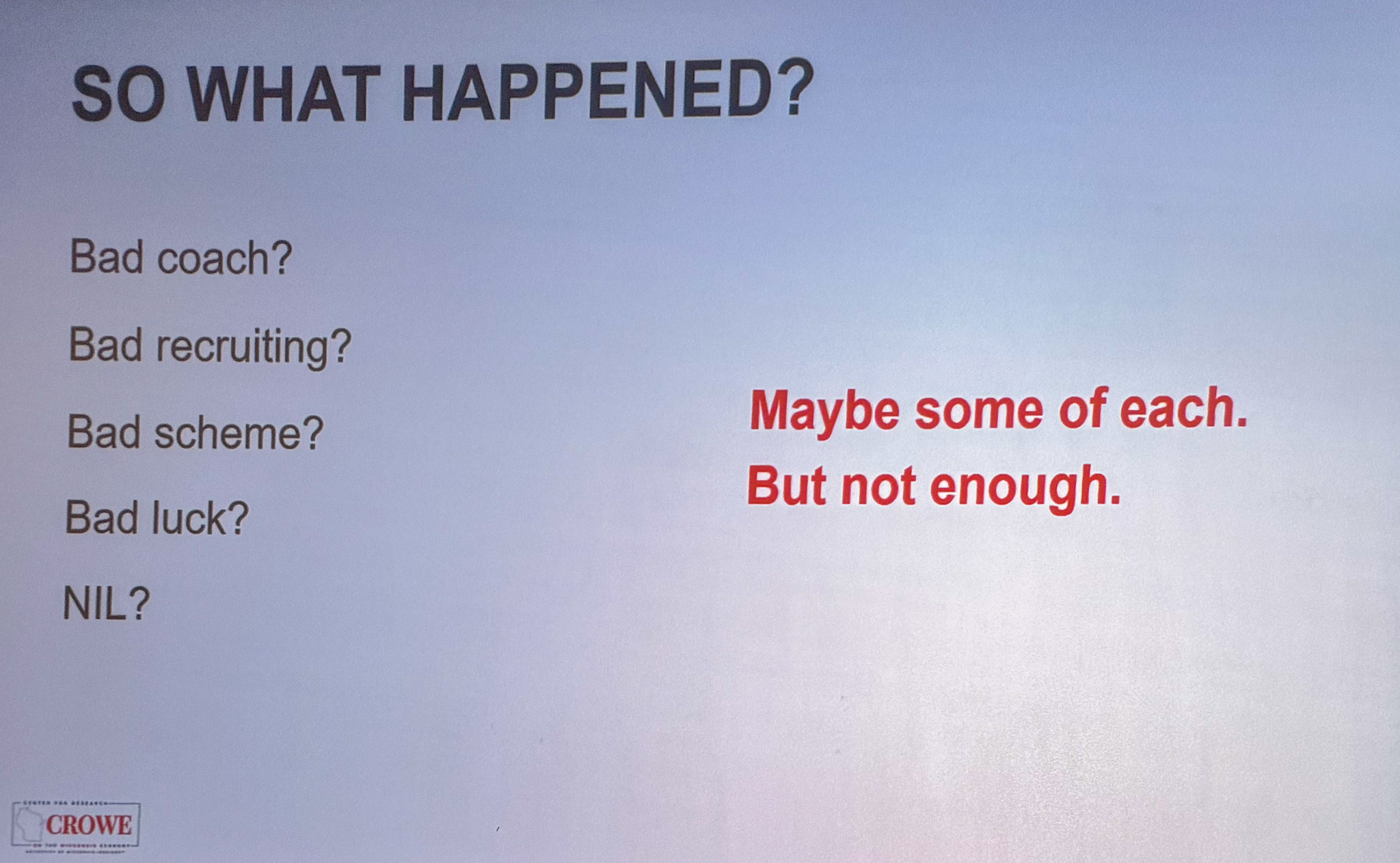
2025, five and seven, four and eight. So the first back-to-back losing seasons since 1991, 1992 So what happened? Maybe all of the above or some of each, but it's still not enough to understand and explain why it happened at the time it did in the manner in which it did. That's my guess. That's my guess. This is not a big econ talk. 7:00
I'm an economist. I cannot tell you whether Wisconsin should run more inside zone. Probably shouldn't have listened to my economics, but I know a little bit more about that, and so I do know something about what happens when the price of talent changes all of a sudden and institutions adjust much more slowly, uh, to those outcomes
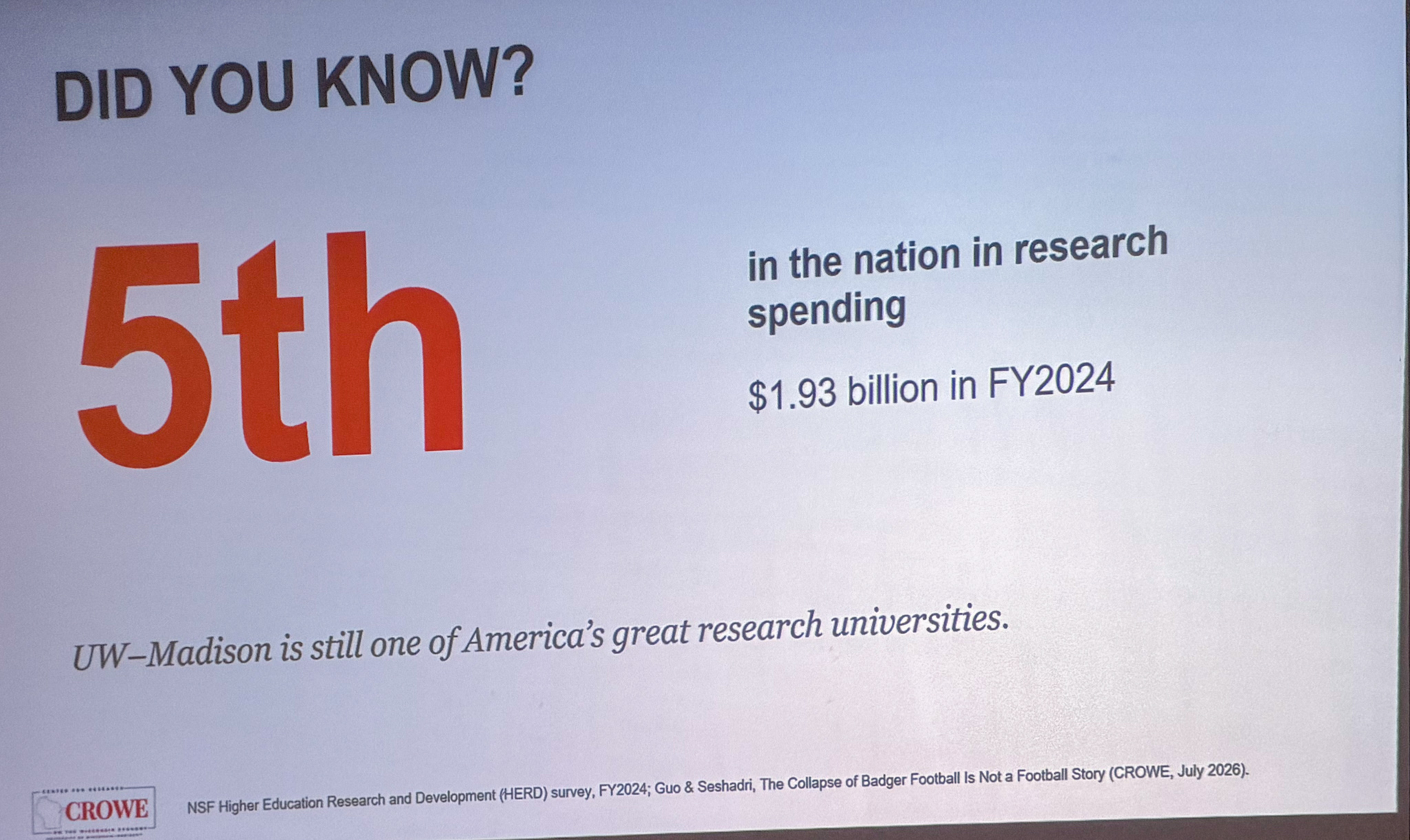
Yeah, this is not a Wisconsin in decline kind of talk. I don't know if you knew, we are fifth in the 7:30 nation in research spending. Pretty big dog in terms of research spending. This is one point nine three billion, close to two billion in FY twenty-four. So we still remain one of the world's greatest research So the puzzle is not quite that Wisconsin is weak.
The puzzle: where Wisconsin is weak
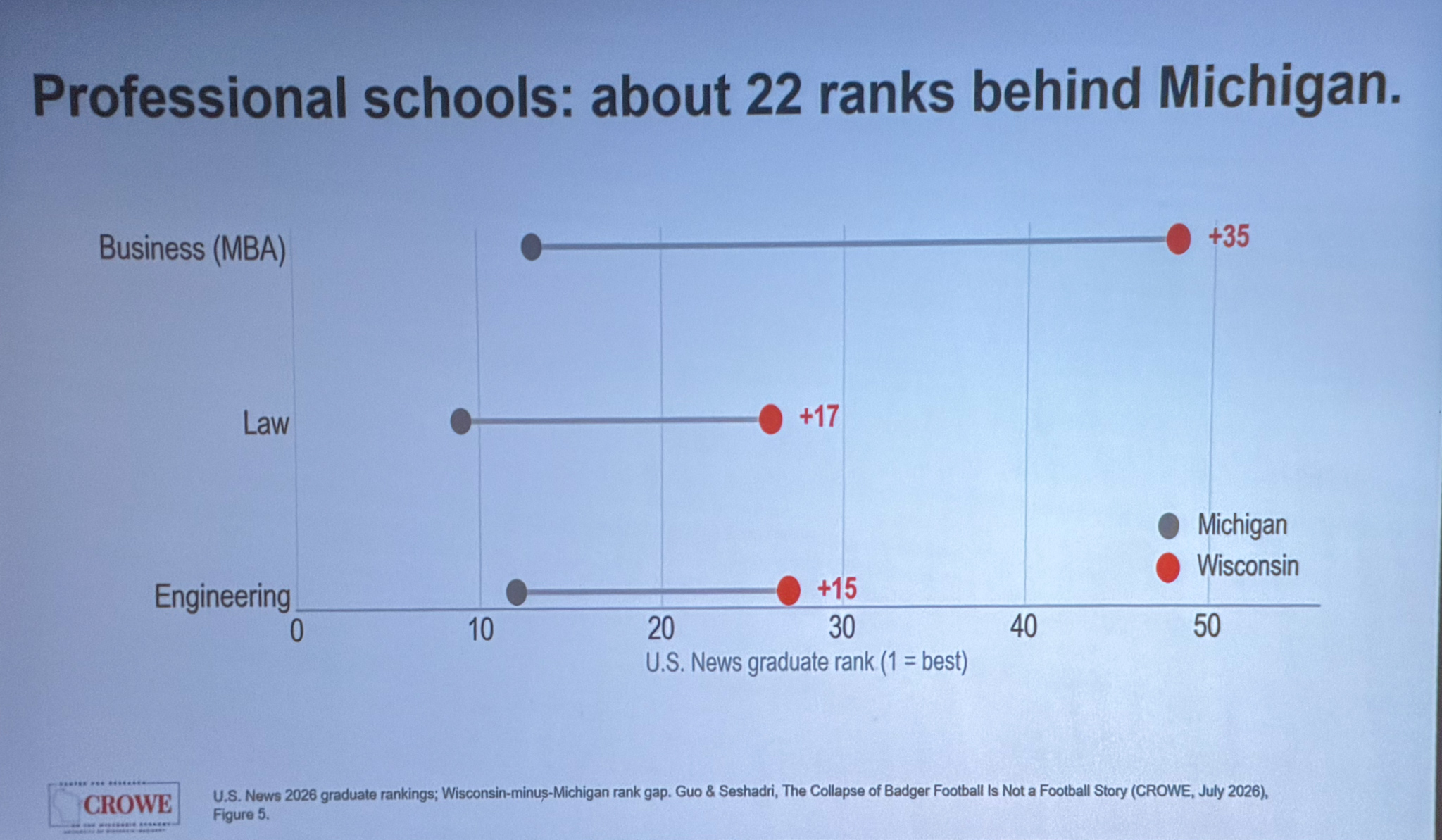
The puzzle is where Wisconsin is weak. That's the way I feel Several Wisconsin's most market-facing programs rank 8:00 far below its research- Wisconsin's MBA, uh, this was the twenty twenty-six ed- edition of the US News & World Report, forty-eighth. Law, twenty-sixth. Graduate engineering, twenty-seventh. So in fact, my favorite story, the way I would think about it is, if you compare Wisconsin and Michigan, and there's good reason for us to compare ourselves with Michigan.
I'll lay the argument out in a minute. We compete with Michigan in the social sciences, in 8:30 the arts and humanities, um, in many other fields. But disproportionately so, in many of the market-facing programs, we rank way below Michigan, and that is not a mere coincidence. Okay? I'm not gonna-- For the economists in the room, there's no causality here.
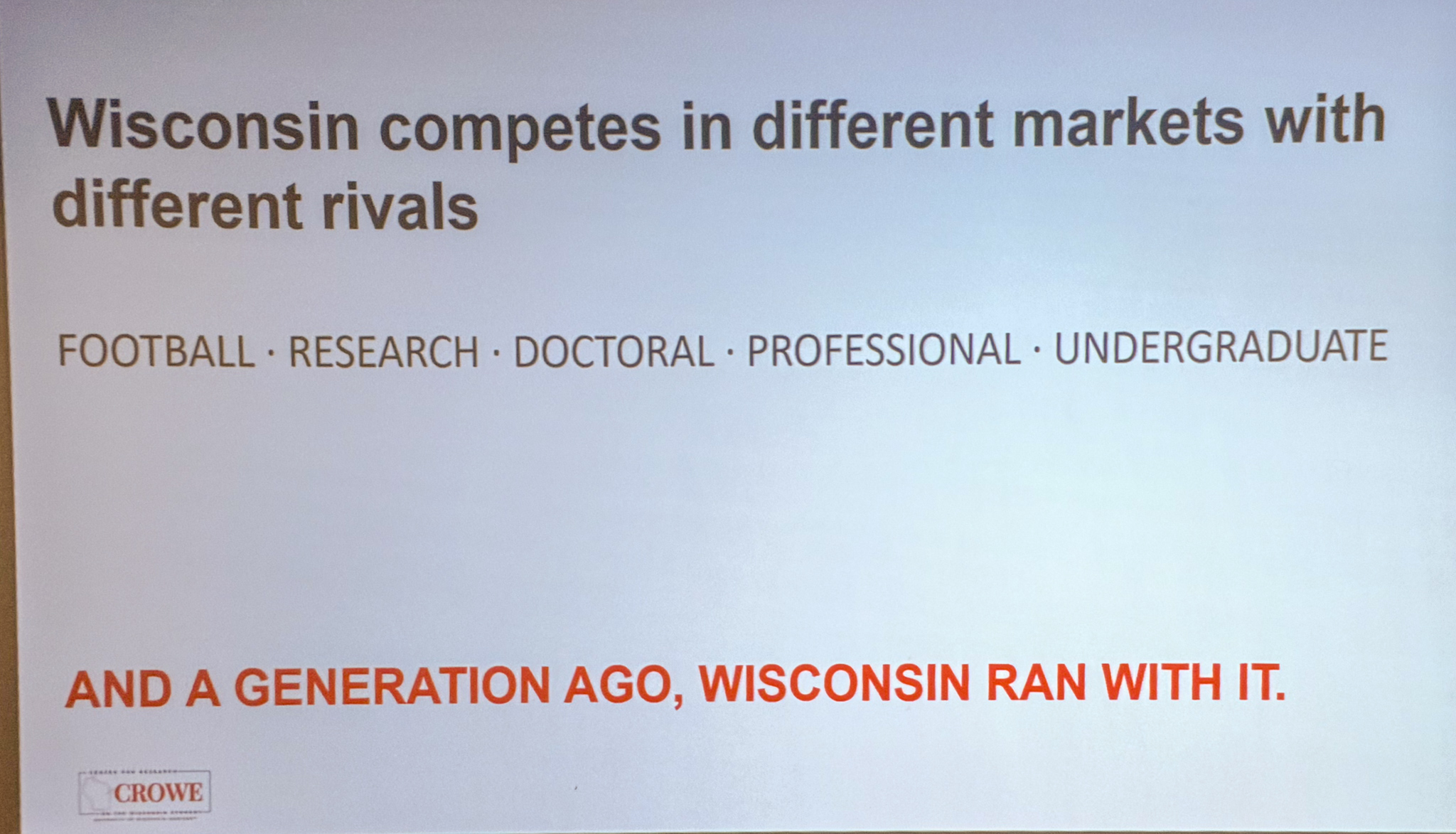
That's why I call it a story So research spending again is fifth. This is disproportionately weak in some areas and strong in, in, in most of the others. So Wisconsin competes in, in at least five 9:00 different markets. We compete in football, we compete in research, we compete in doctoral education, professional schools, undergraduate schools.
And a generation ago, we ran with them. So two to three decades ago, we used to go toe-to-toe with Michigan along all these metrics, these most important
Professional students. So the MBA program, Wisconsin is about thirty-five 9:30 ranks higher, which is to say lower. Law, seventeen. Engineering, fifteen. Now compare that with political science, English, physics, history, math, psychology, computer science, econ, and education. Where-- This is the only field where we're actually behind.
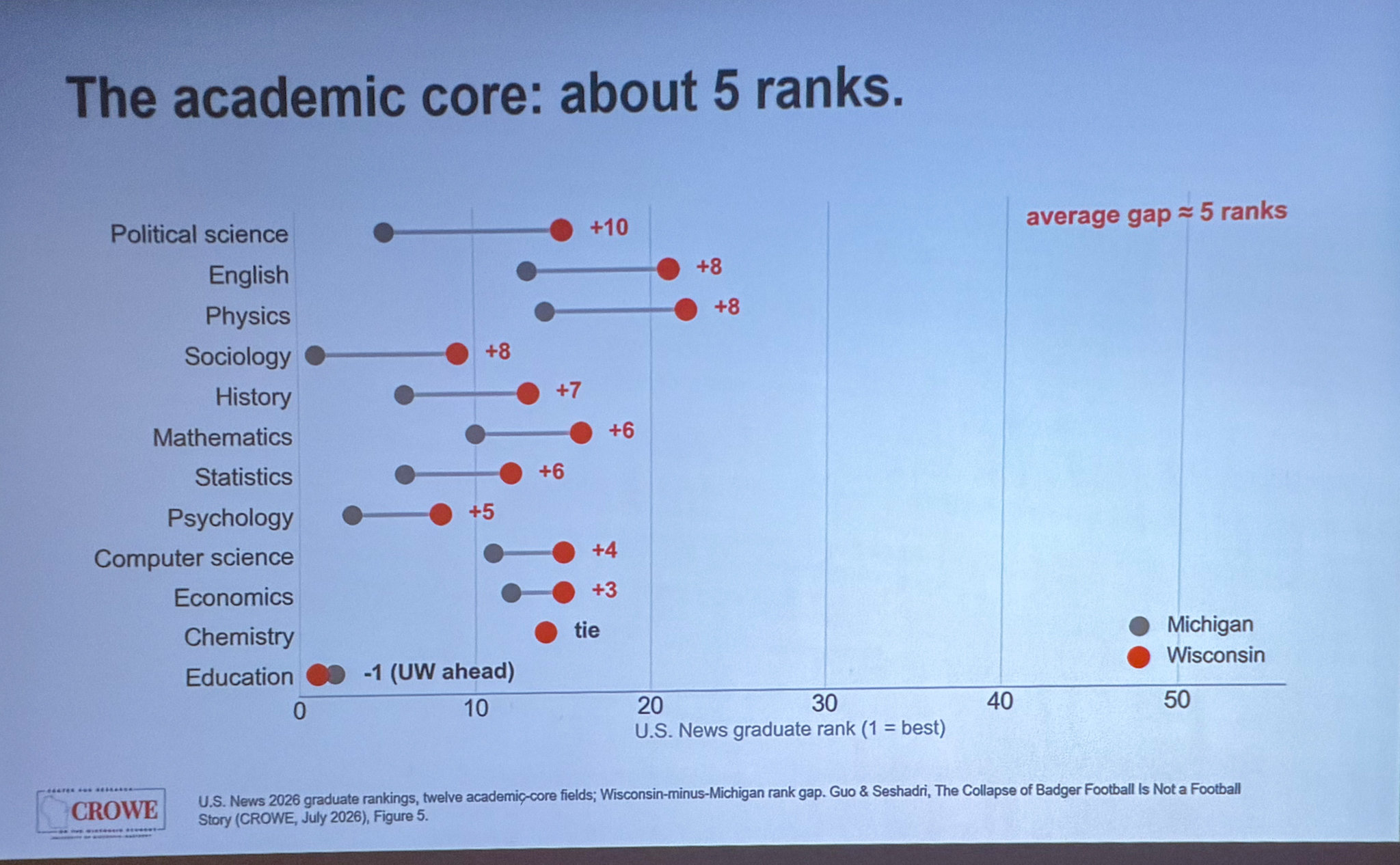
So the average gap is around five ranks, but the professional school rank is significantly higher. Okay, so I'm also wondering why do we have 10:00 a much worse business school? No, I-- no offense to any of my colleagues in business school or law. Uh, but something must have happened decades ago as a consequence of which Ross or Anderson is quite a bit better than UW-Madison is.
And I love the way we put the rankings up. We're number nine
The business school example
Indiana. Indiana built a great business school. Um, this was-- it, it dates 10:30 back to the early eighties and mid-eighties. It, it-- A strong professional school creates much more than just a ranking. It's-- You get alumni, employers, donors, commercial relationships, but the return can spill over to the rest of the university.
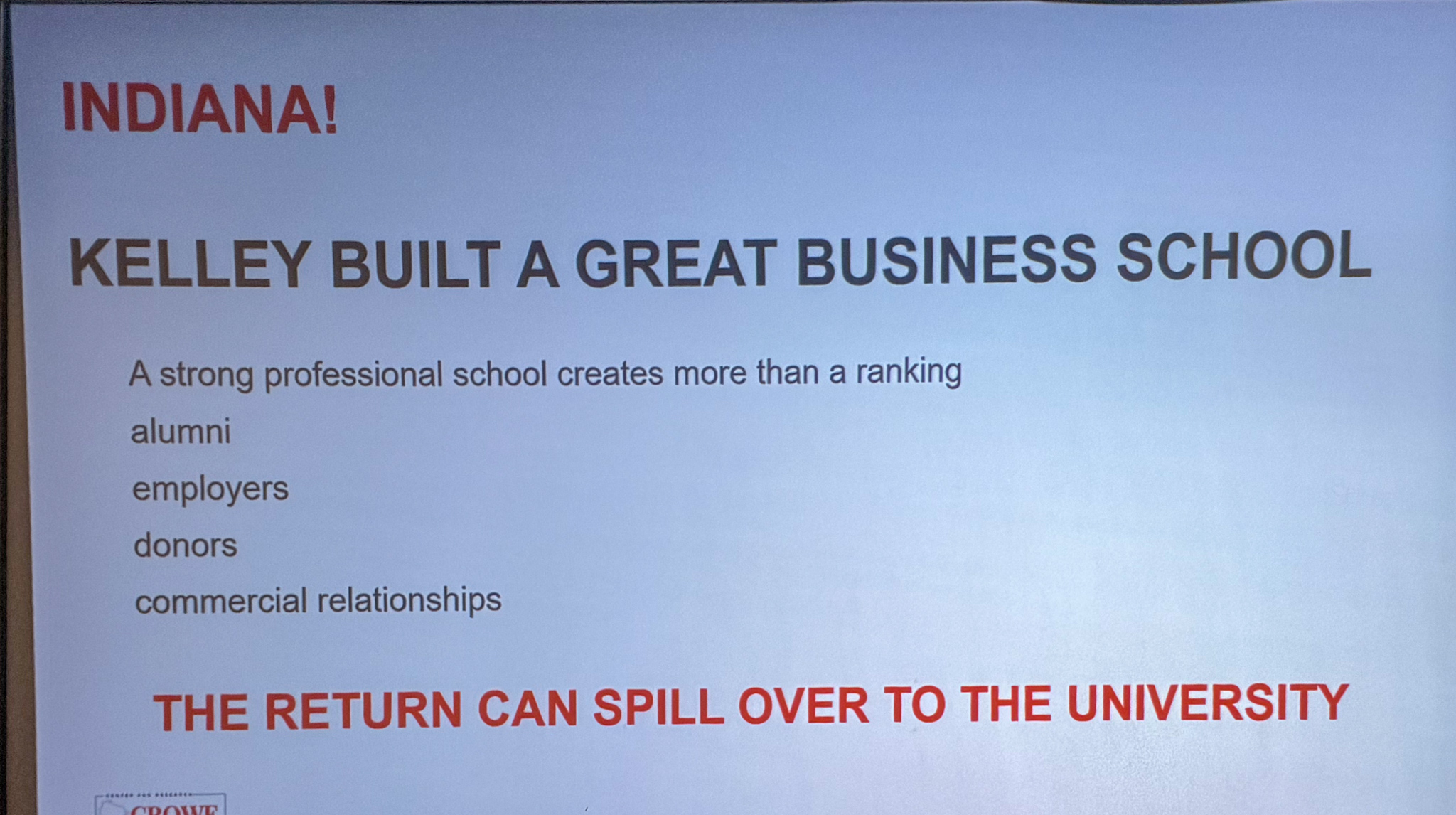
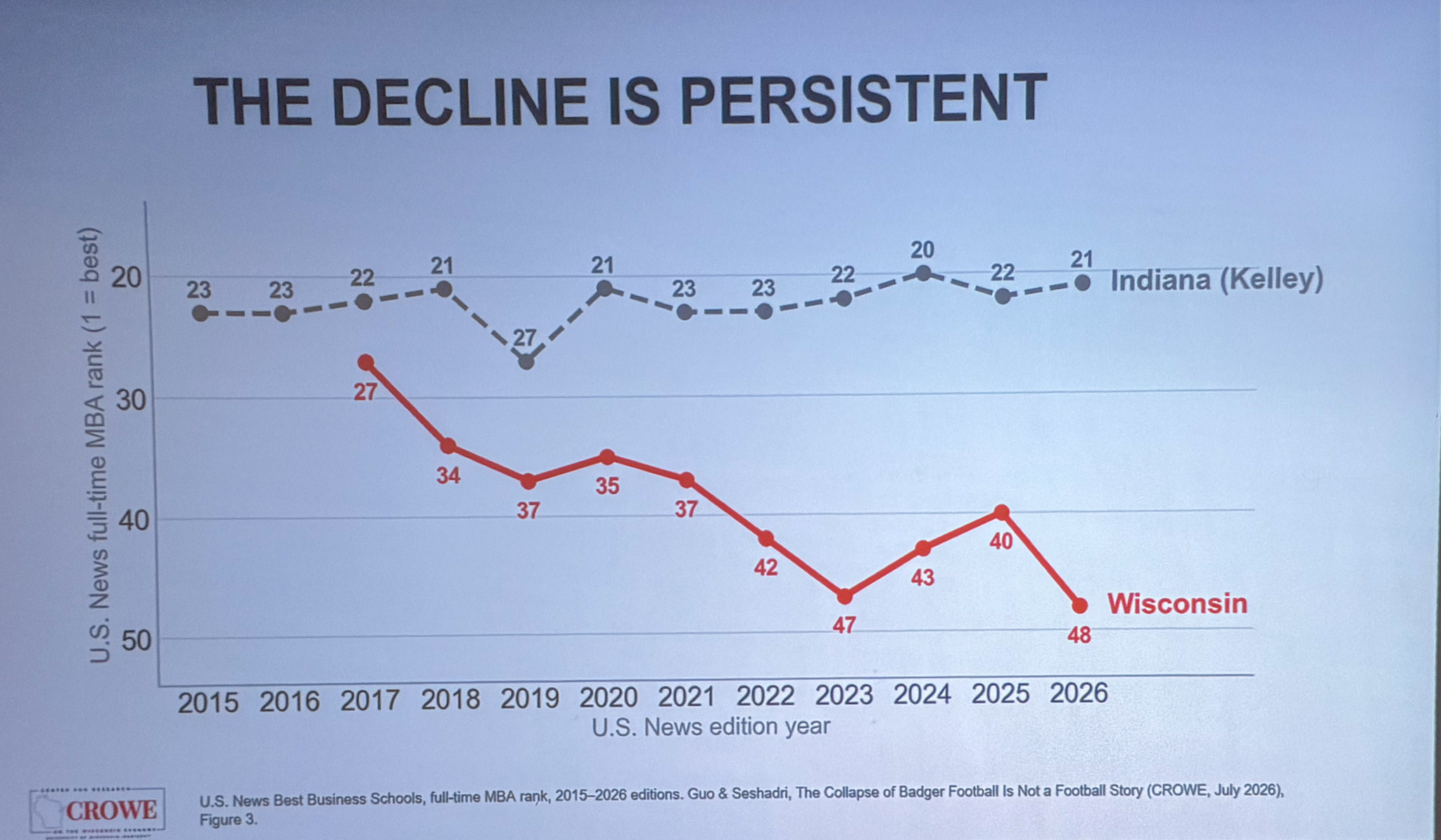
Right? In fact, there's actually some work suggesting that Indiana's football program recently got a ton of NIL money from business alums from Kelley. Okay. So there's interactions between the success of the professional programs and football. 11:00 Okay. So the decline is actually pretty persistent. If you look at Kelley, they ranked at the top for quite a while.
Wisconsin was actually almost going toe-to-toe with Kelley a few, uh, decades ago, and then sank, almost to the point where a prior dean wanted to shut down the MBA program, and she was schooled by the alumni. It's not gonna happen.
But there's-- there is no good 11:30 reason. There is no good reason why MBA should have a better business school. And one of the reasons why they do is they have what's called an RCM model. I don't want to get into the details about it, but it's a budget model which is kind of a bit more of a dog-eat-dog world.
Eat what you can kill. Much more so
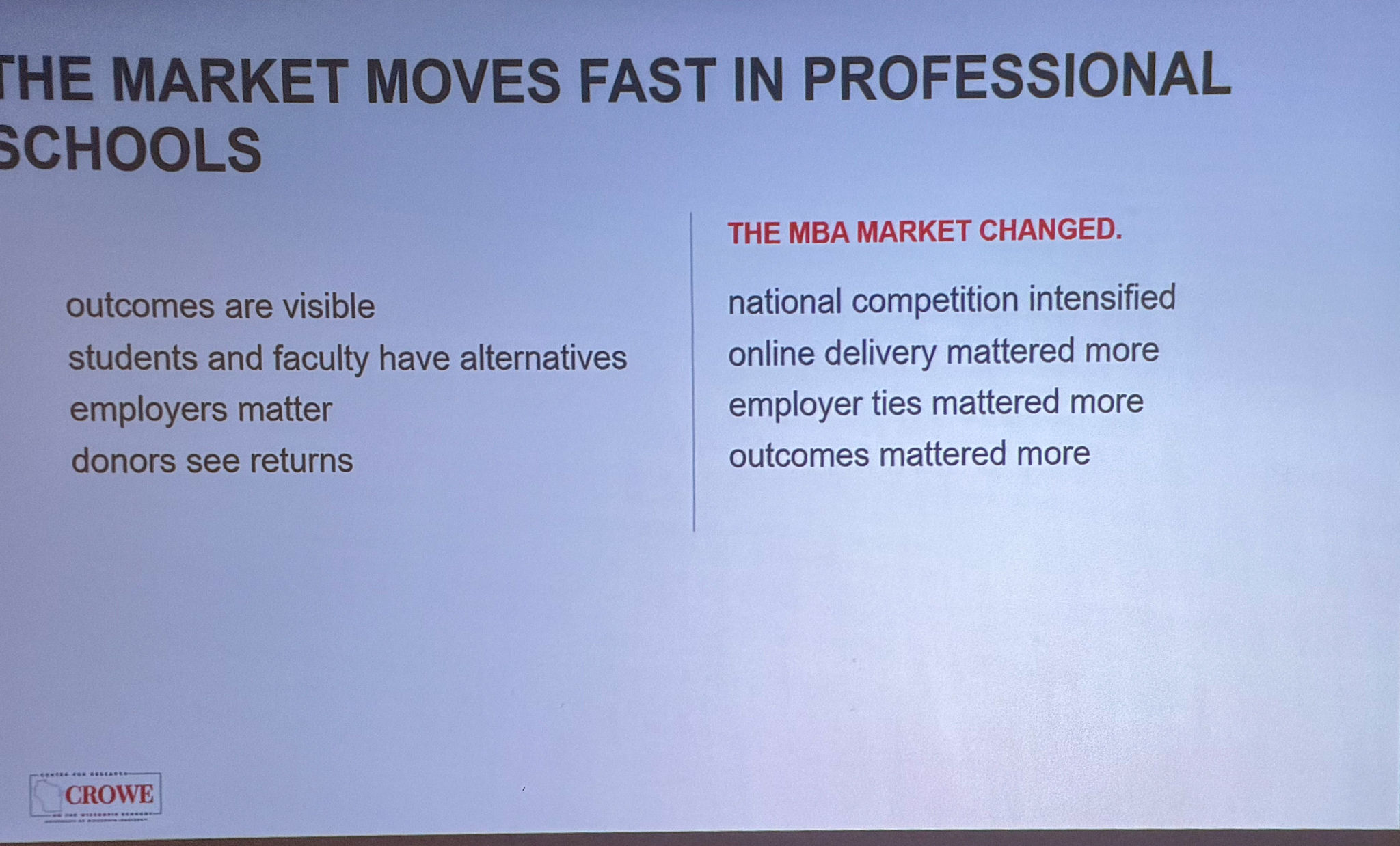
than state science. I'm gonna come back to that. The market moves very quickly in professional schools. The outcomes are very visible. Students and faculty have alternatives. So if you're not gonna 12:00 pay the market rates, they pick up and take off. Employers matter, and donors see an instantaneous return on their-- on their money.
You know, the MBA market changed rapidly. So this national competition identif-- uh, intensified, online delivery mattered a lot more, employer ties mattered more, and outcomes mattered
The computer science example
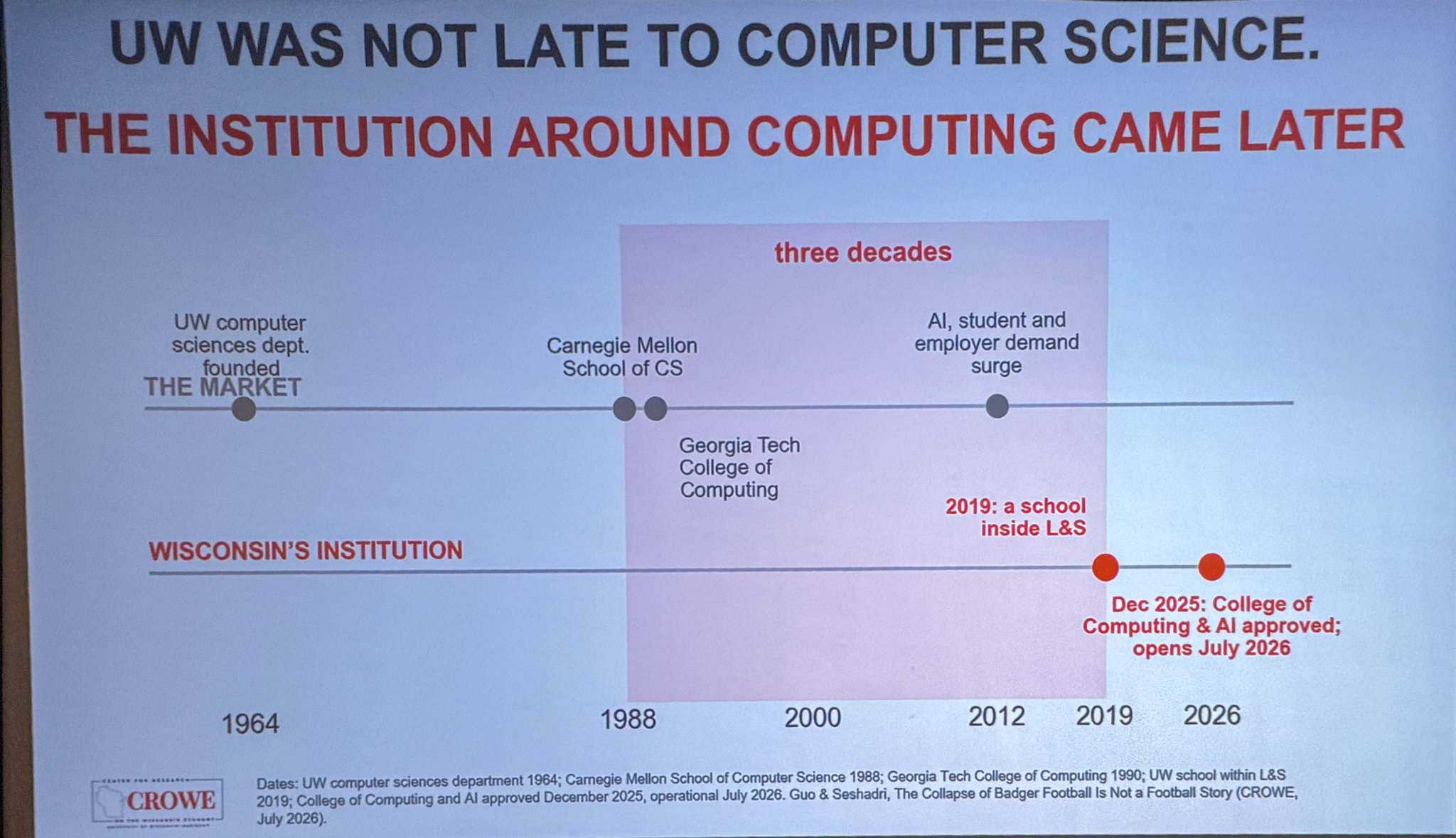
So that's, that's about at least one important professional. Let me turn now to computer science. Um, UW founded a computer 12:30 science department in nineteen sixty-four. It's one of the older computer science Way before Carnegie Mellon, before Georgia Tech. Um, and then you had three decades, and then you had AI and employers-- uh, uh, employer demand surge.
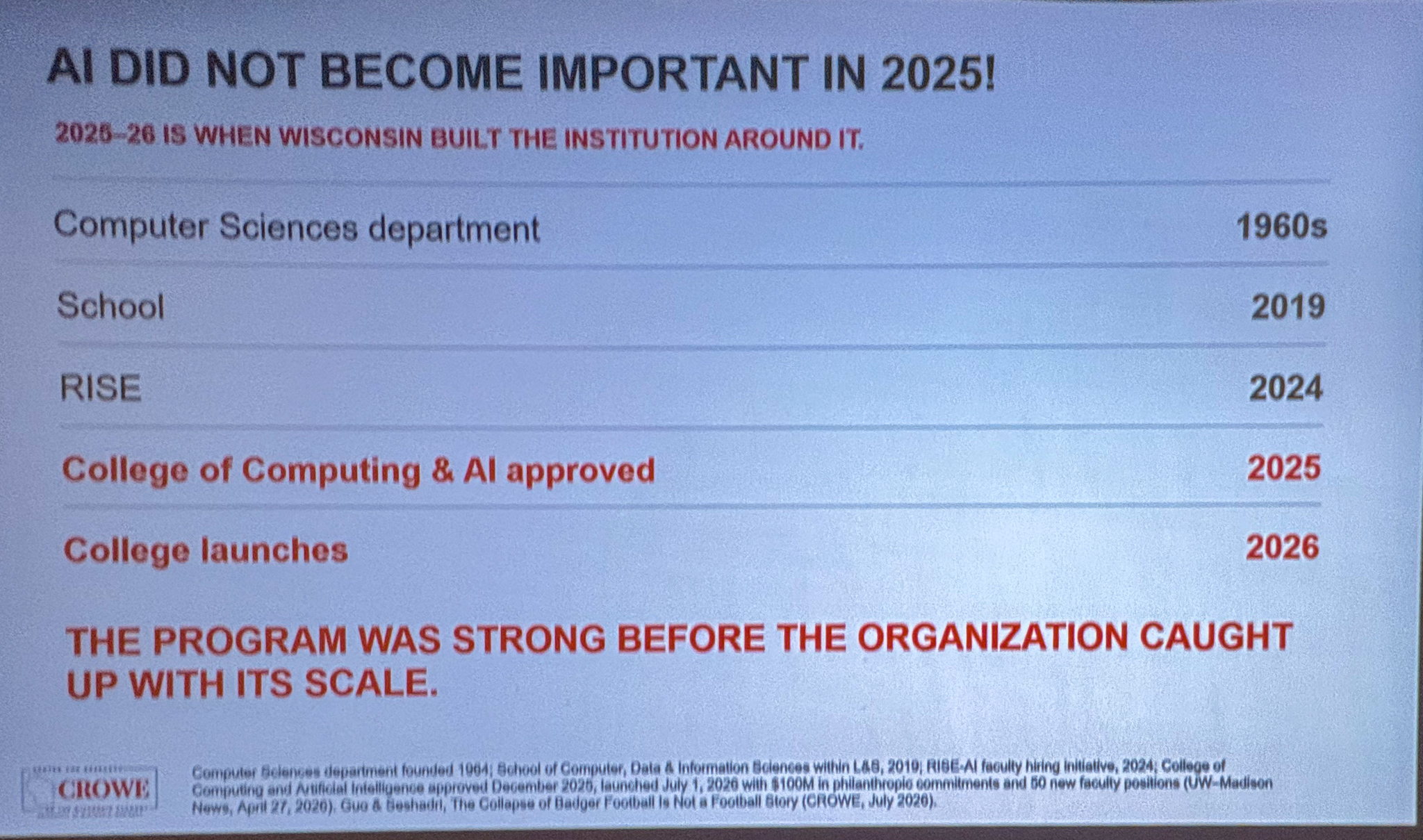
Then there was a school within the college, and then it became a separate college just a few months ago. So in twenty twenty-five, there was a College of Computing and AI. It was opened, uh, I mean Yeah, we were not late to computer science, but we were late to building an institution 13:00 around CS So twenty twenty-five, twenty twenty-six is when we built the institution.
AI did not become important in twenty twenty-six. So again, this is just a repeat of what I said. It's a separate school. Um, it was a RISE AI initiative. If you have any questions about RISE, you should ask, uh, former chair Ken Hendricks. He should meet you about that. And then you had a school of computing and AI, um, that was formed.
Again, we didn't-- 13:30 it, it was not as if computer science was something that we ignored. I repeat that. It's just that the, the structure in-- with which you can possibly capture those returns was created kind of late. And the, the program was strong well before the organization caught up with scale. So computer science grad rankings are not all that different from this year.
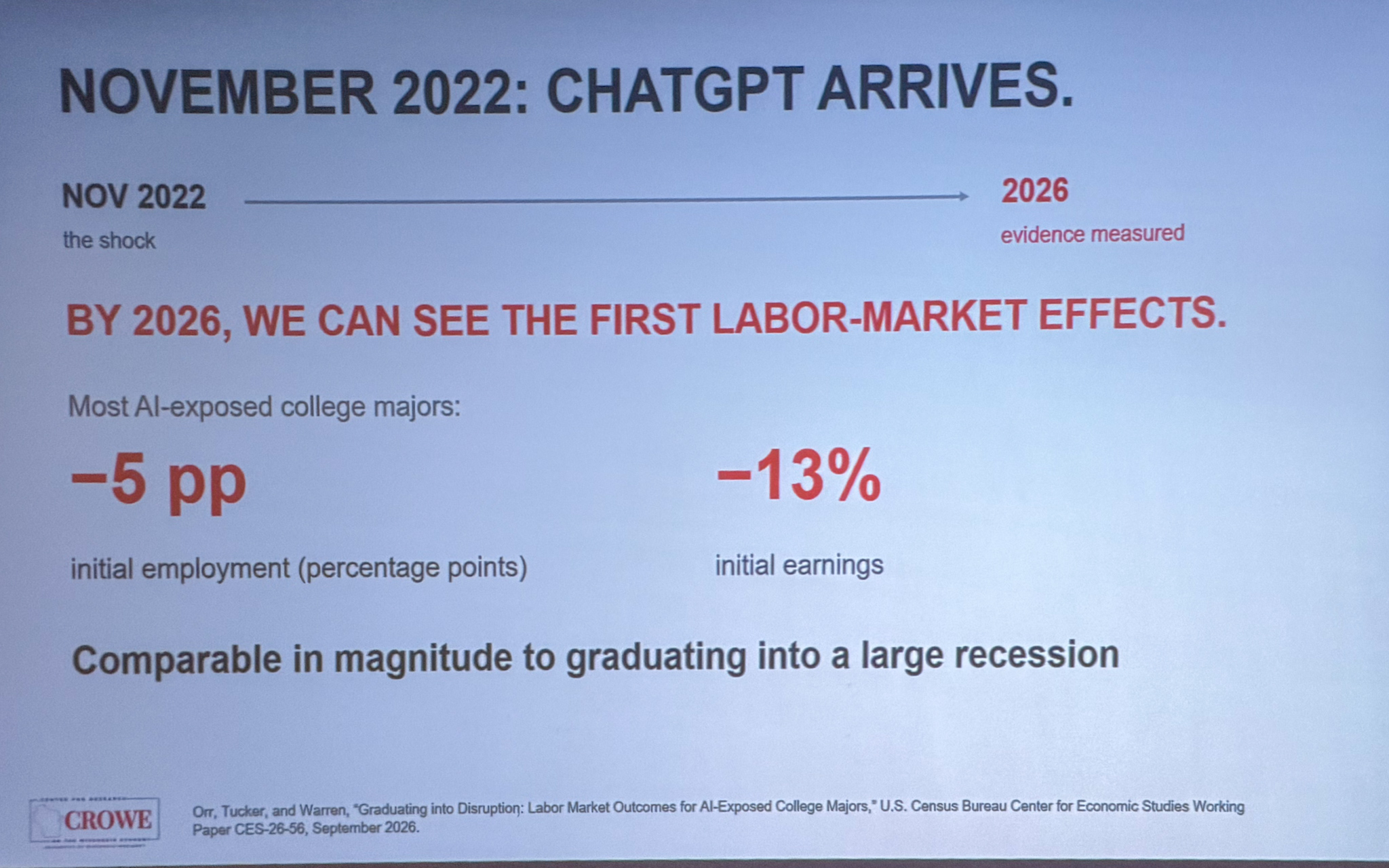
Um, but it's still the case that the structure was built. Um, so November twenty twenty-two. So how do I define late? November twenty twenty-two, ChatGPT arrives. That's a shock. 14:00 Economists get to measure the effects. This is Census Bureau economists. So we can see where the first labor market effects. Most AI-exposed, uh, majors, they decline in initial employment by about five percentage points, and initial earnings are up thirteen percent.
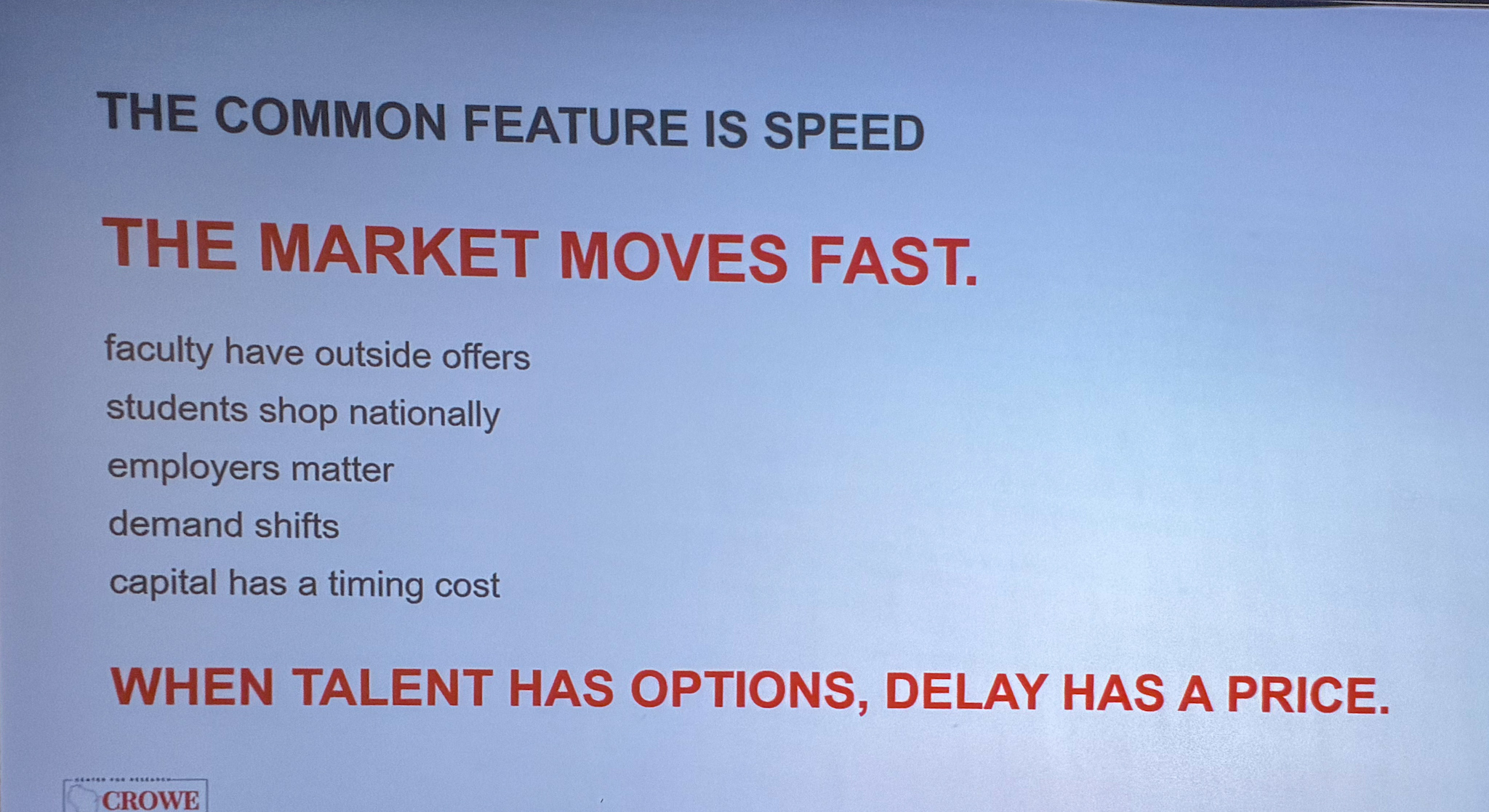
So this is comparable in magnitude right now to being a larger session. Of course, whether it's a trend or whether it's just cyclical, time will tell. And so the common feature here is really 14:30 the speed with which an institution moves. The market moves really fast in these fields, in some fields far, far more so than others.
Uh, faculty have offers, students shop nationally. There's direct entry into some of these fields. Uh, maybe we will in our AI school going forward. Employers matter, demand shifts, but capital has a time horizon So when talent has options, significant options, this delay can be very, very 15:00
Now, just as-- th-this was the US News and World ranking. Sorry, my thing is not working. But you can see the, the ranking at the bottom is the undergraduate US News and World Report. So my view is this is a beauty contest. Everyone says they want good rankings. If you actually go down in rankings and when you go up, you say, "Well, it's the other way around."
Um, and we were almost at the top thirty colleges in America, circa two thousand, ranked 15:30 thirty-one at our highest, and we collapsed to forty-nine. And then we recovered. Uh, I think we were thirty-four or so recently. And the, the other ranking is the ranking of research spending. And in that instance, we went from number two to number eight.
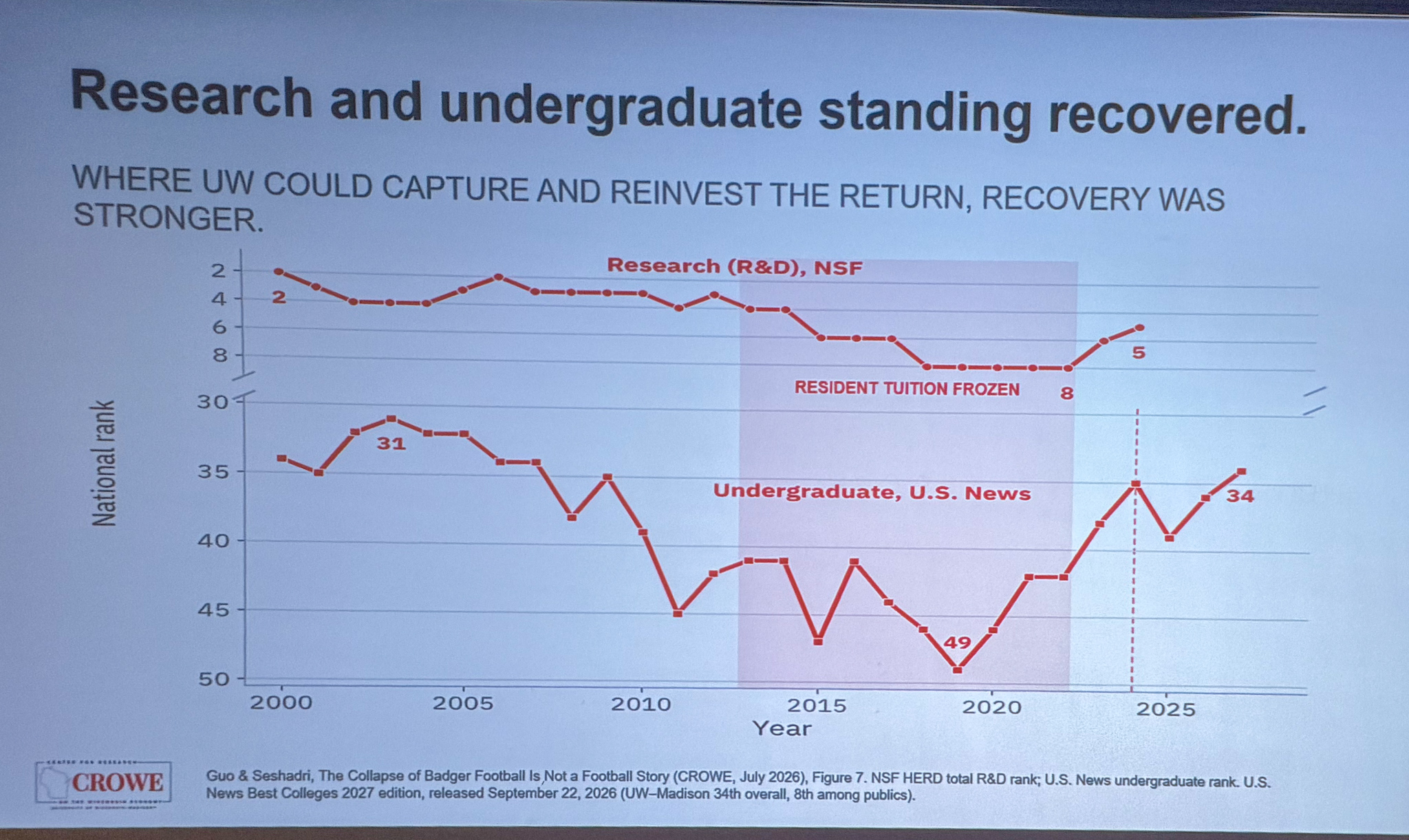
We've just climbed back to number five. And there, there's different reasons for these, but in both instances, those recoveries had owners. By that I mean in-- for research, Worf cares deeply about research spending, and they 16:00 ensure that they give incentives to, uh, ensure that faculty apply for large grants.
Faculty, faculty went up. There were lots of initiatives that, um, that were made on, on the undergraduate program. This is all bottom line. How could we not be in the undergraduate program?
Budgets, tuition and price controls
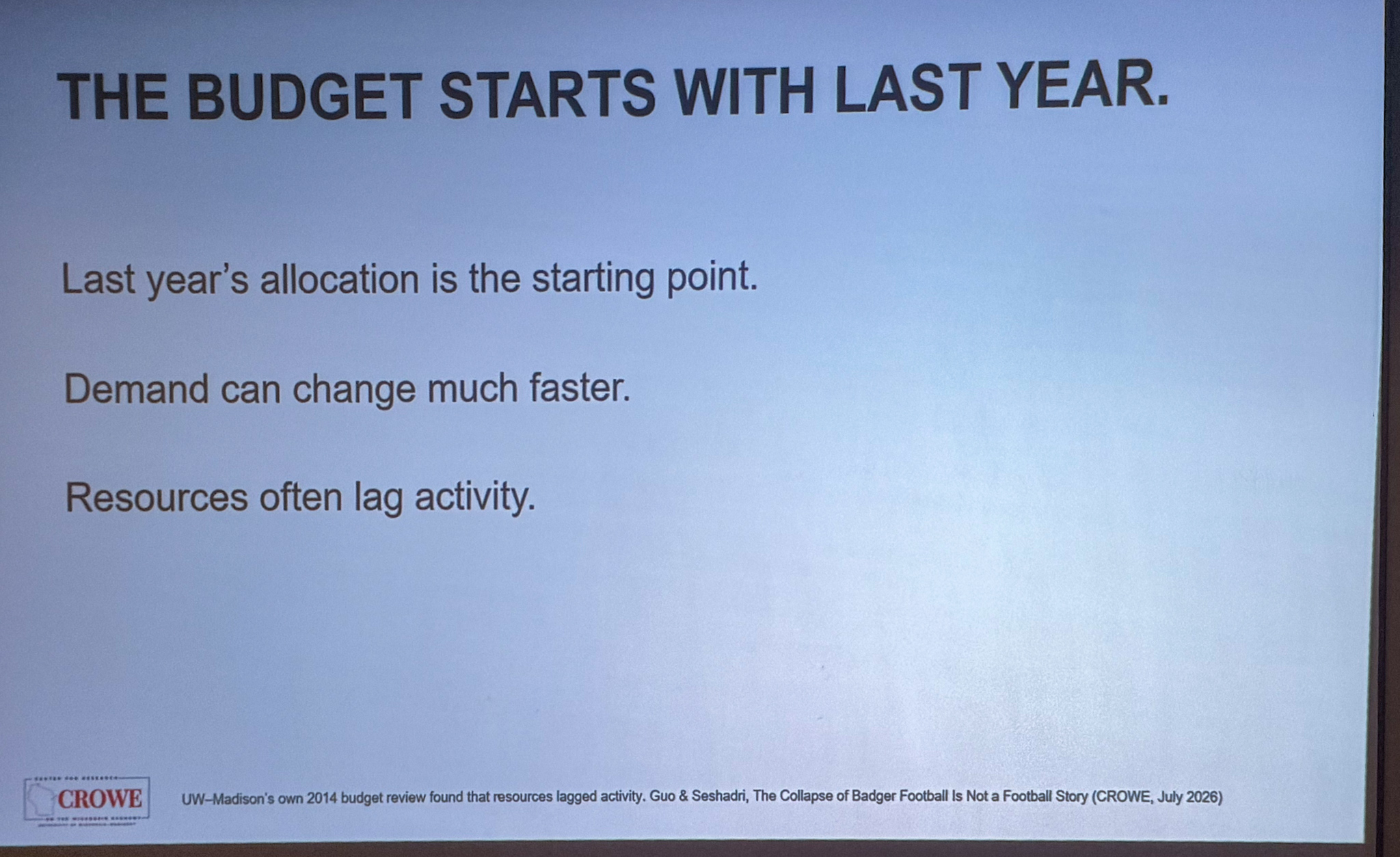
All right. So what is the issues at least with, with budgets? I mentioned a little bit about budgets. Um, we have... At UW-Madison, we have what's called a legacy budget model for the most part. They've made attempts to repair it, but last year's allocation is really the starting point, 16:30 but then demand can start much faster, and resources often lag actually.
So the market moves really fast. You know, other schools have a different framework with which they would say, "Let's reallocate resources to where the demand is higher." It doesn't have to be perfectly correlated. It should not be uncorrelated
So the next-- so the last till here-- up, up until here, what I talked about is internal allocation mechanisms. So what 17:00 do we do? What are the internal allocation mechanism? Is, I don't wanna say efficient, appropriate, uh, in line with peers, but what are the constraints that UW-Madison faces? First, tuition fees.
Wisconsin held resident tuition fees by legislative statute for a decade. Um, our in-state tuition for last year or the year before was about eleven thousand dollars. Now, to put that in perspective, Minnesota's is about twenty to twenty-five percent. 17:30 University of Minnesota is not an elite school. I mean, their, their acceptance rate in-state, uh, not in-state, the total acceptance rate for undergrads is about eighty percent.
University of Wisconsin-Madison, it's forty-five. I think I can say it in this room, we're elite and we love it. Um, and it's despite the fact that tuition is low. So i-if you're gonna hold prices fixed, there are consequences associated.
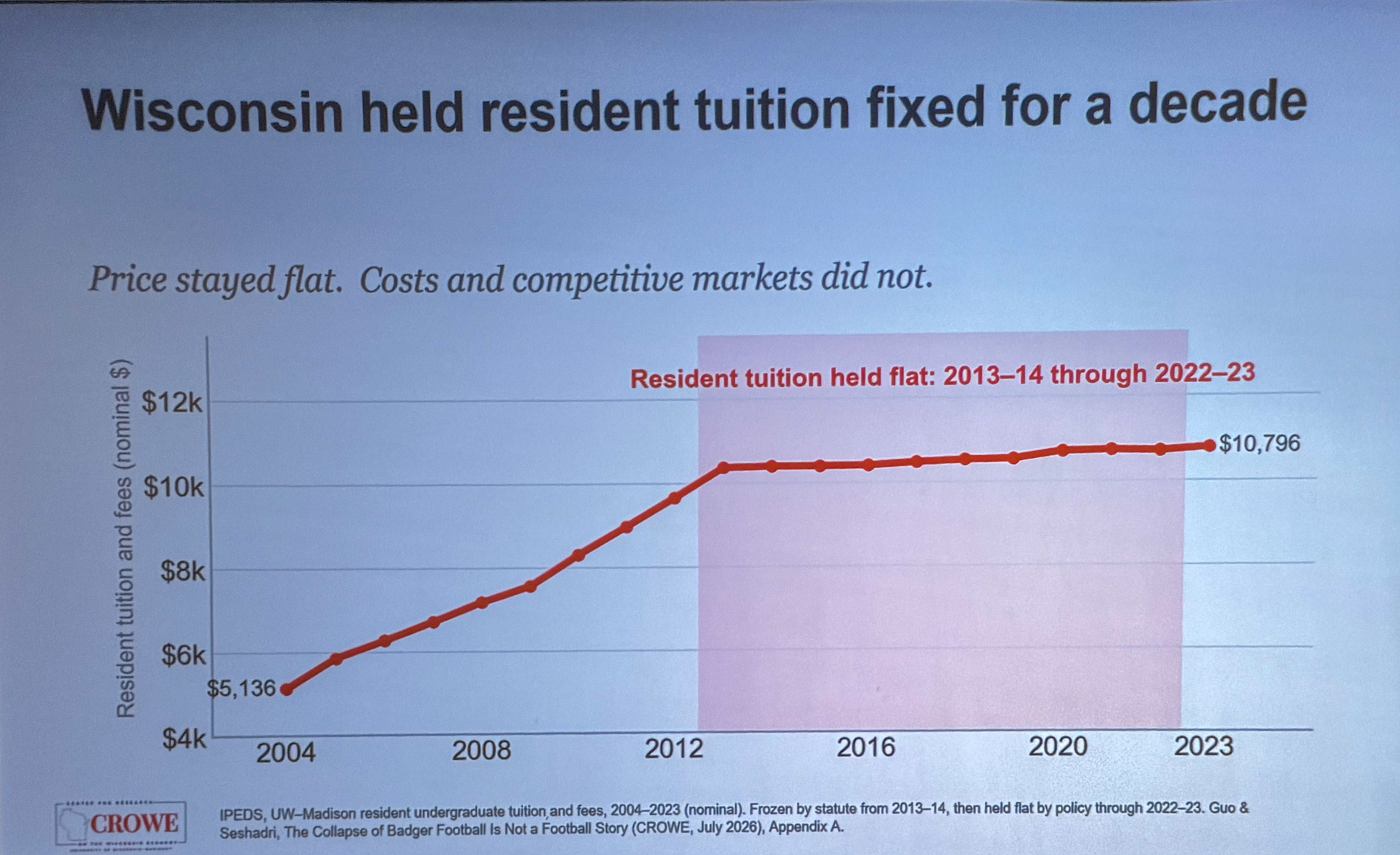
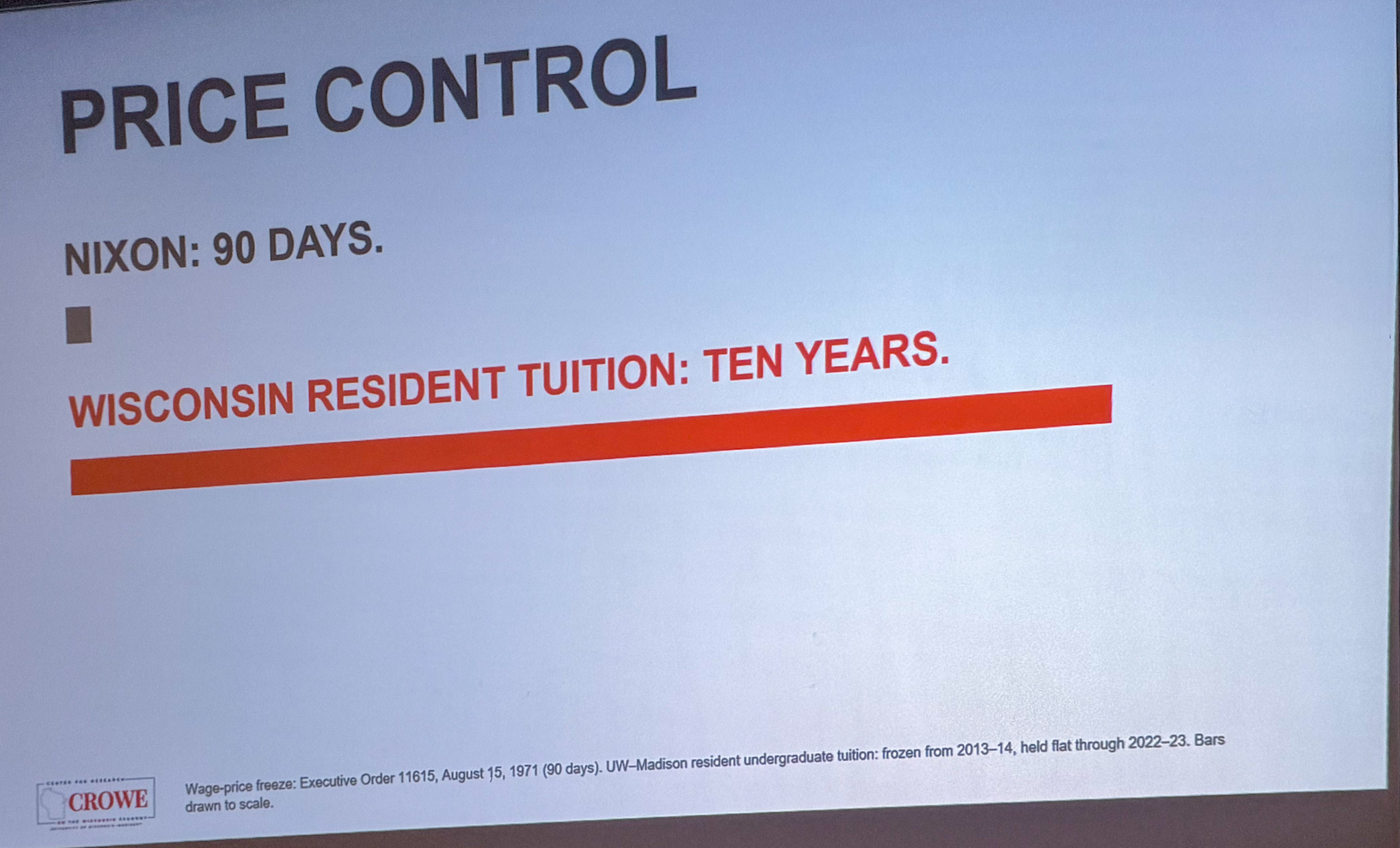
So these-- this is what economists would call price controls. 18:00 Rather than appealing to Econ 101 textbook, I figured I'd just point to Nixon. He really-- He taught us pretty well. That's a really bad idea. And that's literally in- That's a people nine times. So I think it's forty times or forty-one times the, the tuition.
So you can't be in a position where the tuition freeze is a hard tuition freeze and expect UW Madison to be as good an institution as say, the University of Michigan or UC But for the 18:30 undergrads in the room, I'd love for you all to write a petition saying this is nuts, especially if you're a senior.
Tuition has to be, has to go up more. I give you a little serious argument. I think if the argument's gonna be access, there's no good evidence suggesting that holding down sticker prices influences access. In fact, former chancellor Becky Blank, like a brilliant economist, she would say, if you could raise tuition, right, you have the Bucky's Tuition Promise.
On top of that, if you could raise tuition, you actually have 19:00 more money for financial assistance. So this is a lot of price discriminating with by design, by fiat, and now it's not by fiat. It's now more if you raise tuition, I'm gonna give you that
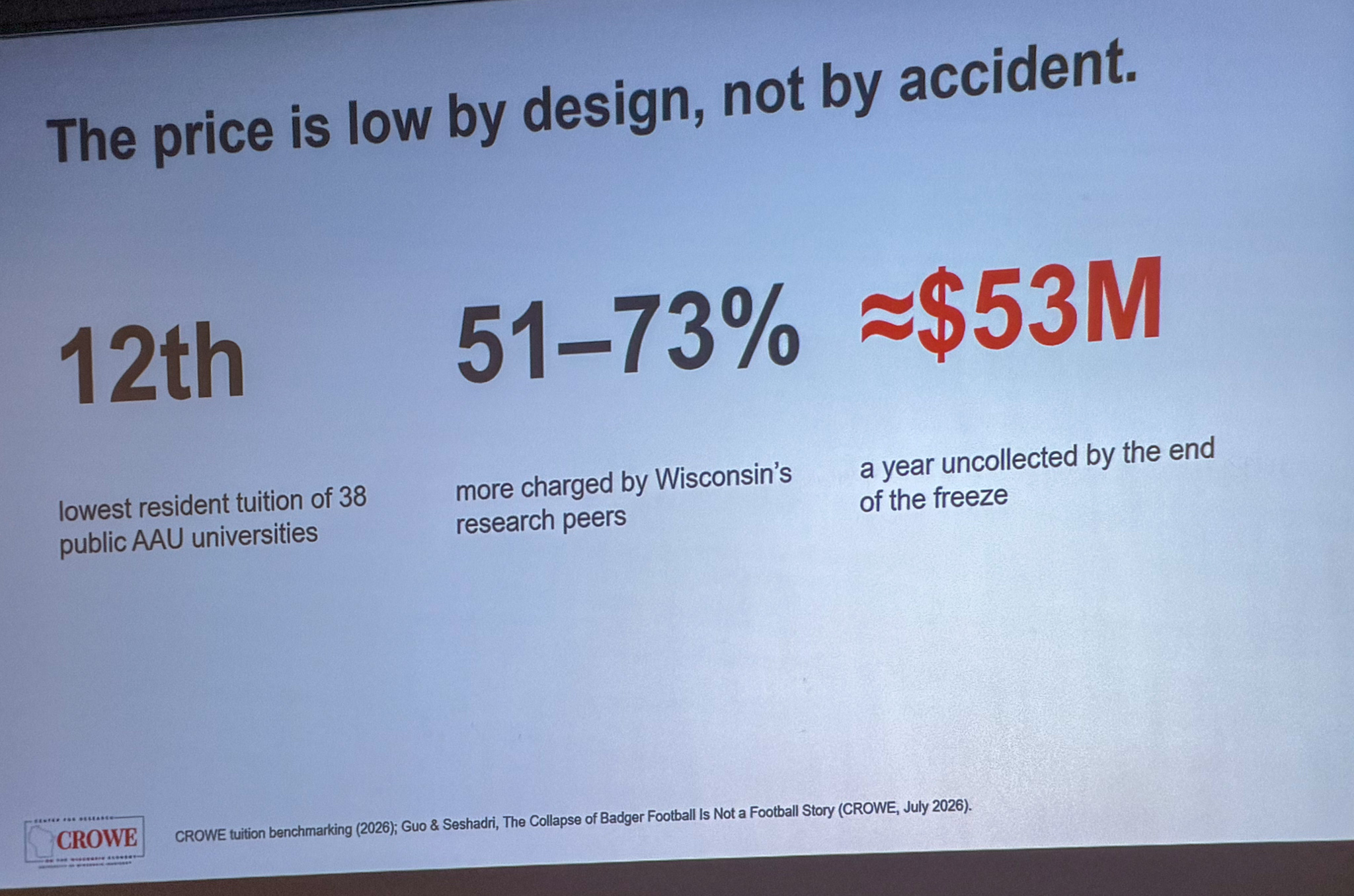
much more. So that's the, that's the politics rather than the economics. All right. So the price is low by design and not by accident, and we forego about fifty-three million dollars or so per year, you know, relative to if you put that in the median of our peers. And if you go to a Michigan 19:30 level, that's a little more than a hundred million a year.
So that's real lost revenue. Now if, if part of the experience here is just that college is not just an investment good, but also a consumption good, and a part of the bachelor experience as a student is a football game or any other kind of game, that should be priced in.
Borrowing, building and the hospital authority
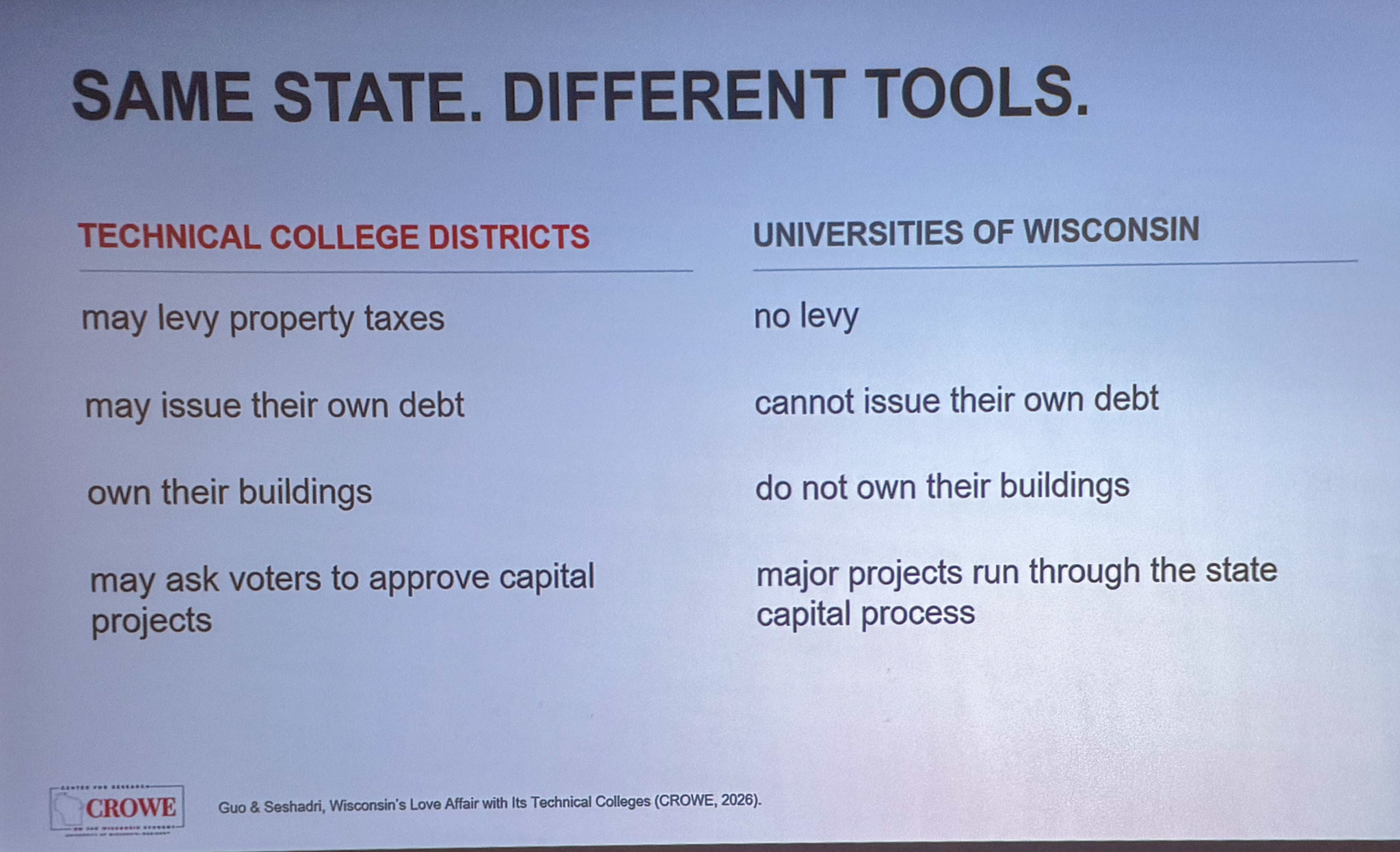
I wrote a paper called Wisconsin's Love Affair with 20:00 Technical
Colleges. But I'll give you the essence. So tech college districts, um, you can levy a property tax. University of Wisconsin, obviously, we couldn't levy a property tax. We couldn't even raise tuition. Uh, they can issue their own debt. We cannot. Uh, they own their own buildings. We do not. They can ask voters to approve capital projects.
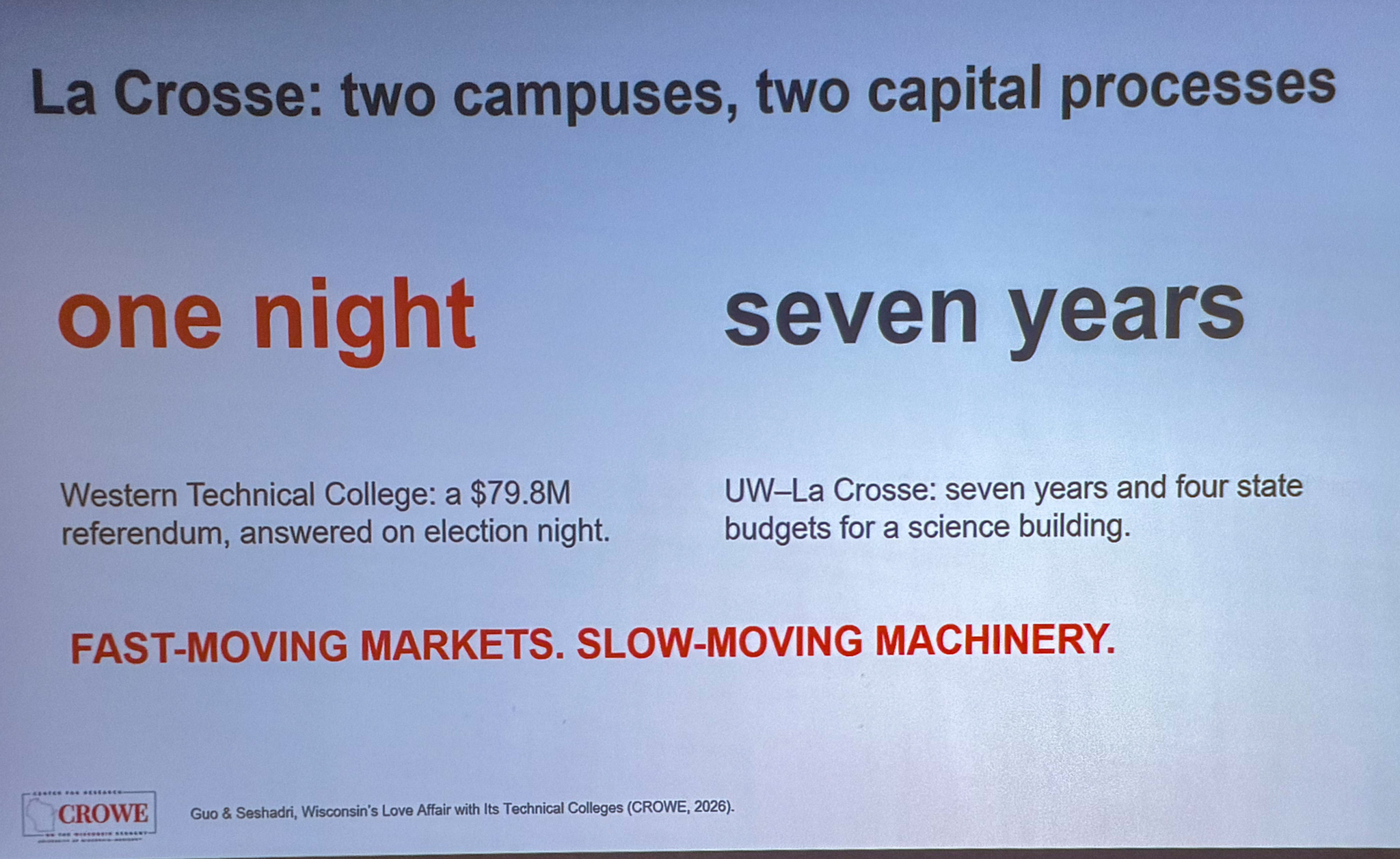
Our major projects have to get run through the state 20:30 process. So an example is worth a thousand words. La Crosse, two different campuses and two different capital processes. One night, Wisconsin Tech College, Western Tech College, about an eighty million dollar referendum, off to the races, answered that night.
Elected board, voters are saying, okay, they build a building. Seven years for UW La Crosse, same nearby, and four state budgets to actually get a science building. So that's the 21:00 scale you're gonna see.
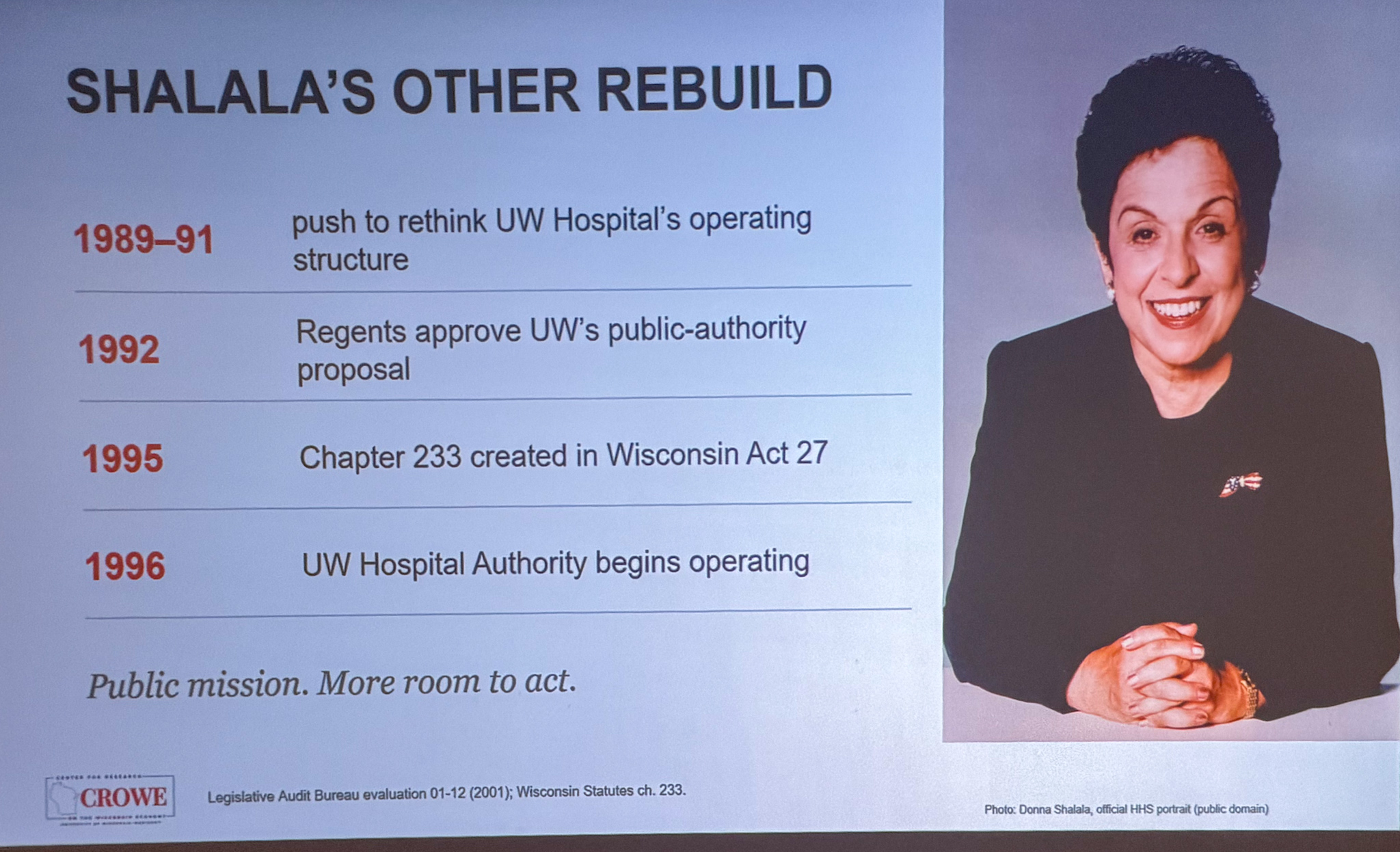
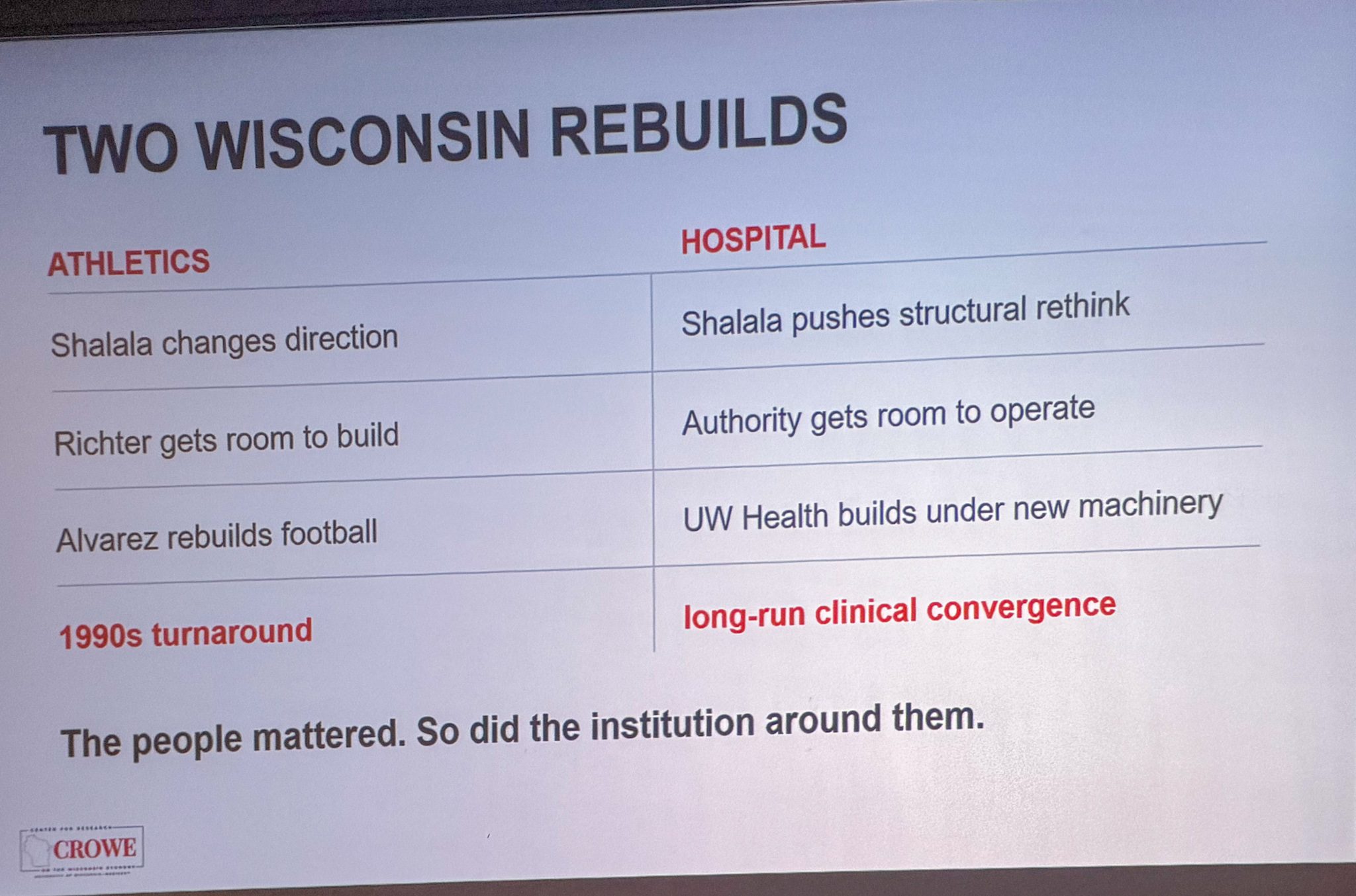
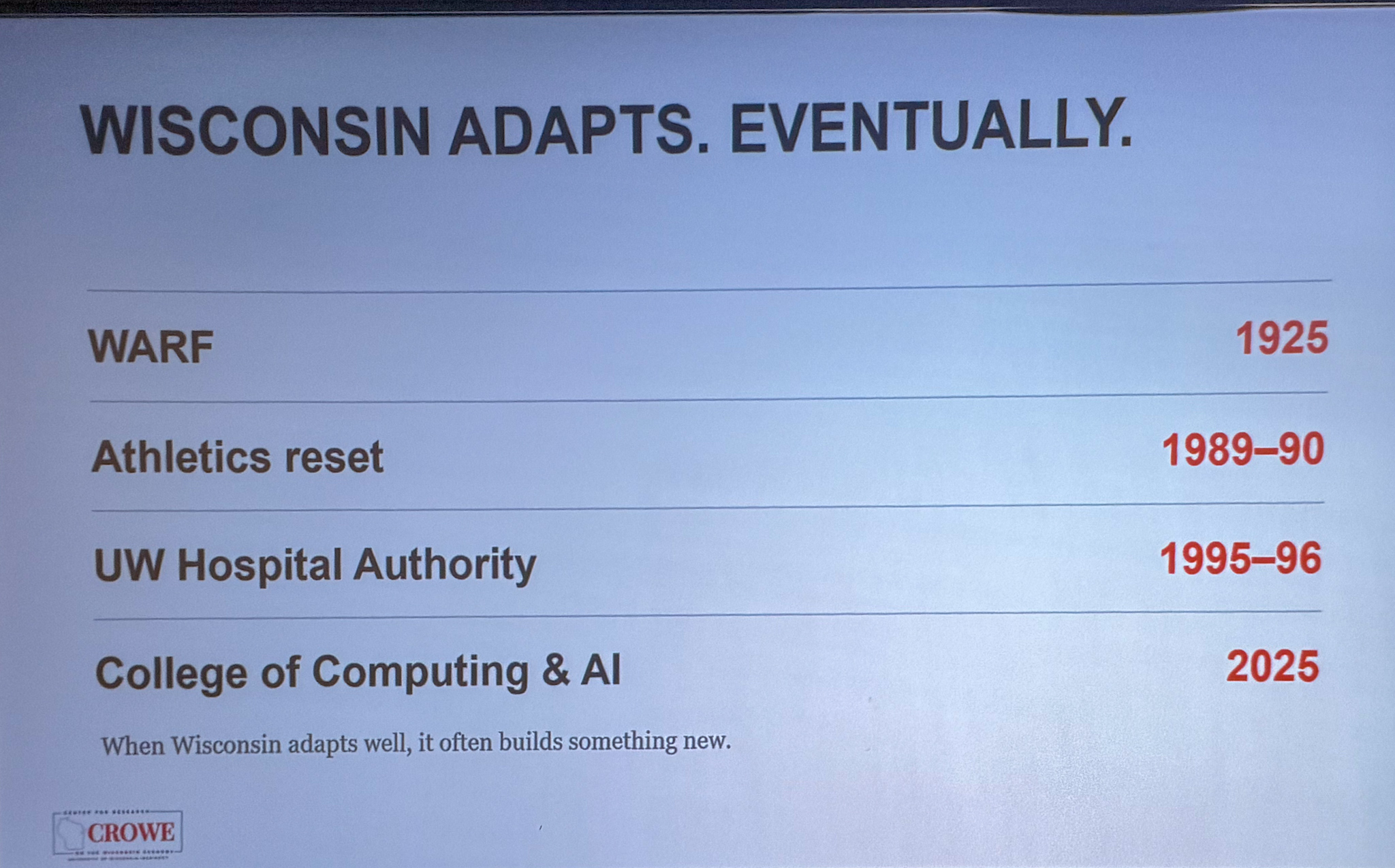
So fast-moving markets can't wait for the slow movers. Shalala's other rebuild. So Shalala is well known for Barry Alvarez and Pathbreaker and football and everything else. But other important rebuild was UW Hospitals. So Shalala in eighty-nine or ninety, like, pushed to rethink UW Hospitals' operating structure.
So the regents approve a public authority struc- proposal 21:30 in nineteen ninety-two, and then UW Hospital Authority begins operating in nineteen ninety-six. And it's not as if it's a private institution now. It's public, it's a public authority, but it's a public mission with much, much more room to, to act. If you wanna build a new building for cancer research, you couldn't be waiting for four budget cycles.
You wanna do it, then be off you go.
Autonomy meant a lot of boring things. Borrowing, building, personnel, 22:00 purchasing, and operating flexibility. That's-- Those are the kinds of flexibilities our institution lacks in general. So what happened with the authority? Um, the way I like to think about it, the hospital and the clinics have two different parts.
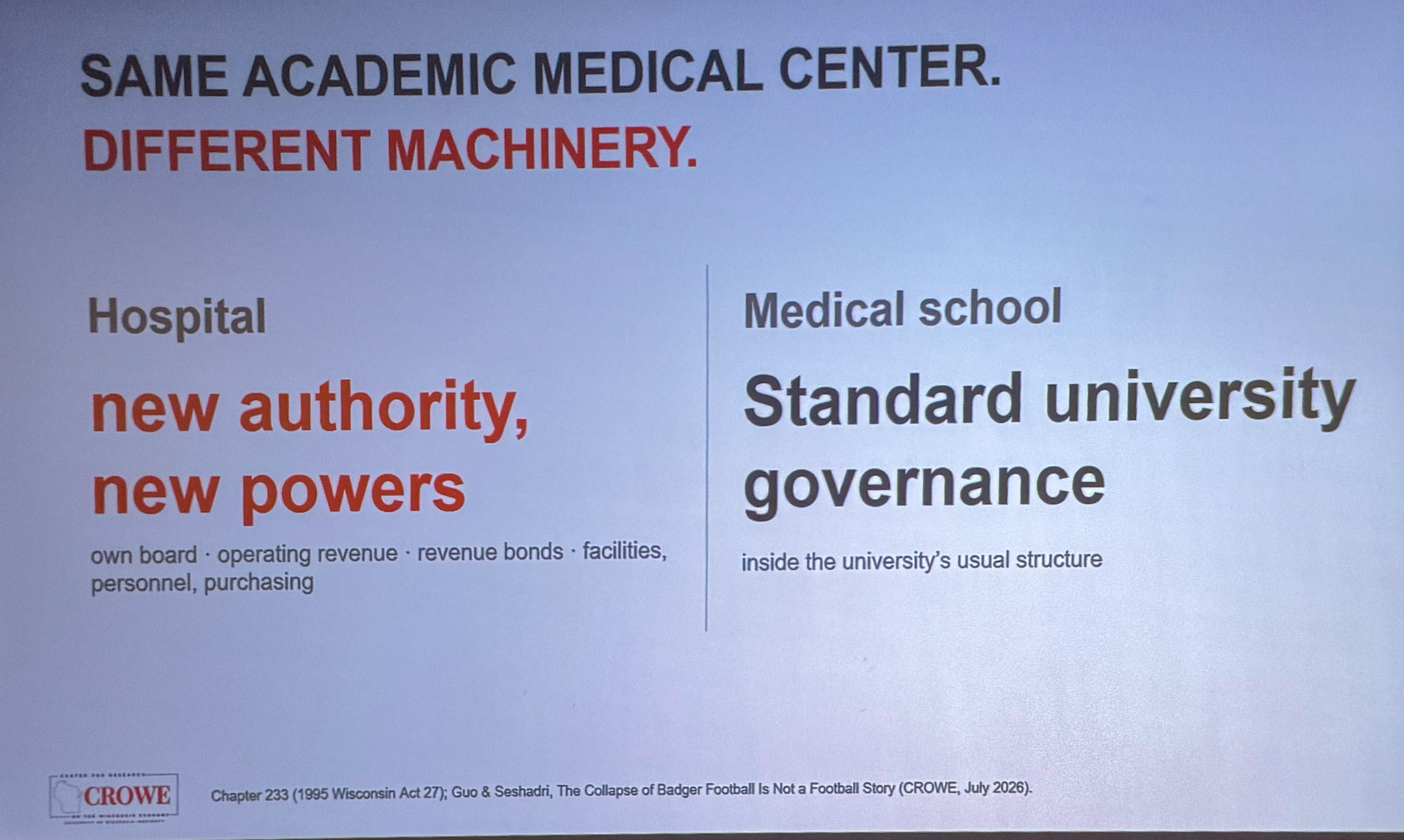
One is a hospital with new authority, new powers. It has its own board, operating revenue, revenue bonds, facilities, and then you have the medical, which is the standard university governance, which is inside the usual structure. Okay, so you have one part of it, if you're a clinician, you have freedom. 22:30 If you're a lonely professor of surgery, you're like me.
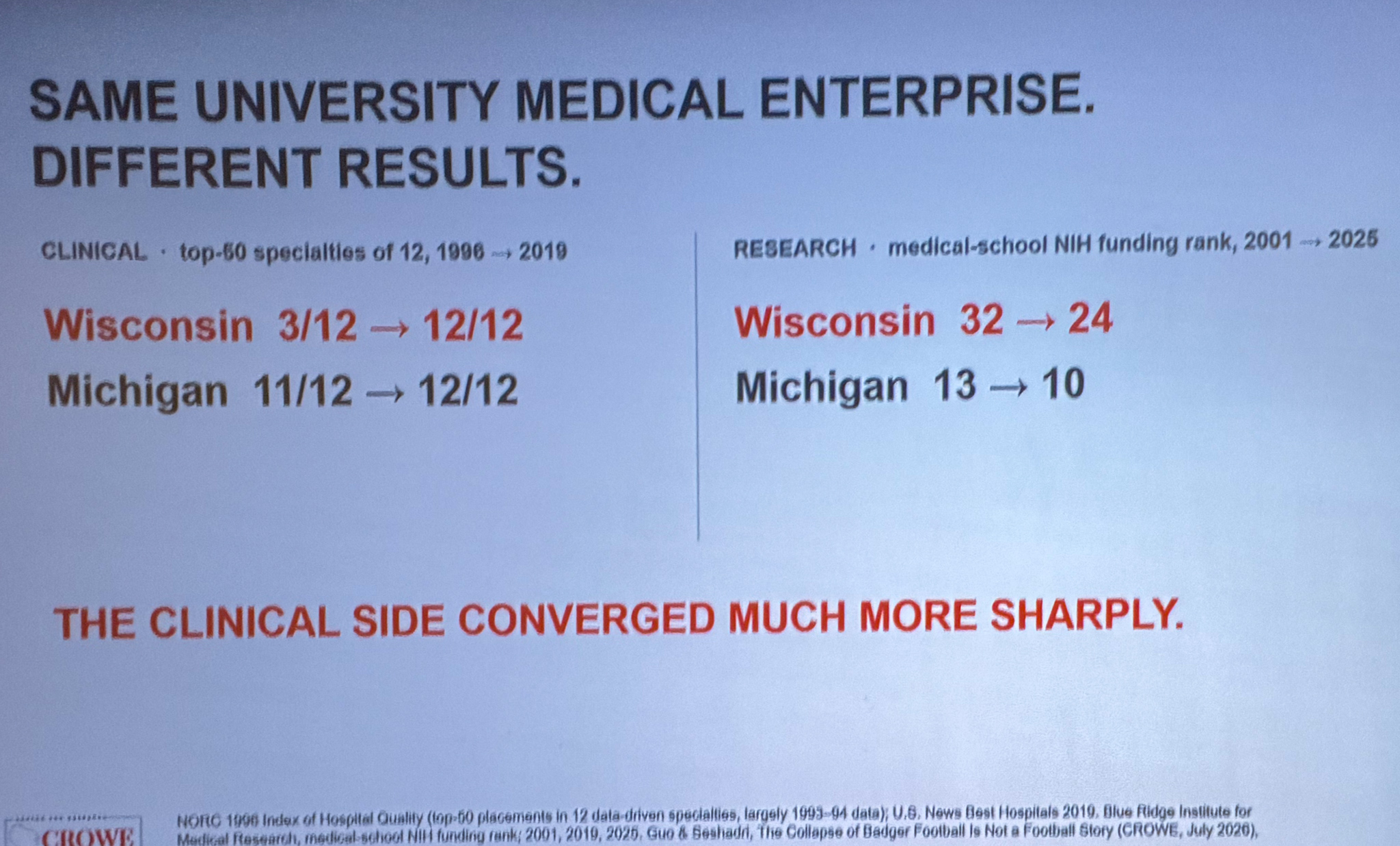
You're ins-inside the bureaucracy of the university. So what? What changed was the party and not mission. What's fascinating is if you look at, if you look at the rankings, uh, on the medical enterprise, you get two very different results. Wisconsin caught up in the rankings of top fifty rankings of specialties.
We made it from three out of twelve to twelve out of twelve. Michigan was pretty much at twelve. 23:00 Whereas if you look at research, there was a little bit of convergence, but by no means converging o-over. And so again, this is not causality. This is not a, a randomized experiment. Um, but the clinical side, the evidence suggests converged much more, more sharply, um, than the
Governance and the Board of Regents
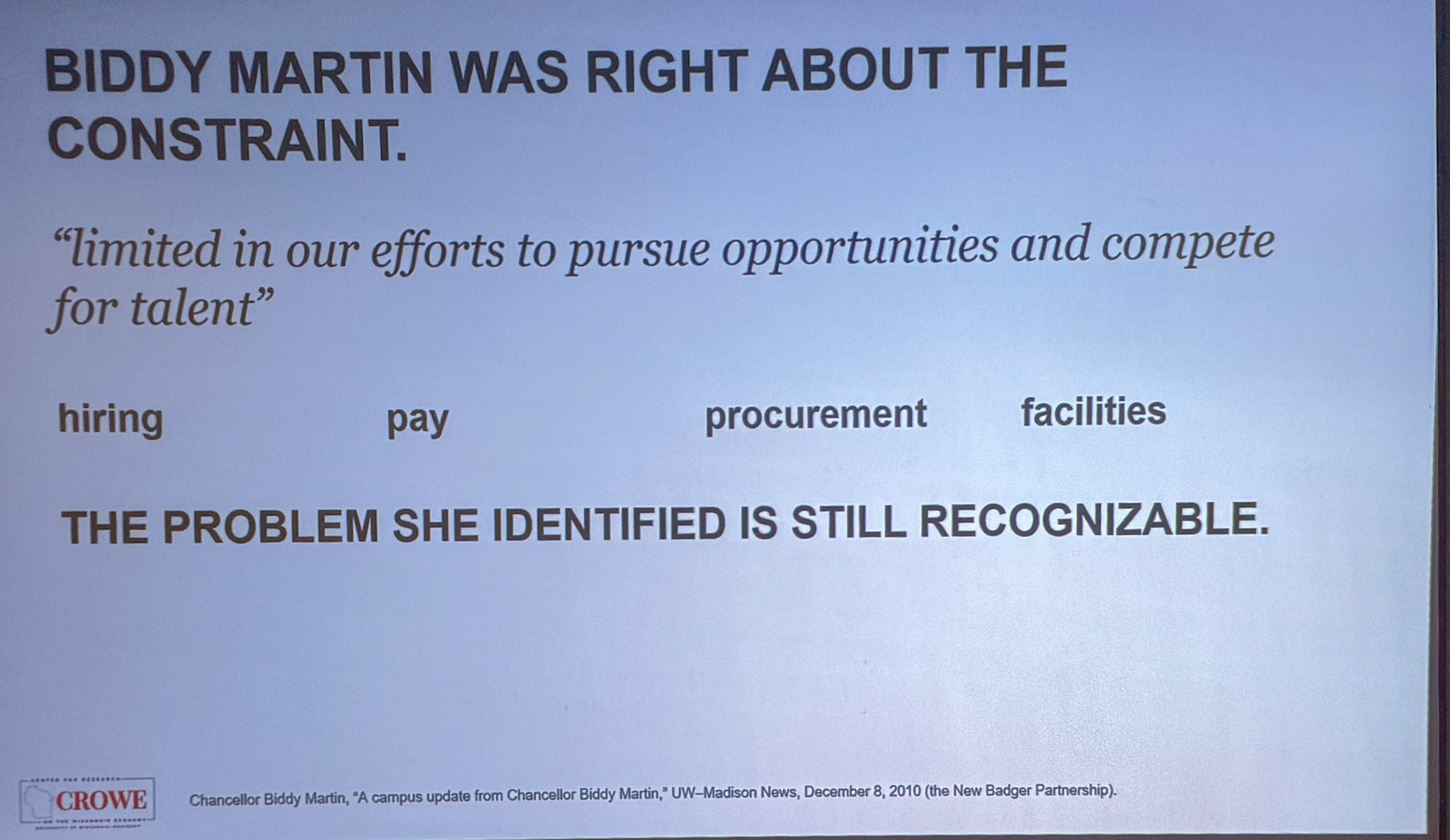
So Biddy Martin, I, I don't know if you guys are old enough or used to follow the news at the time. Um, she-- I thought she was an amazing chancellor. Everyone knew these flexibilities mattered, 23:30 but everyone would raise their hands and say, "Hey, politically it's impossible. Let's, let's just forget about it."
She said, "Let's try and do something about it." She said, "We are limited in our efforts to pursue opportunities and compete for talent, be it hiring, be it pay, procurement, facilities." And the problem she identified is still recognizable. So this was, I think, sort of about twenty ten or
two thousand and nine, um, many, many moons ago. But those problems that she identified still exist. And a big structure is autonomy, a big part of it is 24:00 governance, and a big part of it is flexibility So the governance part, I should mention in the context of tuition, something that's very different about Wisconsin's structure.
So let's think about this question. How-- What is a good example of where governance actually matters? The Board of Regents are appointed by the government, and as a consequence, tuition setting becomes a political decision. It doesn't matter who's in power. It's, I don't like that my phone bill costs two thousand dollars.
I 24:30 wish it cost a thousand dollars. And I buy it. And so who's gonna say, "Let's raise tuition," when Wisconsinites like the lower price? So that's-- whereas most other universities have a separate board, an independent board that can make decisions that are bold. We're not talking about skyrocketing tuition, but just meeting of our peers.
And rather, most of our peers in the Big Ten, I mean, may be good at football. They're not very good at academic. Not as good as Wisconsin
in terms of academics. If you take on Michigan and UCLA, at least in terms of the public peers, they're not very-- they're not-- 25:00 they don't-- they can't come close to Wisconsin in academics. All right, so football, I mean, the cost of this delay is very good. Okay? So Wisconsin rebuilds athletics. Rick Persch gets room to rebuild.
Alvarez rebuilds football, and very similar with, uh, hospital, you get a long-term commitment. So people matter a lot. There's no question Barry did. Shalala did. But what matters even more is the institution that they built around them, which helped- 25:30
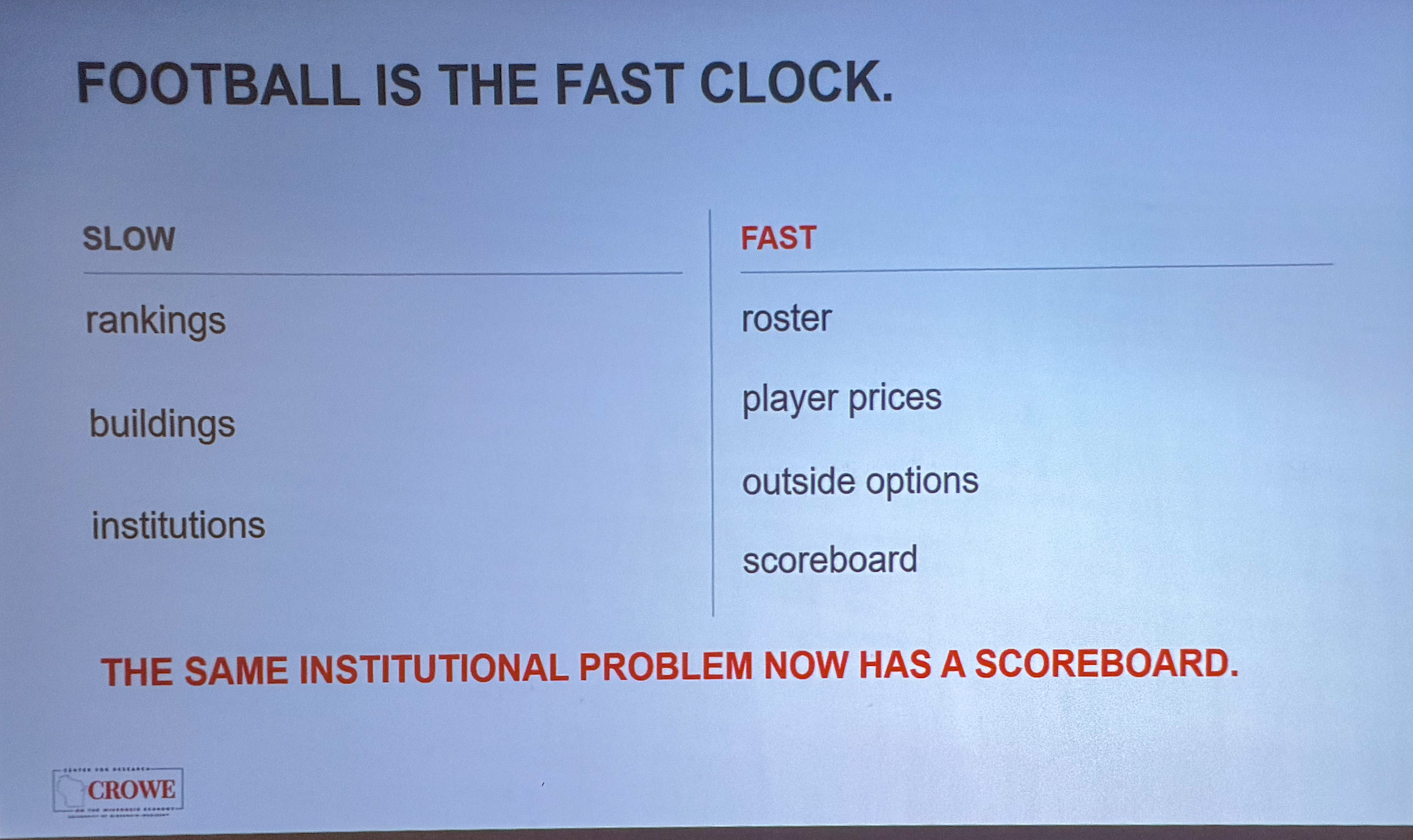
So WARF, um, I think I'll talk about that at the very end. Cost of authority. We now have the cost of computing, and that, that's the eventual report. Right. So football is a fast market. So what's slow here is rankings and buildings and institutions, but what's fast is a roster turns over quickly. Player prices all of a sudden come out, and outside options kinda matter.
The scoreboard is much more visible. If the econ department loses five faculty, no one will notice. But if you, if you end up 26:00 having football, like, not doing very well, like it's just, it's just very, very visible. The same institutional problem now that comes with it. All right. So find, develop, retain, win.
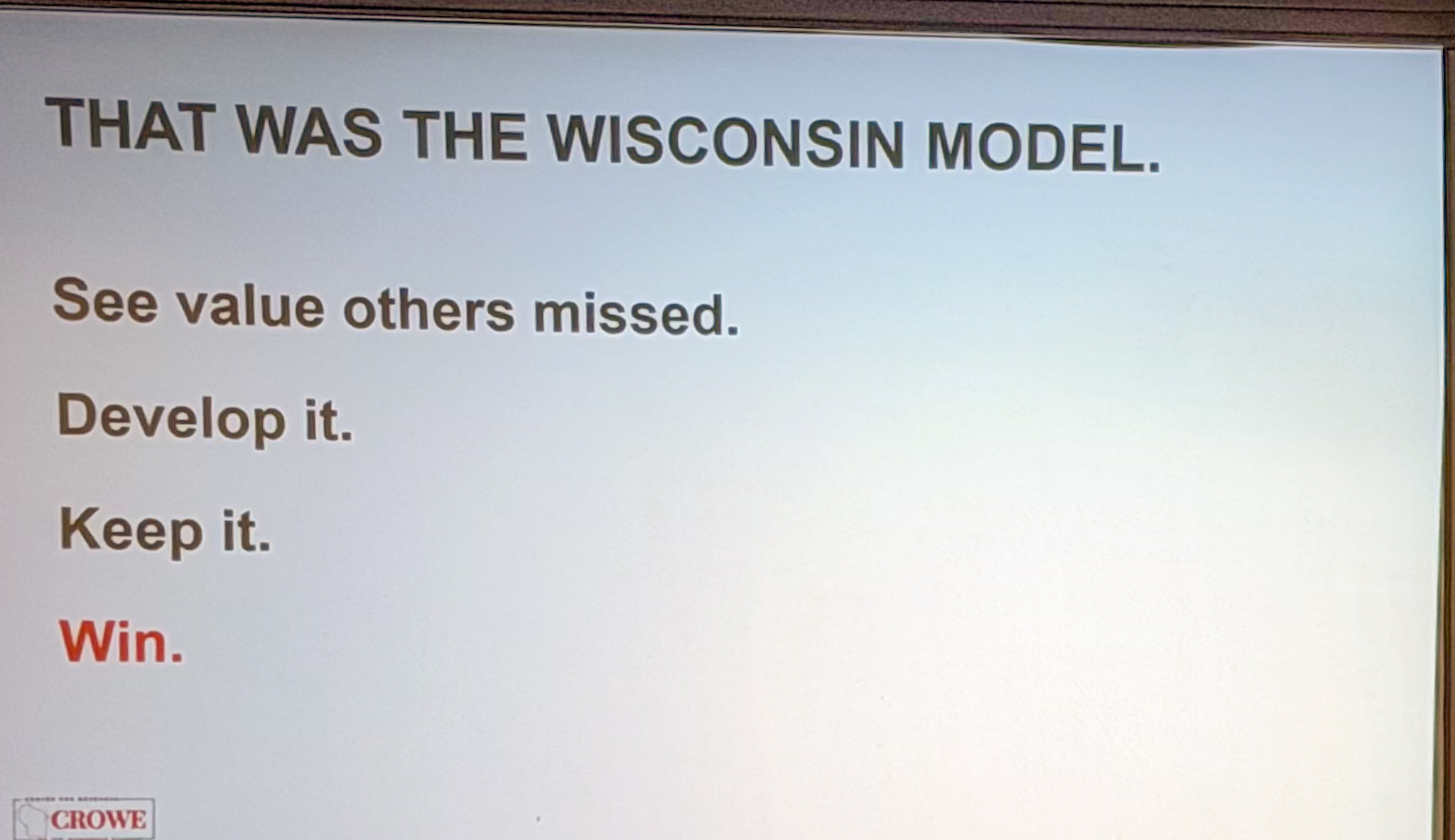
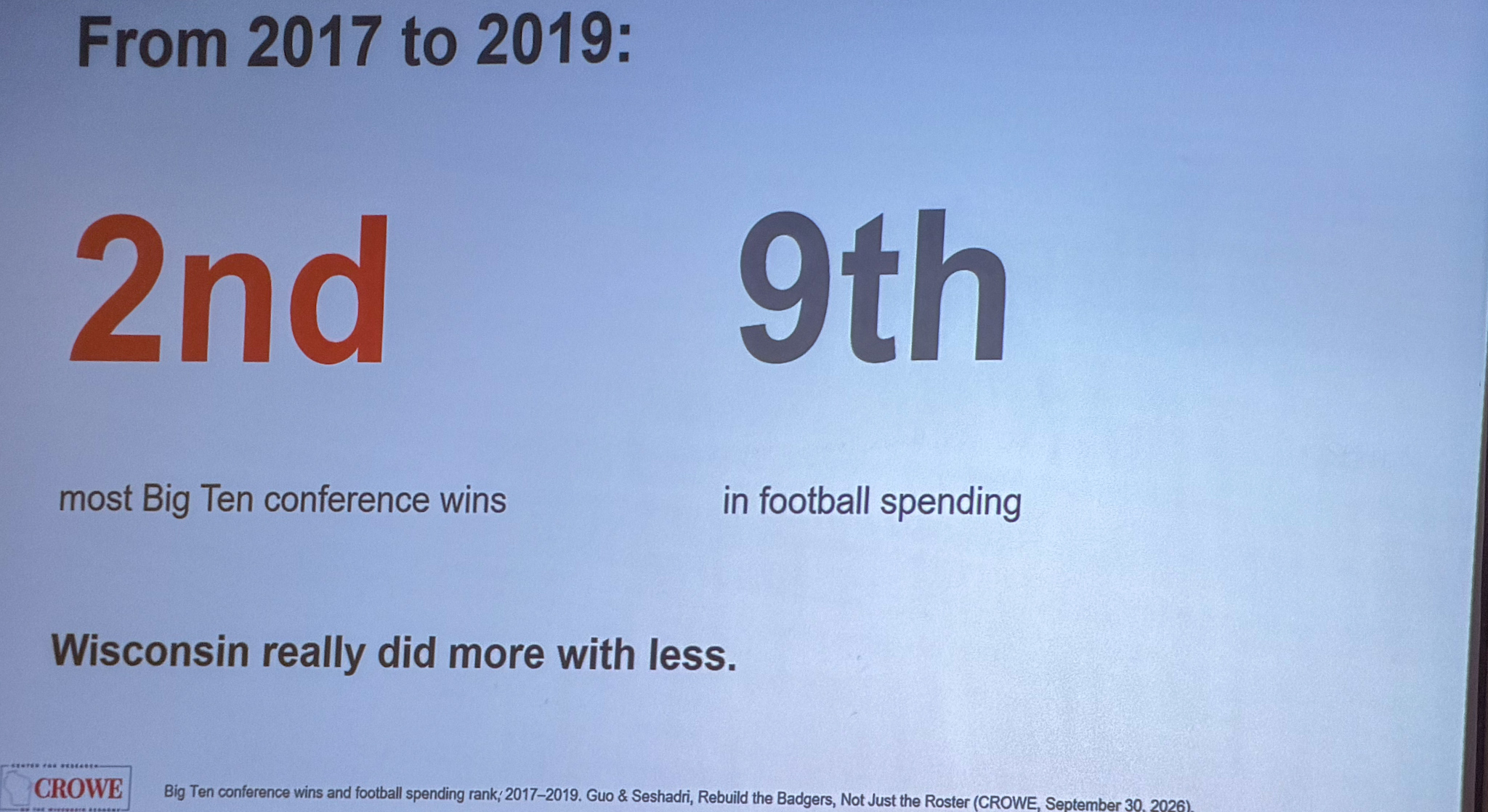
That was our model From 2017 to 2019, we were-- we had the second most Big Ten conference wins. We were ninth in football standing. So Wisconsin really, really did a lot more with less
The new market: NIL, the portal and the cap
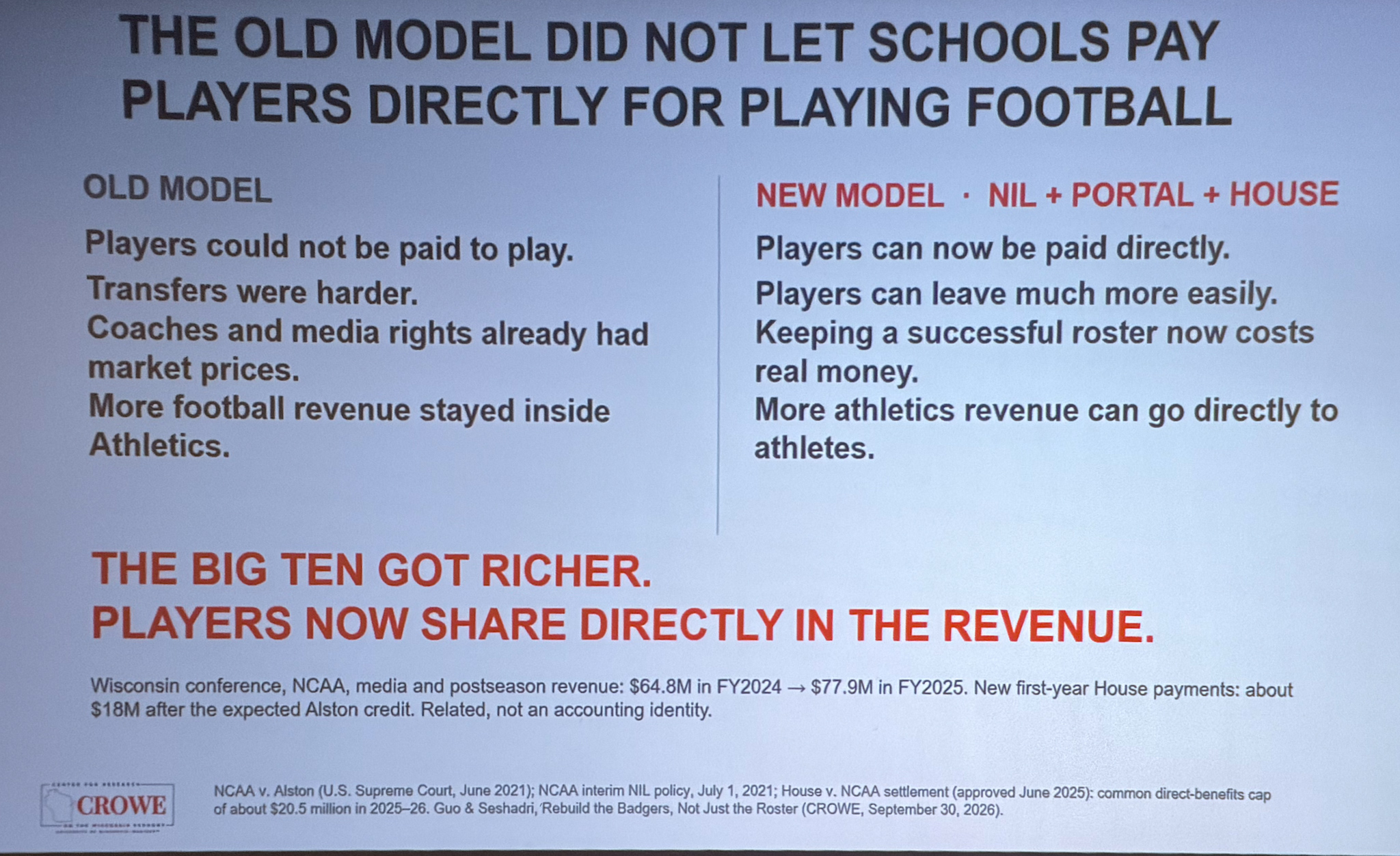
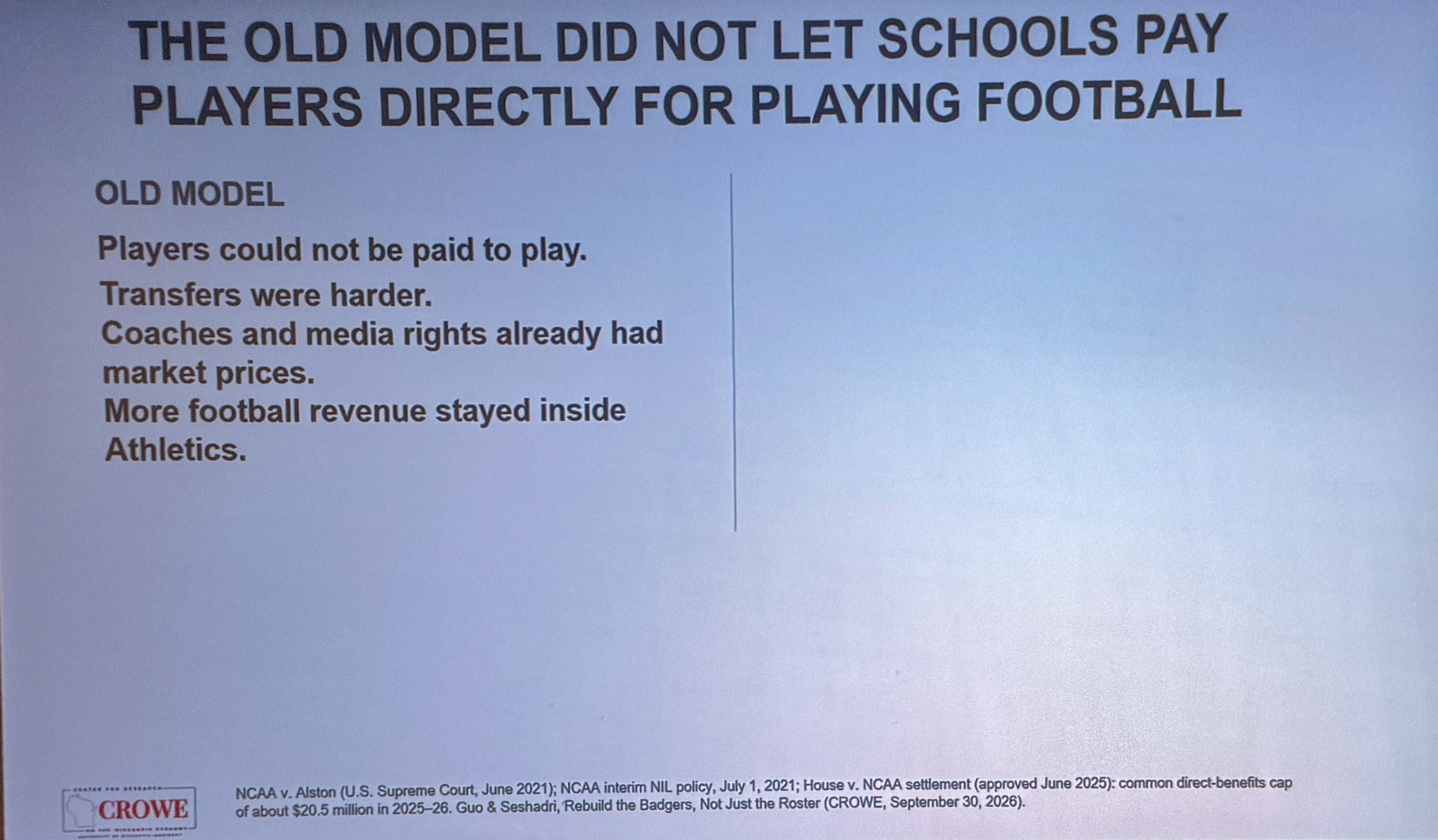
The 26:30 old model did not let schools pay for players directly for playing football. The old model players could not be paid, but you could pay Jim Harbaugh seven million. And football revenue stayed, vastly stayed inside. The new model, NIL, portal, house, um, after the Supreme Court decision, players can now be paid directly.
You can keep much more easily. And keeping a successful roster now costs real 27:00 money, but much more of the athletics revenue can directly go to athletes So the Big Ten got richer and players can now be paid directly, either compensation, direct compensation or through NIL
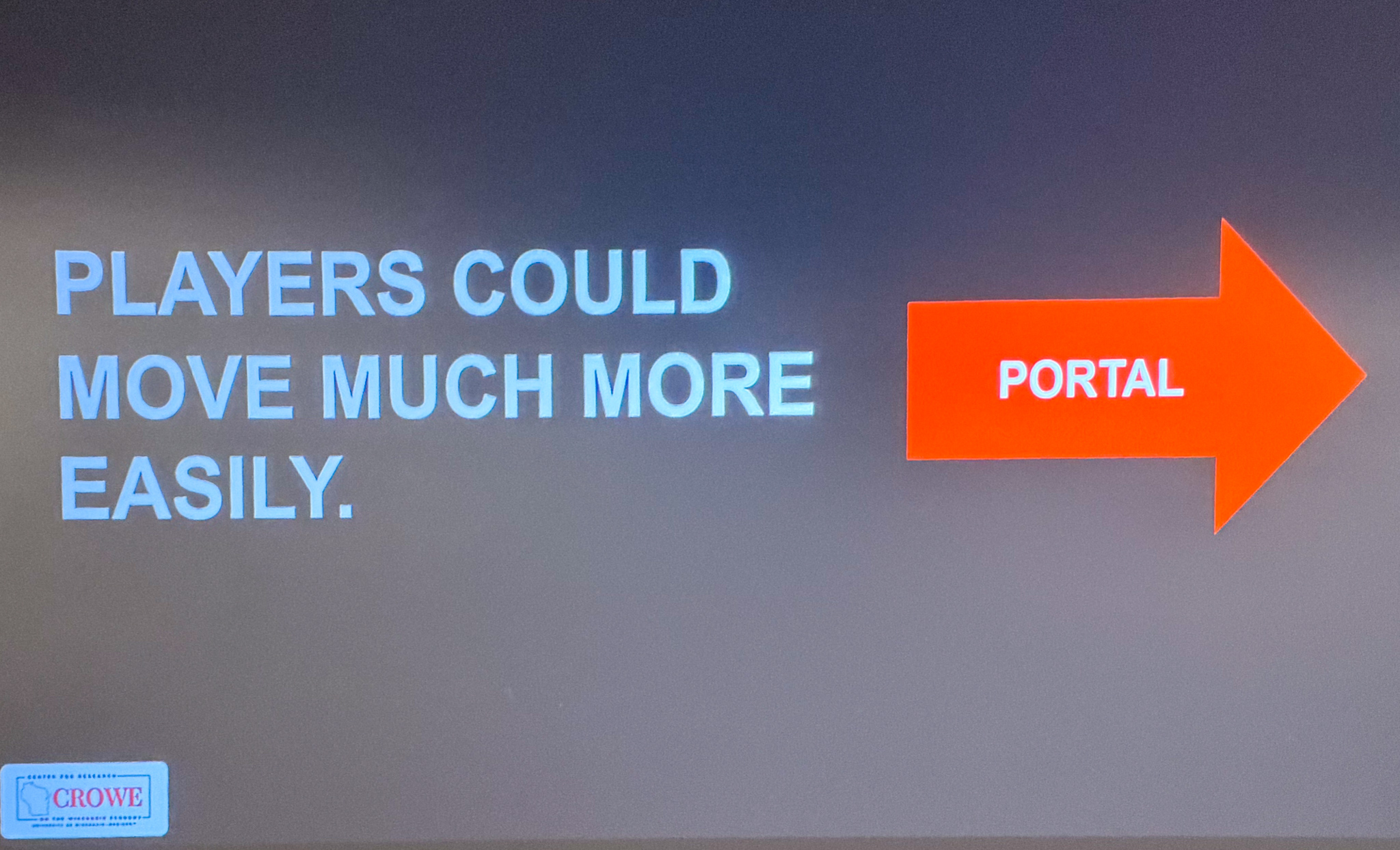
So players can also move more. That's the point. So you went from a scenario where I can't pay them directly. They do it under the table. Um, I could buy your parents a home without no one knowing about it five years later. These are 27:30 not stories I'm making up. It's happened. But you've gotta do it very, very carefully.
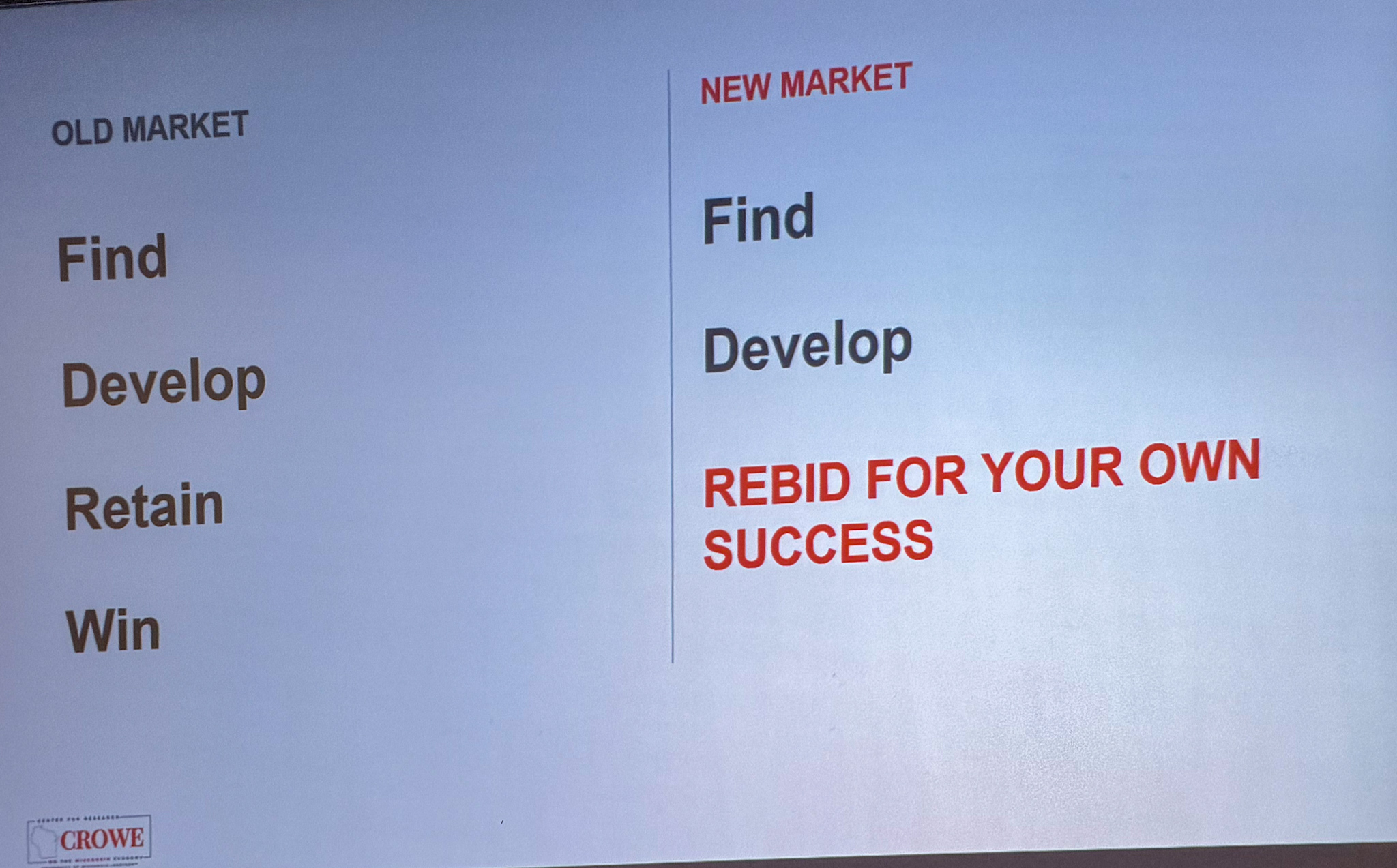
But now you can pay them directly, and they can move. Okay, so the old market was find, develop, retain, and win, and the new market is find, develop, remit for your own success. And that's the distinction for right now. So the, the market's gonna move. All of a sudden, you price talent, and you, you have, you have mobile-- mobility, and then it's a different world here.
So when I first came in as an 28:00 assistant professor in economics, our dean and associate dean were sociologists, very, very nice to economics, helped us rebuild an apartment,
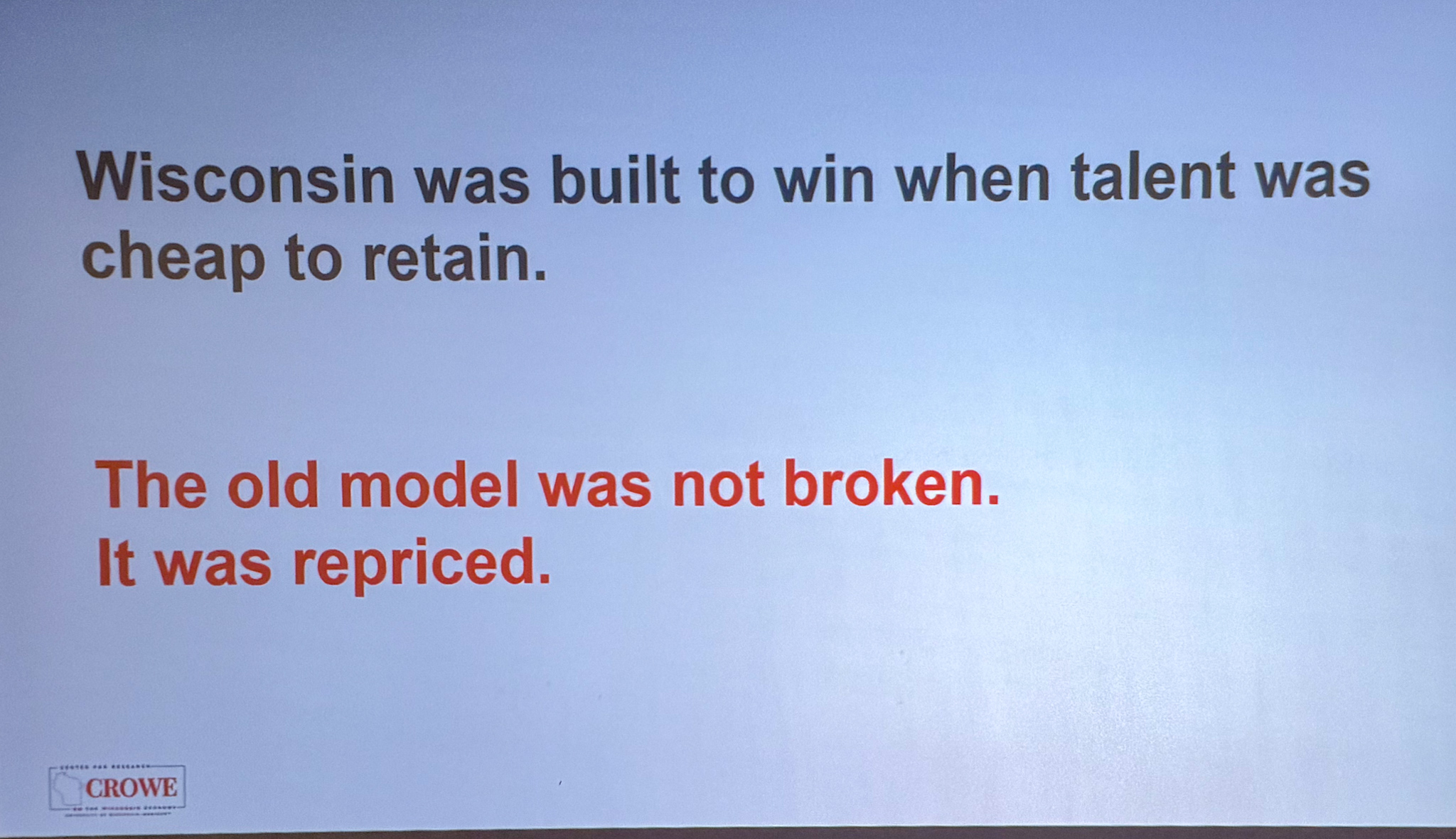
but then we constantly kept losing people to Yale and Northwestern and Princeton. And he would say, "Why? Why do we spend all this effort, like, developing talent if they're gonna go anywhere?" I'm like, "If you don't pay market prices, why do you expect to go to economics school?" Wisconsin was built to win when talent was cheap to retain.
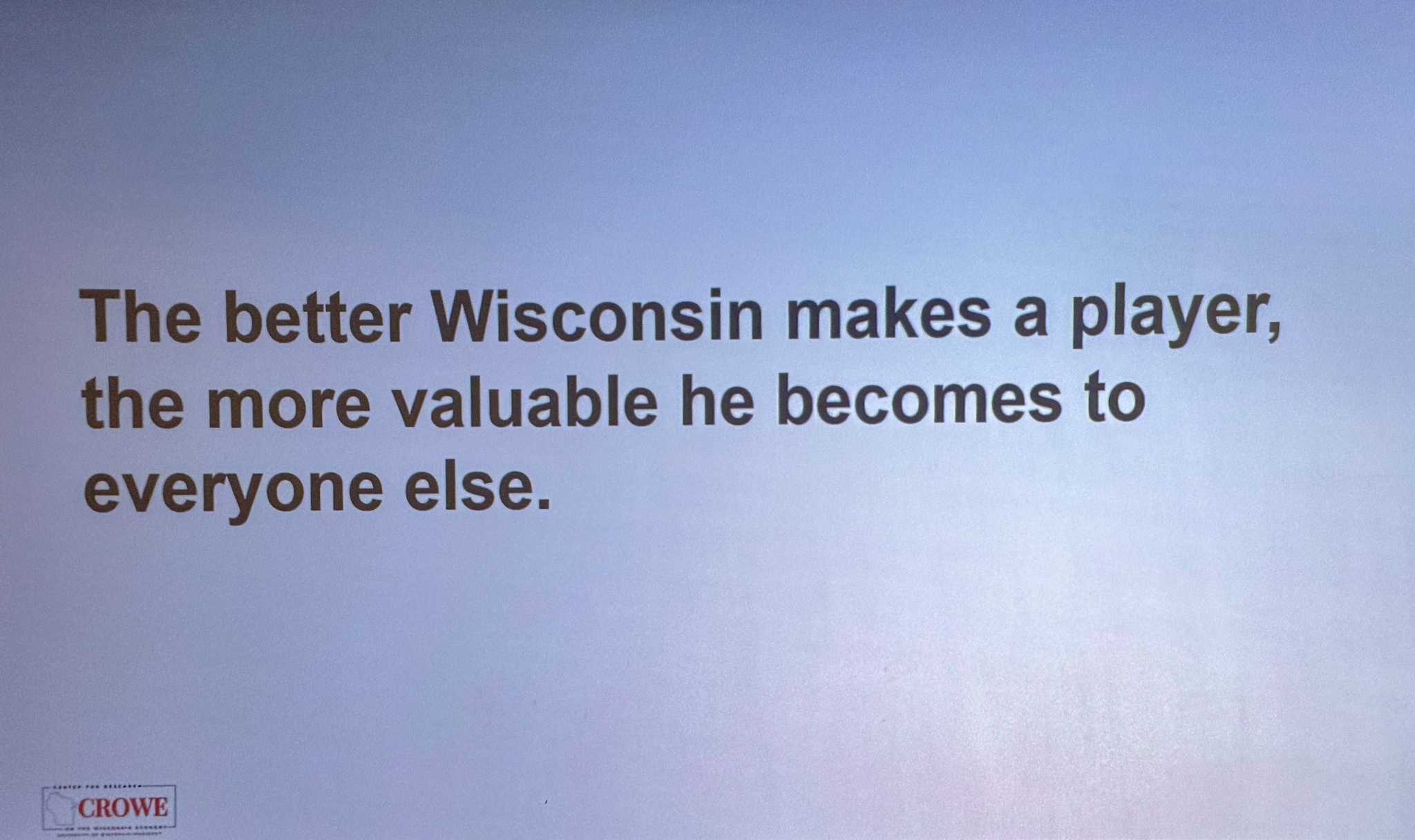
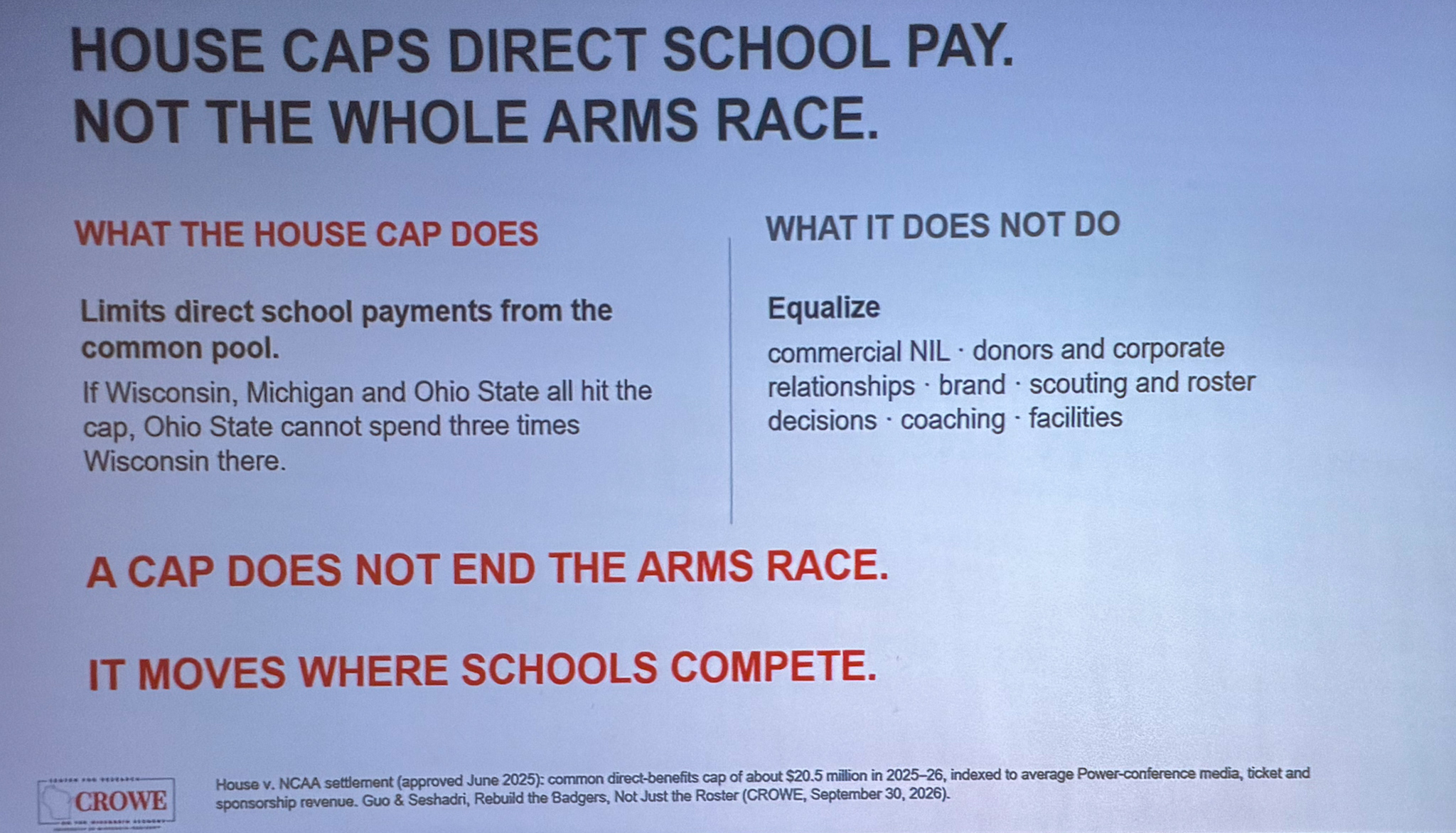
But the old model was not broken. 28:30 It just ended up being greedy So the better Wisconsin makes it clear, the more valuable he becomes to everyone else So the house caps direct school pay and not the whole arms race. So what the house actually caps, um, hou-house does is it limits direct payments from the common fund.
So Wisconsin, Michigan, Ohio State all hit the cap of twenty million, twenty-two million. Uh, Ohio State cannot spend three times as much. What 29:00 it does not do is equalize commercial AI. So if we get our quarterback to appear on Nike commercials, then Nike could pay him for appearing in those ads. Donors and corporate relationships, brand scouting, roster, coaching facilities.
So a cap does not, I don't believe it, end the arms race. It just moves the, the dimensions along which schools compete.
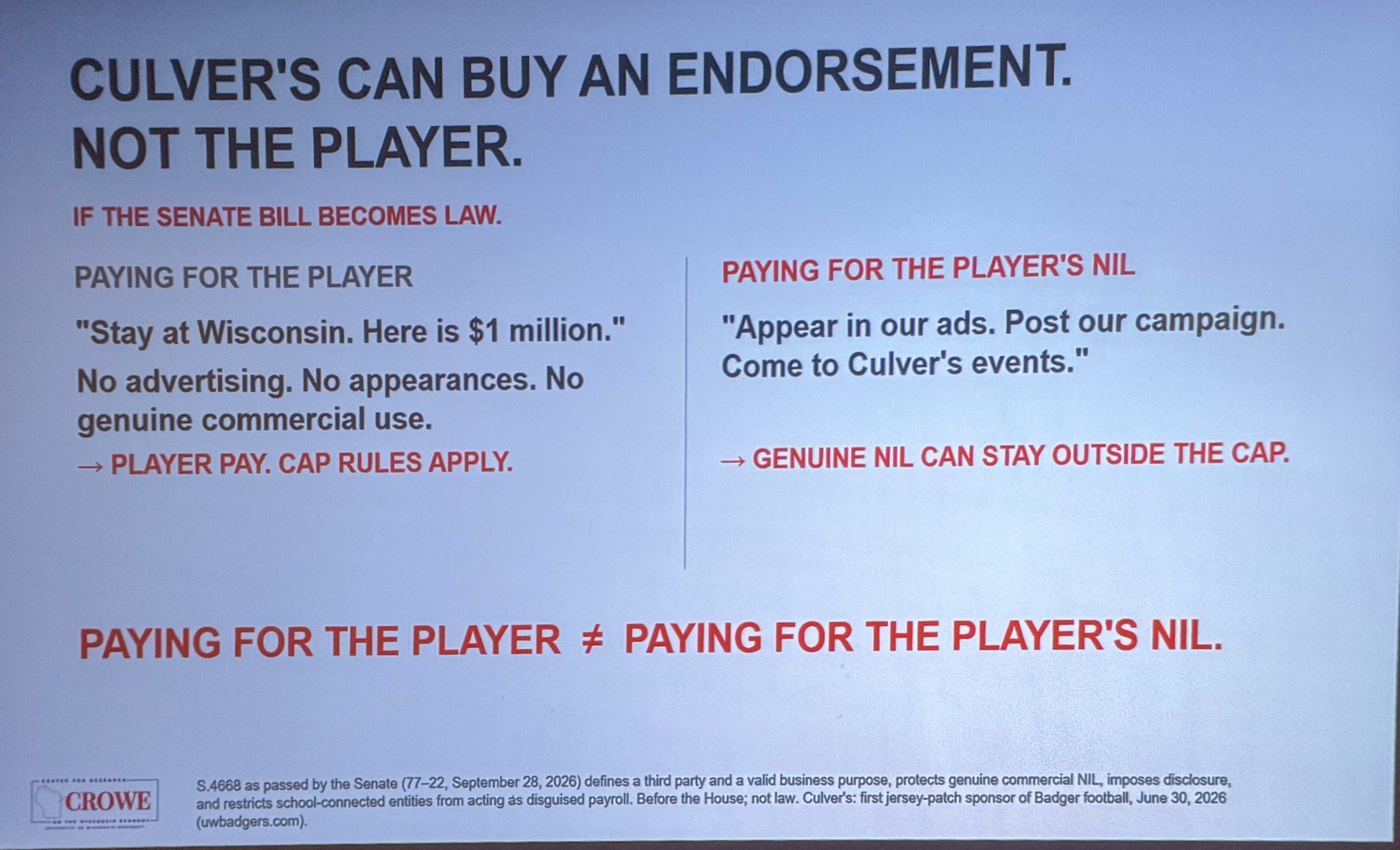
colors, for instance, can buy an endorsement if the Senate bill that was just 29:30 passed a couple of days ago, Senate Bill twenty-two, if it becomes law. Paying for the player, you c- we could tell the player, "Hey, here's a million dollars. Stay in Wisconsin," uh, without him, him doing any, uh, advertising appearances or genuine commercial use.
But if you appear in our ads, whole star campaign, now that's outside the- That's my read of it. No idea whether it'll become law. Uh, President Trump has said he would sign it, but the House 30:00 is not-- it has-- doesn't plan to. But the paying for the, paying for the player is not gonna be the same as paying for the NIL, paying for NIL
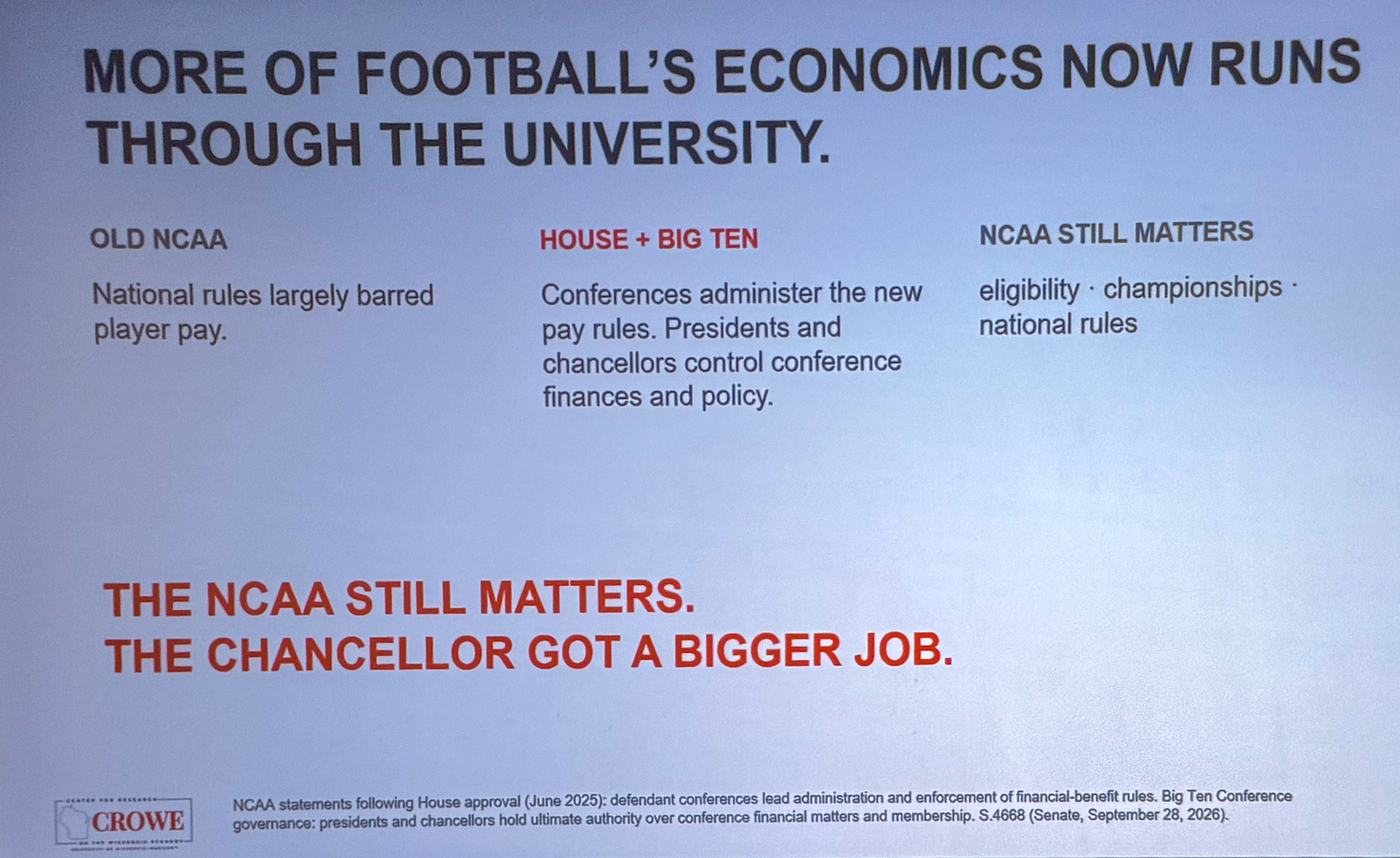
Now, in more football's economics actually runs through the university. In the old NCAA rules, national rules, they're largely barred, uh, clear. Now with the house and Big Ten, conferences administer the new rules, and presidents and chancellor- chancellors control the conference finances now. So in some ways, actually, the, the, 30:30 the economics of leadership has changed to the point where chancellors have and, and presidents have actually more power now.
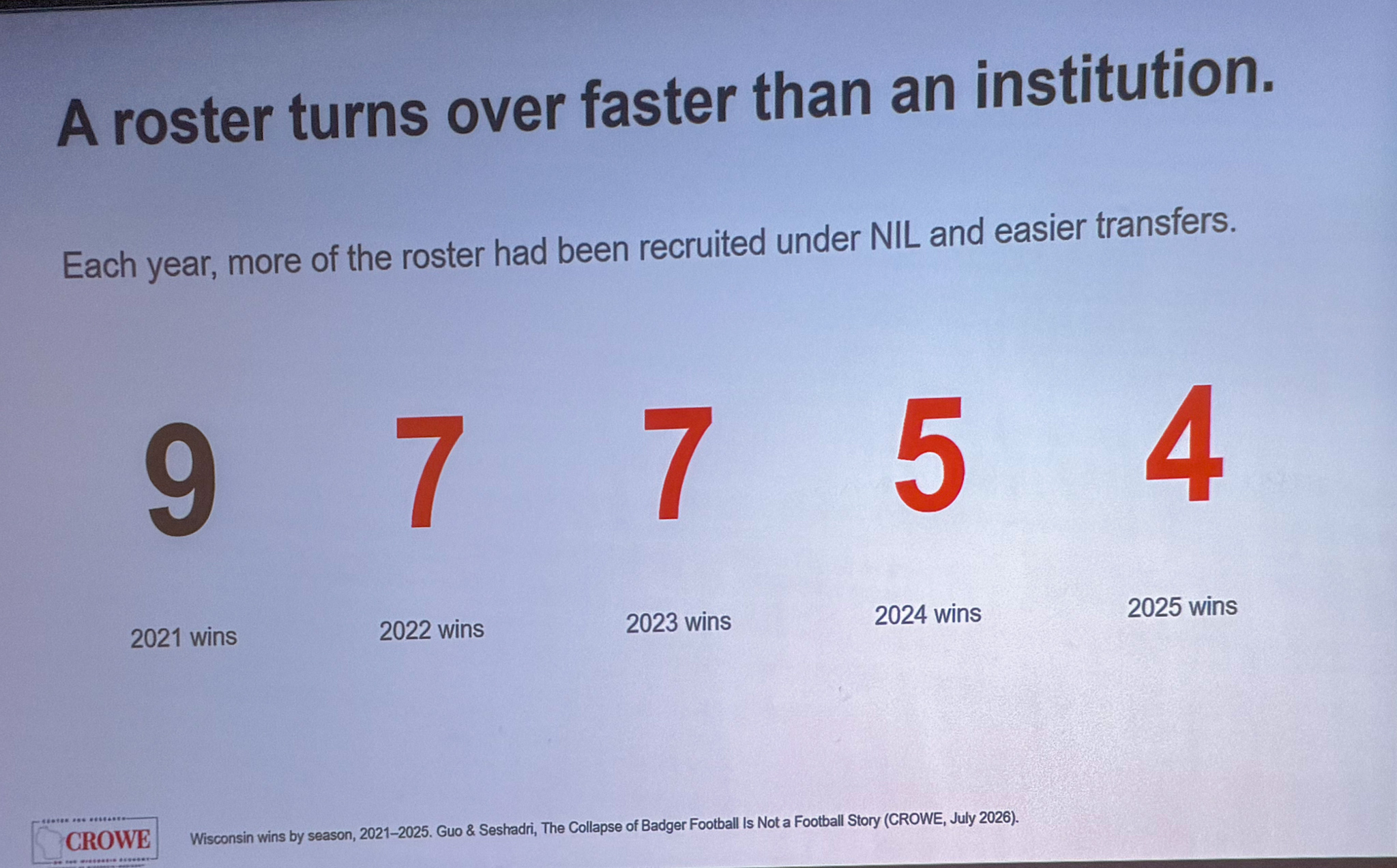
NCAA still matters for eligibility, championships, and national rules. But the chancellor now has a much bigger job than they did, or the chancellor's bigger. So the roster can turn faster than an institution. That's the, the new world we're in. Each year, more of the roster has been recruited under NIL, easier transfers.
Nine wins in '21, seven in '22, 31:00 seven in '23, five in '24, and four in 2025. So thirty years, uh, the-- those are Rose Bowl winning seasons at the very top. We were thirteen and one in 2017. So I got COVID, the floor broke with NIL and portal.
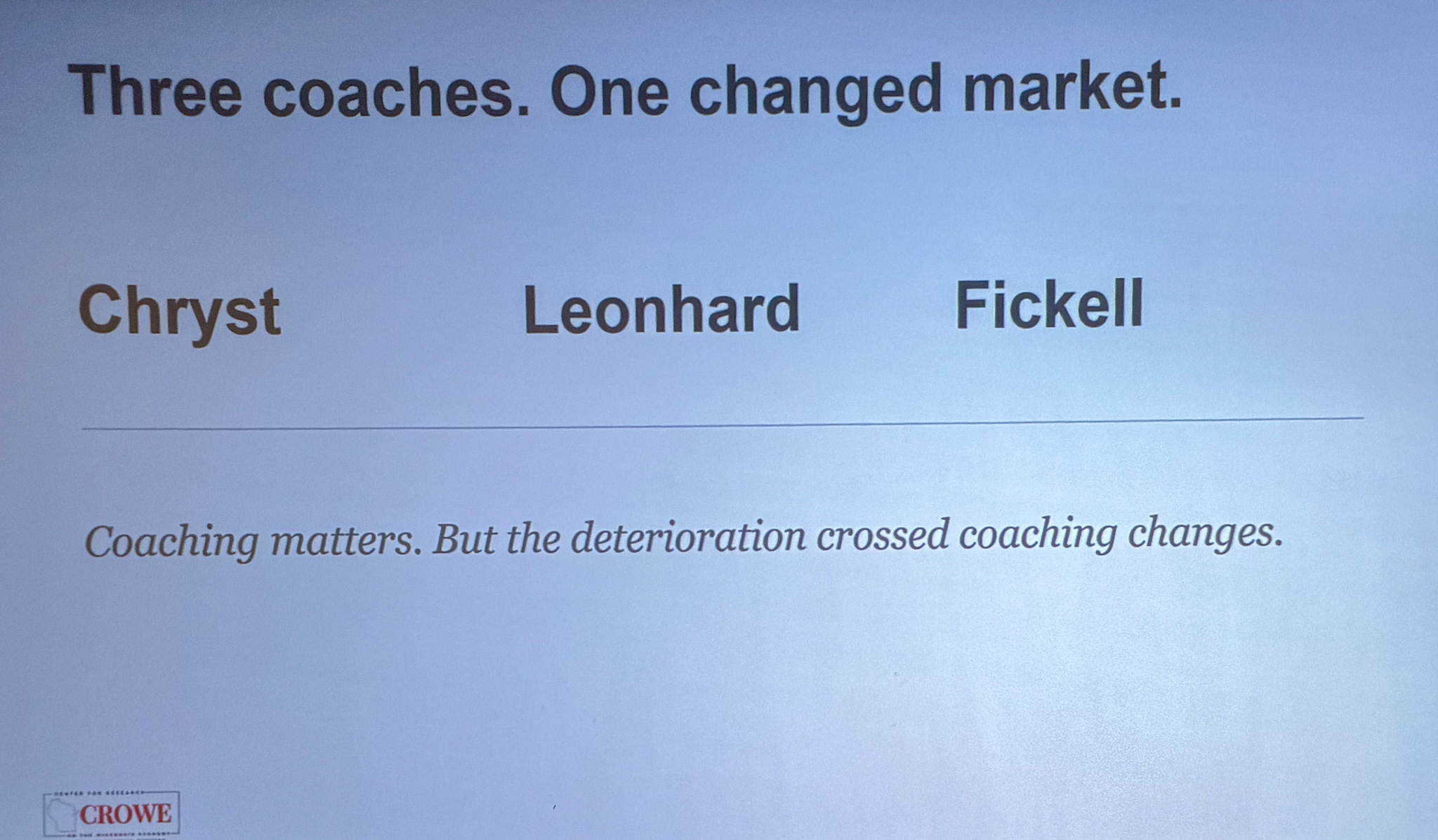
So Pitt survives three different coaches Unclear in recording . Coaching clearly matters. It's not that Coach Fickell, it's time 31:30 we learn how to coach against Penn State.
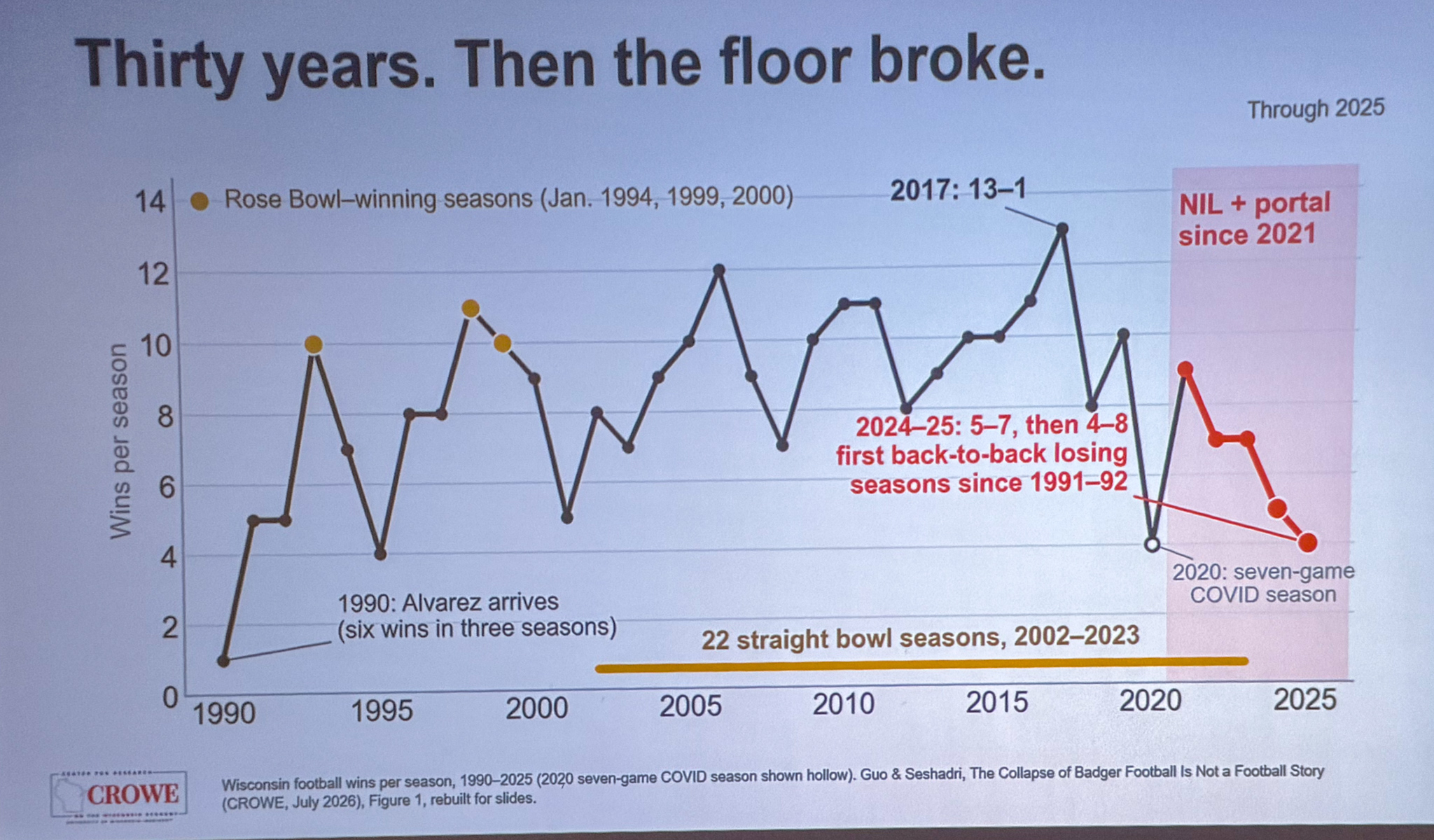
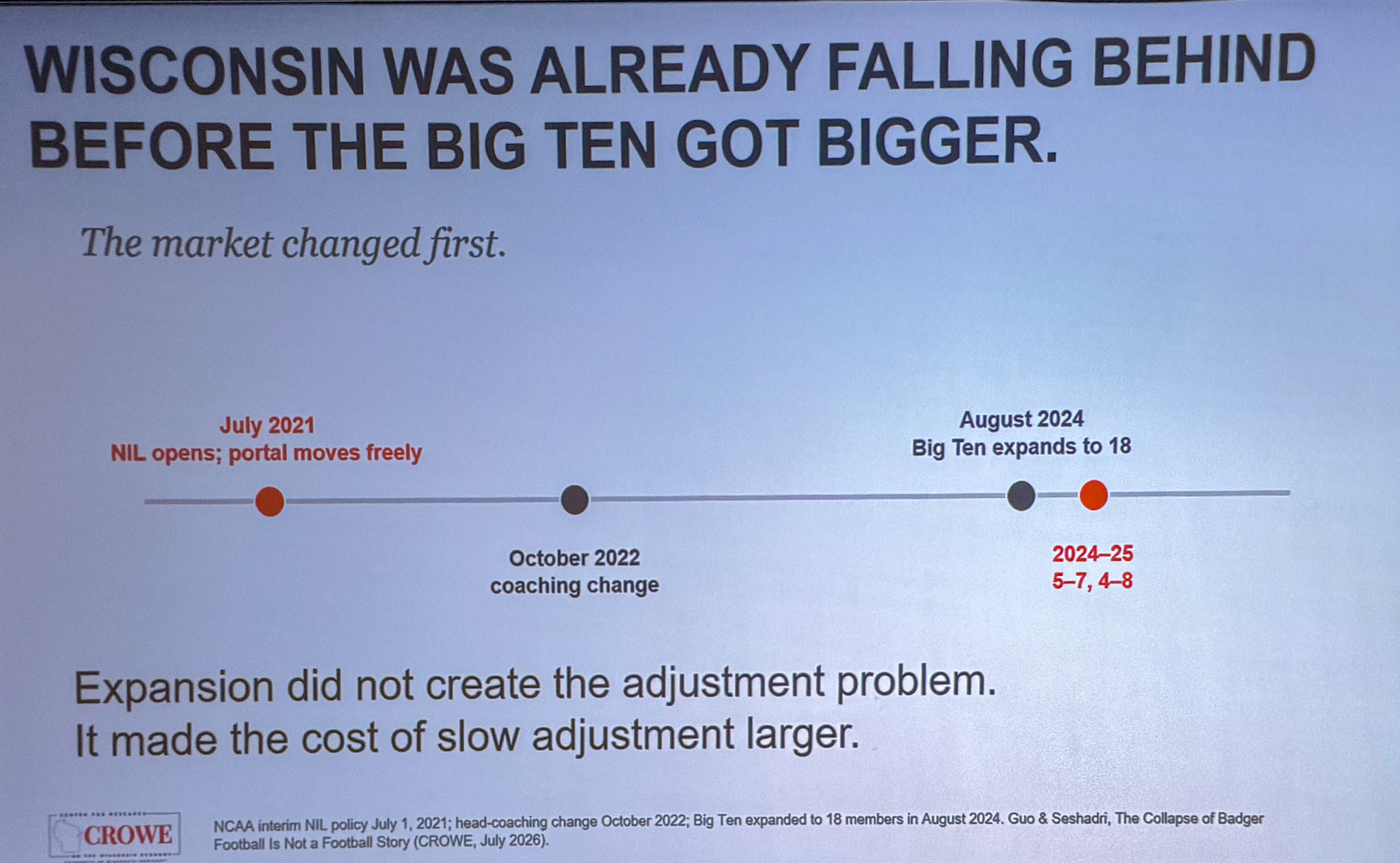
It transcends all those, all those coaches. And the market changed really fast. We were already falling behind prior to NIL. Okay, so the-- so we-- oh, we-- NIL, the portal opens, what, I think ten days after the Supreme Court decision, July 2021. October '22, we make a coaching change. Big Ten expands to 32:00 eighteen. Um, we had those two seasons, five, seven, four, eight.
So expansion did not create the adjustment problem. It just made the cost associated with adjustment or the cost associated with slower adjustment
Where the money goes, and where Wisconsin fell behind
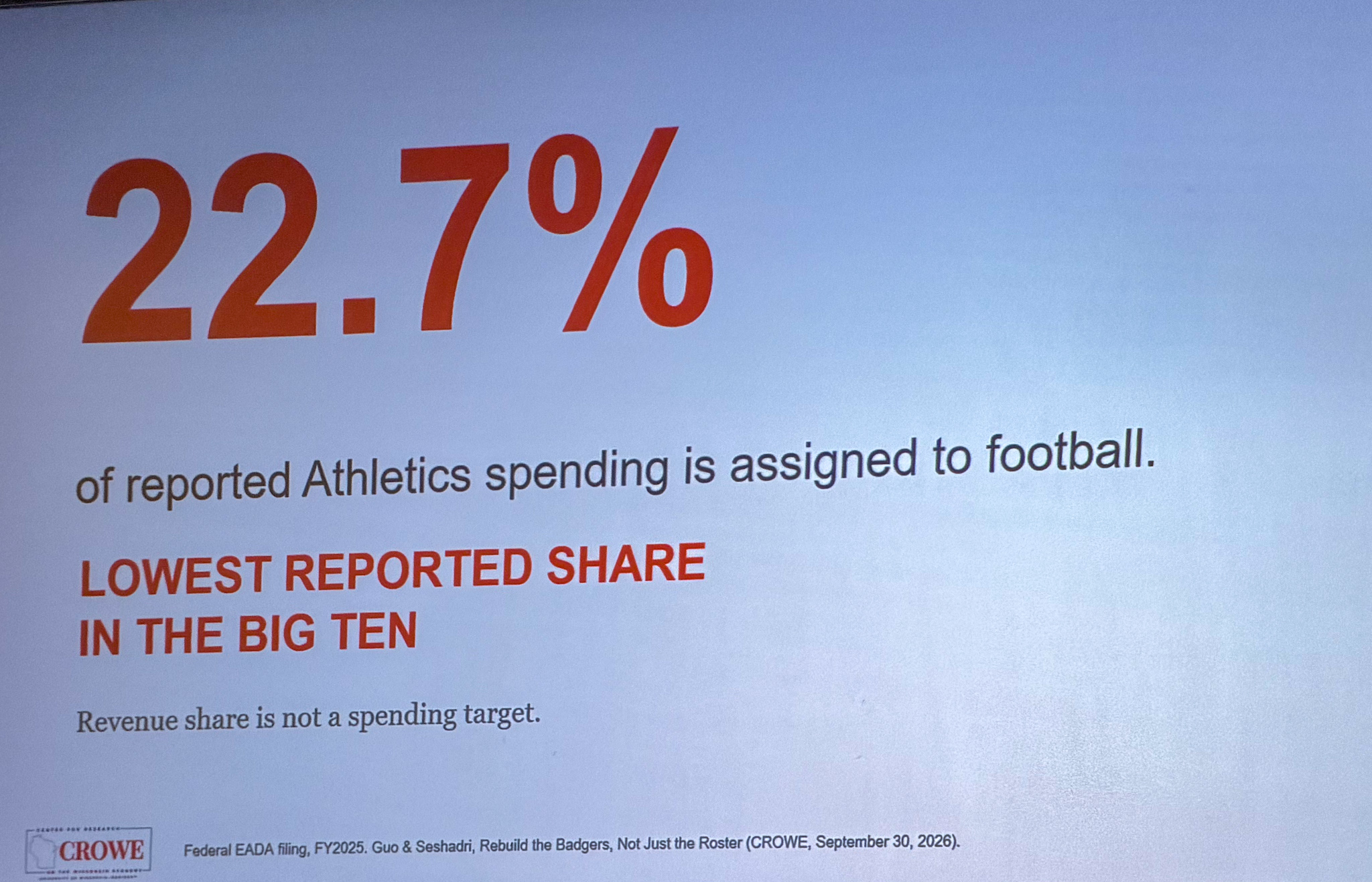
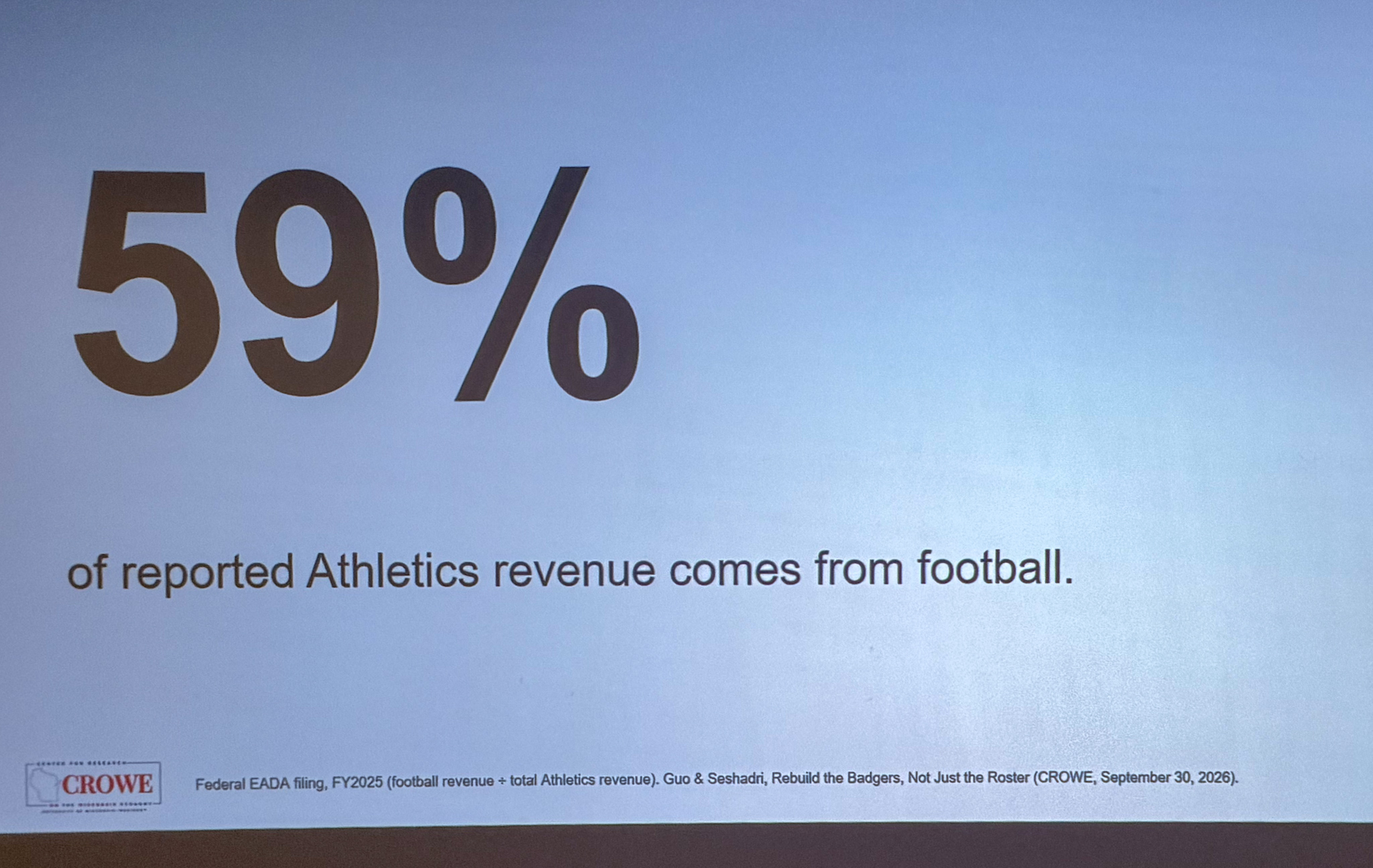
59%, nearly 60% of athletics revenue comes from football Twenty-two percent. Twenty-three percent of athletics revenue. Uh, sorry, athletics spending is 32:30 for scholarships. This is data-- This is da-based on reporting that all schools and colleges have to make to the federal government. The same accounting system across different schools and colleges, which is true.
I didn't do it. It's the federal government. It's their lowest reported share in the Big Ten
Um, and the revenue share is not quite a spending target, so I gotta be clear about that. Uh, again, a picture. The red line is Wisconsin. Pretty much flat. Anyone know why it 33:00 went up that year?
Um, I'm pretty sure that that is upstairs if you remember correctly. That's not here. Okay. That's separate. Right, so this doesn't have that service. Um, it's a separate thing
Chris. So I actually thought when I was looking at the data first, um, I thought, okay, there's actually, wow, a lot of catch up. And no, no, there isn't catch up. Okay, so it's a flat line. Again, I've got to be cautious because different accounting 33:30 conventions, transfers from schools to athletics, it's, it's very, very tricky.
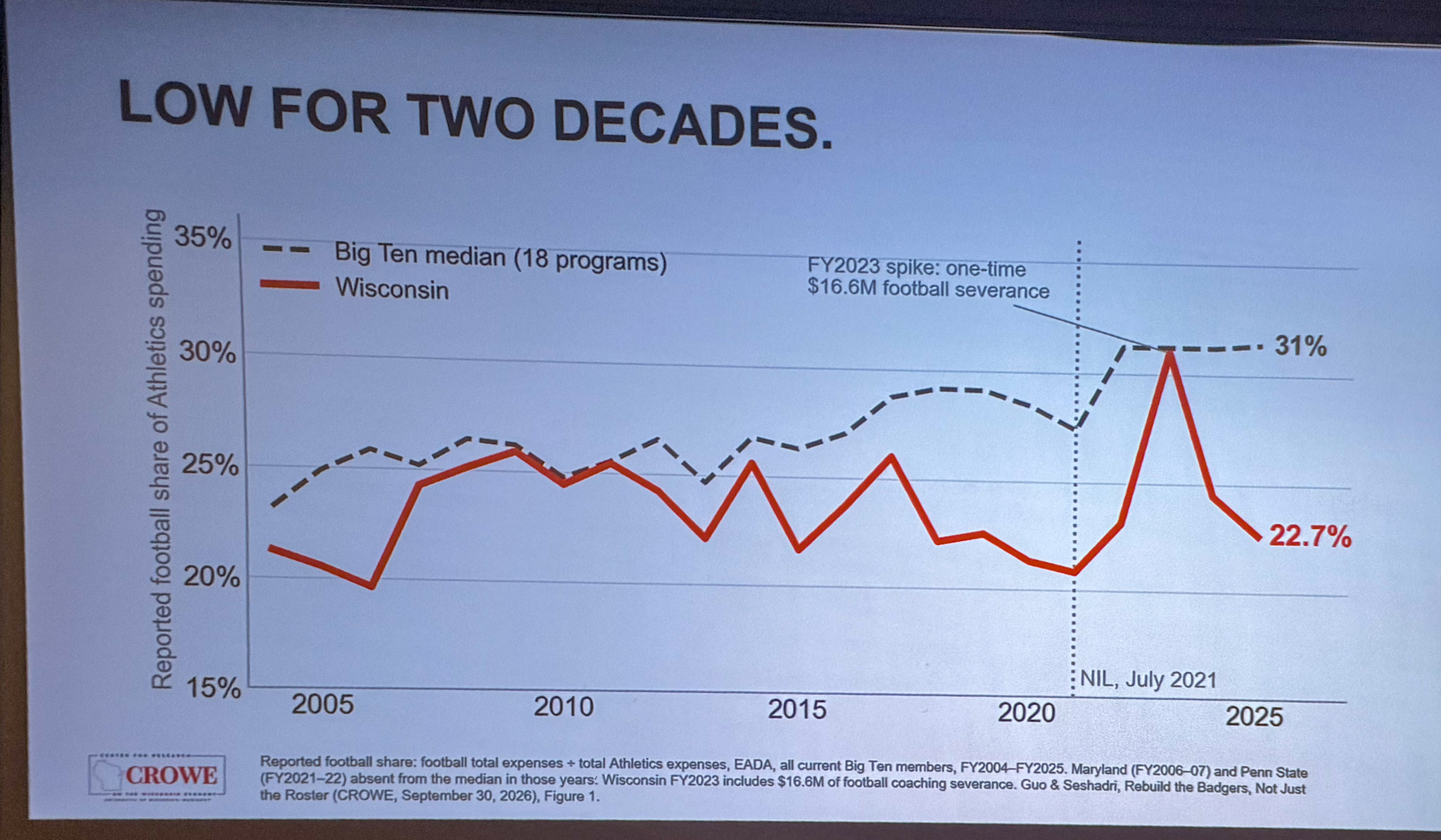
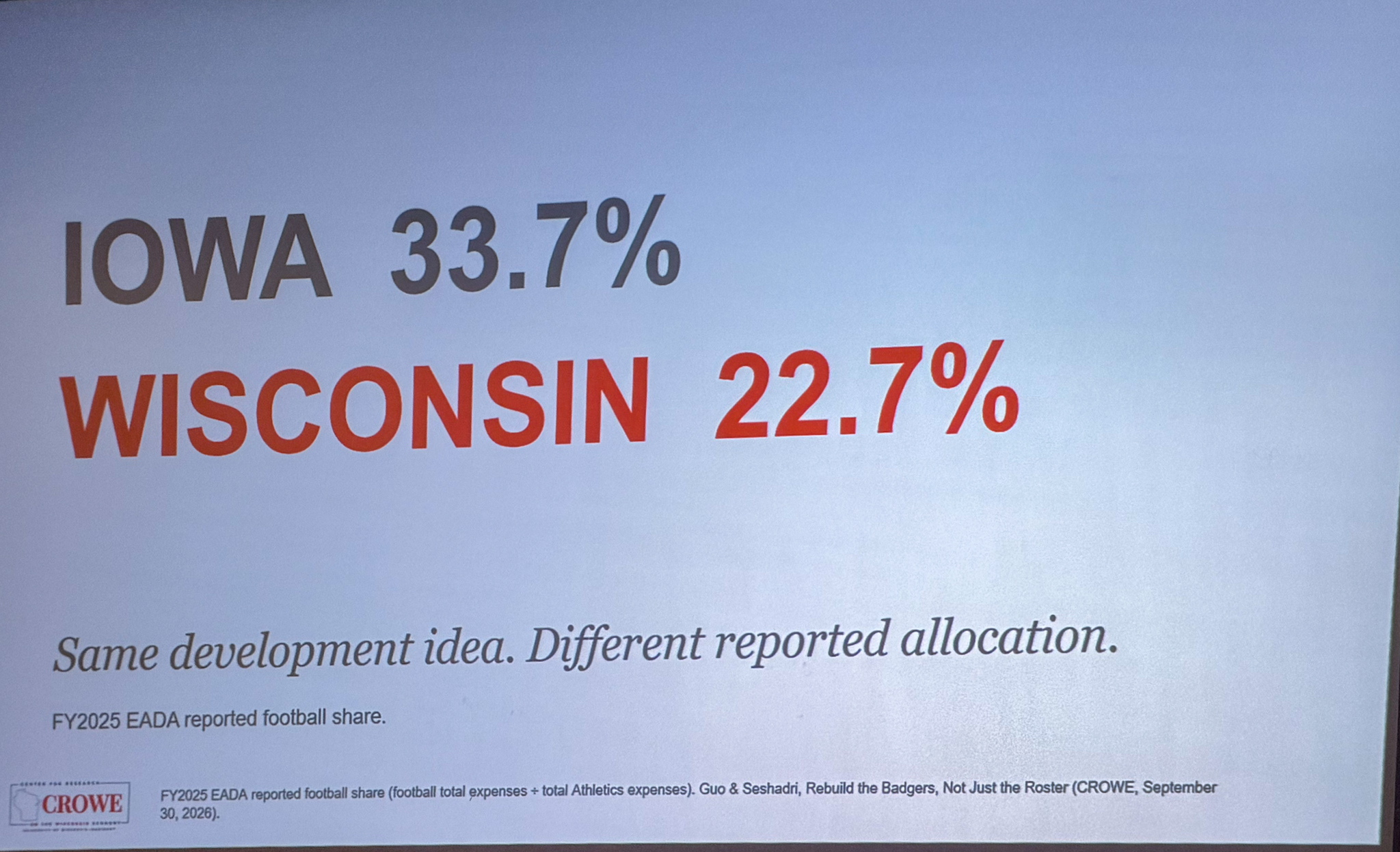
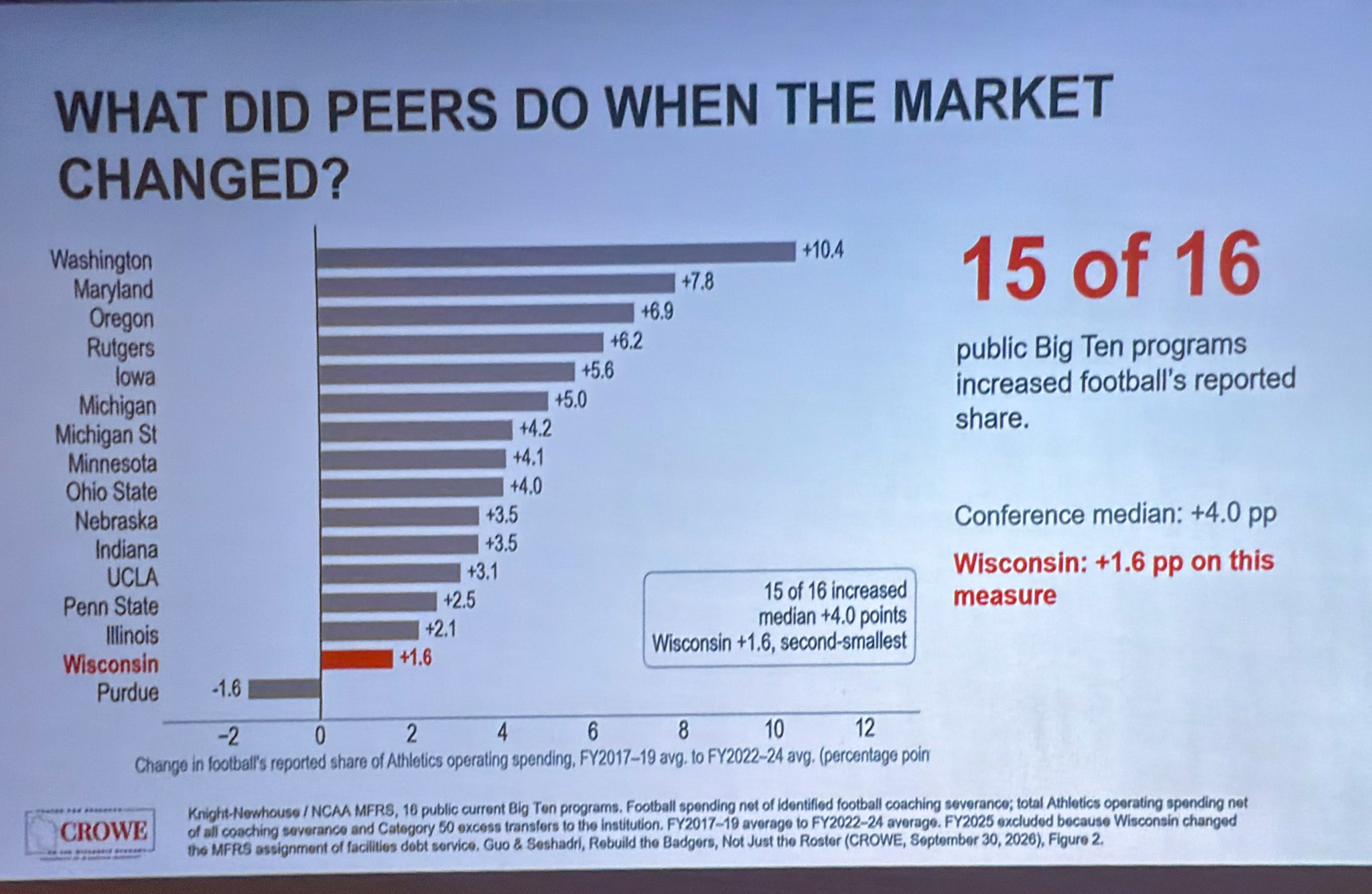
Um, but it's-- it does-- it's suggestive of the fact that That Wisconsin has a different allocation relative to the rest of the Commonwealth. Iowa is instructive. Uh, it's the same development idea, a much higher reported allocation. It's much higher of those resources that the state And this is what Peterson, if you want to look at changes over time, fifteen of sixteen increased their spending on-- increased the fraction 34:00 of the allocation, athletics budget that's allocated
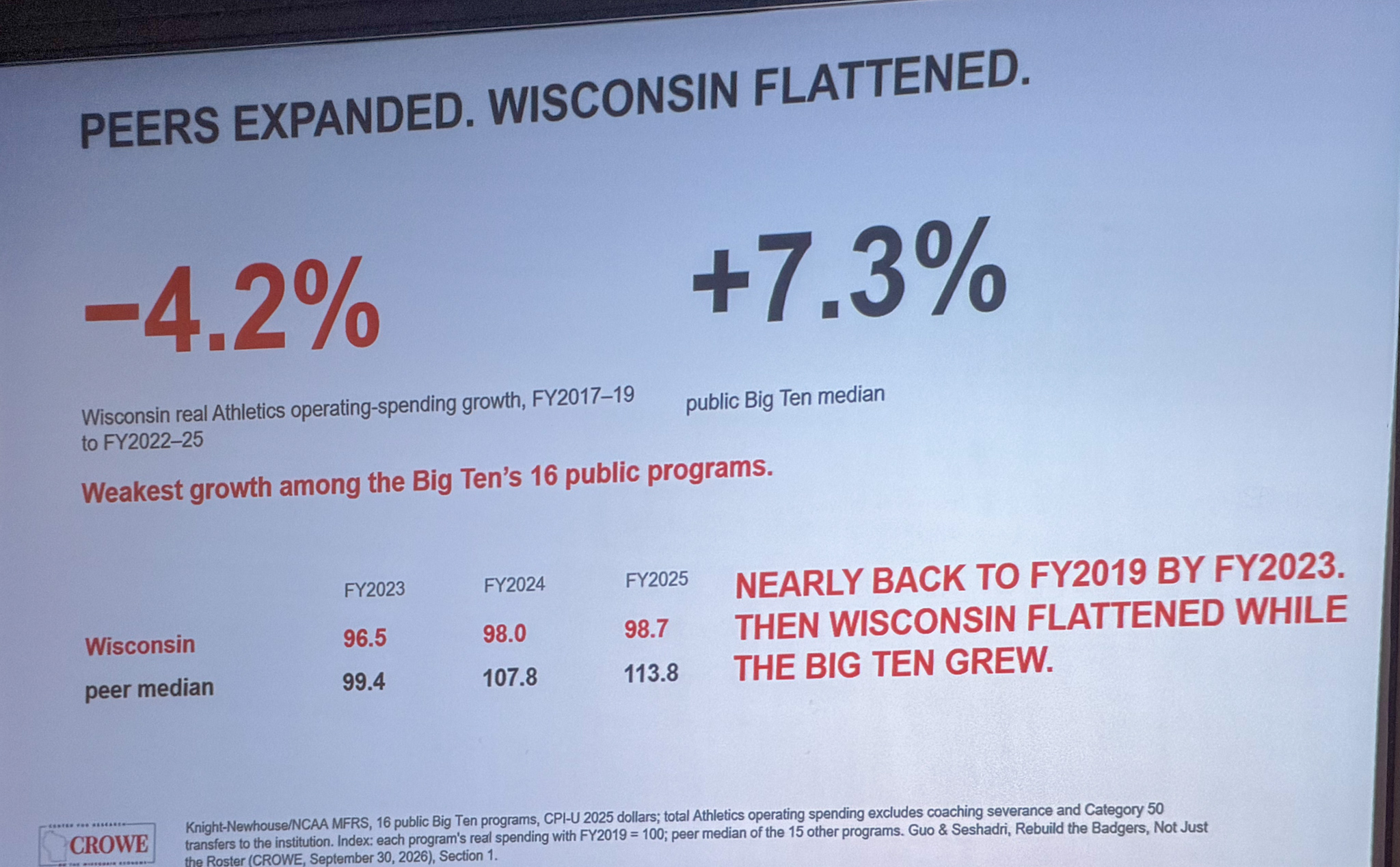
And the conference meeting was, uh, went up by about four percentage points. Wisconsin went up by about one percentage points. Um, but that's not as important as this one, which is what is the overall size of the budget? Wisconsin's, uh, real athletic spending growth, if you look between twenty seventeen, twenty nineteen, so pre-COVID, the years right after NIL came through, uh, aggregate s-- uh, spending went down by about four 34:30 percent, whereas the median-- public Big Ten median went up by seven percent.
To me, this was probably the bigger piece of the story. So we entered the NIL era with a smaller growth in resources relative to our peers. Okay, this is just some numbers where I think twenty-nine-- twenty nineteen might have been, uh, a hundred, and you kind of see that we're diverging, uh, where the Big Ten is getting a little bit richer than we are over that period.
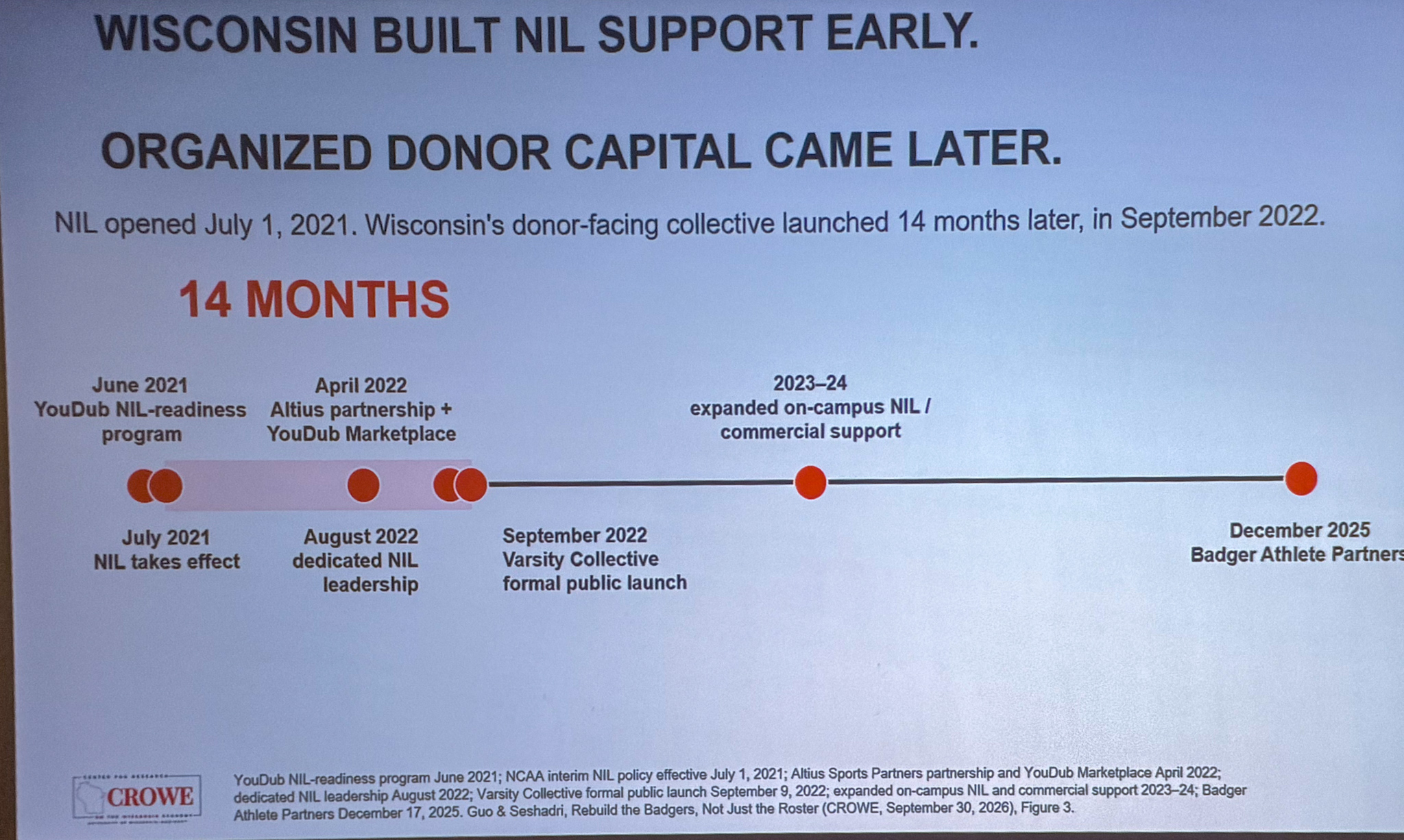
And this does not include debt service. This does not include portal 35:00 money, NIL money. This is, this is exclu-excluding all that. So organized donor capital ca-- kinda came late. Okay, so NIL opens in twenty twenty-one. I think Oregon, like, sets it up the next day exactly. Maybe Phil Knight just set something up and said, "Run with it," and we did.
Uh, but our donor collective face-- uh, donor-facing collective came fourteen months later. So initially read about UW. Wasn't sure whether that's UW or UW. You guys know what I mean. 35:30 It's UW. NIL Readiness Program, uh, NIL takes effect. There's a partnership, there's a marketplace, and it took fourteen months for the varsity collective for its public launch.
And then there's extend-- expanded on-campus NIL and commercial support that we create after that. So this fourteen months is not a whole lot for an academic department, but in real time, when the rules of the game are changing constantly, that can have a huge impact on your ability to buy talent. Right? So we, we had the education program, we had 36:00 the readiness program, but it-- my best read of the evidence is where we were late is in creating this donor collective, donor-facing collective.
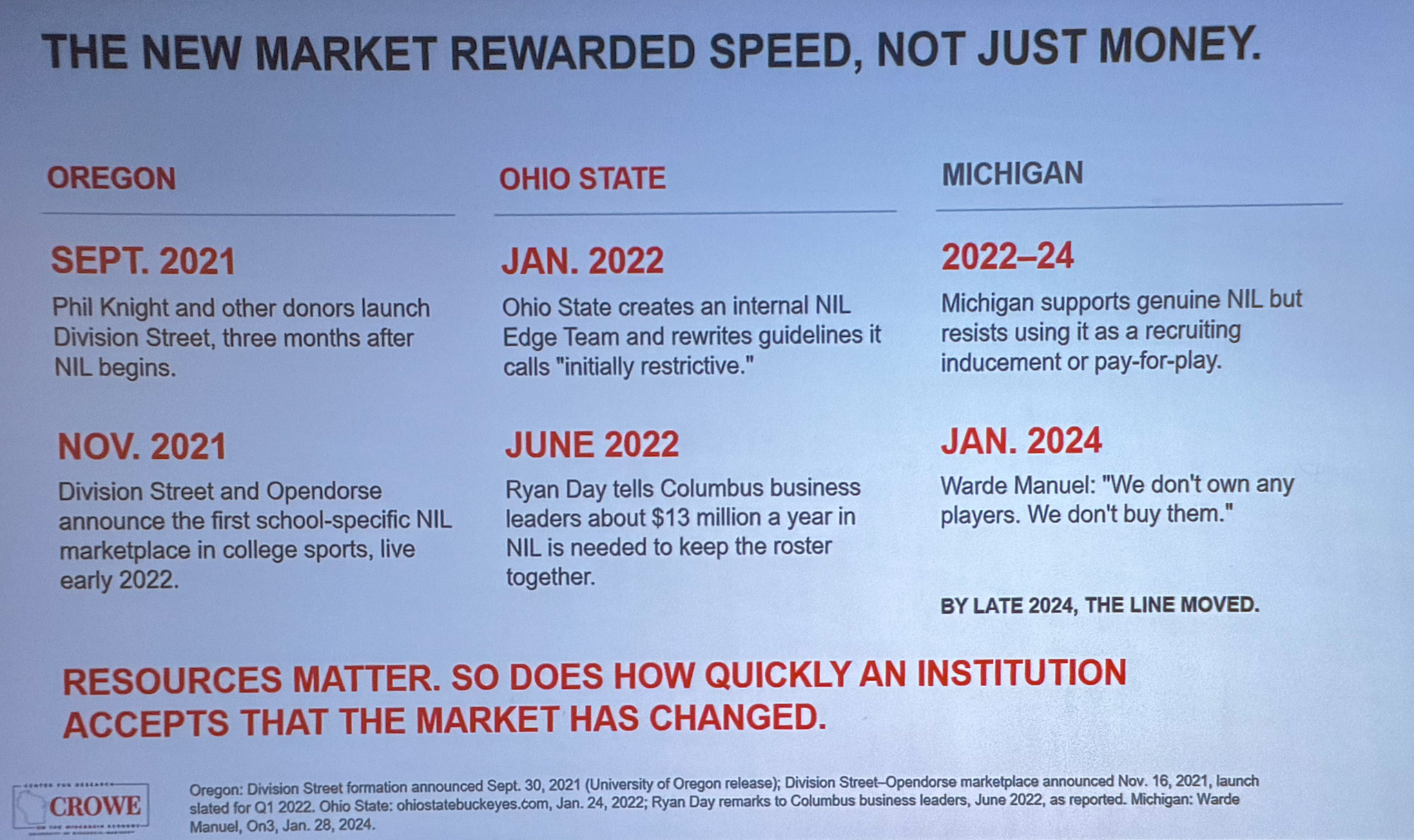
And the new markets rewarded speed. Like Oregon, Phil Knight and others, September '21. Division Street opened doors. It's the first school-specific NIL. Um, Ohio State also creates an internal NIL, initially very restrictive, restrictive. Michigan is a very interesting case. So I praise Michigan because th-there was apparently a debate between 36:30 the athletic director and the coach.
It supported genuine NIL. I think it was Matt-- Warde Manuel who just said, "We don't own these players. We don't buy them." Okay? And Harbaugh apparently wanted to be a lot more aggressive, and he just didn't like the philosophy of using NIL as an inducement mechanism. But then the world, world was changing.
Okay, but, but by late twenty twenty-four, the line kind of- And so resources matter, clearly. 37:00 Michigan is significantly wealthier as an institution than the other two. I think it's a twenty-two billion dollar endowment. Um, but how does-- how quickly and how rapidly you can, you can kind of, uh, change as the marketplace changes can matter to you.
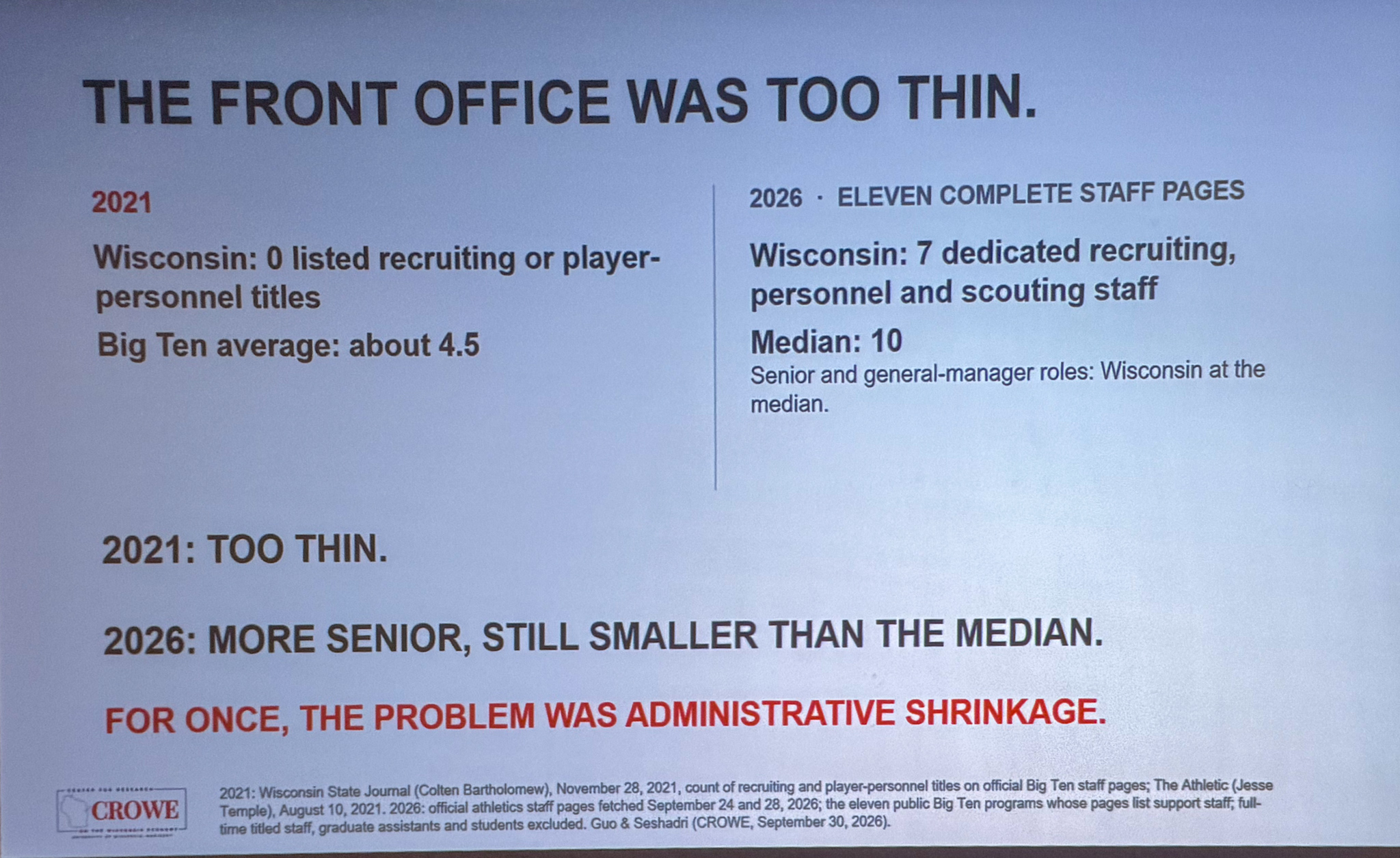
Okay. So the front office was too thin. Um, usually they accuse academia of admin bloat, but this is the opposite in, in the athletics department. I don't know if I should call it administrative shrinkage. Um, Wisconsin apparently had 37:30 very few recruiting or player personnel titles. And in twenty twenty-six we had seven, the median was ten.
In twenty twenty-one, um, I think there was a, there was a player personnel director, Saeed Khalif, if my memory is correctly right, who left Wisconsin to go to Michigan State in an interview with Wisconsin State Journal where he just said, "It's just-- the
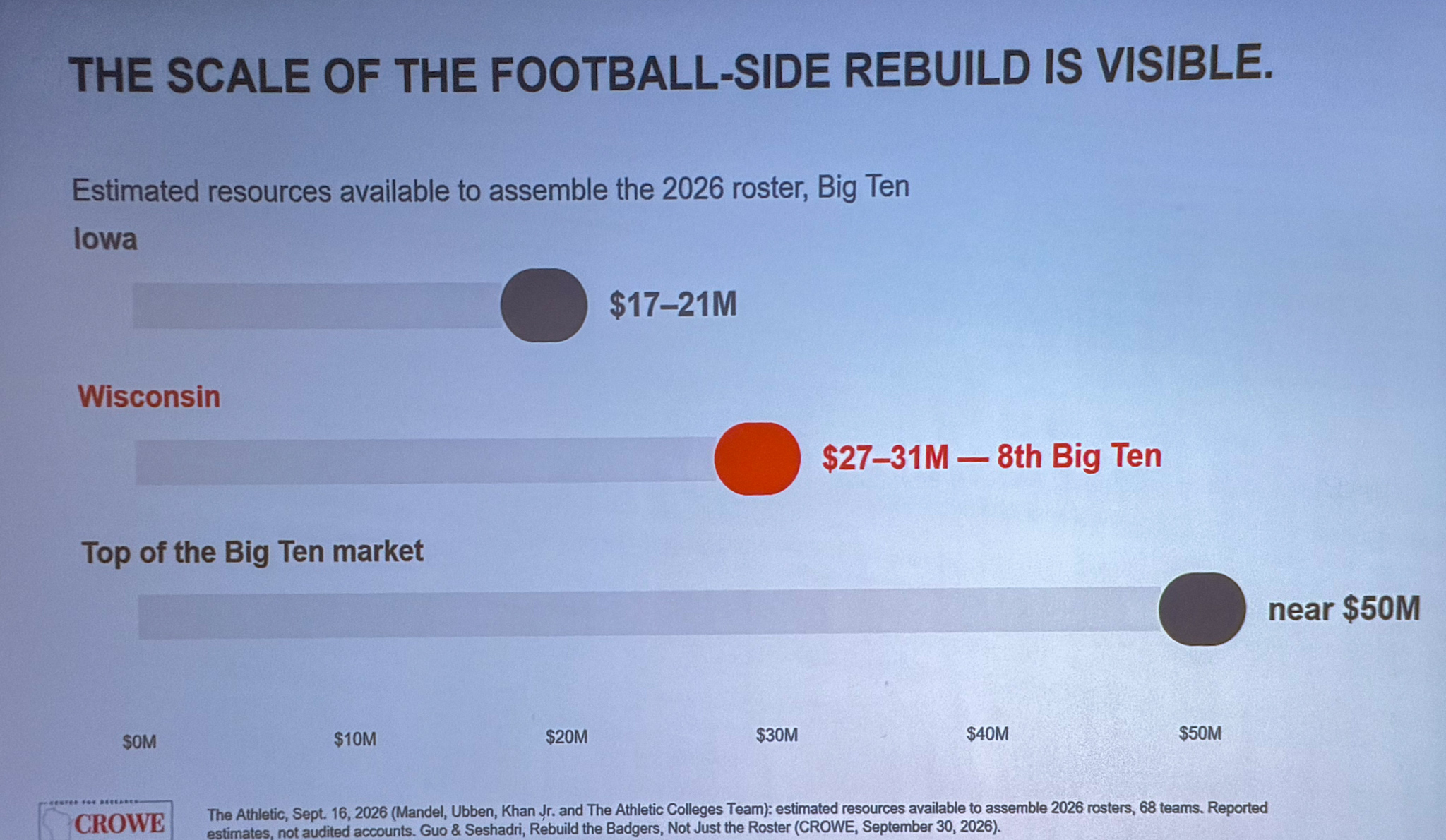
staff is just too, too thin." 38:00 We should send some of our administrators from academia over. So for once, the problem is administrative shrinkage. So the scale of the football side rebuild is very unusual. Um, I think that-- I think we had some numbers in an earlier paper to start out being wrong. Of course, no one discloses these numbers, and I think the schools collude to ensure that they don't disclose the numbers.
It's against the law right now. But Ted Kellner was a big donor to U of-- uh, to the Madison athletics department, and kinda said, "Last year, the year before, we were kind of the bottom third, and then this year we'll be in the top third." I think he should know. I-- certainly much better than 38:30 me. Um, but Iowa was about seventeen to twenty-one million for this year, according to The Athletic.
We are closer to twenty-seven to thirty-one. Um, you know, take all these numbers with a sack of salt. And then the top of the market, the Oregons and the Ohio States of the world, probably get fifty million. So the more you can pay talent, unshockingly, the more you can actually spend on these resources.
There's also a beautiful study that talks about Michigan being late to embrace the inducement NIL 39:00 might have had an impact on, you know, when they went for the championship, what, in twenty twenty-three,
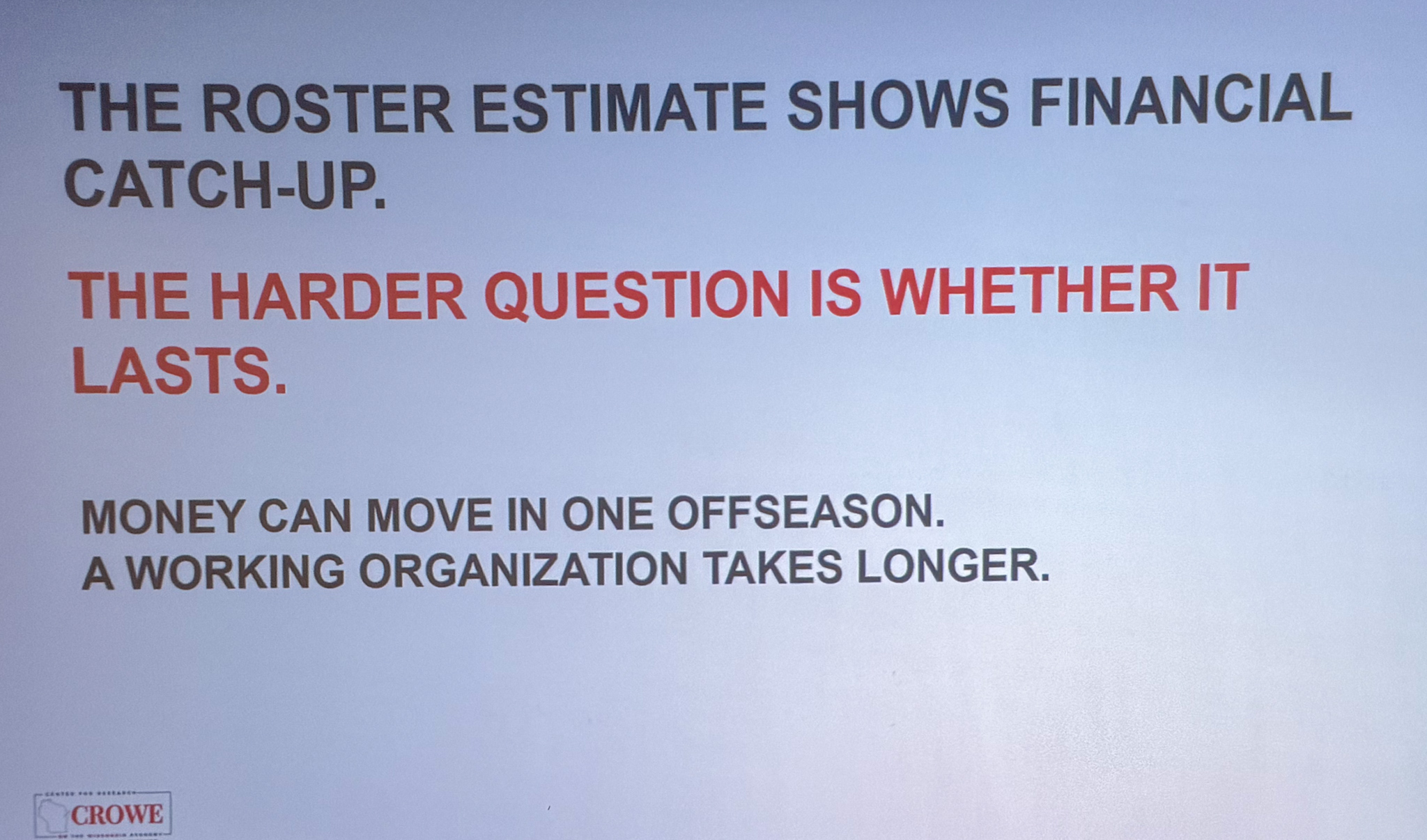
might have been deciding the next few years. So money matters. But money matters are moving fast now. So the roster estimate shows financial catch-up. To me, the harder question is whether this catch-up will actually last, because money can move in a one-off season. But having a working organization is gonna take a lot longer.
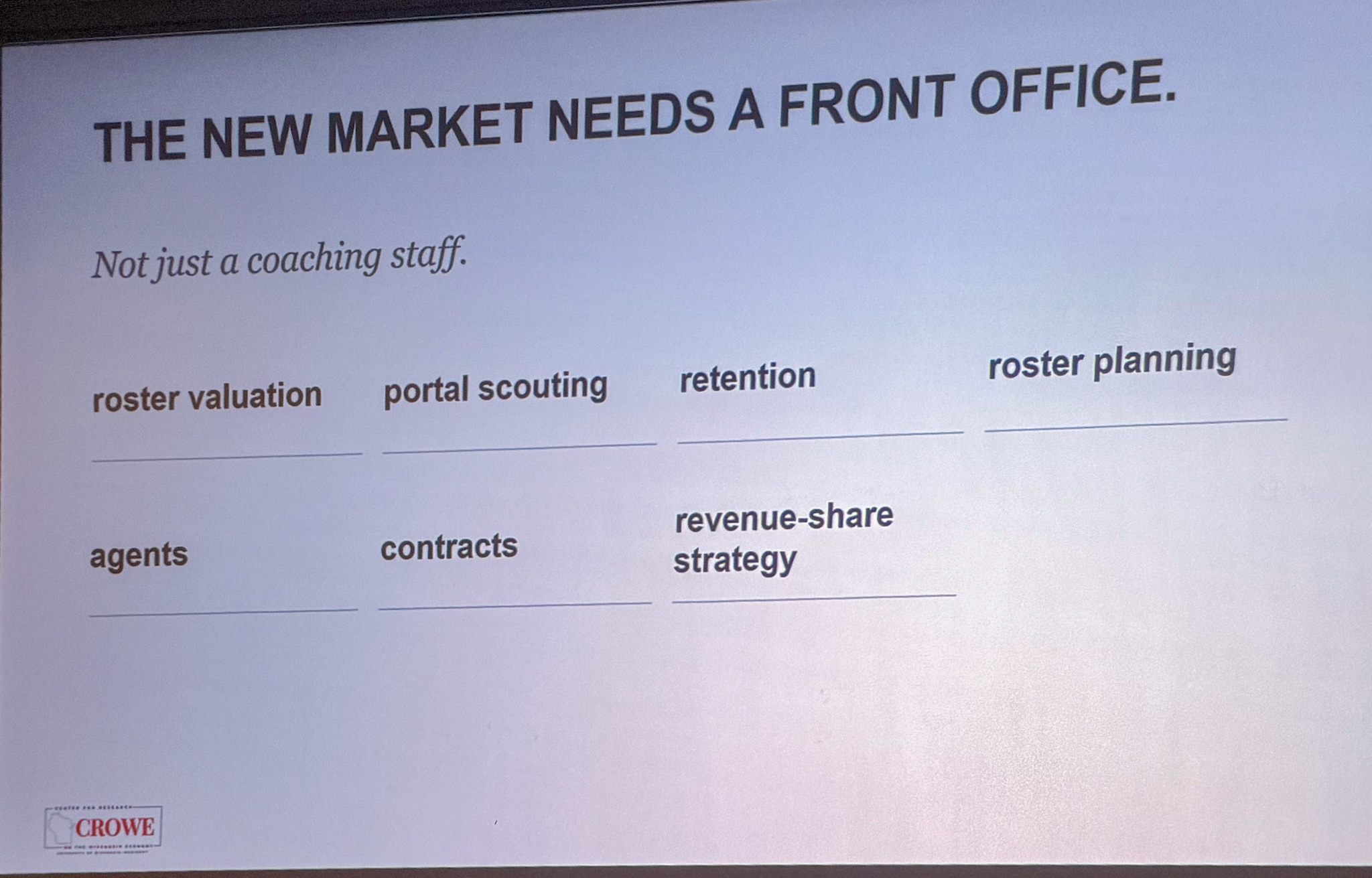
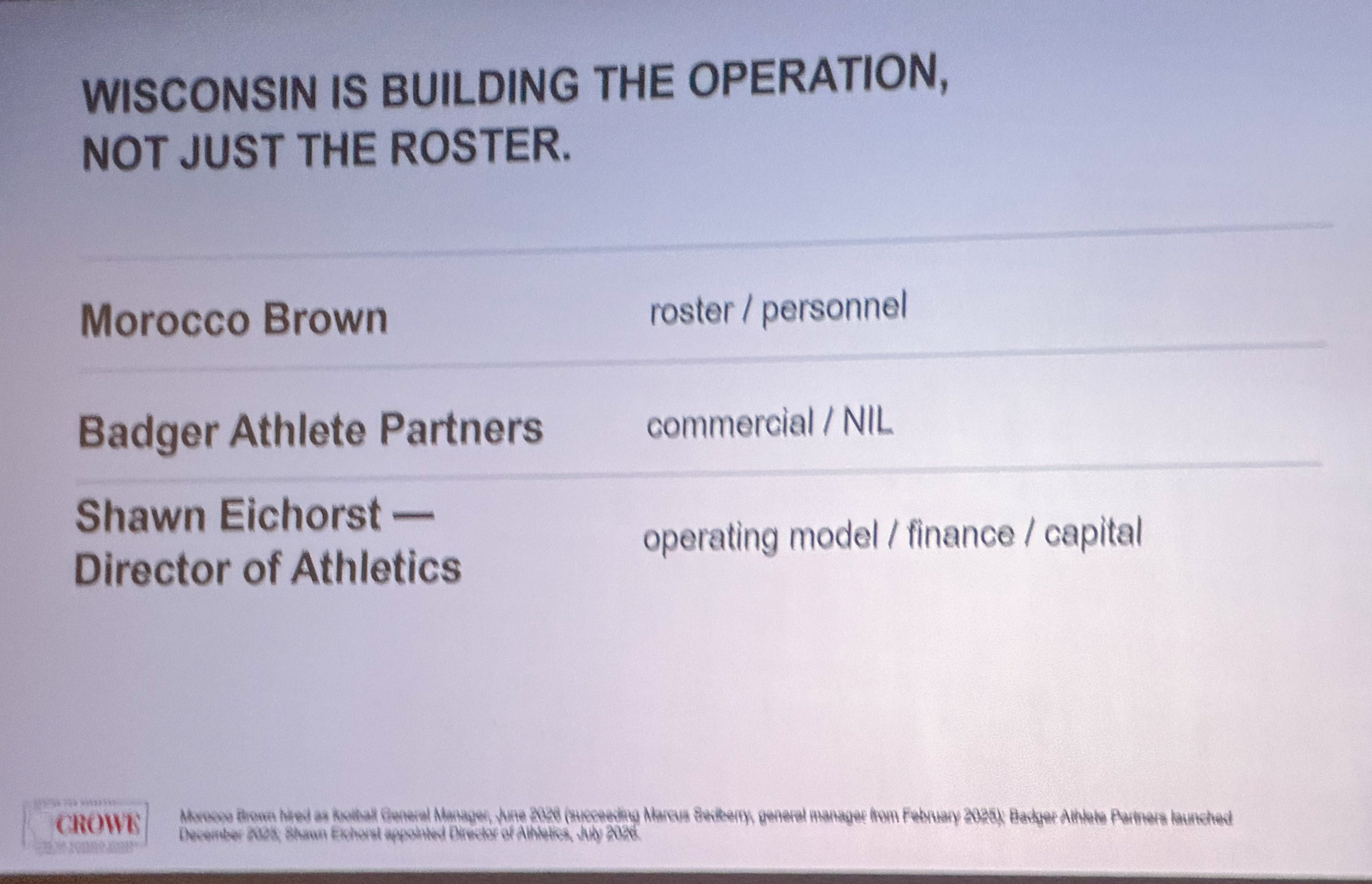
So the new market clearly needs a, a coaching staff. Not just a coaching staff, 39:30 a roster evaluation, scouting, retention, planning, contracts, and a revenue sharing structure So it somewhat begs the question, in the new era, like, what are these transfers gonna be between academics and athletics? Mm-hmm. Well, Wisconsin is building this operation and not just a roster.
Michael Brown, Badger Athlete Partners, like a structure that's in place. Shawn, um, the director of operating model, finance, and capital. Um, and the test is whether it 40:00 survives these fine folks who are
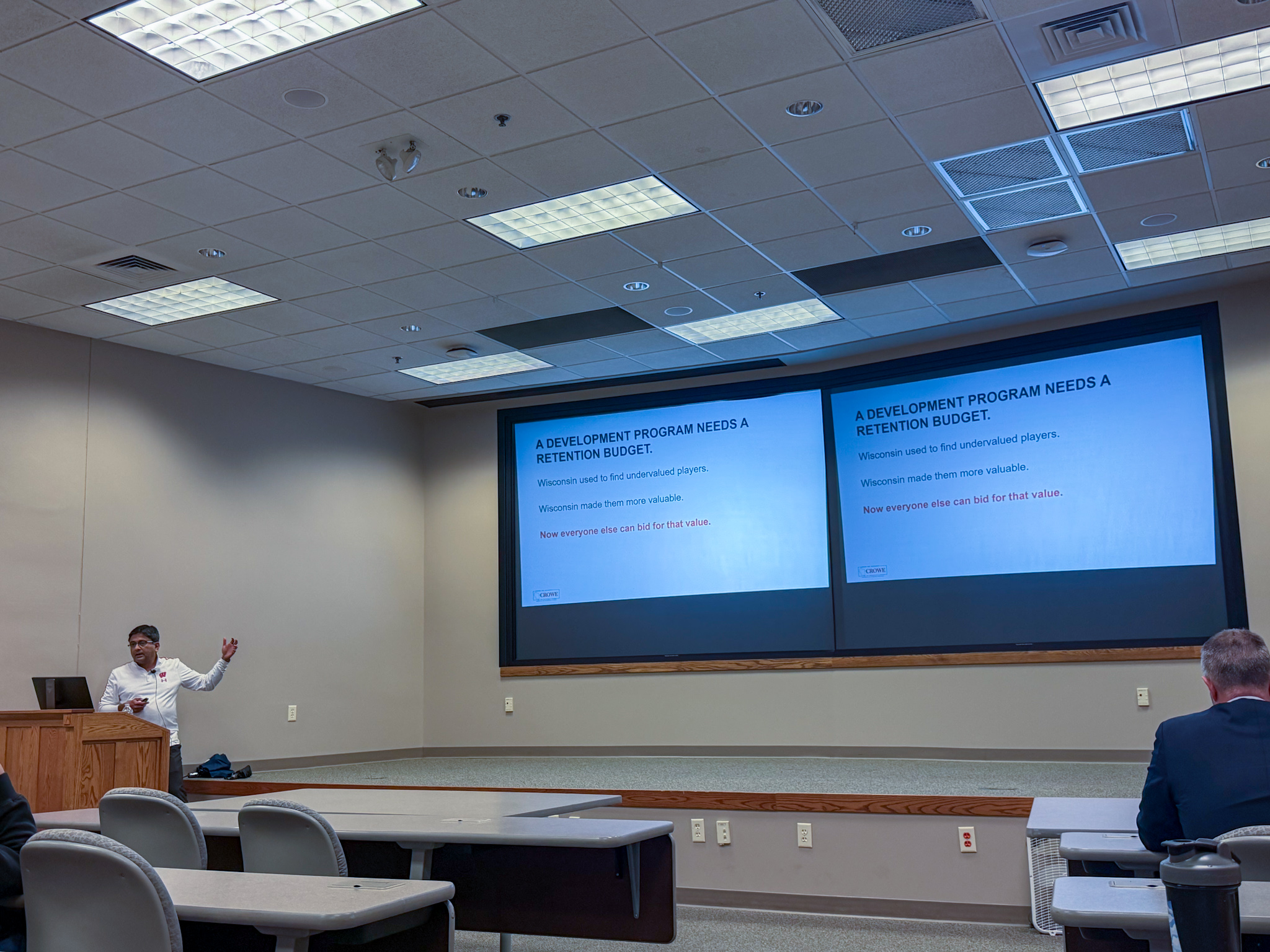
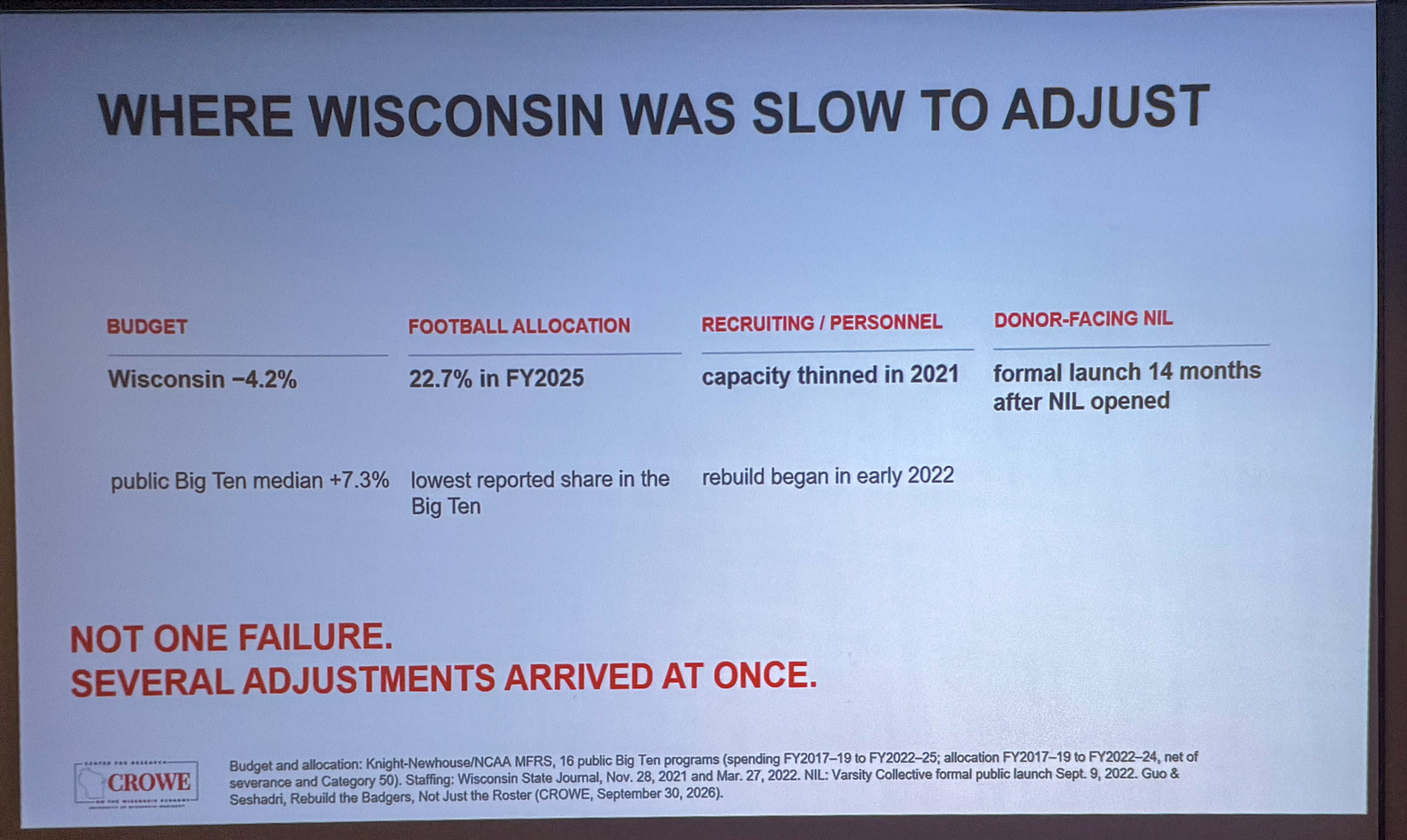
gonna build this. So the development program needs a retention budget. Our model used to be, let's find undervalued players, make them more valuable, and by design, keep them. Put a wall around them. No one else can bid for that value. Where Wisconsin was slow to adjust, our budgets lagged here The allocation for football seems to be reported share, seems to be the lowest in the Big Ten. 40:30
Recruiting capacity was very thin in twenty twenty-one, and the donor-facing NIL was low. So these-- that's our analysis in terms of why or where Wisconsin was really struggling.
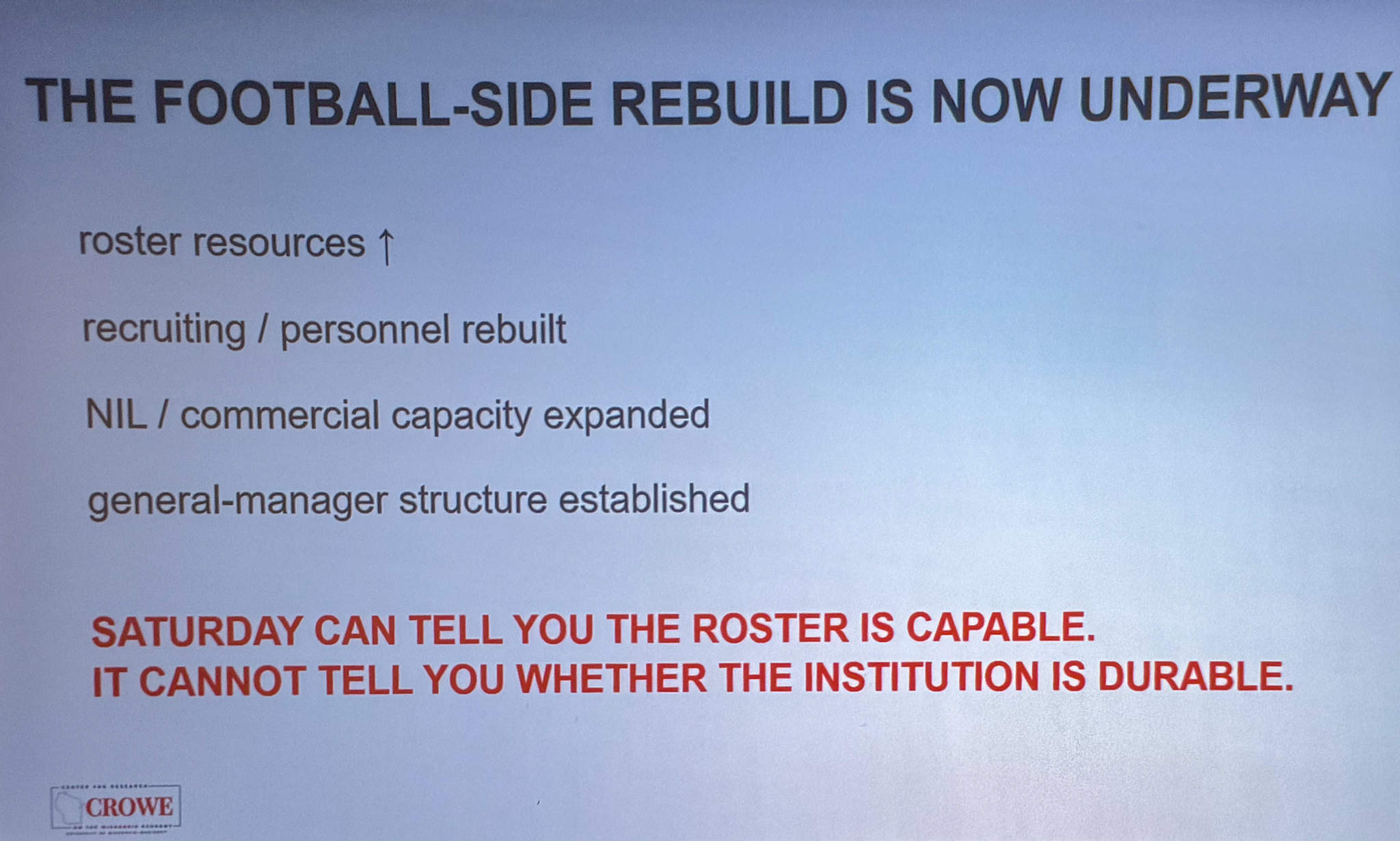
Now, it's just not one failure. I wouldn't even call it a failure, but it's just several adjustments arriving at once. Okay, so the football side rebuild is clearly underway. Roster resources are gone up. Recruiting and personnel are gone up. NIL and commercial 41:00 capacity have expanded. A general manager structure is established.
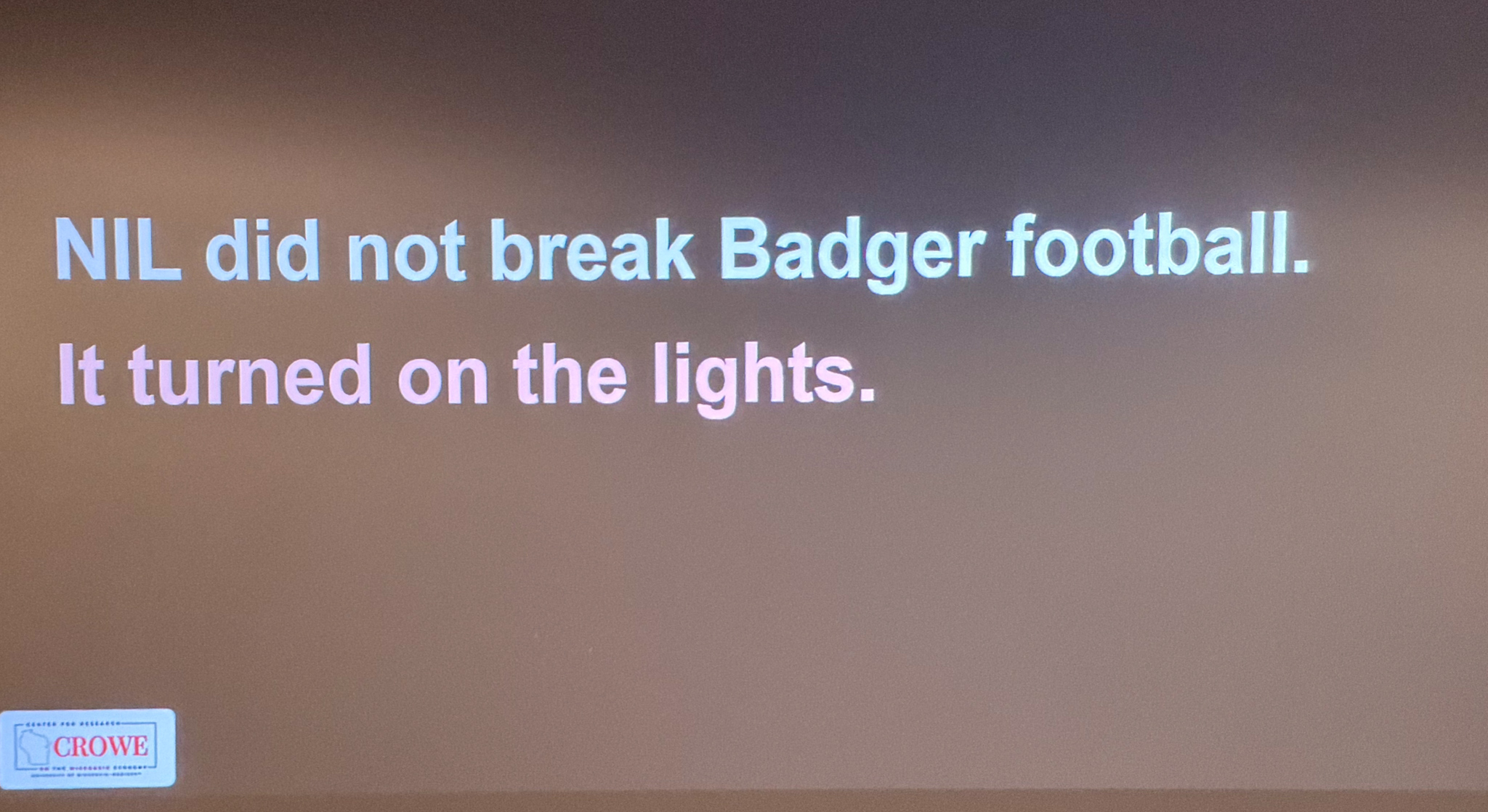
But Saturdays, or two Saturdays, or a few of them, can tell you whether the roster is capable. It can't just tell you whether the institution is durable. What we're gonna build now is it gonna survive even the further changes after the, after the house vote tonight and the new, new, uh, rules of the game So NRL do not break down football, which is phenomenal
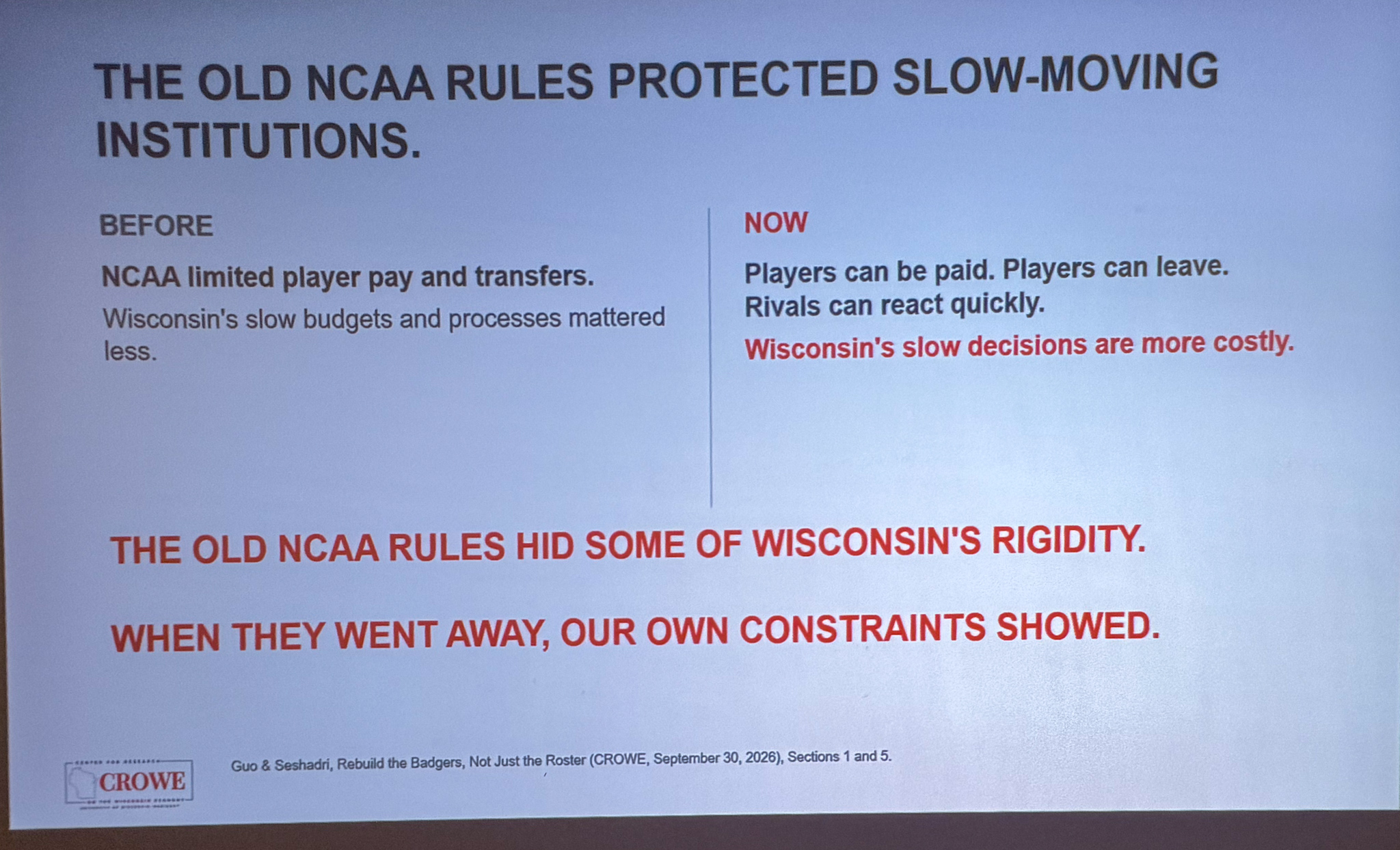
Um, actually, Claude hated this, so this is not from Claude. I just said, "No, 41:30 no, this is my lens." So the old NCAA rules, or the old cartel basically said, "We're gonna limit pay of, uh, player pay and transfers," and Wisconsin slow budgets and processes mattered less. In some sense, the old cartel was a subsidy to slow-moving institutions.
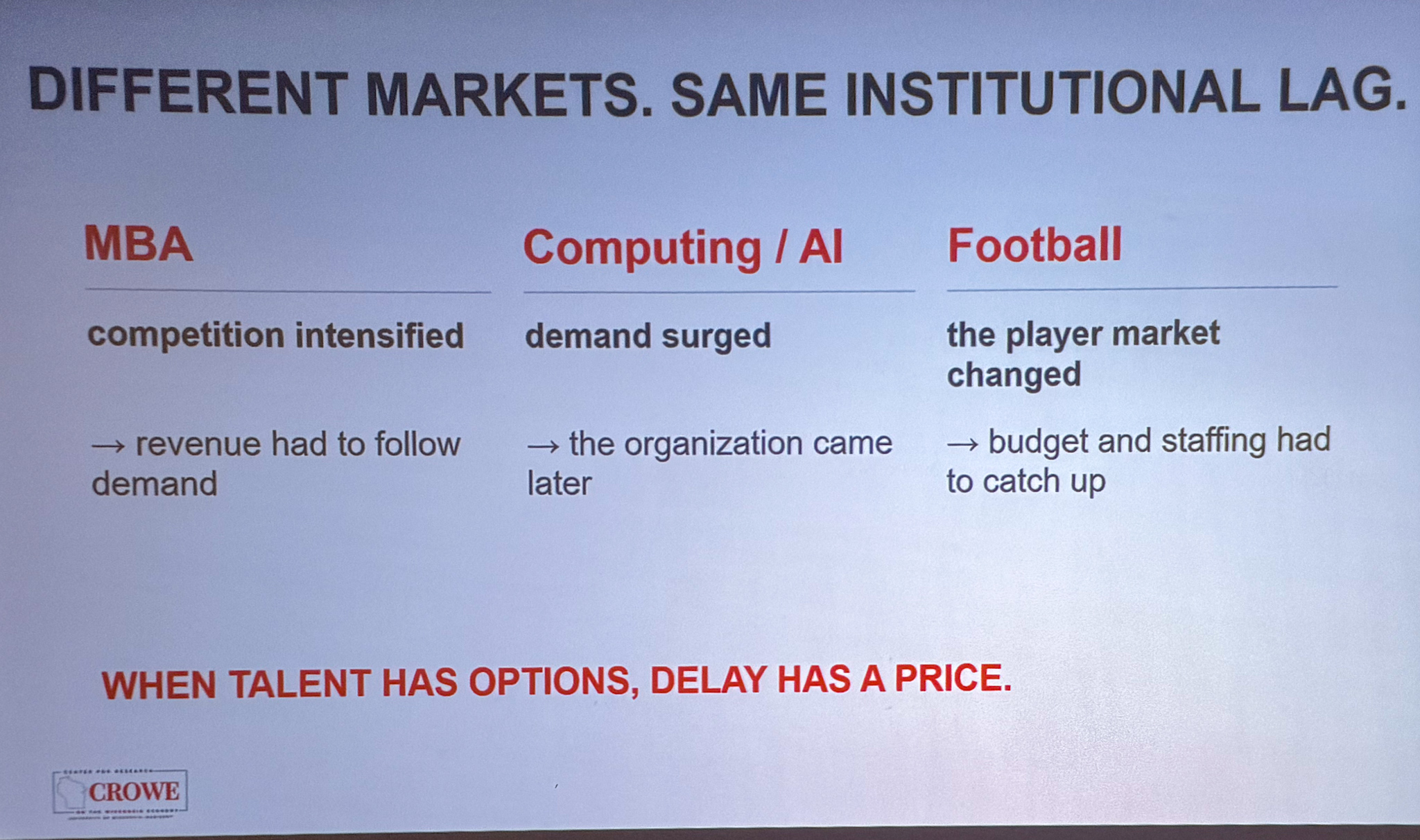
And now that players can be paid, our decisions, if they're slow, are much more costly. So in some ways, uh, it hid our rigidity, and when, when they 42:00 went away, our own constraints had showed up. Right? So if you go back to the NBA, competition intensified. Revenue had to follow demand. We don't have a budget model which did that.
Indiana did that, Michigan did that, UCLA did that, and, and they did it in the eighties and nineties. So if, if you wanna build up the NBA program, you probably need a Phil Knight-type billion one, uh, to build it up to where Michigan is today. Computing demand surged. I don't think there was any failure there, but the, but the structure, the organization came a lot later.
And in football, 42:30 like with computing, you might say we were ten years late. In football, maybe we're fourteen months late, but that's much faster in football time than in computer science. So when talent has options, this delay has a price. So we now gotta keep the return and success fund, uh, what comes next.
What Wisconsin should do
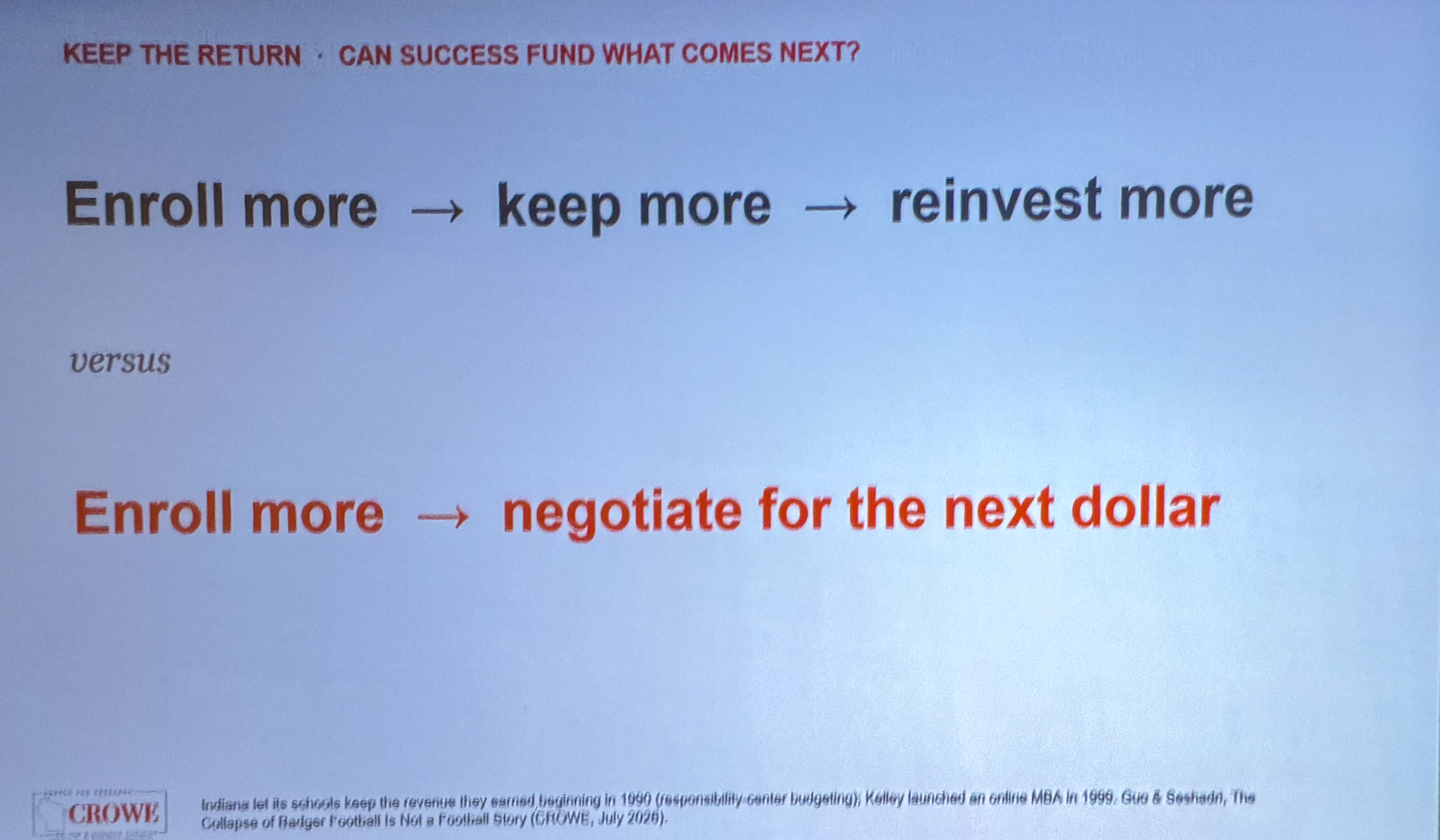
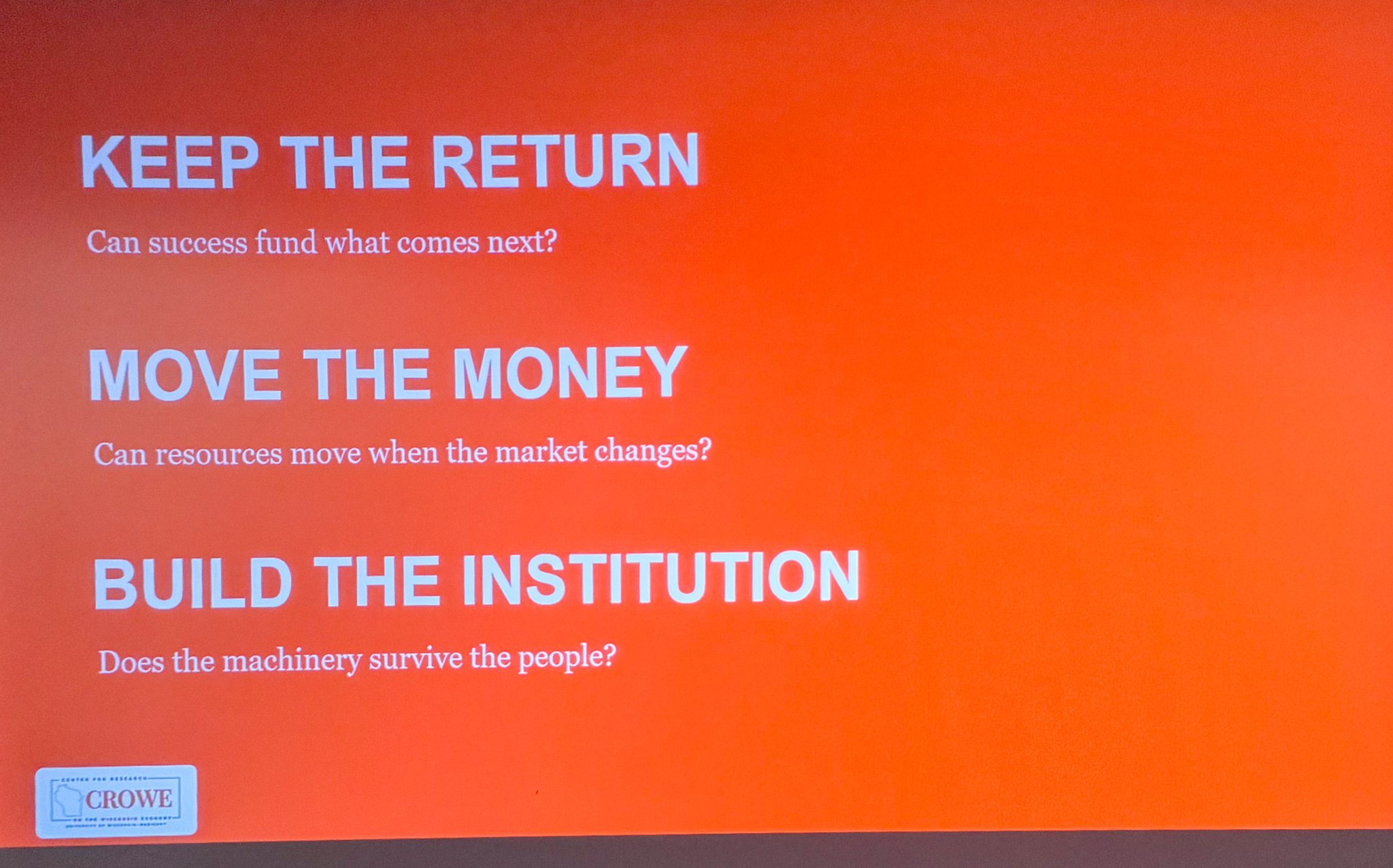
Move the resources around. Can resources move when, when the market changes rapidly? And build an institution around them, so does the machinery survive of the people? So 43:00 in some sense, if you enroll more and keep more and reinvest more, that would be my prescription for the NBA program. And the similarity here is enroll more and ne-negotiate for the next dollar.
Um, and so if your base budgets are just such that you wake up in the morning, you're like another state agency. I'm gonna look at your budget last year. What do I get from Un-uncle Sam, Uncle Wisconsin, and then wash, rinse, and repeat. And that's one model. Another model would be forward-looking and say, "Student demand is here. 43:30
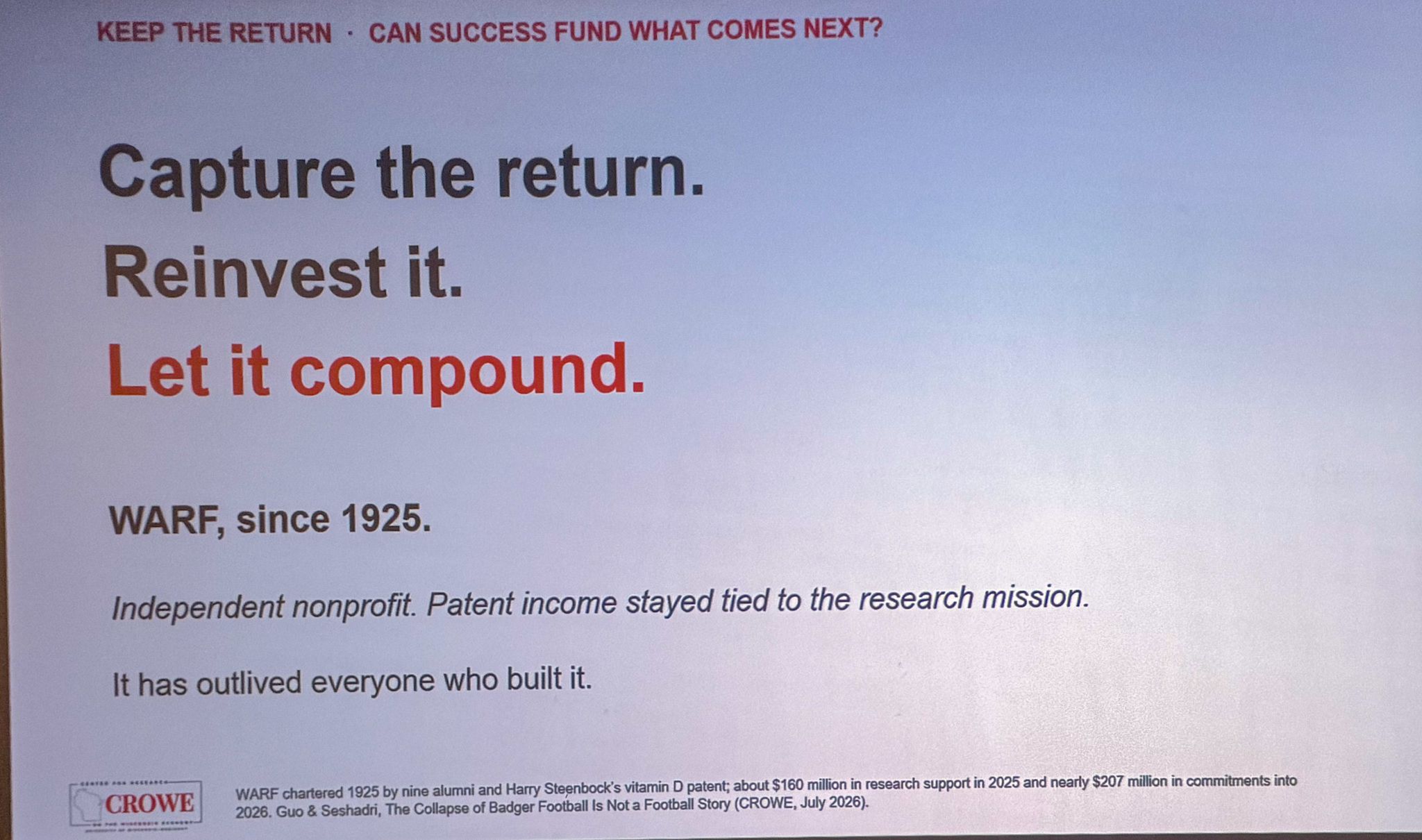
Half the student body is taking computer science, or lots of these kids are interested in finance, and so let's build a structure around that." Others did it, but they created an incentive to do so. So WARF is a really interesting example. I don't wanna spend a ton of time on WARF, but a hundred years ago, Steenbock wanted to give the money-- wanted to give the proceeds of, of the patents back to campus.
But then they said, "Oops, we don't wanna make sure there's no crowding out in economics language." So they created a separate structure. It's an independent nonprofit. Patent income is 44:00 open to everyone who deserves it. All right. So keep, move, build. What has to change? So let the budget move. Make the football front office permanent.
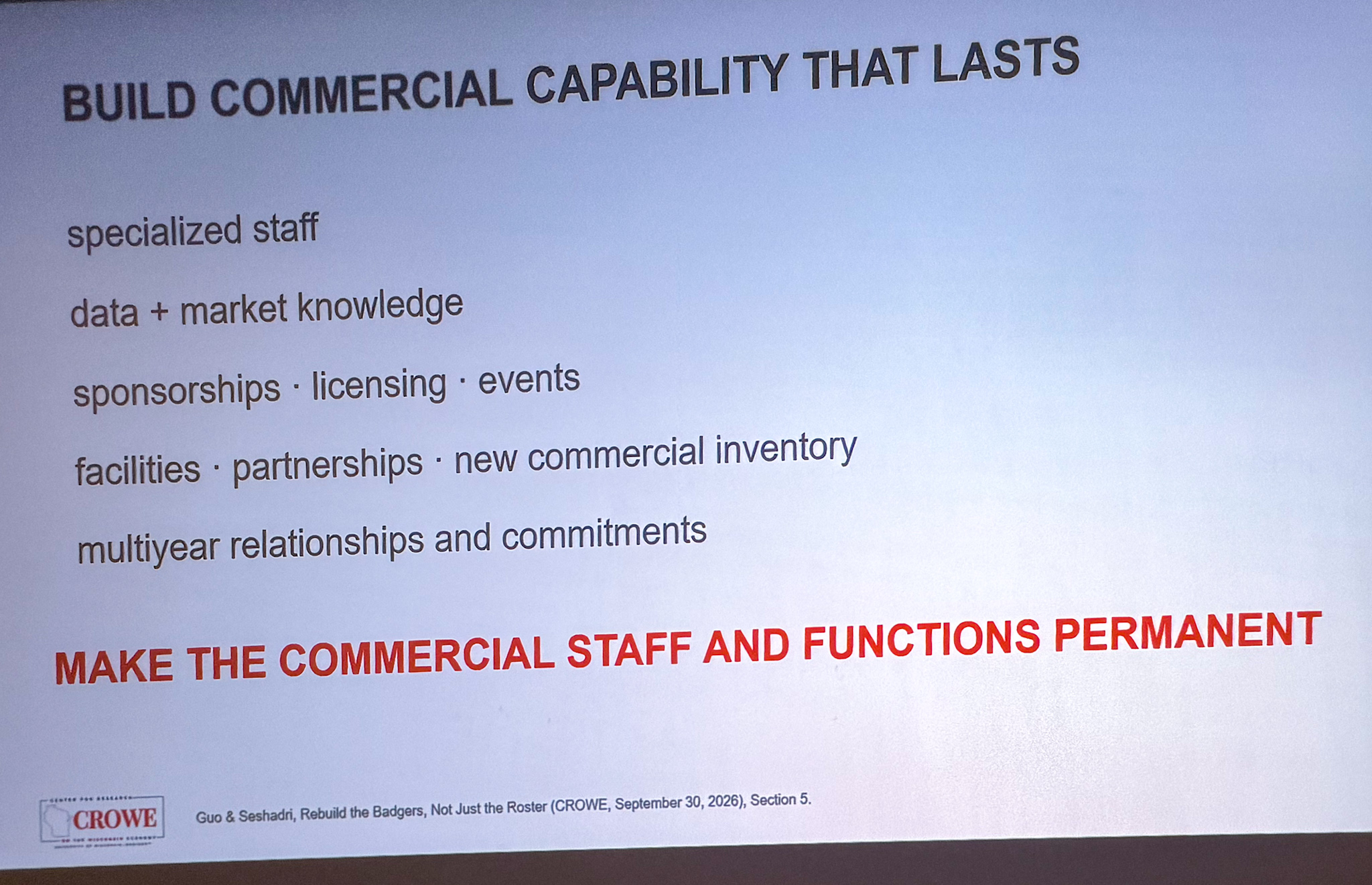
Build commercial lasting capacity that actually lasts. And this is the most-- probably the most significant one. I would-- I would still say tuition is, is important. It should be on the table. Um, students in the room should be paying more if you're in-state or out-of-state. But most importantly, let UW Madison have what's called bonding 44:30 authority.
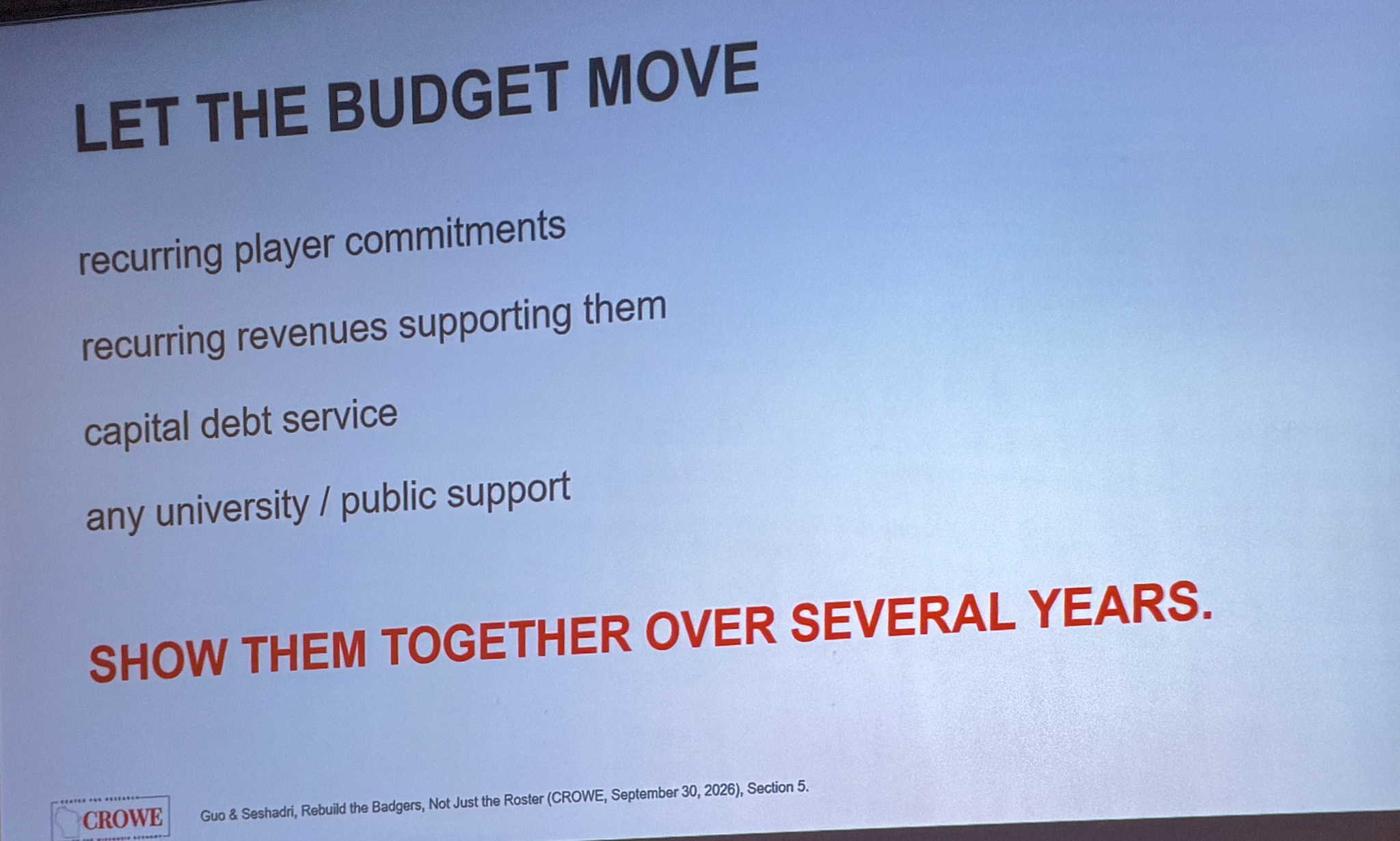
So you've gotta have recurring-- they have recurring player commitments, recurring revenue to support them, capital debt service. Uh, we have the university and public support, and it'd be nice to just see them, uh, and show them together over several years Um, I have-- I'm gonna skip through this slide- Sure
and the commercial capability that lasts. But let me go to governance. The, the people closest to football should obviously be making the decisions, 45:00
the faculty side. Sorry about that. But university-level oversight for, for long-term credit or bonding authority should be borrowing and long-lived obli-uh, obligations. So what do, what do I mean by that? So it makes sense to move fast on market decisions, which athletics is capable of doing. But then oversight, when the-- where the university, where it makes sense for the university to bear the risk.
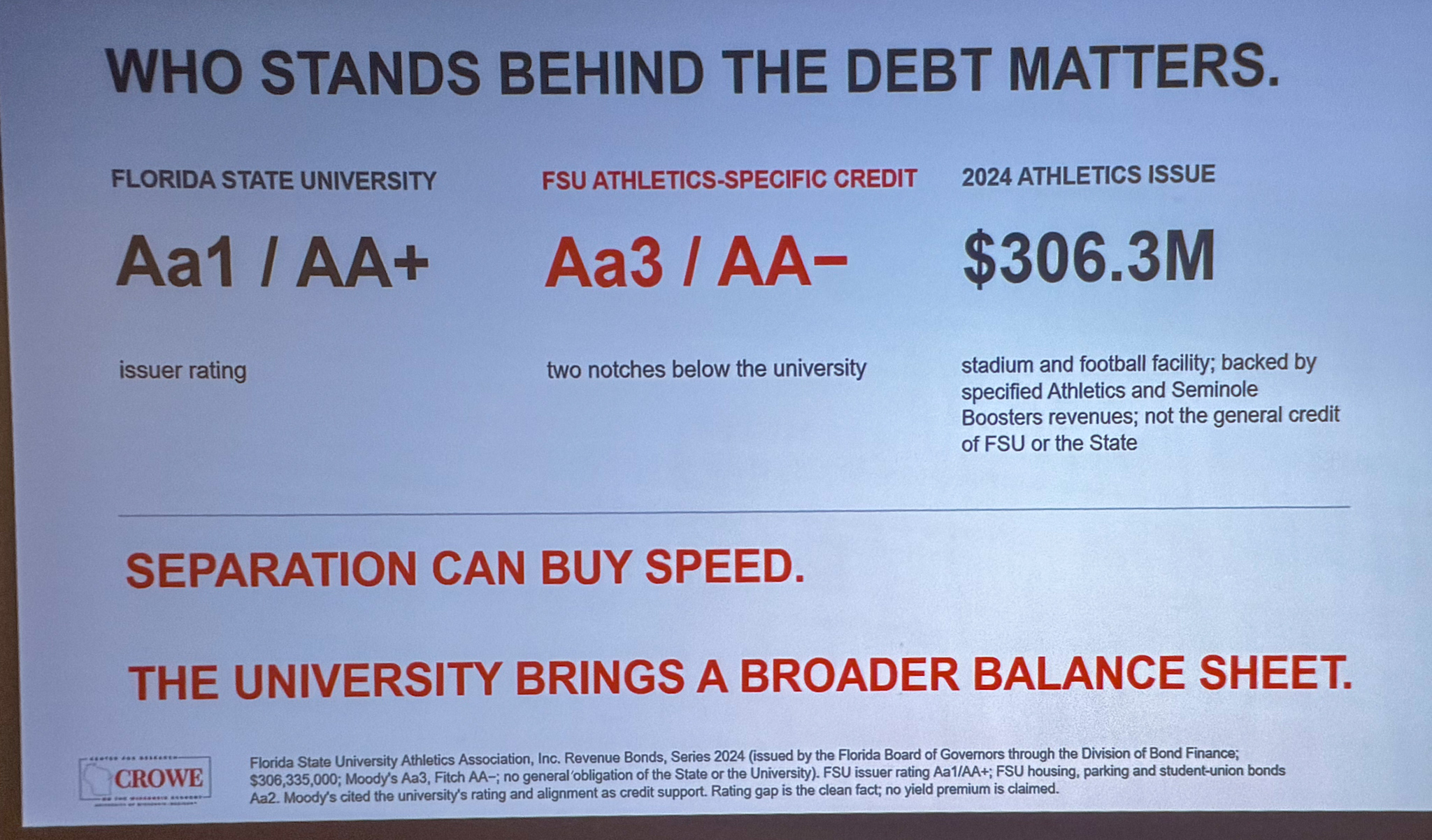
So who stands behind the debt matters. So Florida State is the only school that I know of that has a separate structure 45:30 of bonding for its athletic, uh, athletic-specific credit, credit and the university. And guess what? The credit that's available for the athletic-specific credit is two notches below the university.
Don't be shocked. If you go to issue these bonds and say, "You're the University of Michigan, I can have athletics department self-insure the university if they take the hit and the other way around," you can allow transfers to happen. There's risk-sharing. You get a 46:00 better bond rating, and you can borrow at lower rates And so this is an example where clearly university, the academic side and the athletic side are interconnected.
Okay, so separation can buy speed, but a university brings a broader balance sheet, and a broader balance sheet typically comes with better outcomes This is my favorite, uh, statistic. So till now, critique the university, critique the athletics department, sitting in this ivory tower 46:30 accomplishing nothing.
But this is what economists would call the second best. Seventeen to one, hopefully that's the score we beat Michigan by. And check it's legal. It's never happened in NCAA history where the losing team scores just one point safety. But seventeen Big Ten peers can access capital markets on university or system credit.
Capital, debt and who stands behind it
It'll be Madison County. So there are two main constraints facing 47:00 both the university system and athletics: price controls, capital controls. Price controls, I understand. Like, if you talk to someone in rural Wisconsin, they'll say, "Why should these elites in Madison be able to charge a higher price?" But at that, no one's saying, "Don't give Madison bonding authority."
Half or three-quarters of people don't even know what that is. So we cannot access capital markets, like, directly. Um, Wisconsin could not use the cheap capital window. So 47:30 in the twenty-tens, real interest rates were either zero or negative. Ohio State issued a hundred-year bonds. Berkeley did not. Their athletics department got into trouble, and the university had to bail them out.
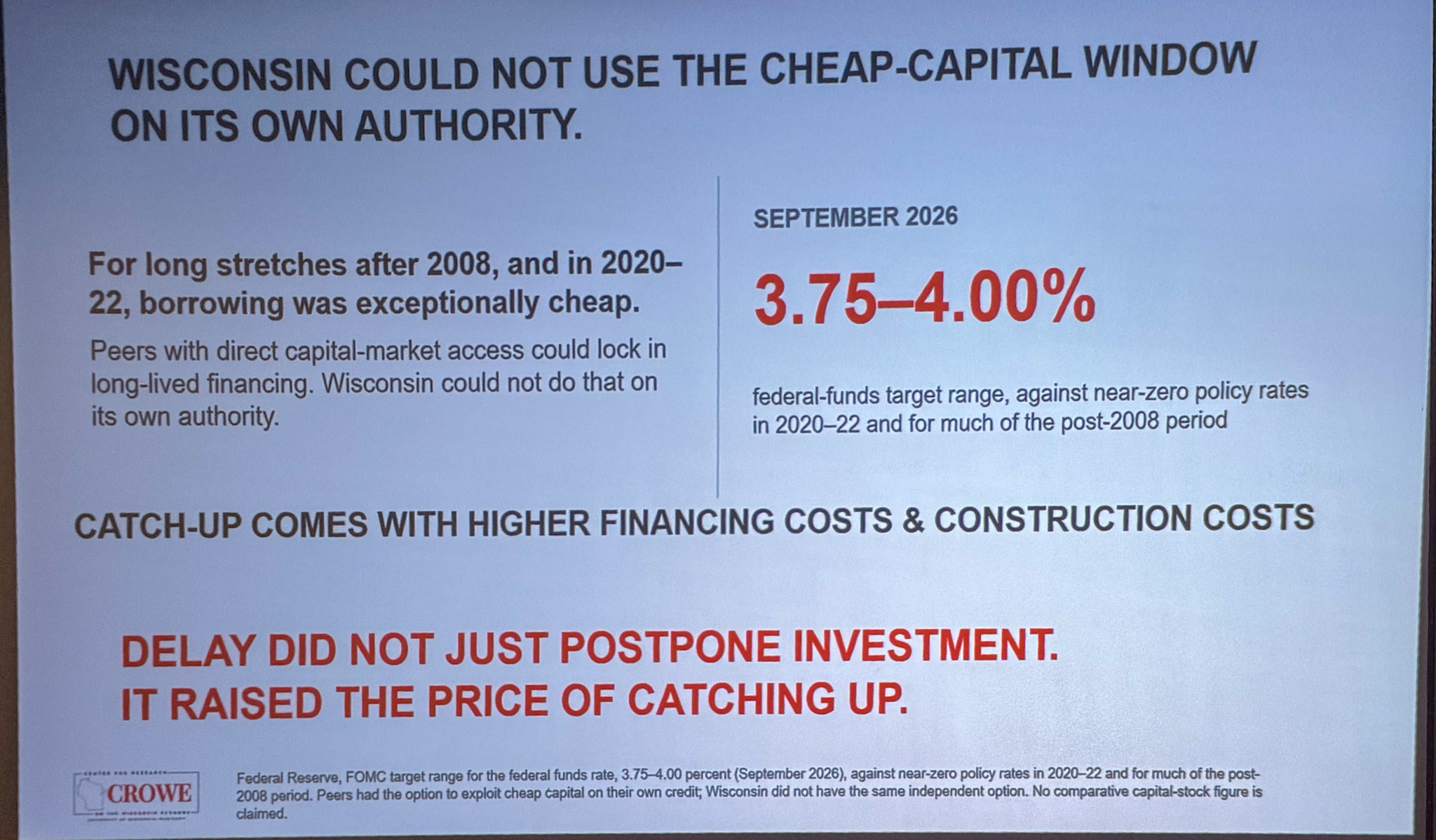
But they could do it because capital markets financing was very, very cheap. We could not do, do this. Like right now, the fed funds rate is close to four percent. The borrowing costs are much higher. So catch up now. We're building an athletic facility now. It comes with much higher 48:00 costs. So the delay did not just postpone this investment, it kind of raised the price of capital.
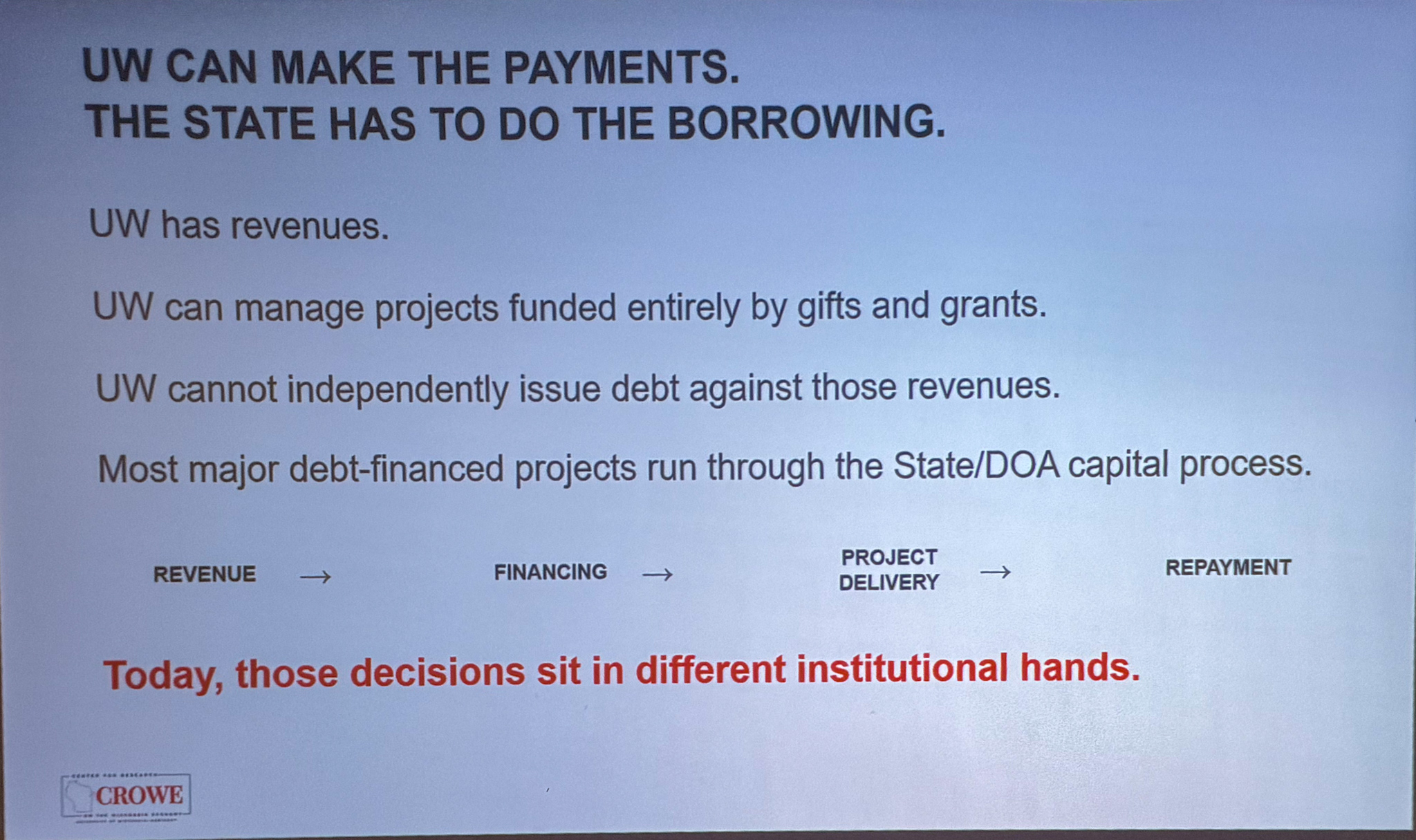
The way it works now, UW can make the payments, right? So if there's an athletic facility, the state has to do the borrowing and manage the project, which is the new way. But we have the revenue, but we can manage projects if you can get a billionaire to pay for all the building. Okay, I'm not even making anything up, just for the record.
Right? So if you can get a 48:30 billionaire to pay for all the-- every-- I think ninety-five percent of the building project, then you get out of the state system-- state procurement process. And but we cannot independently issue the debt against those revenue. Most major debt financed projects runs through the, the state DOA process.
Um, and this is a schematic of the way it works.
But today, those decisions sit in very, very different institutional boxes. So why universities share risk without, uh, blurring responsibility? 49:00 Athletics knows the play market. They know sponsors and donors. They can move quickly. The university has a broader revenue base and can bridge a temporary shock.
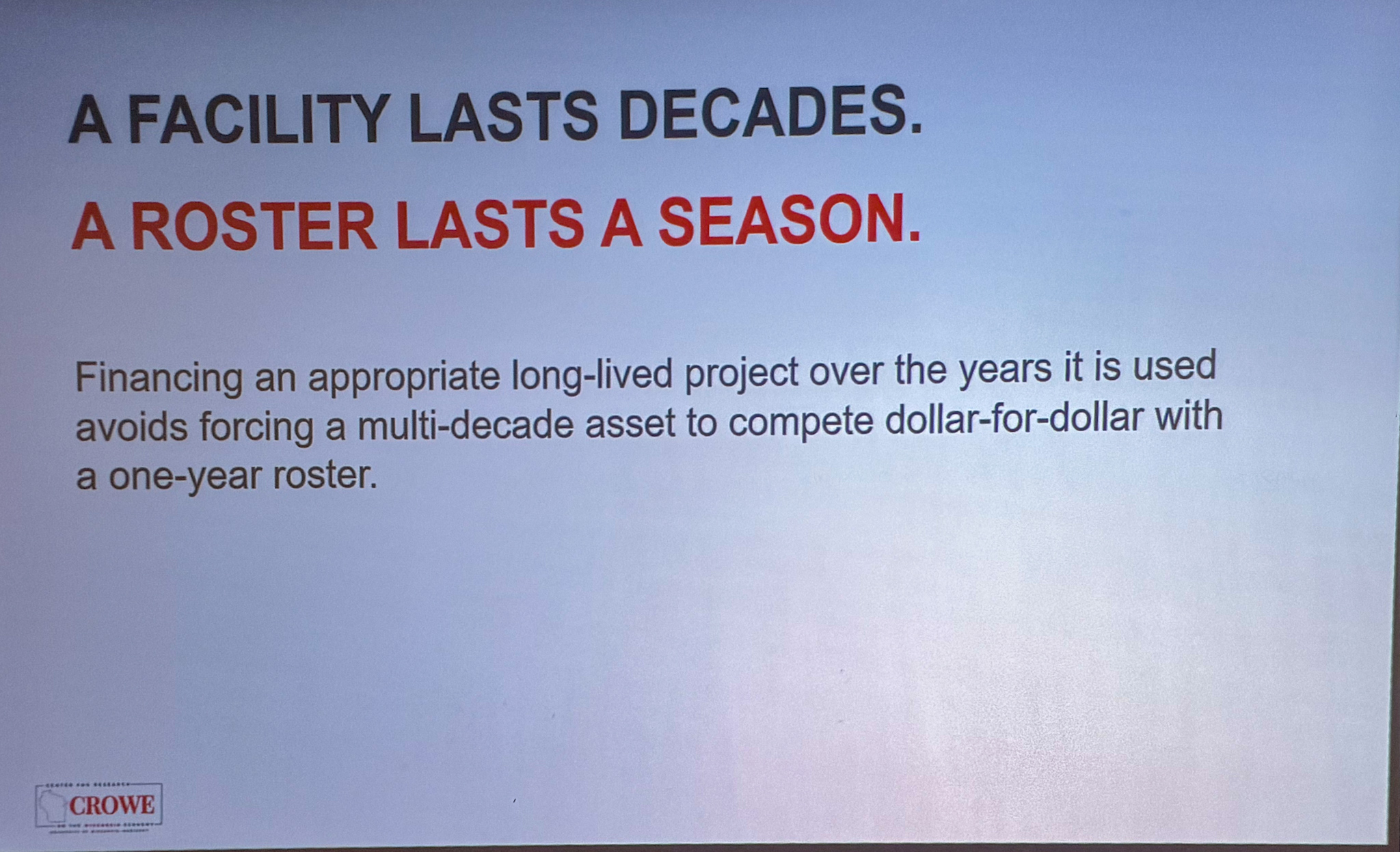
Um, this is important to keep those decisions, market decisions, close to athletics and keep-- and give the whole university credit so that there's some risk sharing So a facility lasts a decade, but a roster just lasts a season. And I think the most forceful way in which I can say it is financing an appropriate 49:30 long-lived project over the years it has been used avoids a multi-decade asset to compete dollar for dollar.
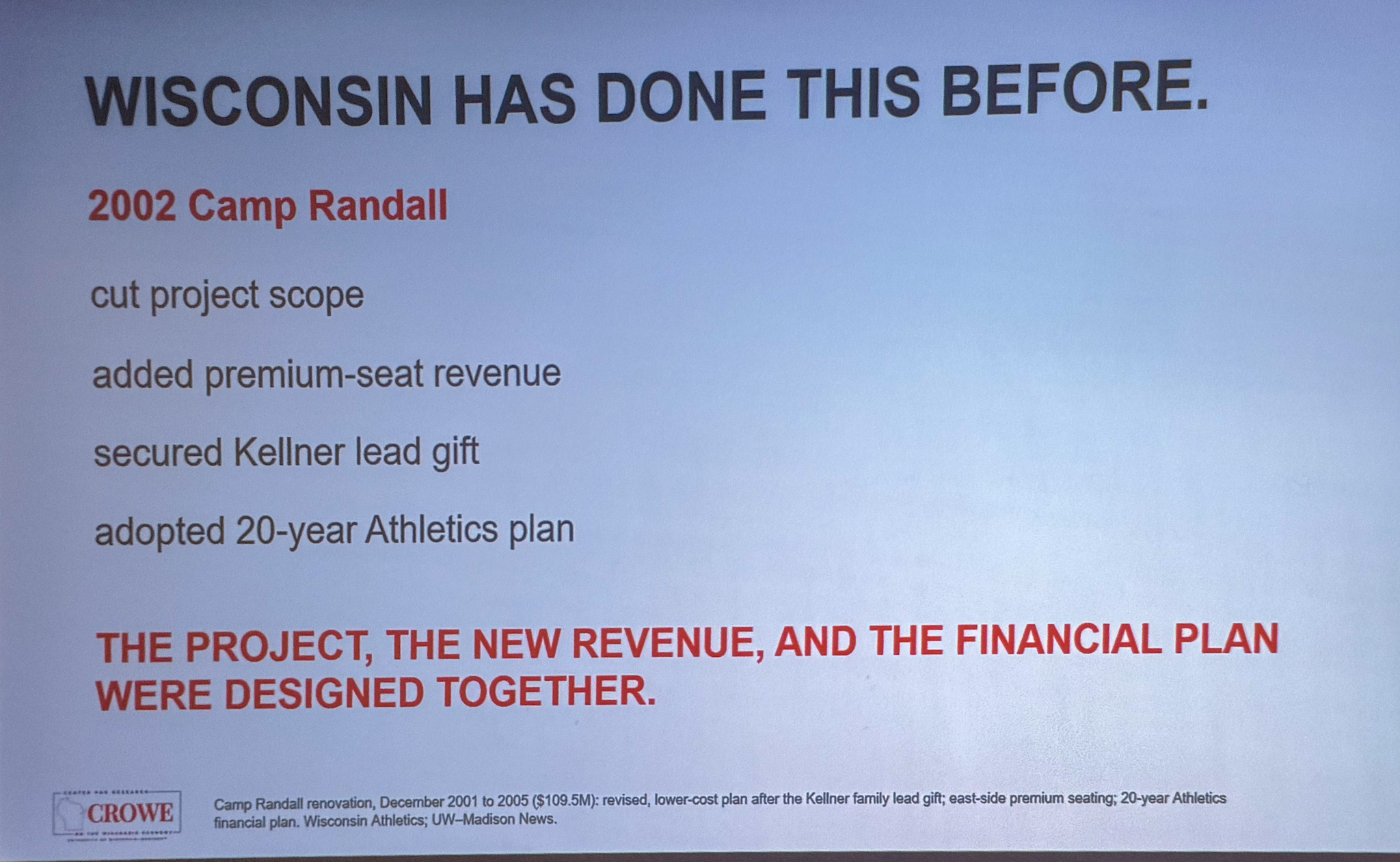
So I've actually had this conversation with Ted Kellner, uh, a major donor of the Kellner Athletic Facility, which I think was, um, was-- the plans for those w-w-were pre-NIL, so in twenty-- in 2020. But imagine that athletic facility could be financed over a fifty-year bond or a thirty-year bond, and maybe the donors would have had more resources to spend on NIL.
That'd be the most direct way to expose it. The trade-off would mean 50:00 forcing us to use donor money for long-lived assets when the rest of the civilized Big Ten-- rest of the Big Ten
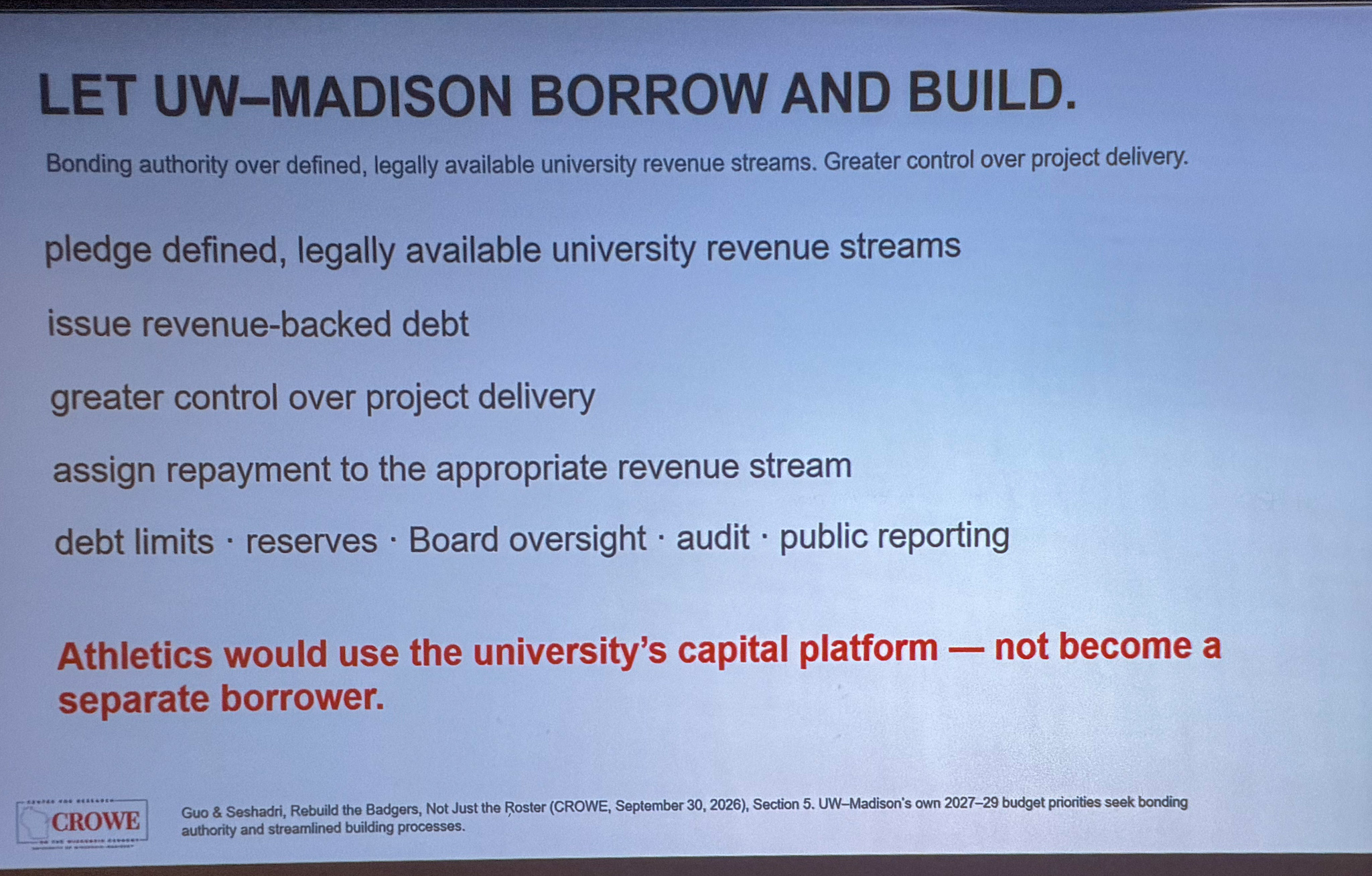
Okay. So we've done this before. Um, again, it was, it was Ted who gave a lead gift. Um, but I think I'm running out of time, so I have five minutes. It's a no-brainer to let us borrow and build. And I, I, I hope it's important that people recognize it's important for the whole institution. If not, the borrowing costs are higher for athletics.
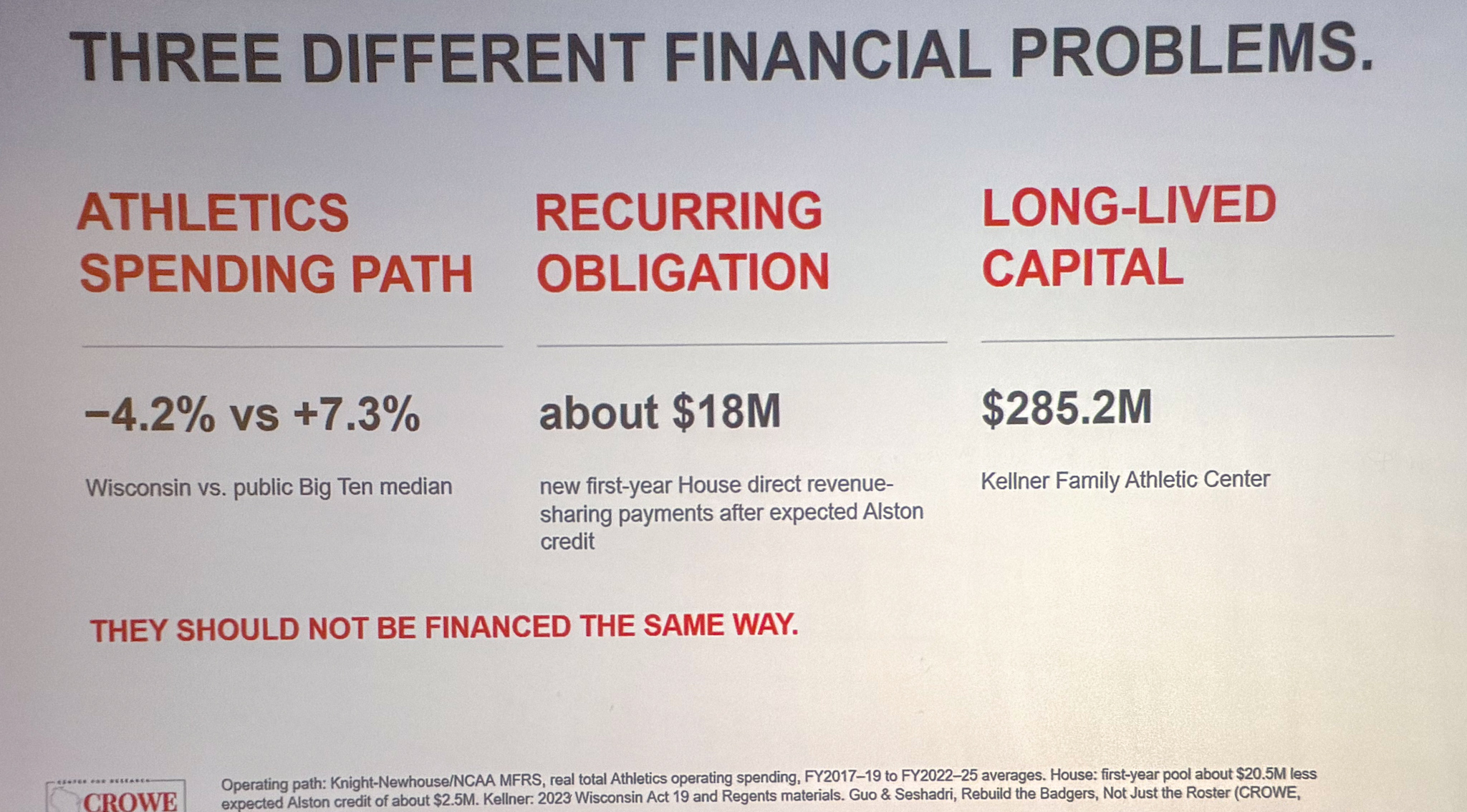
Those, those risk-sharing are much harder. So you can, like, issue revenue-backed debt, 50:30 greater control over project delivery, assign repayment to the appropriate revenue stream, and you can have audit and public reporting. No different than what you do for- Um, so there are three different problems: the spending cap, the recurring obligations, which are about eighteen million, and then the long-lived assets, which we're talking about.
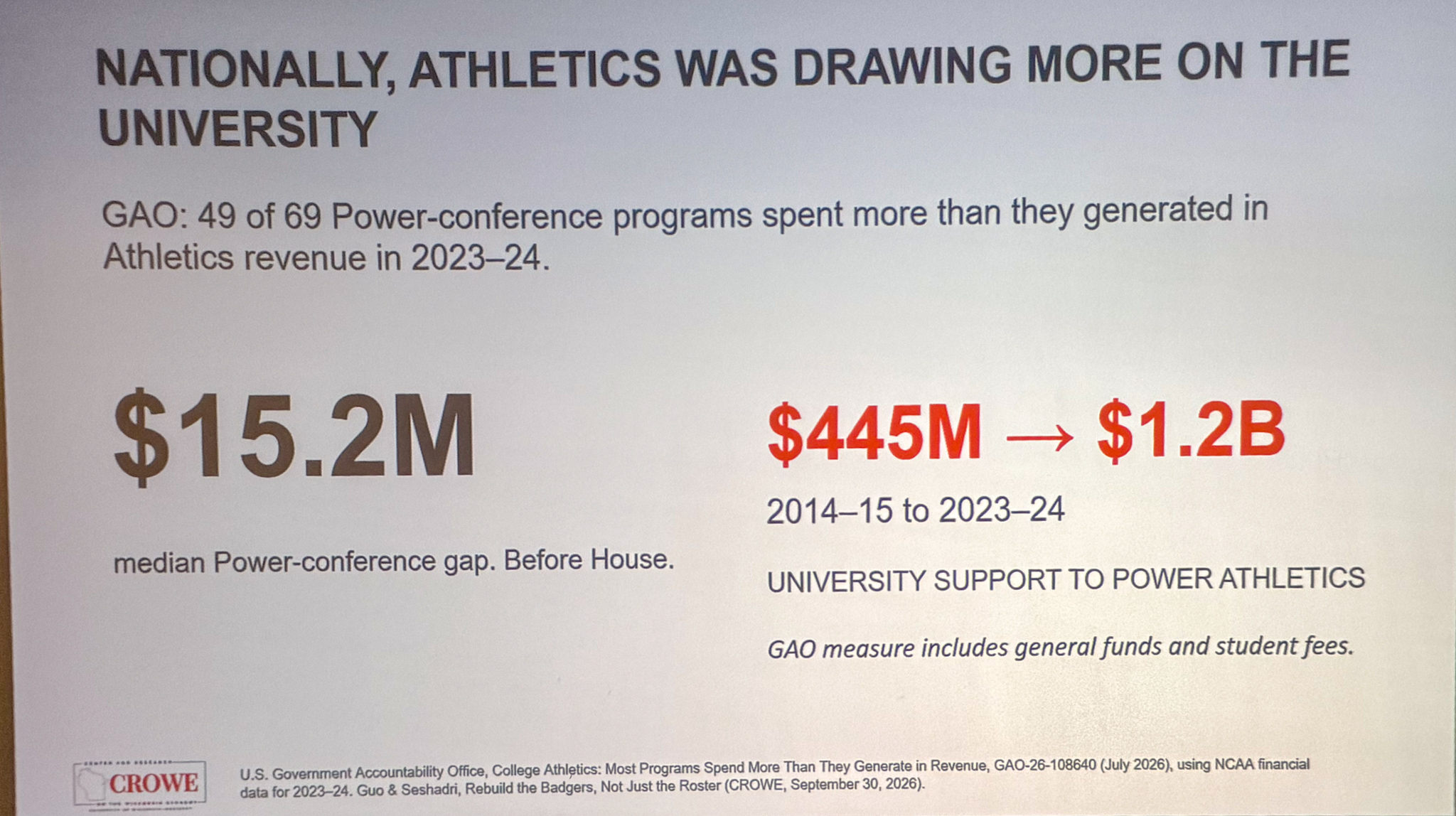
Um, and there's no good reason why they should be financed the same way So you have one capital asset that could be funded very differently than, than the spending. 51:00 Nationally, athletics was drawing much more on the university even prior to that IO, even prior to us, even prior to COVID. So forty-nine out of sixty-nine power conferences, not Wisconsin, spend more than they generate in athletic revenue.
But it tells you the scale, they were already under pressure. Right? About fifteen point two million was the median power conference gap. Um, and from-- Over the last decade, university support of power athletics went from four hundred and forty-five million to one point two billion. This is from the 51:30 GA. It's schools fees and fines.
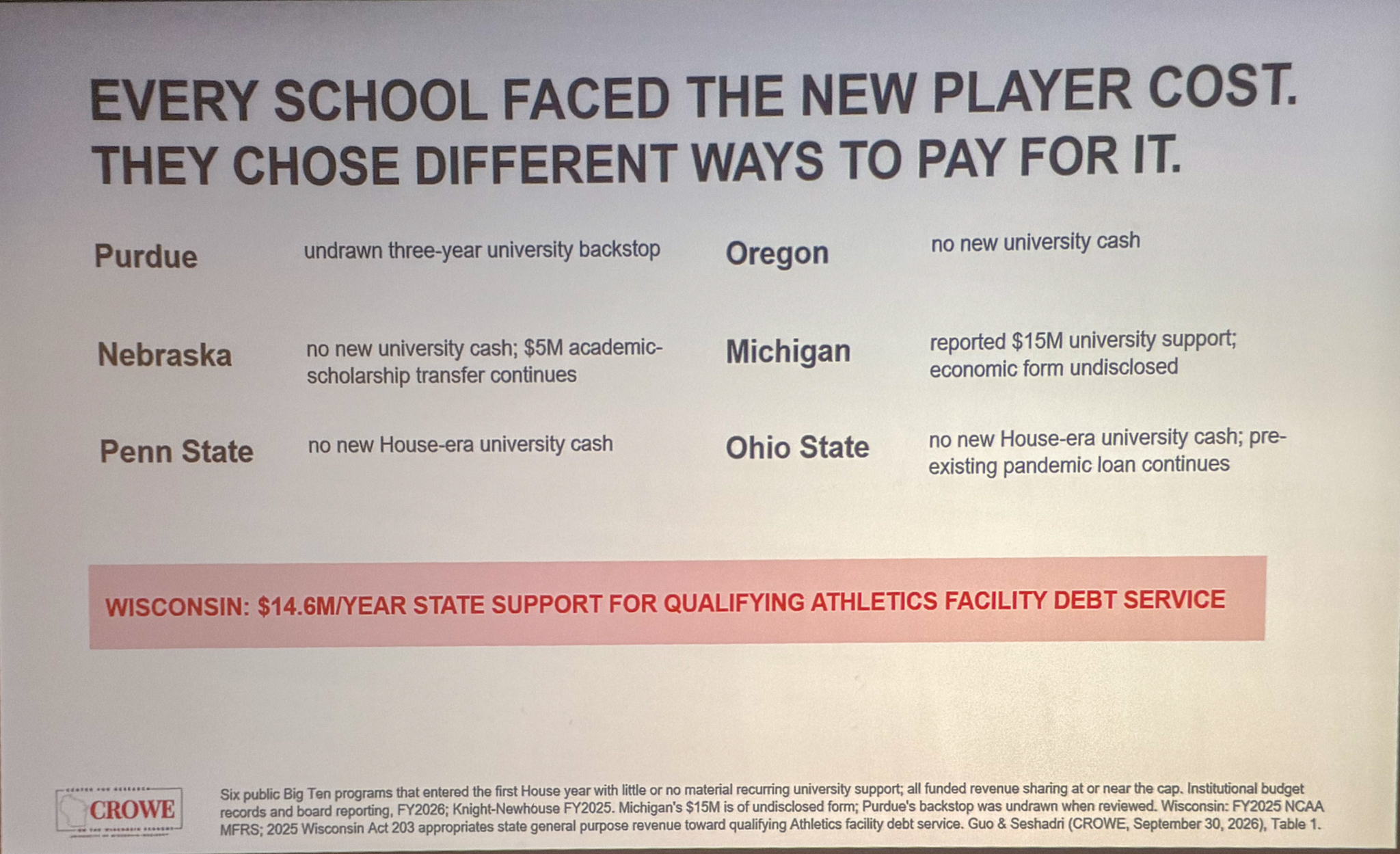
So every school faced a new player cost. Uh, Oregon didn't get cash. Michigan, the wealthy Michigan, gave fifteen million transfer from the athletics department. Um, Ohio State, uh, but pre-- There was a pre-pandemic loan. Wisconsin, the way we funded that is I think what you had mentioned, which is the fourteen point six million a year in state support for qualifying.
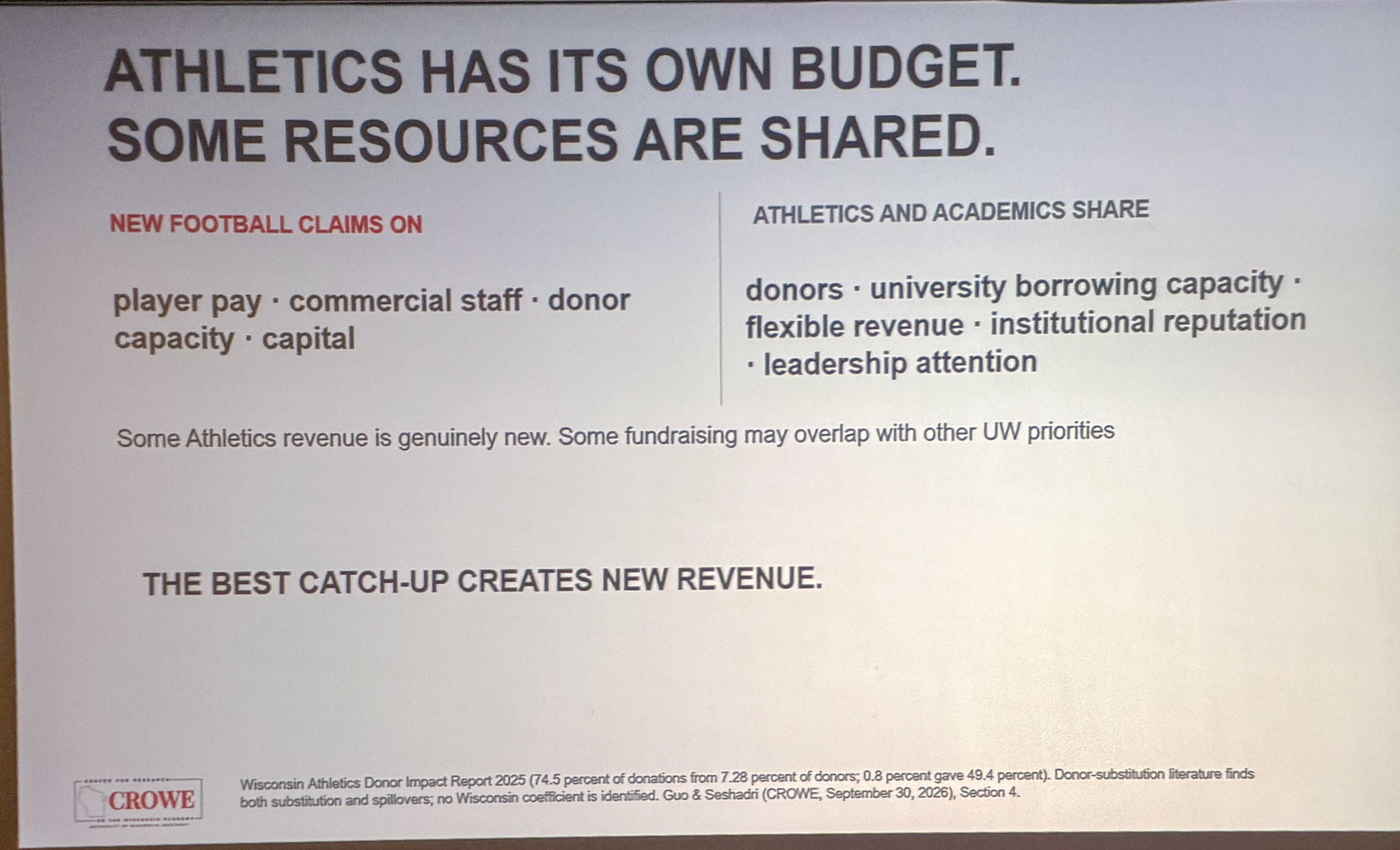
Um, so athletics has its own budget, and some 52:00 resources are shared, and, and there are new football claims on player pay, but athletics and academics share donors, university borrowing capacity, flexible, uh, revenue, institutional rep-retention-- reputation, and leadership attention. So clearly, there might be crowding in, there might be crowding out.
So Karl Scholz, you know, many of you know Karl, who went to Oregon, uh, who said, "We made this big bet with Phil Knight setting up shop," uh, I think he contributed big time to the NIL and just gave a one point one 52:30 billion dollar contribution to the engineering school, to create a new engineering school, um, at Oregon.
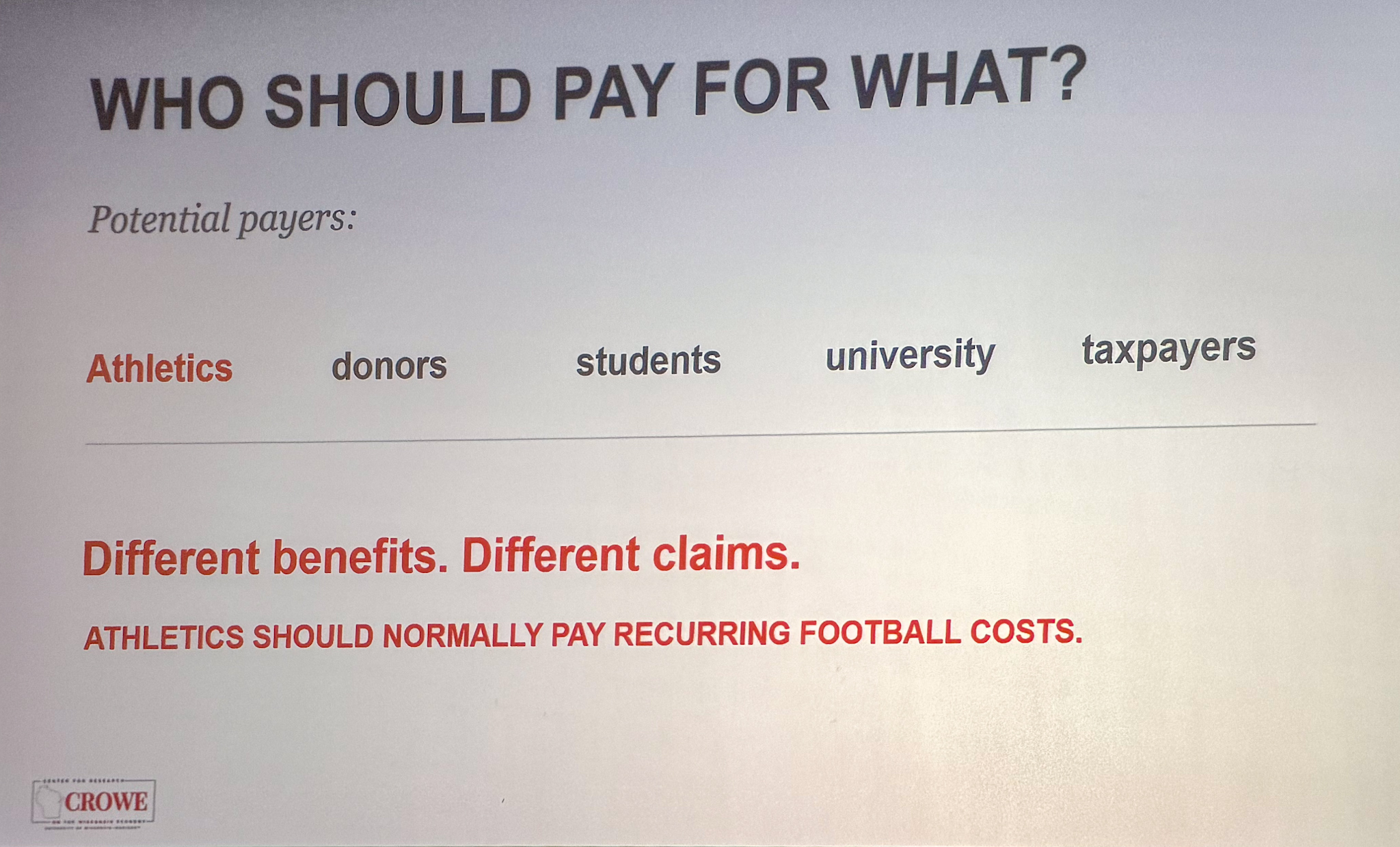
So there's crowding in and crowding out, so you can see both. But the best can opt out, can create new revenue. So now we, we get to the hopefully final question, who pays? Athletics clearly pays. Donors, of course, for those who love the Badgers. Students, you guys should pony up. Sorry if that's-- I've been a broken record, but you can't be paying, you know, bottom dollar for a great football experience.
Especially this afternoon. Come on, guys. 53:00 Someone write a-- someone write in the Badger Herald and say, "We wanna help athletics." And we should be helping, not want to help. You des-- they deserve it. The university, increasingly, and taxpayers. Um, different benefits, different claims, and athletics should obviously not only pay for recurring football costs, but we're transfers back and forth.
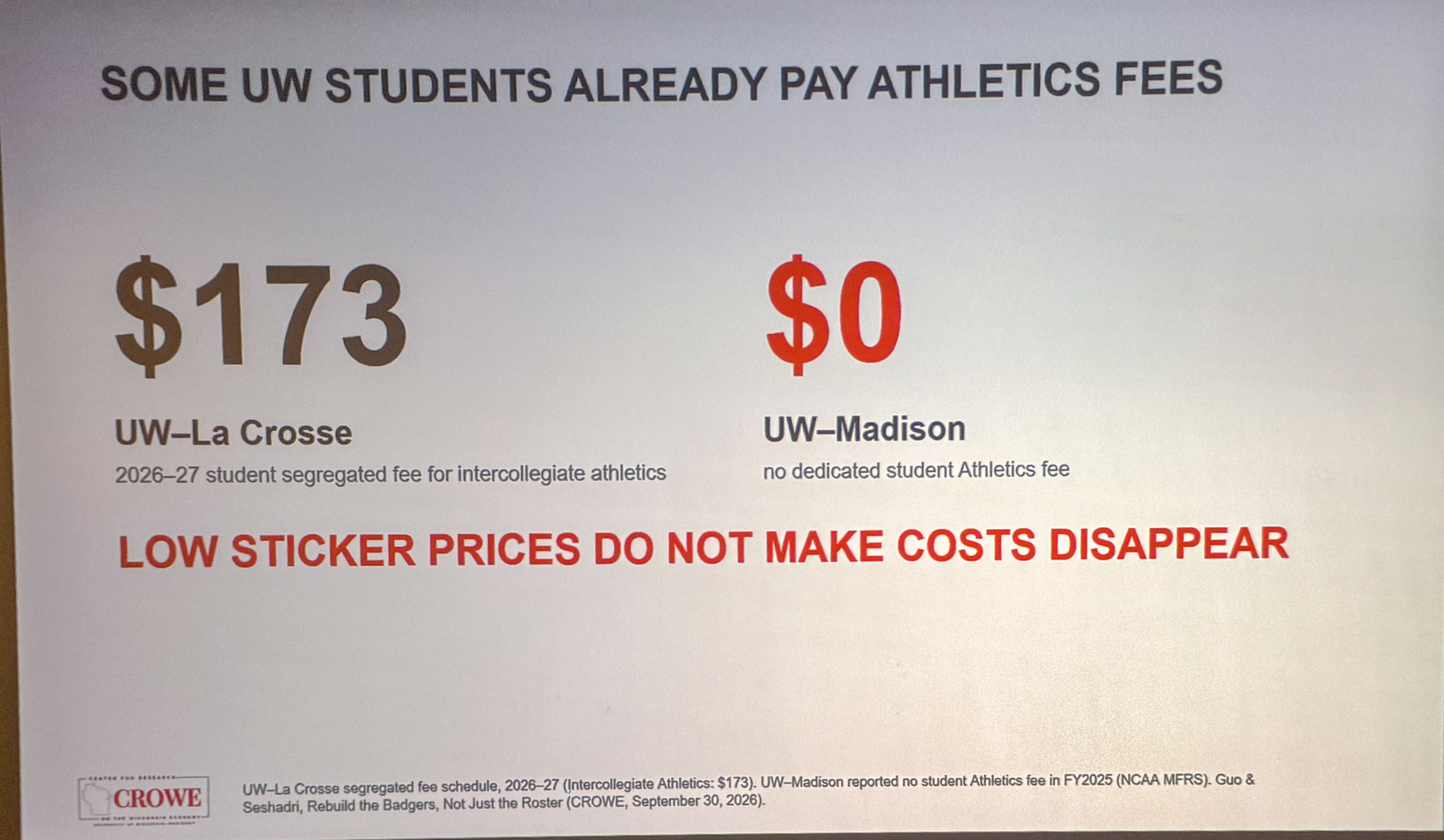
Um, it turns out UW La Crosse has a student athletic fee. I didn't know that, like, until, like, two weeks ago. At UW Madison, it's zero. So if you don't raise tuition, 53:30 we can raise the fees.
But in the lowest income pri-- you know, prices, uh, don't eliminate those costs or costs- All right, so this is nerdy territory. Chris Taber and I had this discussion. People, people love a dagger. So in economics lingo, that's in the utility function. That said, Warren, Dom, and I live in Michigan, so rather than living in neoclassical nirvana, I think I'll keep that in there.
Closing
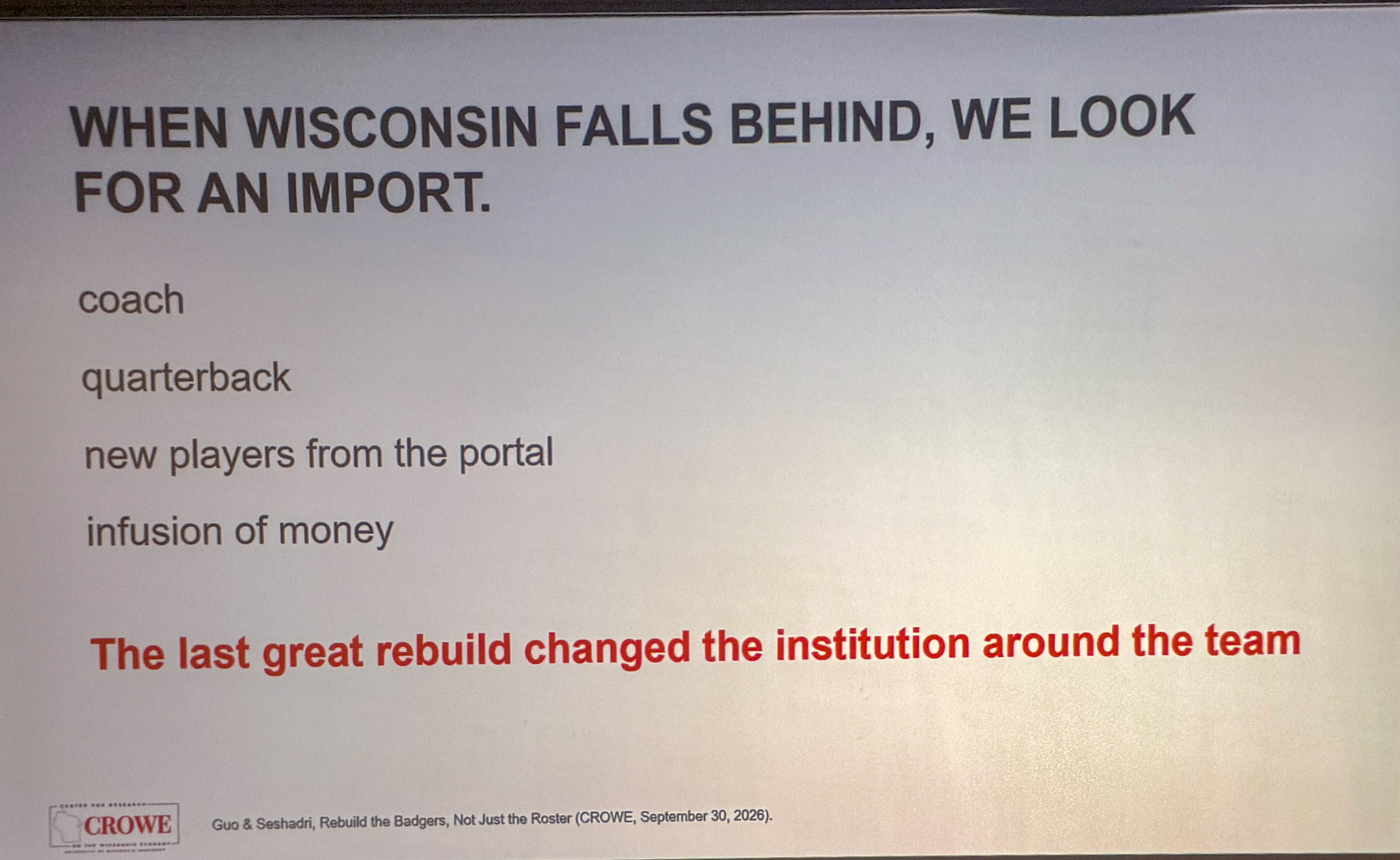
Um, so when Wisconsin falls behind, we look for an import, 54:00 a coach, a quarterback, new players from the portal, uh, infusion of money. And the last great rebuild changed the institution around it. So I'll end with this. The reform should not stop at football, and whatever the state proves willing to do for football, it has just no principled reason not to do it for the rest of the university Wann was das? 54:30
Yeah. So Ta-- where's Tammy? Tammy, where's the reception again? Three thirteen. We're having a reception at three thirteen, so if you have time, please come join us. Thank you all for being here. Thank you.