Transcript
The question
0:00 As someone who studies the American founding, this initial question prompts an immediate second question, which is: how can the American founding help us with this idea? And in particular, how can the American founding documents and the people who produced and discussed them help us determine some kind of answer?
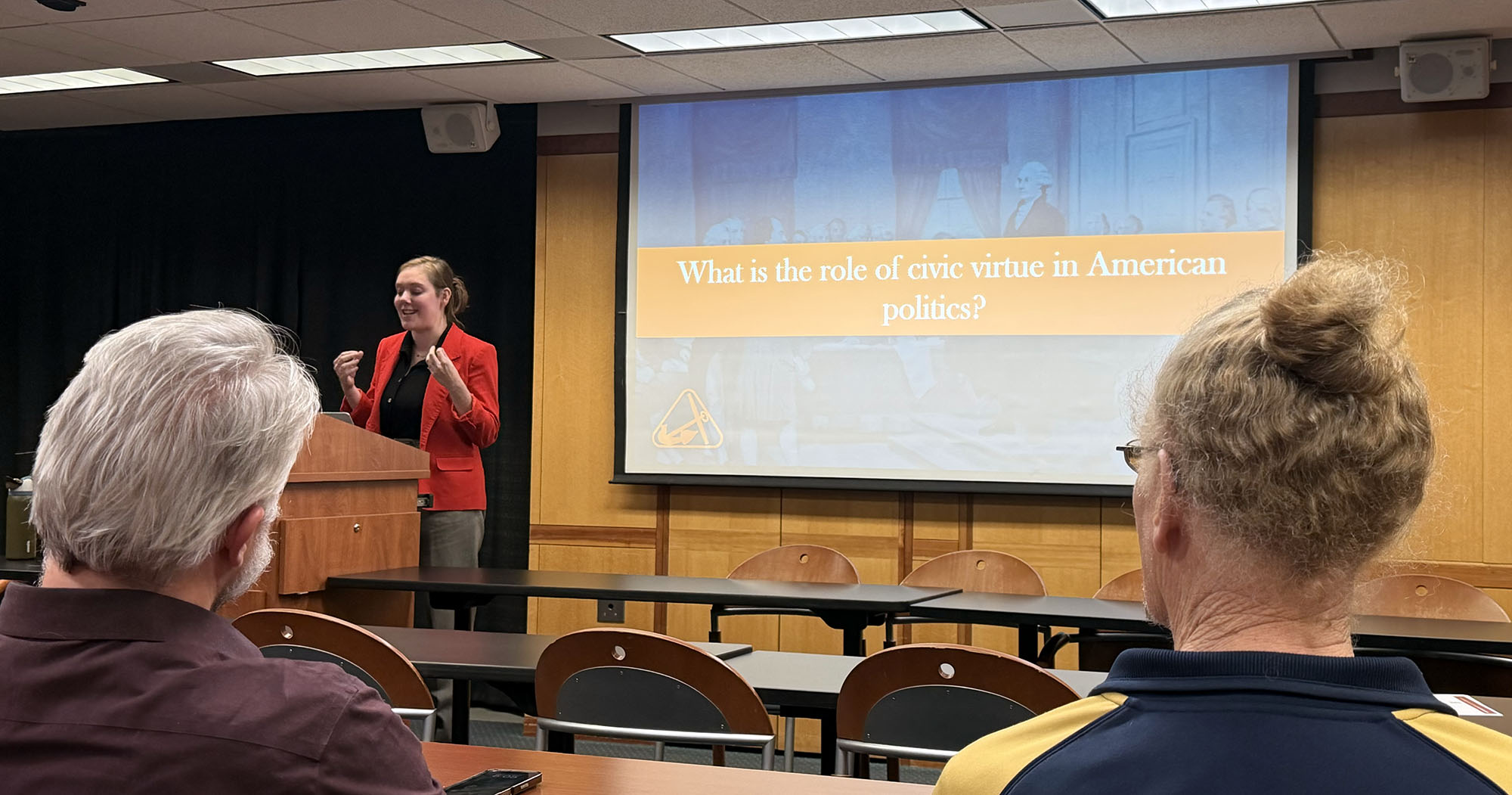
Do the American founding documents, especially the Constitution and the Declaration of Independence, give us a sense of what civic virtue is and how it ought to be protected? What kind of wisdom does the founding 0:30 generation have for us in this regard beyond the text of these just two central founding documents?
What the founders left out
Now, here's the thing about civic virtue and the men typically known as the American founders. Vanishingly few of them left behind a clear or consistent ethic for understanding what civic virtue for the average American ought to be or look like, and even fewer of them articulated the role of the founding documents into the, in de-- into developing an idea of civic virtue.
Maybe a, like, 1:00 far outlier would be someone like Benjamin Franklin, but even in his moral writings, he's not really incorporating the founding documents into his vision. Uh, it seems as though generally the canonical founders, your Hamiltons, your Jeffersons, your Madisons, and the like, viewed the founding era as the process of a people creating a politics.
And across the board, they generally paid a lot less attention to the idea that this new science of politics would 1:30 also in turn create a people whose behaviors, habits, and mores would play an essential role in upholding the new political order. It's not just that a people are creating politics, it's that a politics Now, this isn't to say that no one during the founding was thinking or writing about civic virtue, especially with regards to the founding documents.
It just turns out that these people were actually mostly women. Uh, and I mean, the reason we forget 2:00 about them is relatively straightforward. No women were permitted to debate the Constitution in Philadelphia. No women signed the Declaration or served on the Continental Congress that approved it. Uh, the women of the founding did not possess voting rights, and coverture laws ensured that many married women retained little legal identity themselves.
They couldn't own property, for example. Their primary modes of participation in their politics were not by way of enshrined legal rights, but by 2:30 way of civic engagement and participation, the education of children, the fostering of community, the practice of dignified labor. So it makes sense that given this backdrop, many of the women who wrote about American politics put a premium not on legal rights and institutions per se, but on the social and interpersonal dimensions of politics and citizenship.
So it's the women of the founding who actually best articulate how American politics were going to shape an American people, and 3:00 how the founding-
It just turns out that these people were actually mostly women.
Enter Mercy Otis Warren
So with all of this in mind, I want to investigate the thought of Mercy Otis Warren. Well, I actually already have, but I want to tell you about it. Uh, and I want to glean what wisdom she may have for us on the practice of civic virtue in the United States and the role of the founding documents, uh, that they play in upholding those practices.
This project examines two major works by Warren, 3:30 her seventeen eighty-eight essay, Observations on the New Constitution, which is a pointed critique of the document, and her two-volume History of the American Revolution, which is published in eighteen oh five and is her most complete expression of her political and philosophical viewpoints.
The thesis
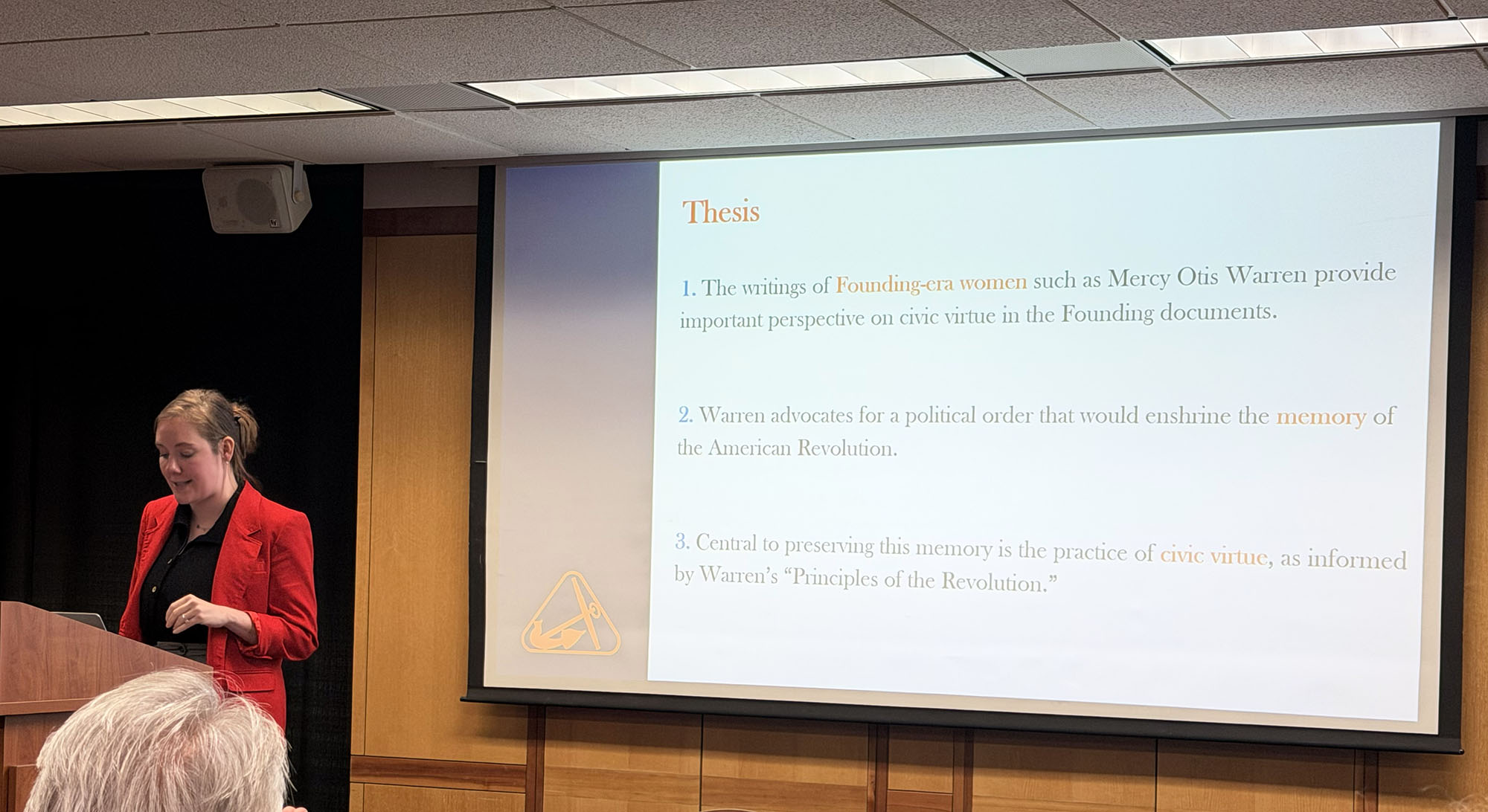
Using these works, I analyze Warren's thoughts on civic virtue, the Declaration of Independence, and the Constitution. And from this analysis, I have gleaned the following tripartite thesis. 4:00 First, the writings of founding era women, such as Mercy Otis Warren, provide an important perspective on civic virtue in the founding documents.
We want to find where people are writing about civic virtue and these documents, the women who are doing it. Second, within Warren's writings, she advocates for a political order that would serve the memory of the American Revolution, asserting that such a memory is necessary for the upholding of liberty over time. 4:30
Uh, and that her reservations regarding the Constitution especially flow from her doubts that it would do so. Uh, this memory of the American Revolution is of ultimate importance for Warren in upholding basically everything we might hold dear about the American order. Finally, that civic virtue is, for Warren, necessary for preserving the memory of the American Revolution, and it is the practical exercise of what she termed the 5:00 principles of the revolution.
I want to demonstrate this thesis today mostly by way of storytelling. First, I'll give you some background on Mercy Otis Warren, who she was, how she thought, why she's important. Uh, and then I'll dive into her writings, beginning first with her seventeen eighty-eight essay, Observations on the New Constitution, which, as I've said, uh, expressed some of her early concerns about the preservation of liberty and civic virtue in the United States.
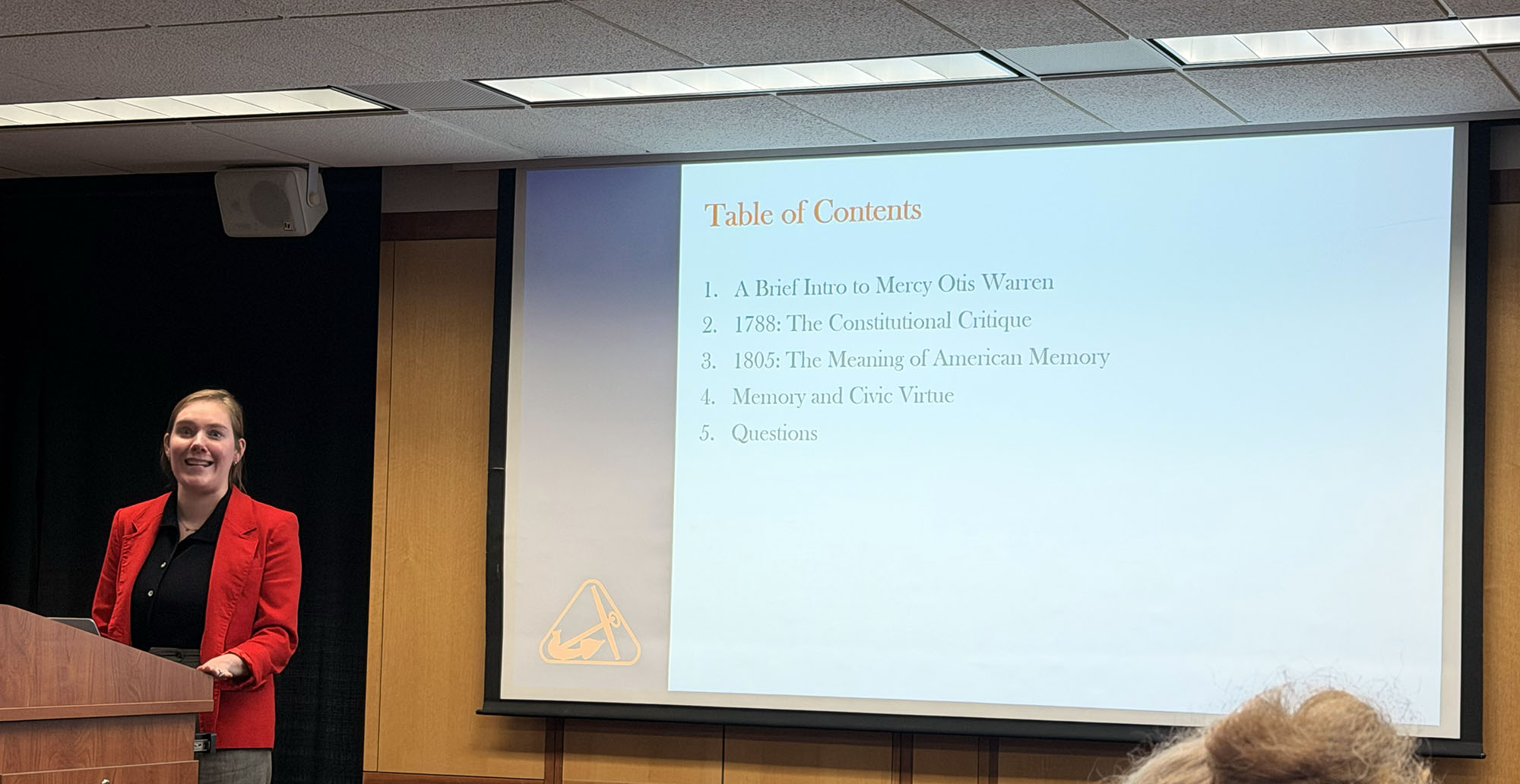
And then I'll continue on to that eighteen oh five History of the American Revolution, 5:30 which more clearly spells out her vision for practical civic virtue, uh, and the preservation of civic virtue in the new nation under the Constitution. And then I'll conclude with some overall thoughts on Warren's theory of memory and its relationship to civic virtue.
A biography
And from there, I'll be delighted to take any questions that you may have. Uh, but let's dive in and begin with a bit of biographical history here about Mercy Otis Warren. So Mercy Otis Warren is born 6:00 in seventeen twenty-eight, which means by the time the revolution hits, she's almost fifty. She's a fully mature woman.
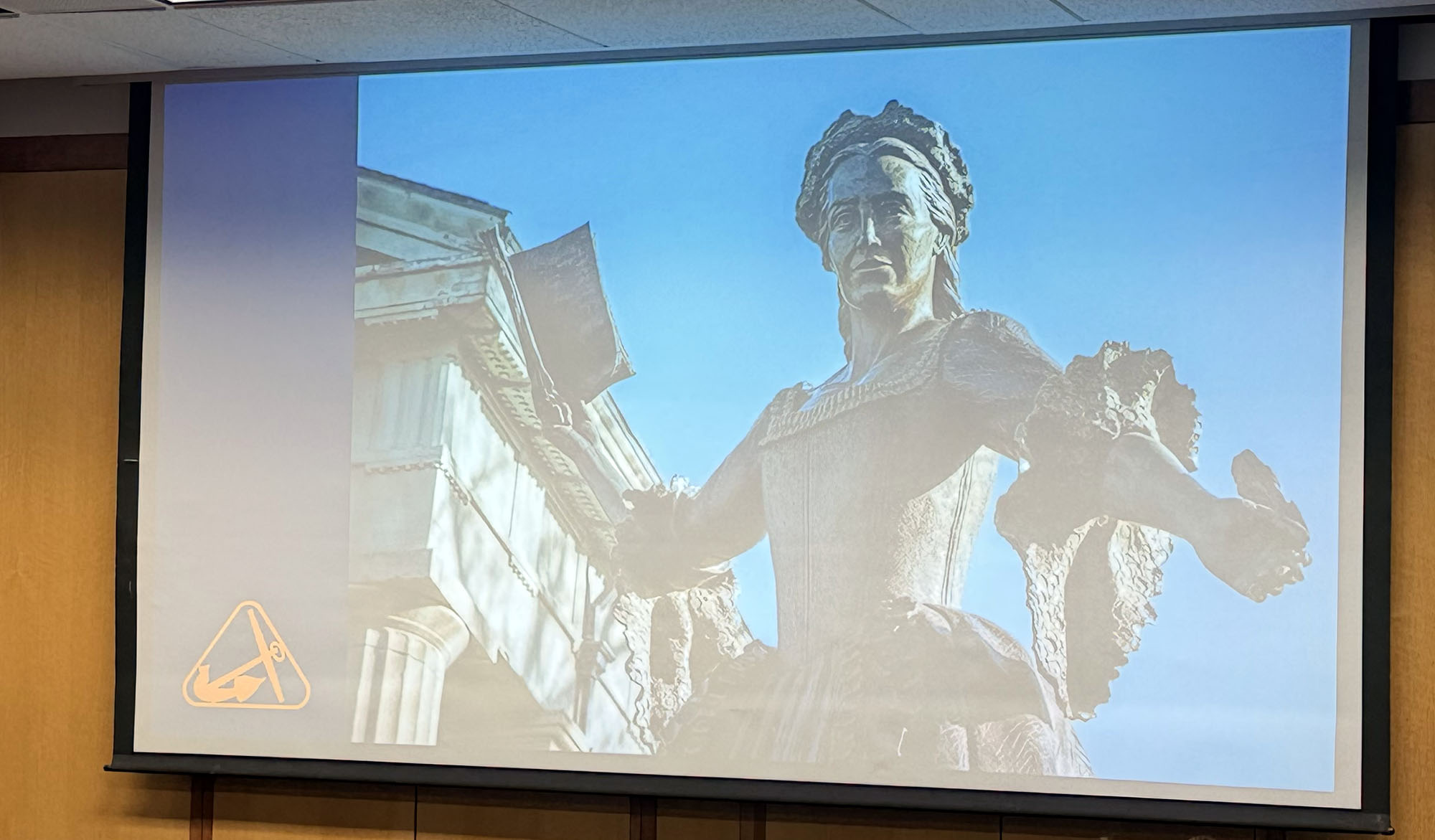
She's had five sons. Uh, her husband is an extremely important man. James Warren is a major general in the Massachusetts militia. He's a prominent Son of Liberty, and Mercy Otis Warren herself is a really important person in New England. One, she is descended from fine Puritan stock. Her family can trace its lineage all the way back to the 6:30 Mayflower, uh, making her a member, basically, of the Massachusetts Also, when she is quite young, she receives this very unusual experience for a woman of her time, and that is, is, uh, she receives an education meant for a boy.
Basically, what had happened is she had two brothers, two older brothers, uh, and one of them decided... They were being educated by a local reverend for entrance into Harvard, which was the family school, and, uh, one of her brothers 7:00 decided that he wasn't going to continue on with his education. He wasn't destined for higher ed.
He didn't wanna continue on with his tutoring. And her father, realizing he was already, you know, out of pocket a bunch of money to this tutor, decided to just send his daughter in his place. So she ended up receiving a pretty quality education for her time, education in many of the important thinkers of her day, uh, and becomes a kind of formidable intellect all in her, uh, her own right.
Uh, and according to many of her biographers, this is 7:30 likely why she marries a little bit later. She's twenty-eight, I believe, when she gets married, which is on the older side for her moment. Uh, but like I said, she married James Warren, and James Warren certainly was, uh, more than a match for her, an equally intellectual and important person.
Publishing from 1774
Uh, she first publishes in 1774, so right at the outset of the Revolution. And at this point, she was something of a land lady for the Sons of Liberty. They were gathering in spots throughout New England. One of the primary locations that they 8:00 gathered was at the Warren homestead. Uh, and as a result, she's in the mix of a lot of these conversations that people like John and Sam Adams, and of course, her husband, are having about i-the issues with Great Britain, the potential for independence.
Uh, and in 1774, she writes a poem. Uh, it's a propaganda poem, and it reflects on the events of the Boston Tea Party, and she shows it to John Adams. And John Adams, who is on record all over the place as just being, 8:30 like, out of his depth when it came to Mercy Otis Warren, he thought she was way too smart for him to ever be in a room with, uh, read it and said, uh, "You publish this, or I will publish it for you."
And she sort of shrugged and said, "Okay, you can publish it for me." So he did. He published it for her under a pseudonym, but this begins a publishing career, uh, in which she writes a lot of things centered on the politics of the day. She's an essayist, a play, a playwright, a poet, uh, and an anti-federalist.
9:00 I think that that's not, uh, a minor point of her biography Uh, as things begin to develop down the lane, she actually becomes what Herbert Storing would call one of the most philosophically integral, uh, Anti-Federalists. She has a kind of sophistication about her reasoning that is actually absent in a lot of her fellow Anti-Feds.
So she writes throughout the Revolution and the founding eras. Uh, some things that she cares deeply about, the concept of individual liberty 9:30 is her most prized value. She considered herself a Lockean. Uh, her older brother, James Warren, when he was at Harvard, he sent a copy, uh, of a collected works at that time for Locke, uh, back to her, and they read it together and exchanged ideas.
James Otis actually is a, uh, really important early figure in the Sons of Liberty leading up to the Revolution, her brother. Uh, and he, somewhat tragically, gets into an altercation with a British 10:00 officer, gets caned over the head, and is never quite the same, suffers a traumatic brain injury. So this, like, bright light of the early Revolution is snuffed out, but not before he had exchanged all these ideas with his sister, and she carried those ideas with her, um, really through the rest of her- Um, she was really skeptical of popular figureheads.
She was terrified of the idea of demagoguery, that there would be a figure that everyone would become so enamored with that that person could collect up power, uh, and encroach upon people's individual liberties. Uh, it's for 10:30 this reason she's always a little bit wary of Washington. Uh, she never quite buys into all the hype.
She's on record being relatively respectful, but not nearly as effusive as many people of that moment were. And like I said, she writes these two really important works: the essay that we're going to look at first, and The History of the Rise, Progress and Termination of the American Revolution. Uh, a little note on that history.
It is often panned by modern historians as being factually inaccurate, and it is. Uh, it 11:00 is absolutely factually inaccurate, in part because she wrote it from memory, which was a method of doing history at that time that was perfectly acceptable. And also, the history is really kind of secondary to the other things she wants to do with the work, which I will get to talking about in just a second.
The ratification debate
So, those are the basics of Mercy Otis Warren. I now want to get into her role in the constitutional conversation. All right, seventeen eighty-eight. The ratification conventions are happening. The Constitution has been presented to the 11:30 states for their approval or disapproval. Uh, we have something of a tug-of-war.
Um, this is not an AI image, by the way. An actual artist made this image. I cred-credited him. Uh, between the Federalists and the Anti-Federalists. The Federalists, of course, are represented by people like Hamilton, Madison, and Jay, writing together as Publius. You read that, you know, assigned reading for American civics classrooms.
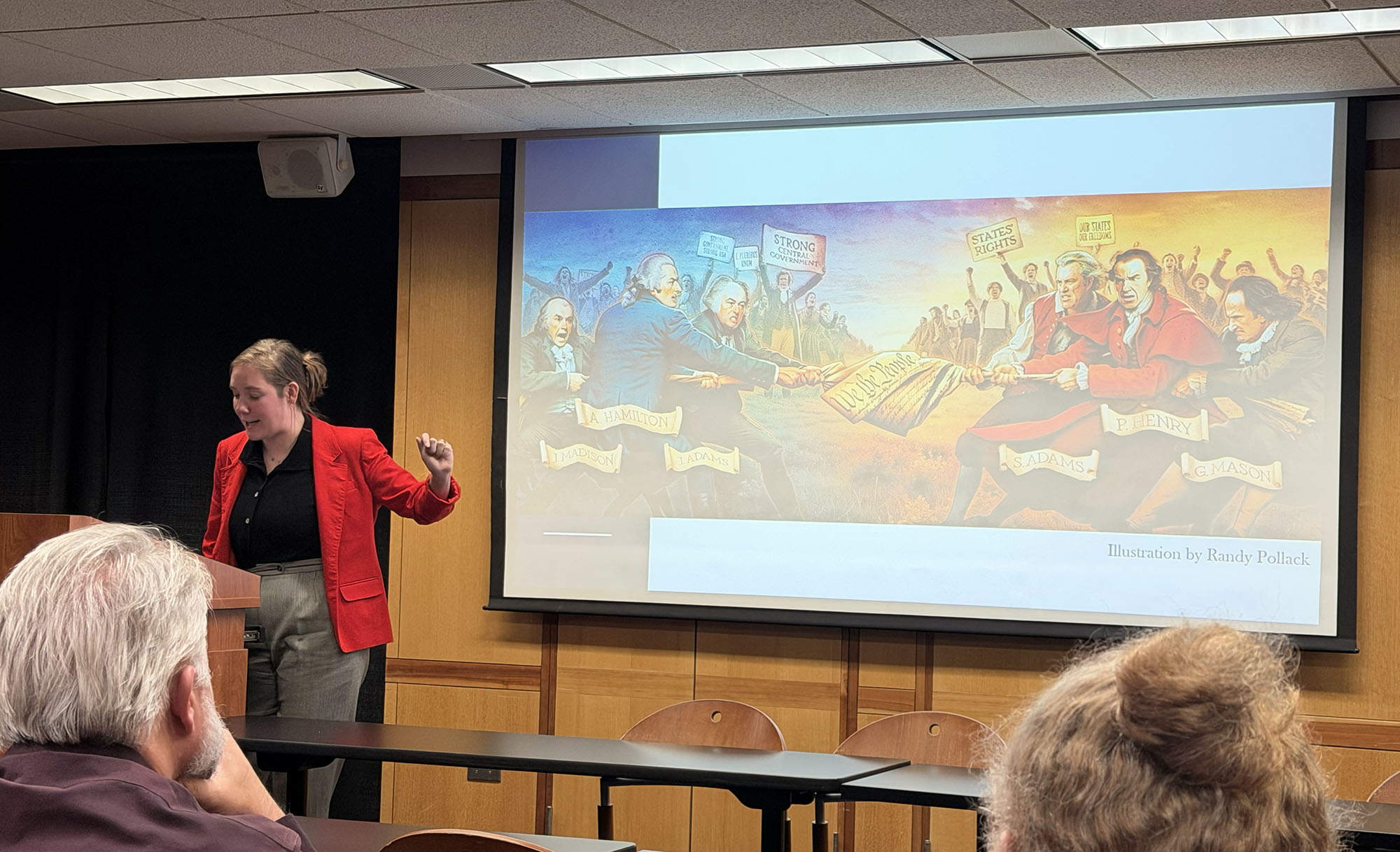
And then on the other side, we have a more, uh, diffuse, uh, you know, less kind 12:00 of coherent movement among the Anti-Federalists. The likes of people like Cato, Brutus, and Sentinel, who broadly oppose the Constitution for, but for a lot of different reasons. Uh, Anti-Federalist concerns included things like, uh, the diminishment of states, the concern that, you know, these previously relatively sovereign entities under British salutary neglect, the states would become subservient to a federal government.
Uh, the concern that individual rights, with the diminishment of 12:30 states' rights, would also become, to some degree, infringed upon. And then, uh, kind of across the board, the potential tyranny of this federal government, not only in its existence, but in its construction. Uh, and then into this conversation wades Mercy Otis Warren with Observations on the New Constitution.
Who wrote Observations
Uh, side note here. Observations on the New Constitution, until relatively recently, was thought to be written by a Founding Father called Elbridge Gerry, from whose name we also take the term 13:00 gerrymandering. Uh, we now know definitively that he did not write it, but it is in fact Mercy Otis Warren's writing.
But it, it's a relatively recent, uh, change that we know that that was her. Uh, and when you read this essay, maybe superficially, or at least it's been put to me, that this essay reads like kind of standard anti-federalist fare, right? She's concerned about the diminishment of state and individual rights, tyranny of the federal government, et cetera, et cetera.
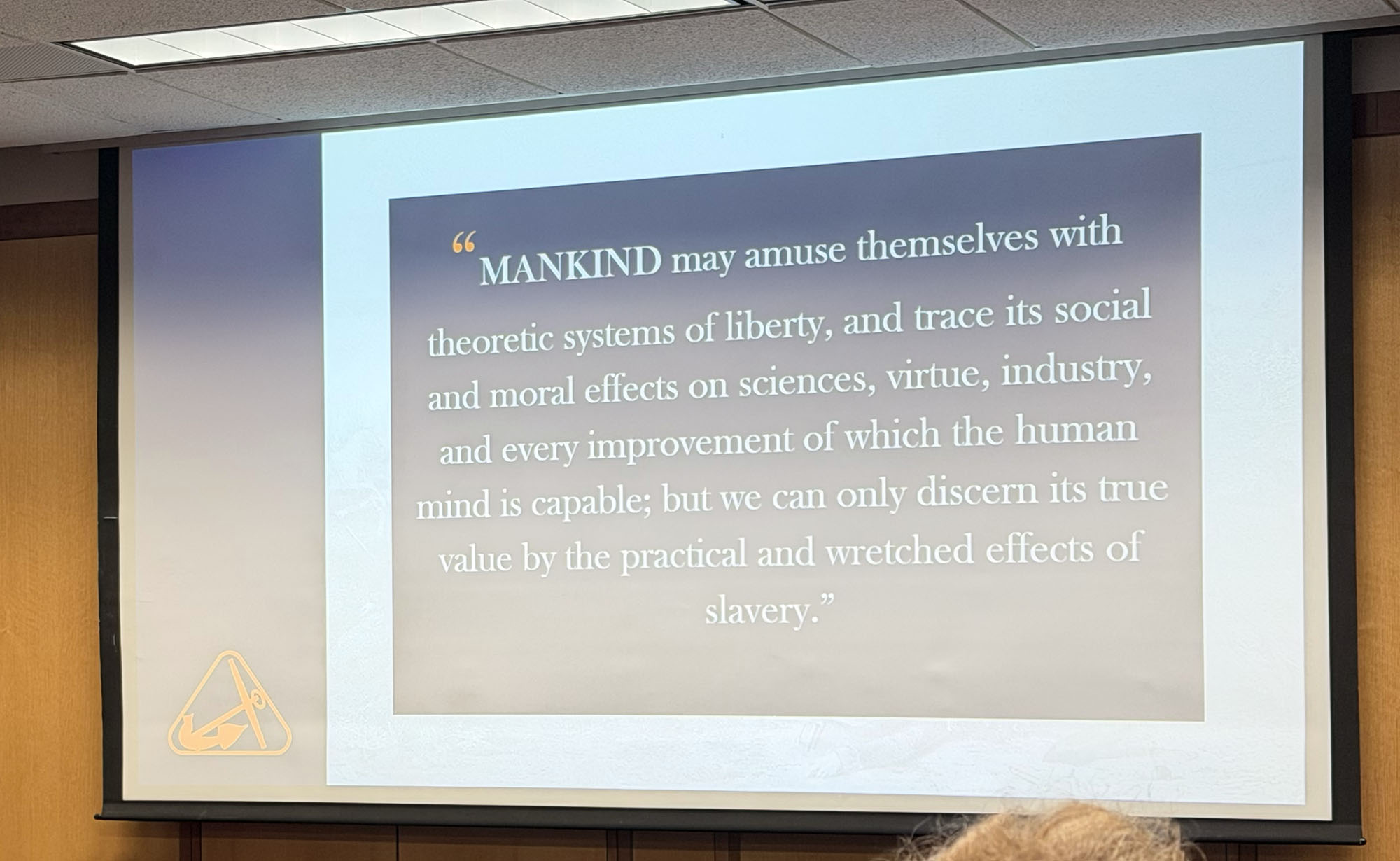
Uh, I think ultimately this isn't the case. There's something really unique going on here. 13:30 And the good news is, is that we don't have to wade very far into the essay to get to the thing that is unique about Warren. It's in literally the very first line, which I'm going to read in a minute. She writes that, "Mankind may amuse themselves with theoretic systems of liberty and trace its social and moral effects on sciences, virtue, industry, and every improvement of which the human mind is capable.
But we can only discern its true value by the 14:00 practical and wretched effects of slavery." So I'm gonna put it to you guys that Warren, in this essay, which is a long time in advance of her later history, is sort of setting up what she's going to do with her history of the American Revolution. She cares about the past, and she's going to start by analyzing the past in this very first line.
Theoretic systems of liberty
She's going to analyze, in particular, what she calls these theoretic systems of liberty, these 14:30 theoretical regimes that have existed in the past, and she has a few in mind, in particular, Greece, Rome, and Great Britain. These are, uh, republics that have, at some point in history, come to some great theoretical truth of how to operate a good politics.
And for Warren, that's always gonna be bound up in liberty. These are, uh, regimes that have come to know the importance of liberty for politics. 15:00 But the problem is, is that ultimately this is just purely theoretical knowledge. So these regimes, the likes of Greece, you know, Rome, and Great Britain, have at some point served as the torchbearers of liberty in the world, right?
They have set the example, but eventually they fall, and they fall particularly as em-empires, as oppressors themselves. And for Warren, this is because 15:30 of a particular kind of forgetfulness about why liberty is important. As she says, "We can only discern the true value of liberty by the practical and wretched effects of slavery."
What makes us know that liberty is needful is not having it. And once we've secured liberty as some kind of center of our political order, it doesn't take us very long to start forgetting why we need it. Uh, and the effects 16:00 of this for Warren, uh, she's going to write about it later on, are always going to lead to empire.
Uh, eventually, people get obsessed with their luxuries, with their decadence, with having more, with using the freedom that they have to acquire things. And when that happens, there's potential to become oppressive. And once you become oppressive, you've forgotten why liberty is needful. Okay? But Warren thinks this is an important and unique moment, right?
A chance to break the cycle
The American 16:30 Revolution is happening, the Constitution is up for consideration, and there's an opportunity to break this cycle of history, to be more than a theoretical regime of liberty. But in order to break this cycle, the United States needs to remember, or its people need to remember, what it means not to be free.
And the way they do this, Warren says repeatedly over and over in her writing, is by remembering what she calls the principles of the revolution. Okay? I'm gonna get to those in a 17:00 minute, but I wanna first note that her primary fears for the Constitution was that as it is written, it was not going to inculcate a people who remember what it means not to be free.
What makes us know that liberty is needful is not having it.
It is going to inculcate instead a kind of forgetfulness. And she's concerned about this in part because she thinks it's really, really easy to cede power to a federal government, and comparatively, it's really hard to govern yourself. Freedom is 17:30 extremely difficult to manage, and yet it is a privilege that the men of the revolution had fought and died for, right?
So it's worth dying for, even if it's hard to hang on to. And she is concerned that this document doesn't properly honor the memory of oppression or of bloodshed that is represented to her by the revolution. Okay? So Warren lays out in this same essay a couple of principles 18:00 that she views as essential for upholding the memory of the revolution.
The principles of the revolution
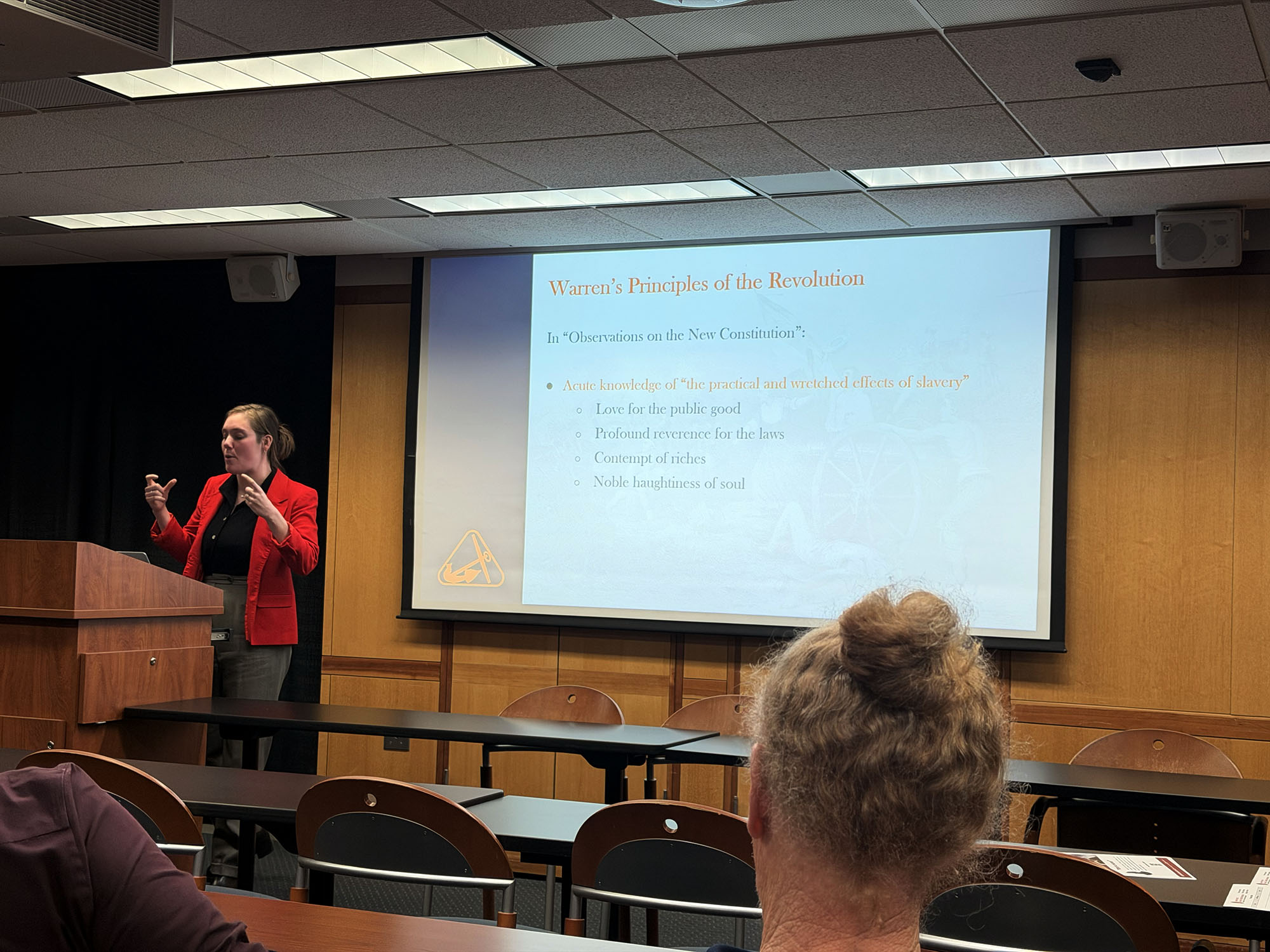
Uh, and as a reminder, these are the things you need to maintain an acute knowledge of the practical and wretched effects of this, uh, slavery. Uh, she's counting or she's, uh, quoting here from a well-known French philosoph. Uh, but I think that these are the really important things for her. The first thing you need is a love for the past.
Have to care about what is 18:30 common
This is kind of an interesting one to me because by
law breakers. Uh, but for Warren, no, this is actually loyal-
Have a kind of moderation in 19:00 terms of your taste for luxury and consumption. And finally, and I, she says, "You have to have a noble haughtiness of soul," which I just take to mean to be a kind of sense of one's own dignity. You have to have a pride in your liberty and in your freedom to the extent that you're going to jealously guard it.
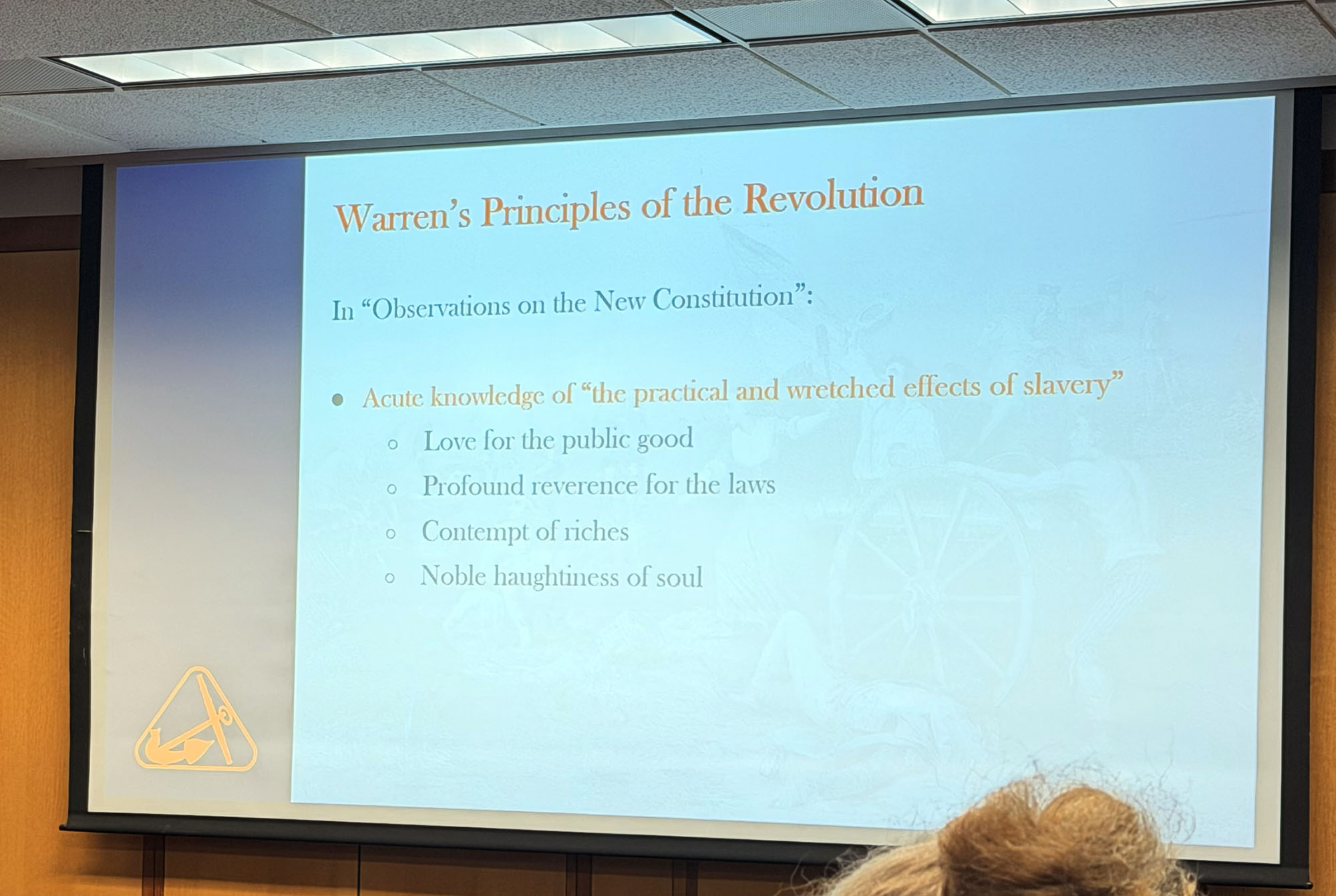
These are her principles of the revolution. She's qu-quoting Abbé de Mably. Uh, found my note there for it. Um, but for 19:30 her, these are the things that you need to inculcate the memory of the revolution Warren's primary concerns when she's writing this essay is not about what kind of politics is going to create-- be created by the Constitution, but what kind of people are going to be created by the politics.
What sorts of things are going to unite people? What sorts of things are they going to value? What will they, what will they remember? What are they going to forget? Are they 20:00 going to be able to remain free? And is this document going to give them the tools they need to protect and guard their own freedom?
Uh, and if it does, if we have a founding document that can inculcate this love of freedom for her, remembering the principles of the revolution is going to yield a people that is constantly renewing that freedom. It's constantly thinking about it, protecting it, safeguarding it. And for Warren, freedom is a progressive concept, and I say that in the least 20:30 scary, uh, like, use of the term, only to say that if you are jealous of your own liberty, you're also jealous for the liberty of others.
Not an accident that Warren is also an early advocate for the rights of Native Americans. She is a critic of slavery because freedom is not just for the person who possesses it, but for all people. It should be progressive. It's the opposite of empire is where this love should lead us. Okay?
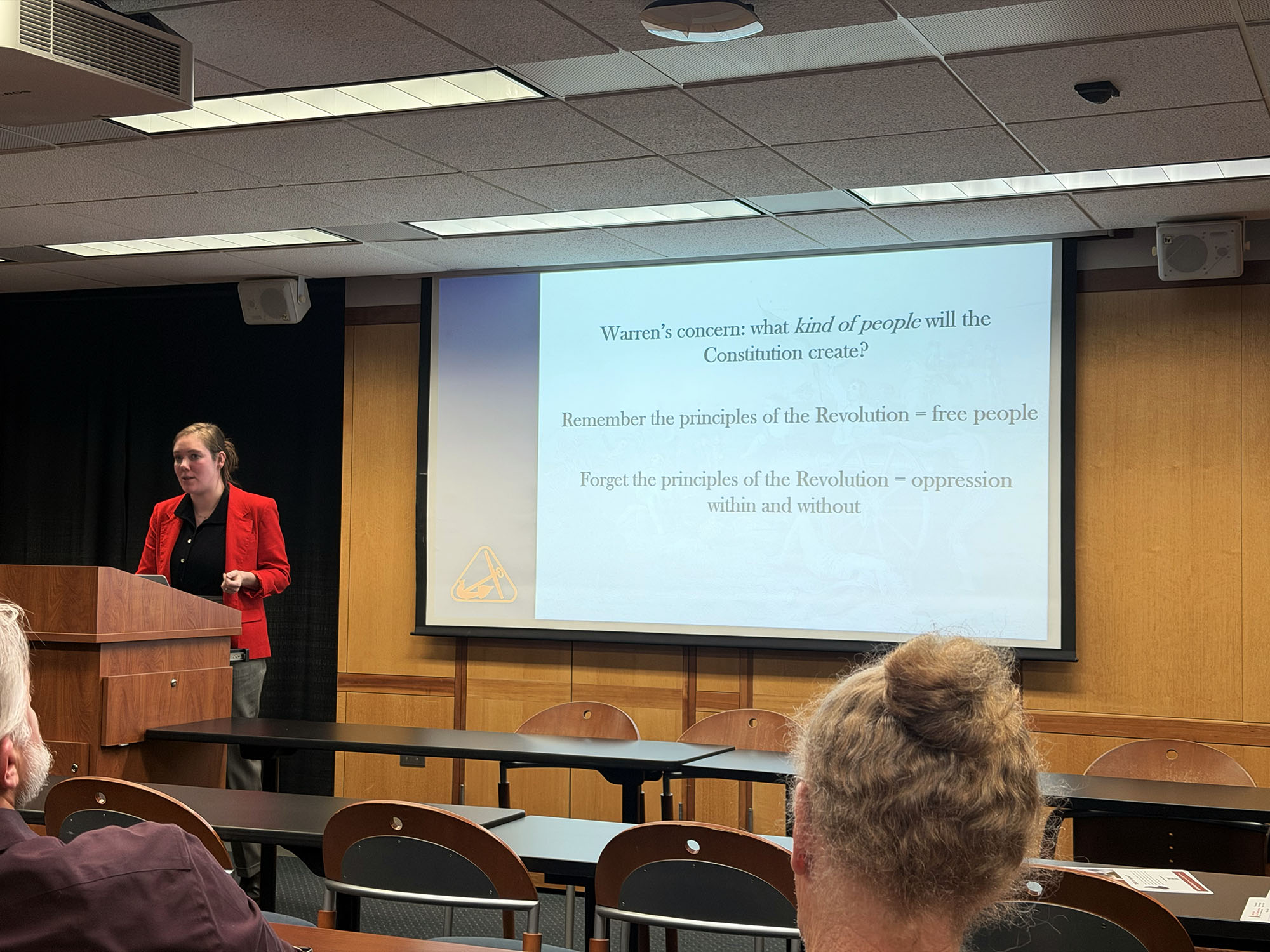
Comparatively, forgetting the principles of the revolution is 21:00 going to lead to oppression within and without. There's going to be an increased desire and need for luxury, uh, an increased desire for empire that is going to lead towards oppression outside the boundaries of the country, and internally, the failure of those institutions that protect- So the rest of her observations on the new Constitution lists out a variety of grievances and corrections that she offers 21:30 to the Constitution.
What she won
She does get, like, a pretty big win. Generally, this essay is considered one of the kind of linchpin essays in securing the Bill of Rights. A couple of the things that she highlights, including freedom of the press, make it into the actual document itself. Uh, but she sustains many more losses with her radical-
Uh, she wanted, for example, the elimination of the federal standing army. She wanted to further divide the executive and judicial branches, thinking that 22:00 they were too closely aligned. Uh, but of course, these things don't make it So Warren has all of these reservations about the Constitution, what kind of document it is, and if it's going to inculcate a forgetful people or a people of remembrance.
Freedom is not just for the person who possesses it, but for all people.
But ultimately, we know the Constitution is ratified, and ratified with only a couple of the changes that she suggested. So that means that by the time we hit eighteen oh five, she's had plenty of years, almost 22:30 twenty years, more than twenty years. Math is hard for someone who studies political theory. Uh, twenty-odd years, uh, to, to think about and, uh, consider what it then means to live under this Constitution, which she views with so much doubt and trepidation.
If not the Constitution, then what?
So if the Constitution's not gonna inculcate this memory, if it's not going to make a people who remember what it means not to be free, then what do we do? The answer for Warren is 23:00 civic virtue, but it's civic virtue inculcated by way of people's ongoing memories of the revolution So I wanna just quickly re-highlight this list of principles that she thinks need to be within the American people.
They need to remember the revolution. They need love of the public good, profound reverence for laws, contempt of riches, noble haughtiness of soul, and of course, all of this is aimed at remembering the practical and wretched effects 23:30 The thing that Warren suggests is that education in America now needs to be part of preserving these memories.
And I don't just mean education in schools. That's part of the story for Warren. Uh, but for her, education means civic education. It means what parents teach to their children. It means the examples that people in community set for other people within the context of their community. Uh, I 24:00 wanna read another quote.
The Declaration at the heart of memory
One of the kind of main things that she dials in on as being part of the preservation of this memory is the Declaration of Independence. A kind of knowledge of the intricacies of the Declaration of Independence, studying it in schools, but also she talks about, like, reciting it publicly, right? I-in civic organizations, things of that nature.
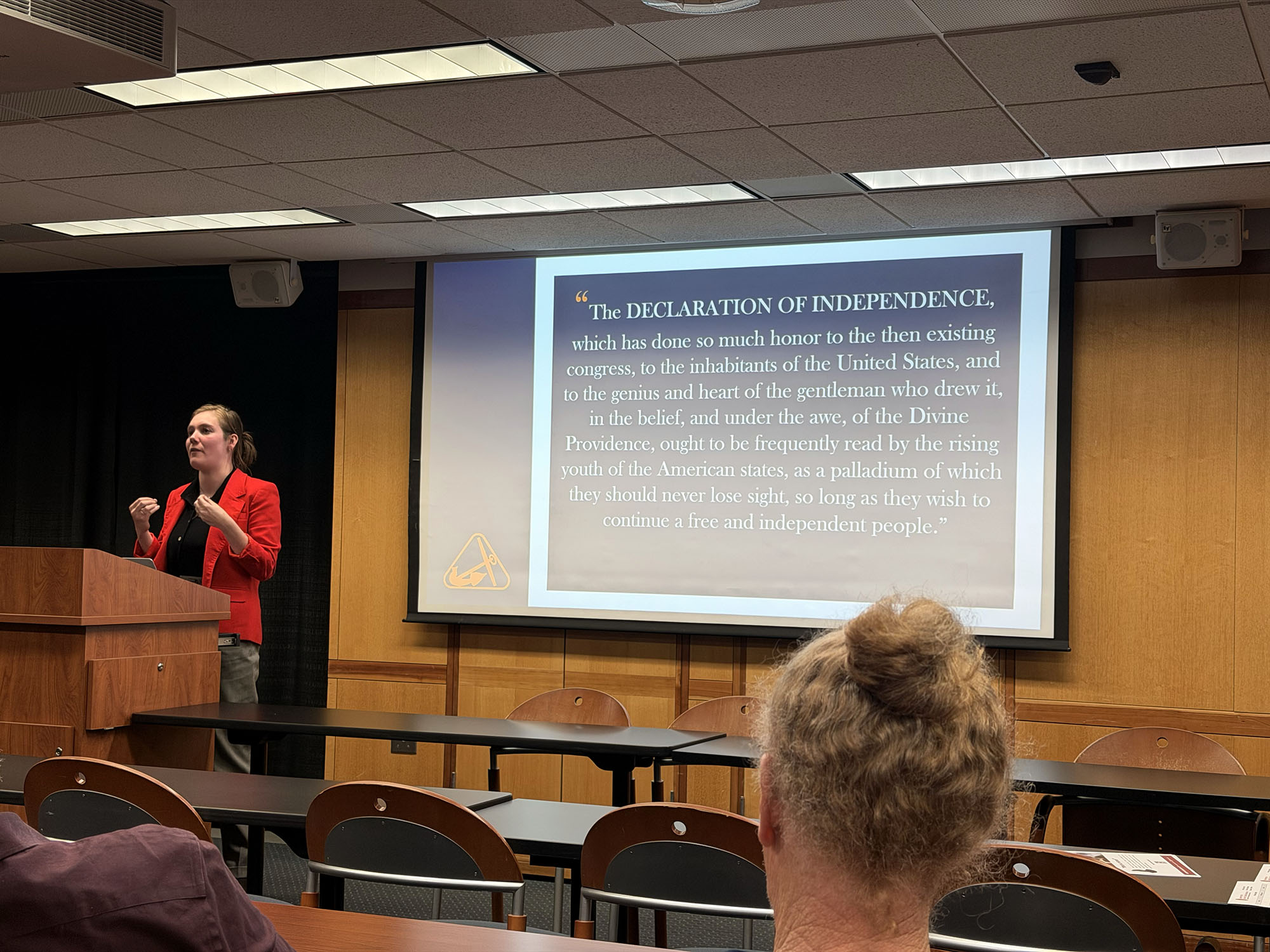
This is really important for her. If you'll indulge me in kind of a long quote, it starts with what's up on the screen, and it continues. She writes that, "The Declaration of 24:30 Independence, which has done so much honor to the then existing Congress, to the inhabitants of the United States, and to the genius and heart of the gentleman who drew it, in the belief and under the awe of the divine cause of Providence, ought to be frequently read by the rising youth of the American States, as a palladium of which they should never lose sight, so long as they wish to continue a free and independent people."
She goes on, "These were the opinions of Ludlow and Sidney, of 25:00 Milton and Harrington. These were the principles defended by the pen of the learned, enlightened, and renowned Locke. And even Judge Blackstone, in his excellent Commentaries on the Laws of England, has observed that trial by jury and the liberties of the people went out together.
Indeed, most of the learned and virtuous writers that have adorned the pages of literature from generation to generation, in an island celebrated for the erudite and comprehensive genius of its inhabitants, have enforced these rational and 25:30 liberal opinions. These were the principles which the ancestors of the inhabitants of the United States brought with them from the polished shores of Europe to the dark wilds of America.
These opinions were deeply infixed in the bosoms of their posterity and nurtured with zeal until necessity obligated them to announce the Declaration of Independence. We have seen that the instrument which announced that final separation of the American colonies from Great Britain was drawn by the elegant and energetic pen of Jefferson, 26:00 with that correct judgment, precision, and dignity which have ever-" Warren writes that if we want to remember, this is where we should start.
We have to start by remembering the Constitution, and I want-- Or I'm sorry, the Declaration. And I'll offer not just the very beginning of the Declaration of Independence, which talks about, you know, the things that we all know when we think of it, uh, all of our articulations of natural rights and whatnot.
But then 26:30 further down, getting to the grievances, those errors of common law which the king is responsible for against the colonies. This, uh, these candid facts pre-- or these facts presented to the world on behalf of the signatories of the Declaration of Independence. This is what we need to remember, that there was active ills engaged, uh, in this dialogue between, uh, Great Britain and the United States, that there's actual wrongs committed, that there's 27:00 oppression involved at the outset of the Revolution.
Otherwise, it just becomes this symbol, something that has no meaning, no real truth. We forget that there were people at the heart of it, people who suffered, people who died, people who were willing to go to war over the common law. Someone put that to me recently. Americans were willing to go to war
It's staggering. And this is the sort of thing that Warren wants us to remember, and that's why she thinks the Declaration of 27:30 Independence needs to be at the heart of these- If a constitution's not going to inculcate these principles, Americans are gonna have to do it themselves, and they can do it by education.
Not just education in schools, but by civic education and by keeping these sort of, you know... They tend to function as symbols. Things like the Declaration functions as a symbol, but she wants it to be so much more than that. She wants it to be a real and living history of why freedom matters and why it's important to us 28:00
Memory and civic virtue
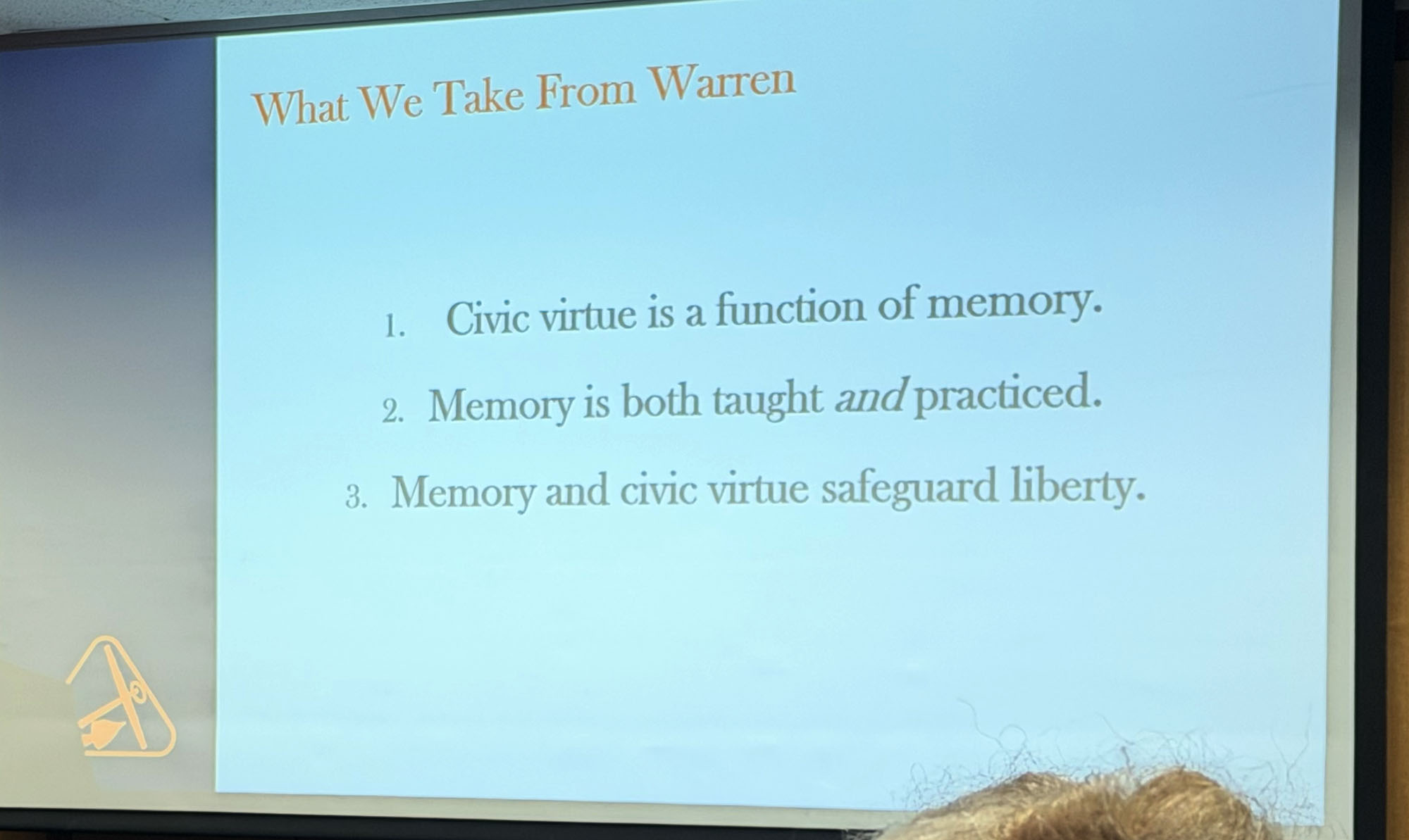
So a couple of notes here on memory and civic virtue just to conclude. I wanna offer that what we take from Warren is a couple of things. First, that civic virtue, practicing those things that she lays out as the principles of the revolution, uh, contempt for riches and love of the public, these are things that are habits of the heart.
They function in 28:30 part by way of memory. When we remember what the revolution is, what it meant, not just think of it as a symbol, it will naturally point us towards behaving in particular ways, and behaving in particular ways that safeguard our freedoms and our liberties. Uh, it's not just about having an intellectual view of what it means not to be free, but living your life in such a way that you act like you care about it, right?
It's about, uh, living a life of civic 29:00 virtue through your remembrance of particular things. Um, this memory is both taught and practiced. So education is the way that we get to memory because our government is not going to enforce it upon people by way of a Constitution. Uh, and that is in what we tell people around us, our children in particular, but it is also in how we live our lives.
It's practical. It is intellectual, and it is practical. And then finally, memory and 29:30 civic virtue together are what safeguards liberty. Reminding ourselves what it means not to be free and living in such a way that we act like we care about our freedom, these things together will allow Americans to protect their liberty, uh, in ways that they might not otherwise be able to, uh, especially in lieu of a Constitution that is going to lay these things out, uh, explicitly
Okay. That's all we got so far. I'm happy to 30:00 open it up for your questions.
Questions from the room
The, um, principle of square root of samples Unclear in recording . Um, an interesting question. Uh, right. For someone like Warren, her answer would be that this is a v-- this is a virtue. It is habitual, it is practiced, it's also theoretical. So 30:30 we have this idea that, uh, riches potentially leads us down a political path that is a danger to liberty.
Capitalism as a way of doing economics is value neutral. It doesn't have particular values. So for someone like Warren, I think she would say that that is a value or a virtue that you should impose upon the economic system in which you find yourself. Capitalism doesn't have internal constraints, but this is a constraint that people who are within capitalistic 31:00 systems can impose upon themselves.
Uh, and I think that's sort of what Warren was... That's one of the many things Warren was concerned about when it came to self-government versus government by, uh, a federal force, is that it's hard to actually impose virtues upon yourself. It's much easier to have them articulated for you. So
Religion and providence
Um, I have a question about religion. Okay. 31:30 So the quote you put up from, I think, Observations- Yep ... read to me as very Calvinistic. Oh, yeah. Very pessimistic about human nature, and especially in comparison to the optimism you see in, like, Federalist Ten, right, about the new political science. Mm-hmm. Um, so what influence does, uh, religion, and especially Calvinism, have on her?
'Cause I would imagine a lot, given that she's a woman. Yes. Yeah. Great. I've actually written on Warren 32:00 and her kind of religiosity. I think her writing's infused with religiosity. She is, um, definitely a Calvinist. Uh, and, uh, women on average tended to take religion more seriously than the men of the day. I think that's reflected in not just her marriage with James Warren, but also Abigail Adams and John Adams, same sort of story.
Um, and ultimately, I think what she... The way she traces divine providence, especially over her history of the American Revolution, uh, is really aligned with her concept of liberty. 32:30 I don't think it would be going too far to say that she believes that liberty is God's plan for the world. Right? That is, I think, what Warren would say.
Freedom, individual freedom, is God's will. Uh, and to some extent, those who get in, in the way of that are getting in the way of the will of God. Uh, she articul- articulates it in that, those sorts of terms. She says, "This is divine providence," capital D, capital P. So that's absolutely part of the story, and she's ex- she's using those 33:00 terms purposefully, expecting that that's what people will take away from it.
Uh, in some ways, I, I think there are a lot of similarities between someone like Warren and someone like Alexis de Tocqueville. Uh, but Tocqueville talks about democracy in similar terms, that, right, this is a divine destiny
Was there a sorority?
You mentioned Abigail Adams. Yeah. Was there like a sorority of these women that were married to 33:30 influential men? Mm. You mentioned the other Sons of Liberty. I mean, Abigail Adams is also well known for leaving behind a large cache of documents. Yep. Clear visions of the roles of women and equality. Um, what can you tell us about that?
Yeah, I read on Abigail too. Um, so I wouldn't go so far as to say a sorority. I don't know that there's that many of them that are, like, close friends who... They're not putting together salons or something like that to talk about political ideas. But Mercy Otis Warren and 34:00 Abigail Adams are really good friends.
Not only do they know each other very well, but during the American Revolution, when the men are off, I mean, James Warren's fighting, uh, John is not fighting, but he's doing other important things. Uh, those two are-- they're neighbors, and they're kind of keeping each other afloat, right? They're-- Women can't legally own property, so they're running a kind of like back alley fabric trading system.
They were awesome, and I think also influential 34:30 political thinkers in their proximity to powerful men. There's a really interesting letter between John Adams and James Warren where he says, "You know, I'm not really of the mind that women shouldn't have a hand in politics, but if I were, I would still exclude Abigail and Mercy.
They should have a role in politics because they're like the best political minds" Um, so yeah. And there are other really interesting female thinkers in New England at the time as well. Uh, Phillis Wheatley is 35:00 a really interesting thinker. She is an enslaved Black woman, uh, who lives in Boston and not kind of out in the country like these two do.
Uh, and there's no, not a ton of clear-cut evidence that they met or exchanged letters with her. But she's also, you know, writing these really interesting politically tinged poems throughout the course of the revolution. Uh, someone like Susanna Rowson is also writing around this time. Judith Sargent Murray, we think of those as kind of architects of, you know, women's identity in the Republic.
But not all of 35:30 them are the best of friends. Mercy Otis Warren and Abigail Adams are kind of a unique case there. Also, as a side note, just because I have the floor, and I will use it, um, John and Mercy Otis Warren, John Adams and Mercy Otis Warren were also very good friends and had a really long epistolary letter exchange.
Uh, and it all just goes up in flames when John Adams publishes Discourses on Davila, where he suggests that, like, there's maybe a natural aristocracy. And what he's talking about really is that, like, there are some people who have, like, 36:00 more talent than others. But Mercy Otis Warren does not like this.
She w-won't even tolerate a whiff of, like, aristocratic, uh, notions, and she writes him just a series of letters torching the book. Uh, and then they never speak again. It's, like, it's quite dramatic, worth reading if you can ever get your- I'm curious, um, if you can tell us a little bit more about the social conventions- Mm-hmm.
Coverture
-that govern husband and wife relationships along the Nile Unclear in recording 36:30 Valley, and whether- Mm-hmm. -this particular pairing in your mind is acting more in conforming with those expectations or whether It's a complicated question. In order to talk about the informal relationships between husband and wives, you really have to talk about the legal relationships.
Coverture is an extremely important legal reality. Just women can't maneuver economically without the at least, I mean, most of the time, explicit permission of their husbands. 37:00 Sometimes tacit permission- Mm-hmm ... is okay if you have a male Uh, and, and that is the truth. That is the legal reality. It is also obscuring some very gray and messy non-legal realities, which is that women are operating economically as actors of their own accord, often with their husbands' consent.
So Abigail Adams, when John is gone, speculates on land. Uh, she, uh, writes him a 37:30 note and just says, "I signed your name on a document buying a bunch of land in Vermont. I know you didn't want it. I bought it anyway, so deal with it." And he just sorta says, "Okay." "What a good day." Yeah, no, didn't ask his permission.
She just sorta... Right? But at that point, she'd been-- That's, like, s- the early 1780s. She'd been running the farmsteads for fifteen years. Uh, she had had-- She was the steady hand at, at all of this sort of stuff. So on the one hand, you have these real legal realities of coverture, and practically in the sort of informal 38:00 relationships between husband and wives, these are decaying, uh, as a kind of institution.
There's a lot more, uh, entrusted to women, especially during the Revolution. That never really stops. It kind of puts coverture on its way out of the door. That's what the Remember the Ladies letter is about, is like, you know, you can recognize that we've been Basically managing all the farms on her own this whole time.
When you create the new constitution, John, thank you very much. Uh, and someone like Mercy Otis Warren and James Warren, very similar story, right? 38:30 That I think that in, like the Adamses, they're kind of a marriage of equals where they exchange these sorts of ideas. Uh, we don't have a kind of explicit outlining of those ideas between them the way that we have in the Adams correspondence, in part because the Adams correspondence is unusual.
Most of the time, people burned their letters when they died. For some reason, the Adamses didn't. So we have all of this, like, intermarriage
And just a quick clarification- Yeah ... with coverture claims. 39:00 Forgive my ignorance. Yeah, you're good. But, but if, if a wife went broadly without, outside the constraints imposed by coverture and other surrounding circumstances- Mm-hmm ... would they, would that be a criminal violation? Would it be a, a, a husband suing the wife or- Yeah
a family member of the husband suing the wife? Or- He, he could sue the wife. He could sue the wife, or she could be brought under, uh, like, particular legal, uh, sanctions, uh, 39:30 as a result of going too far outside of her husband's prescriptions. Um, in the Remember the Ladies letter, Abigail writes to John, "All men would be tyrants if they could."
And there's, like, effectively implying that, like, coverture is tyrannical. And when John replies, he's really joking about it. Like, he kinda thinks that she's kidding around, in part because we know from their relationship that he never would've brought the law to bear against her. Uh, but that was their relationship, and she doesn't 40:00 necessarily have a problem with him specifically, but instead the kind of legal fiction that existed.
So there was potential for women to, to be tyrannized by their husbands under coverture, even
if that was unlikely to happen in, in her particular case.
How was this meant to spread?
Question about the dissemination of this information, meaning this. She sets up the need for an understanding, knowledge of the Declaration of Constitution, et cetera. Does she go a step further and lay out a plan or a 40:30 formula as to how this information that's in these documents is gonna be spread amongst the populace on an ongoing basis to assure that the virtue she wants maximal-- has a maximum chance of occurring?
In a word, no, she doesn't. She doesn't lay out a plan for it. My argument has always been that her history of the American Revolution, which was very famous, very widely read, is meant to be a kind of meta practice 41:00 in, in locating these kinds of memories. So it doesn't necessarily have the text of the documents.
She's assuming that most Americans know and have access to the major copies of the major documents, which was broadly true, uh, especially where she's living in New England. But her history is meant to reflect, you know, the particular kinds of memories she wants preserved. And this is why I think for Warren, all of the little factual details of the revolution that she might get wrong are kind of 41:30 secondary to the important point, which is why the revolution was fought, and that's the upshot of her history.
So she's hoping that with this book she's writing, it will accomplish the sorts of education she hopes Americans will take. She's also not proposing it to be a kind of like school textbook or something like that. She wants it to be-
leisure time, whatever leisure time that they have, or that they read to understand 42:00
This was the Netflix of the day She would own Netflix Does it make sense? Yeah, um, probably. Through her husband. Yeah, right. Very right. Yep. Yeah, he's the puppet 42:30 43:00
Empire, and the Federalist Papers
No, it's Jay. He does write the first five. Um, in some of the early, uh, Federalist Papers, there are these, like- I think it sets up this question of what sort of nation the United States is going to be, and there are-
And one of the major questions I 43:30 And which is one of the things that Warren is directly responding to. Uh, for her, she would have considered herself somewhat Jeffersonian, and that her view of an ideal American life is going to be kind of agrarian and self-contained. Um, that people generally are going to practice their individual liberty, not at the expense of others, but for the kind of flourishing of their immediate communities.
And that, in some ways, is just very 44:00 classic anti-federalist of her. Uh, and I would say she didn't necessarily view empire as, like, a great evil, maybe kind of, so much as a threat to liberty. Maybe there are ways of practicing empire in which, you know, no one's liberty is encroached upon, and it doesn't lead to the degradation of liberty on the home front.
Uh, but she says we have all this evidence that it's-- it hasn't gone that way in the past, so we 44:30 need to be able to rely on these historical examples, which interestingly is also sort of what Hamilton is doing in some of those early essays in terms of, uh, critiquing the kind of classical regimes and things like that.
But, um, she's sort of returning that as well. Um, and importantly, I think tying in the treatment of the United States
How riches lead to tyranny
Uh, I was hoping you could talk a little bit more about how 45:00 a coveting of riches can lead to tyranny within a political system, because I kind of see how, uh, within the context of an empire, it could mean to- lead to tyranny without or against other peoples. But, uh, how does the lack of that virtue of contempt for riches contribute to tyranny within a political system or a society?
The direction of a nation will be determined forewarned by individual behavior. A nation's 45:30 going to reflect the people who exist within it. And if you have a nation of people who are constantly fiending after luxury and expansion, you are going to have a politics that will reflect that. Uh, so again, interested in the kind of symbiotic nature of, of politics and a people.
Uh, and yeah. So I think that's what, what I would answer here, is that she is concerned about the far-ranging effects if more Americans care more about aggrandizing 46:00 themselves than about preserving their, like, essential political liberties. And she thinks that that's gonna be a trade-off that we- So like my violin Yes, for a while
When you talk about the course that she places Unclear in recording 46:30
Warren and David Ramsay
I'm glad you asked. Uh, there's one other history at the time. Uh, David Ramsay writes a history of the American Revolution. David Ramsay is a doctor. Um, I don't ever want to encourage someone to not read something. It's not fun to read. It's, it's extremely dusty and 47:00 dry. Ramsay is aiming at a kind of technical precision.
He doesn't care much about being beautiful. He doesn't care much about the meaning of the things that happened. He cares more about just saying what happened. Uh, so that's her main competitor at the time, and I think this would be exactly the thing she doesn't want to do. She doesn't just want to recount the facts without telling people what those facts meant.
She wants to do positing Unclear in recording . Uh, and she's upfront with that too. It's not as if she's trying to Trojan horse it in so that people are 47:30 propagandized in a particular way. She offers that, like, this is what she thinks things meant. Um, a-and ultimately, she thinks that's what the work of history should be, is thinking about the meaning of things, not just the things as they happen.
And to some extent, that's why I think memory is more her project than what we would think of as, like, academic history. She's trying to, to shoot a gap between, you know, the cold hard facts and a kind of truth of feeling, and she's ending up with a, a something that is kind of 48:00 like squishy, uh, and a little bit gray, but a-and malleable.
Uh, but ultimately, you can build with it so much more easily. It's way, it's way easier to sculpt out of clay than it is to roll a bunch of rocks home, uh, and try to build a house out of those. So, so that's her major competitor at the time, is David Ramsay. Uh, and comparatively, to the extent that we've mostly forgotten about Mercy Otis Warren, we've almost entirely forgotten about David Ramsay, I think for similar 48:30 reasons.
How widely was she read?
How widely read was her book? Quite widely read. She was very well known at the time. Uh, and she's also quite old at the time. She-- So she's not only Massachusetts royalty to begin with, but now she's kind of a matriarch, uh, and is a well-known literary figure. So it was, it was anticipated. Uh, people pre-ordered copies, including some of the men she'd long been in correspondence with.
Uh, John Adams did get a copy. Made him very 49:00 sad. He liked her book way more than she liked his. 49:30
Political science as poetry
Throughout her career, just is, is her-- is she kind of trying to do political science as poetry, for vice versa, or? Oh, maybe. I tend to think that she is a very lyrical writer, uh, a very beautiful writer. Her kind of technical abilities are, are really excellent to the extent that sometimes I think she cares more about the bea- of the thing which, which is sort of the opposite error the writers of The Federalist Papers have.
They don't necessarily care at all about the- 50:00 Mm-hmm. Um, she writes a lot of poetry, but she also writes plays. So she is- Mm ... a literary thinker, and she's thinking in terms... And this shows up a lot, especially in, uh, her history of the American Revolution. She thinks a lot in terms of allegories, in terms of metaphor.
He liked her book way more than she liked his.
Um, yeah. So to some extent, she's very-- Uh, you would call her kind of like liberal in that sense, in that she's bringing in a bunch of different disciplines, uh, and bringing them to bear upon her political 50:30 philosophies. And I think she's- I think there's a case for her doing a kind of
I think she corresponded a bit with Jefferson, although Jefferson appears to have largely been too busy for her. Understandable, he was doing a lot of things. Just read his gravestone. 51:00 Um, but, uh, yeah, generally speaking, a lot of the people that she's in community with are pretty pro-Constitution. So she's kind of a lone voice in the wilderness w- among many of them, sort of sticking to the claim that, you know, there's some real issues with this document.
Her education
But she considered herself a Jefferson- Women, like, weren't able to obtain an education in order to be able to write all these books? Yeah, she's weird. Um, not to put you on blast. I saw you snuck in a little bit, a l- a 51:30 little bit after I mentioned this. She, uh, one of her brothers dropped out of his kind of primary school education that a local reverend was giving her brothers, and her dad just sent her in his place.
So she got basically a young man's education. Uh, a young man who was gonna... who was being prepared to enter Harvard, no less. So she, um, yeah, she, she had a kind of unusual education, and then from there, she is pretty autodidactic. She reads a lot of stuff, and she reads a lot of stuff in exchange, 52:00 in exchange with her older brother, um, James Otis, who- Was that- Yeah
the case for a lot of women at the time? No. Or was that just her? She's, she's, she's really weird for that. Uh, women's education is sort of in flux at this point. Uh, there's a kind of dominant narrative that, you know, women's education is best served for writing nice letters and, you know, being able to do, like, basic household calculations and things like that.
Um, but then you also have, you know, plenty of 52:30 women who are on their own reading great books, uh, and kind of self-educating, or otherwise they're being educated in, like, within the context of friendships or even marriages sometimes. You have these lively intellectual engagements. But yeah, formal women's education of the type that would prepare someone for a college education, yeah, not common at the time.
Did she have to dress up like a guy to go to Harvard? She didn't go to Harvard. Um, you know- Oh ... there's a, there's a kind of interesting sort of question there. 53:00 In an alternate timeline, she sort of, you know, tries to get her own education, um, that way. N-no evidence that she did or that she had to dress up, uh, for the reverend to accept- Funny story, complete departure, but it made me think of it.
There is a female soldier during the American Revolution who gets by for, like, four years dressed as a man to the extent... And she went so far to hide it that she actually removed, like, a musket ball from her own thigh. 53:30 Uh, her name was Deborah Sampson, and her husband was the first, uh, man to receive veterans', uh, spousal benefits from the United States government.
They found out that she's a woman and, like, they discharged her immediately. Uh, but then after, like, years after the Revolution, she got-- used to get invited to all sorts of, like, celebratory remembrance, you know, and she would dress up in her military uniform. She was 54:00 awesome.