Transcript
Opening and a show of hands
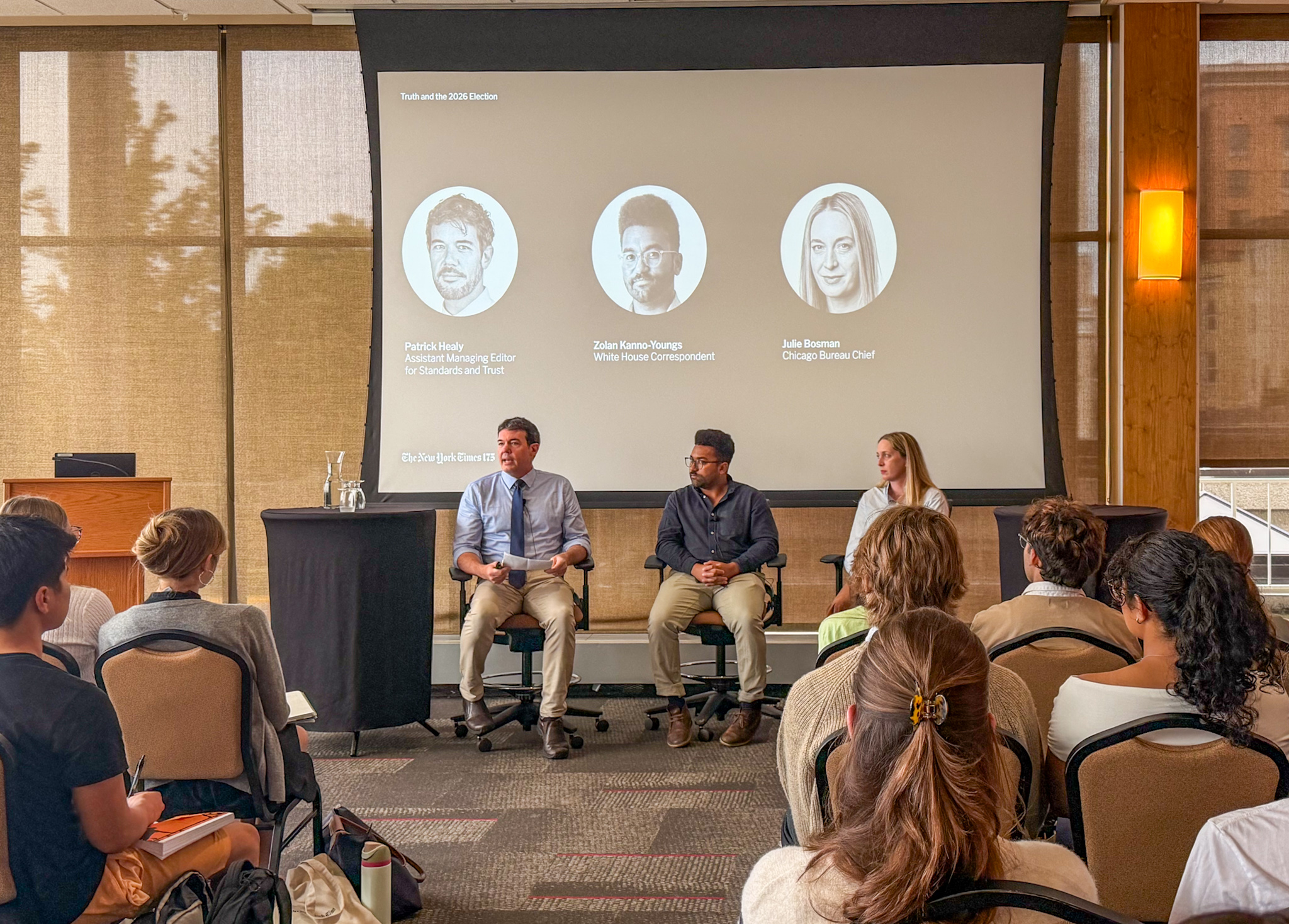
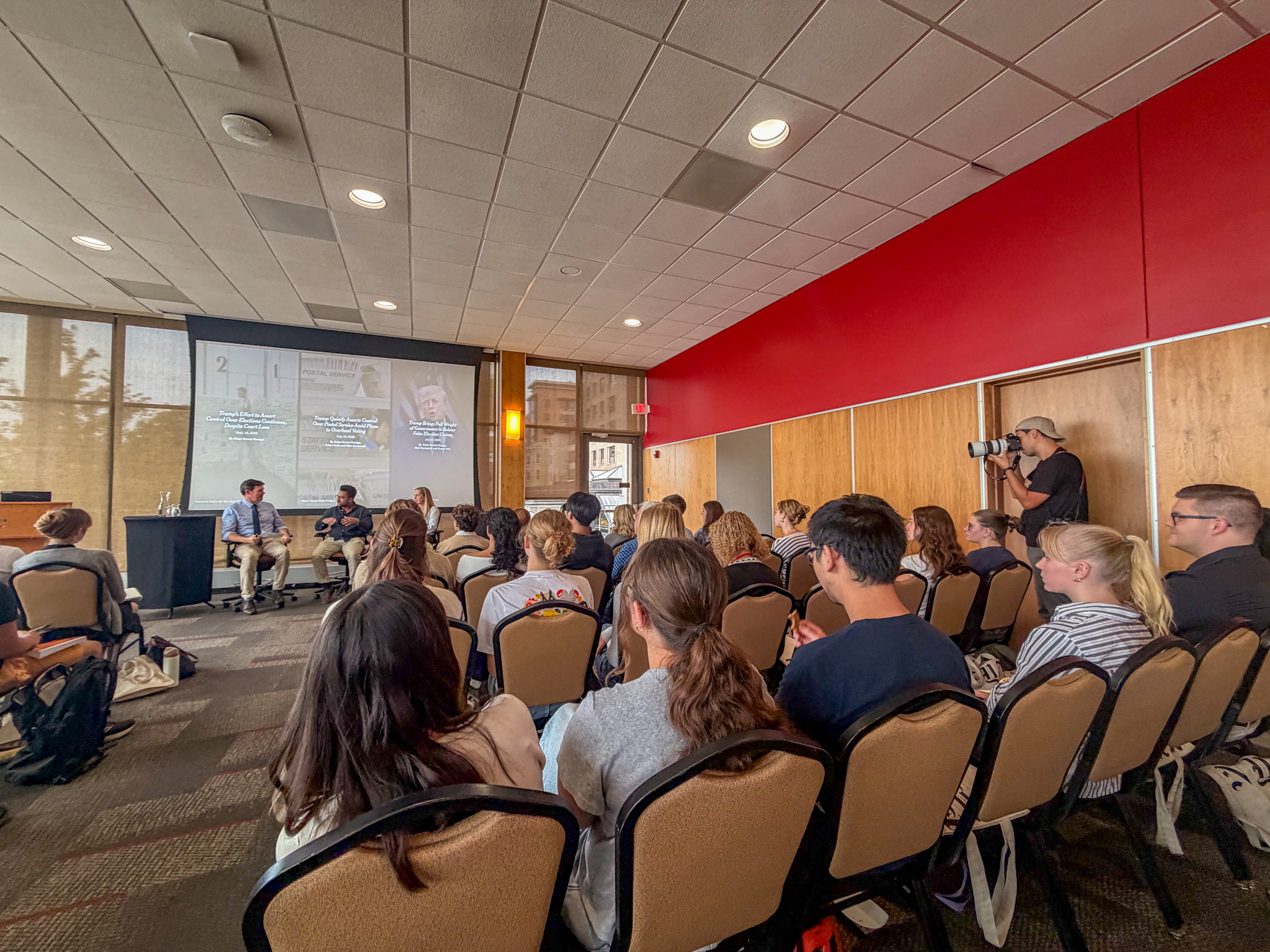
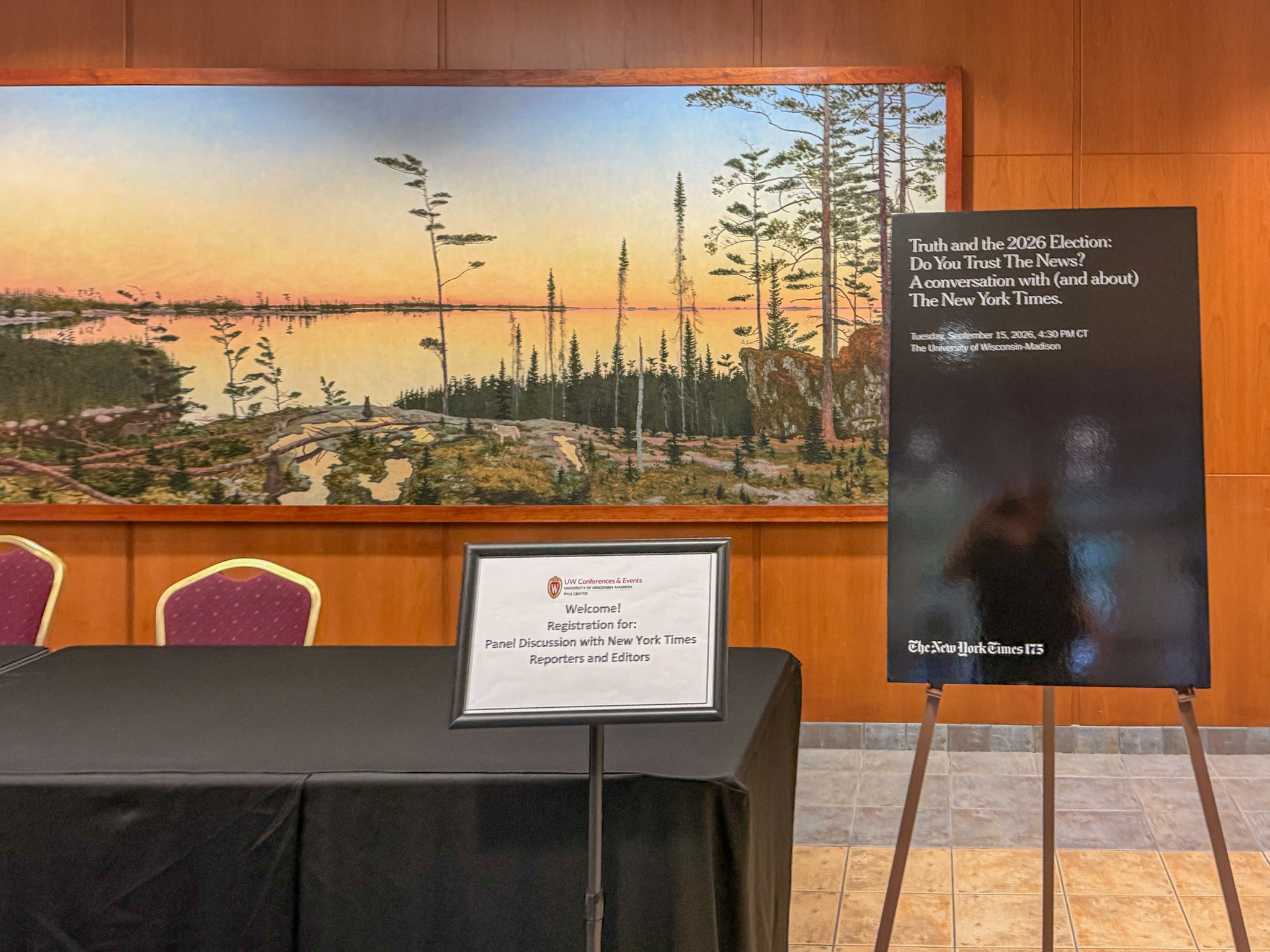
00:00:00 All right. Uh, hey, everyone. Uh, I'm Patrick Healy. I'm an assistant managing editor at The New York Times. Uh, I oversee standards and trust and independence issues, what I sometimes call sort of hard shit, if I can say that. Uh, uh, difficult decisions at The Times. And I'm joined today, uh, by my two colleagues, uh, Zolan Kanno-Youngs, who is a White House correspondent covering President 00:00:30 Trump and the administration, and Julie Bosman, who is our Chicago bureau chief, uh, one of our top reporters on our national staff and in the Midwest.
Julie also grew up in Kenosha and is a graduate of the University of Wisconsin-Madison. Zolan,
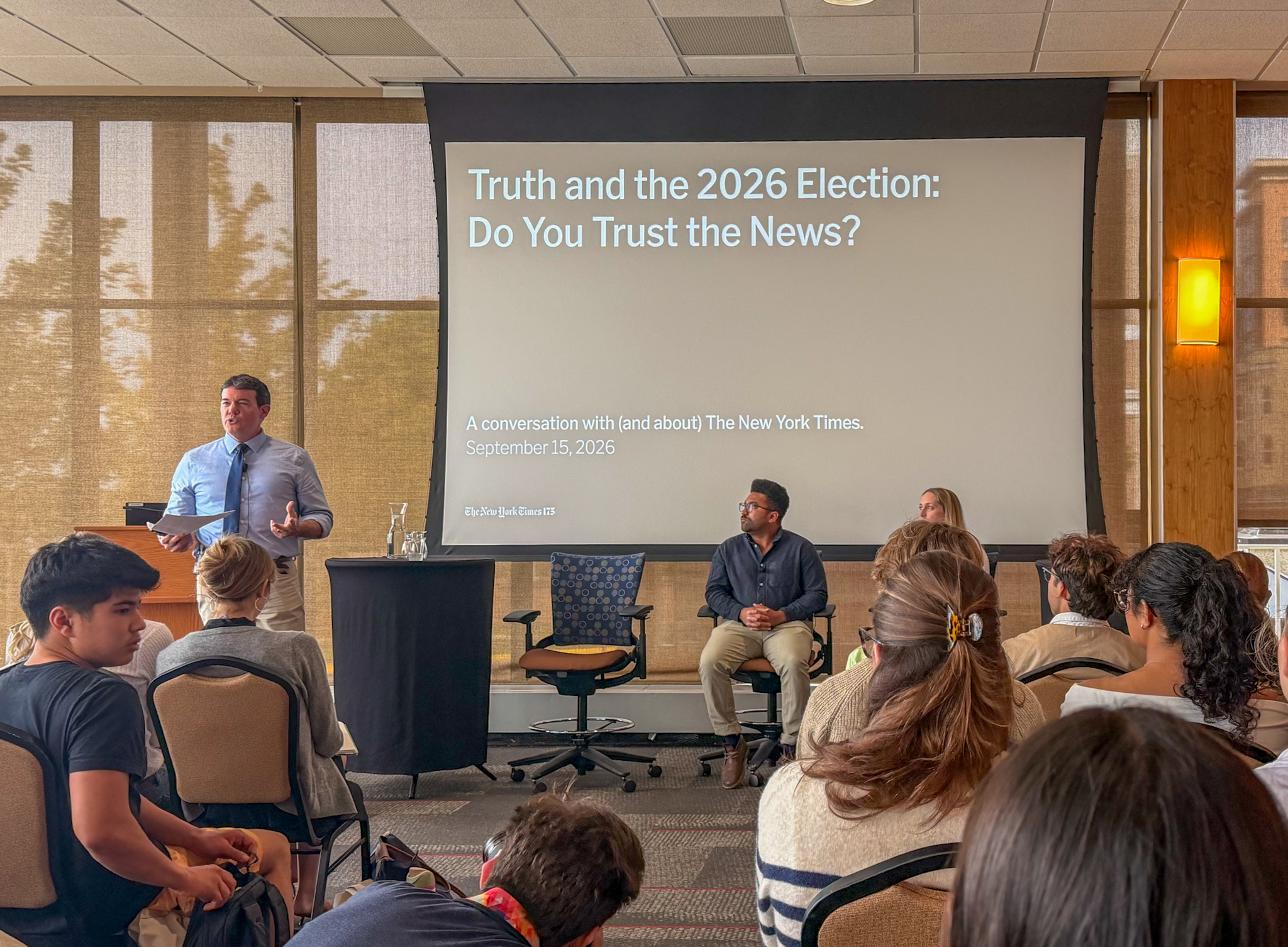
Julie, thanks for joining me here. Happy to be here. So, okay, I want to start with a little bit of a focus group. 00:01:00 Uh, I would love to see, for everyone who's comfortable, uh, kind of a show of hands, uh, about these three questions. I'd like to know who here trusts the news media, who here does not trust the news media, and who's kind of on the fence.
Who's on the fence? Um, and, uh, and then we'd like to just hear a little bit about kind of why, um, how you kind of feel about it, just to kind of set up our, our 00:01:30 discussion. Um, so show of hands, and no judgment, no judgment. Uh, who here would say that they trust, in general, the news media? Okay. Decent size.
Decent size. Who here would say that they don't trust the news media? It's okay. Cool, cool. Okay. And then who's, uh, kind of on the fence? Sort of fence sitters, not sure. Okay. Oh, I love it. Okay. That's kind of a majority. Um, so I 00:02:00 wanna kind of start with the fence sitters, um, and really just, uh, if you might, uh, sort of speak up very, very briefly, a word, a sentence, what it is about kind of why you're on the fence about news media.
Go for it. Um, I don't really trust the U.S. ones because when I check out like BBC News or Deutsche Welle... Sorry. Yeah. I don't really... It seems like U.S. media is more polar- uh, polarized. Polarized. So I trust more like BBC 00:02:30 News, Deutsche Welle. Yep. Things like that. Got it. Good, good, good. No problem. And what about right behind you, uh, in very cool orange?
I think a fair amount of skepticism has to be, uh, considered when talking about any news media, so it's just- Cool. That's great. Actually, like what are the underlying, you know, biases that these organizations may have? Good, good, good. Okay. Polarized biases, and maybe just one more. Yeah. Yeah. I, I think just the 00:03:00 fact that, you know, Iraq war, Biden's, Biden's condition, Iraq war, it seems like people could see what was happening, but then the major media would always have a, "Oops," a couple years later, right?
Got it. "We should have covered it," right? Yeah. Yeah. So credibility, really. Yeah, credibility. Yeah. That's really good. Okay. And then what about for those who, uh, don't trust the news media, who are kind of like... And I know there were maybe just a couple of you, if even just one of you wants to maybe speak up just briefly about what it is, maybe why you don't trust, 00:03:30 please.
I think it, it's not that I fully don't trust- Sure
It's like thinking of like the Wisconsin Democratic primary election, how like Francesca Hong was asked all about like her past like cringey Thanksgiving tweets. And then David Crowley was like asked like, "Oh, do you support Thanksgiving?" He's like, "Yeah, yeah, ha ha ha." Or like with like the Michigan Senate race, we spent a lot of time talking about like Hasan Piker 00:04:00 and things like that, things that aren't really relevant to the greater like actual policies for the community.
And so in that case, you're like, it can feel like it's from like the media's like trying to shift one narrative without talking about the things that actually really matter in the community. Yep. Totally. Right. Relevance, news judgment, does this really matter? Um, anybody else just wanna pipe up about folks who don't wanna-- don't trust the news media?
But that's a really good point. And then just a couple on why you, why you trust, uh, those who trust the news 00:04:30 media, why it is you trust. And I'm kinda curious also what you would define as the news media that you trust, if there's a specific outlet or kind of media that, that really interests you. Anybody?
Any couple people wanna speak to that? Yeah, please.
We'll take it. I, I trust The New York Times, and, and one reason is there was, uh, an article last year about Zohran Mamdani's application to Columbia, and there 00:05:00 was a lot of backlash. But afterwards, you actually took to X and talked about the process of getting a lot of that information and how you chose to share that with the public, and I think that that transparency was really, uh, valuable for me.
Wow, okay. I'm gonna remember. Thank you. Uh, transparency. No, appreciate that. Anybody else on trust? Yeah, please. Um, I, I think it's important to, like, understand society as it is before criticizing it too much, and I feel like mainstream news, like The New York Times, reflects the worldview of, like, 00:05:30 predominant groups that are in power.
What erodes trust, and what builds it
So I think it's important to understand this world. That's great. So I mean, these are some issues that we're gonna get into today from the point of view of, uh, a senior editor in the newsroom who works specifically on trust and grapples with the fact that trust is at a real low in the news media. My job, which didn't exist two years ago, uh, on the masthead at The Times, is to think about ways to, to build and deepen, uh, 00:06:00 not just trust, credibility, reputation in The Times, but also to level with readers about how we're not perfect.
We sometimes make judgment calls, uh, about coverage that people really disagree with and try to show why that is. Uh, but we're also gonna look through it through a lens of, uh, the Trump administration, coverage of the Trump presidency, and through the lens of our national coverage in the U.S. Why do we write about certain things?
Why we don't write about certain things, which is often, 00:06:30 uh, a real sometimes driver of mistrust. Why does The New York Times write about that but not about that? 'Cause that's important to me. Why do you make these judgments, and where's the transparency in showing that? You know, the, the... One of the fence sitters mentioned bias, and we've done a lot of research around trust in the news media, and the single biggest driver that erodes trust that we found in The Times- is the perception of bias, that people think we 00:07:00 have an agenda, that we're putting our thumb on the scale, that we're taking sides in stories.
Uh, the biggest driver of trust that kinda supports trust in the Times is the perception of expertise, human expertise in the AI era. Uh, accuracy, a sense that we're generally accurate, and when we screw up, we are... have a very robust corrections and editor's notes, uh, page, including, you know, some real bangers that I've worked on that were very 00:07:30 painful.
But, you know, you, you need to sort of, uh, come out and come clean. So I wanna just get maybe a sense, just Zolan, Julie, in terms of what you heard, um, in terms of the feedback, anything that particularly resonates with you in terms of your reporting. Yeah. I mean, what you said about reading the story in the paper or wherever you grab it, and then doing that extra step, and that's just very interesting, that extra step of explanation, why we are thinking about this, that knowing that there are human beings 00:08:00 behind the work.
Um, I thought that was really striking and encouraging, actually. Totally. I think someone in the back, uh, mentioned that it's, uh, that they're skeptical often just as sort of a norm when it comes to reading the news. I, I actually think skepticism is a good thing when you're reading, when consuming news. I, I don't see that as sort of a, a knock or- Something that, um, something that we would try to push back against.
You know, I often... When my friends are asking me what they should read, I 00:08:30 say, "I mean, I hope you read The New York Times, but I also hope that you're reading a couple different outlets, right? And, and being skeptical of each thing." Hopefully that then results in a reader engaging, uh, with me, you know, and sending an email asking questions and maybe having some construction criti-- some constructive criticism.
All of that I think helps inform the reporter. So yeah, I think the skepticism is a good thing. I also think that a lot of reporters, when we write our stories, as we're going through rewriting, polishing, fact-checking, you're 00:09:00 always thinking about how it's going to be received. You know, is this fair? What is a reader going to think about this?
What might a reader pick apart?
You're always trying to anticipate, like, what you need to do differently in your stories before they're even published. So yeah, I mean, we're, we are, uh, always thinking about how readers are gonna receive things and how that skepticism might come into that. Yeah. I mean, The New York Times, actually this Friday, is turning hundred and seventy-five years old.
Oh 00:09:30 my gosh. Uh, yeah, it's a really big deal for us. I mean, we have some pieces that are gonna be publishing later this week about how we covered the Civil War and how we were- Wow ... kind of an eyewitness to events from, you know, middle of the nineteenth century to, uh, Afghanistan, Iraq, uh, Iran, um, you know, Israel, Gaza, where we've been fighting to get into, uh, Gaza and, and pushing the Israeli government on 00:10:00 letting journalists go in independently, uh, into Gaza to tell those stories.
Um, it's, it's really part of our legacy that we kind of take so, so seriously. And I think that we also want, as you said, Zolan, that skepticism. Yeah. A lot of the media these days have made a choice to kind of align with certain viewers. Uh, they wanna give viewers, uh, kind of what they want, um, kind of reinforce viewers' own assumptions, uh, 00:10:30 opinions, uh, whether it's on the left or the right.
And our North Star, uh, and it's not spin, it's something we, we really think about and live every day, is this idea of independence, independent journalism, that nobody's gonna tell us what to write. You know, whether it's President Trump, President Biden, whoever's in charge, CEOs. And that can come at, uh, at some real, uh, some real pressure, uh, that we face.
Covering the president
And, uh, and Zolan, I kinda wanna start with you. You have been 00:11:00 writing, uh, about President Trump for, uh, a few years now. Yeah, I covered, uh, DHS... I got hired by the Times in twenty nineteen to cover the Department of Homeland Security. And so I mostly, uh, covered immigration policy, spent a lot of time in South Texas on the border. Um, and then I covered Biden on the White House team, and now covering Trump from the White House team. Now covering President-- And you flew in yesterday from Ireland- Yes ... where you were with, with President Trump. And you actually wrote this first story 00:11:30 about the Supreme Court Uh, case yesterday. Were you writing it, like, from a bar in Madison?
Uh, I, I, I went to the Old Fashioned afterwards. A- after, after, after it got edited. But, um, but it was, yeah, landing... I, so I, I wrote the sort of key matter and had the, uh, what we call, like, the HFOs- Yeah ... drafts for multiple scenarios. Scenarios. And then you get to the hotel, and you're like, "Okay, now I gotta, you know, make sure this is all timely and accurate, 00:12:00 and top it off."
And then we were gonna head off. Well, it's really, it's elections and politics where I would say is one of the main contested areas where we, uh, really grapple with trust issues and issues around the truth. And I'm wondering how you approach that with regard to President Trump, because there are not a few readers who have a very fixed view about President Trump- Sure and who want The New York Times to be kind of presenting 00:12:30 what they see as the truth about, uh, about the president. Yeah. And, and you're in rooms with him regularly. You are covering him for a readership that's, that's very diverse. Talk a little bit about how you, how you go about kind of navigating, uh, that work.
I mean, for one, I, um, I have a bit of an unconventional, maybe unconventional path to the White House beat, where I didn't cover campaigns. Um, I didn't really start in- I, 00:13:00 I, I covered law enforcement, I covered a homeland security agency, um, and, and then kind of made my way to the beats. And I've tried to cover not just politics, but the intersection between politics and policy, and ultimately how that policy impacts people.
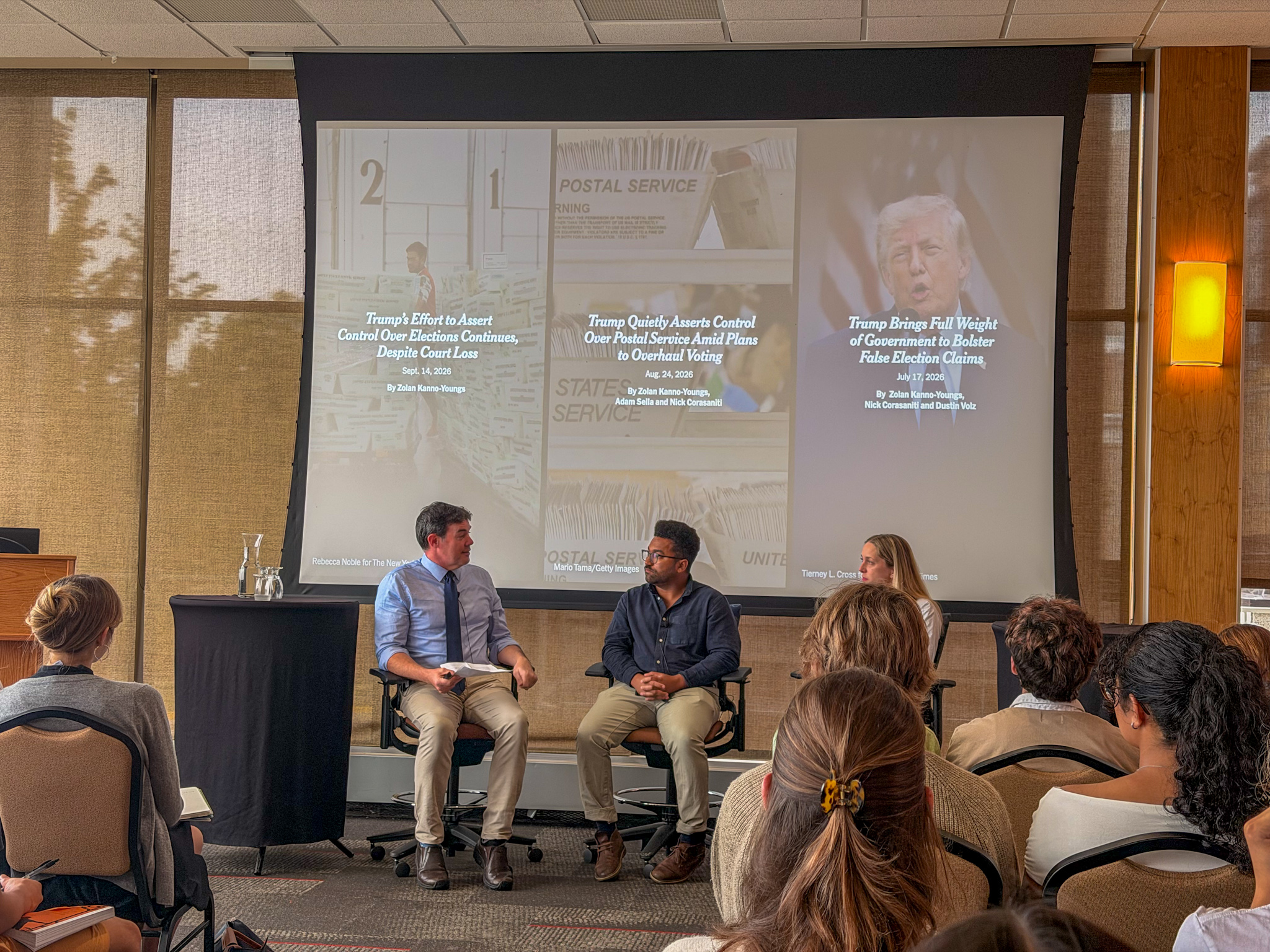
Okay? Uh, the origin being trying to crack this institution that's at the center of that policy, which is the White House. Um, for this story and this sort of series of stories, 00:13:30 um, I'd like to think that it's a bit of an example of, like, my editors and The Times sort of reflecting on how we've done things in the past and the stakes that we're in, the state of democracy and issues, right?
Like, my editors often tell me, "Don't cover the building. Cover the issues that the buildings are rooted in." Right? So, um, earlier this summer, uh, our- my- our Washington bureau chief, Dick Stevenson, called me, you know, into a meeting 00:14:00 and said, "Look, you know, there's so much noise out there, and there's so much happening."
We've reported on this, that an intention of the Trump administration... And this isn't my view, right? This is something that's reported. This is something that officials in the White House have said and during the transition have said, was to flood the zone. Flood the zone with the courts, flood the zone with public consumption, flood the zone with the media.
And it, it has- they've done it, right? There's a lot coming at you. To create questions about trust in elections and whether 00:14:30 the, whether we can sort of have faith in elections. I, I would say flood the zone in every direction- Every direction ... just so people will have trouble ch- keeping track- Yeah ... of everything going at them.
And, uh, but yes, also with this issue as well. And what my editors and we talk about, and- You know, it's kind of a discussion back and forth was like, okay, so what do we do about, say, you know, um, the president, you know, obviously we did the project on the big lie from twenty twenty, right? And how he continues to be obsessed over, over that 00:15:00 election.
Uh, what do we do when he does a prime time speech, uh, ma-- uh, where he basically announces that he'll be using intelligence agencies but also investigate that election, but also all of the changes that he's making when it comes to the Postal Service as well, trying to restrict mail-in balloting. DHS also investigating different states to scour voting records to look for evidence of fraud. This is just a lot coming at people. And it was a back-and-forth discussion, right? Because on one hand, I also have had the view of you've been in a scenario where the 00:15:30 president might post a true social, and you're like, "Do I write this daily just on this? Is that amplifying it, right? Is that giving it noise?"
I think what we came back-- came down to is this is like all gonna have real world impact. Mm-hmm. This could potentially be the issue that impacts the midterms if people's mail ballots do-- are, are void, right? Right. If we actually-- If the president upends a electoral process that is constitutionally mandated by the States.
So what he asked us to-- me to do is 00:16:00 take everything that's happening in these different agencies and try to connect the dots to present it to people in a clarified way. And how do you do that without lapsing into, for lack of a better word, kind of opinion? You know- Yes ... like, uh, because a lot of that that you're describing to some degree of connecting the dots can be seen as kind of analysis.
Yes. But, uh, you might go to Fox News, and they might connect the dots in a very different way- Sure ... or MSNBC in a very different way. So what goes into kind of your 00:16:30 approach to that, that keeps kind of opinion out? I started with saying there's a lot of noise out there, and one thing I think I try to not do is look at, focus on sort of the hyperbolic statements of what could happen from various public officials, and actually just very much clarify to people this is what has been proposed, this is what is in effect right now.
You know, the... And I'm talking policy. Like this is actually how the federal government is mobilizing to change the election process. Yeah. I try to stay away from some of the statements from 00:17:00 either party that say, "I'm worried about this happening or that happening," and kind of just try to hone in on this is what's happening right now and this is what is being proposed.
Um, establishing patterns, I think is just- establishing a link between fact that might be impacting, that might be proposed by different federal agencies, and giving people a clear picture of what does this mean when it comes to the entire federal government. Also, it's reflecting what might be in Fox News, right?
Sure, sure. It's, it's including that statement to what they're saying, but just ensuring that you're 00:17:30 immediately fact-checking and providing context. And how do you... We heard a mention of, like, bias earlier- Yeah ... and that's something that we certainly hear kind of a lot, sort of concerns that the Times may be biased against President Trump, or the Times is biased against President Biden because we, uh, because we did sort of dig into, uh, sort of his age and his, his health.
How do you kind of grapple with that in terms of... Look, a lot of people might say, uh, there's unconscious bias- 00:18:00 Yeah ... or are they aware of their own biases? You're writing about President Trump. Uh, how do you, how do you sort of think about that? You know, I, I'm a human being, right? Like, so... And I, I think part of the job is you're sending me out to be on the front lines of, of some intense stuff.
Yeah. And I, particularly when I was covering DHS, right, on the border, I don't think that we should be numb to a lot- I don't think that-- I kind of think there's a difference between objectivity and neutrality in that way. Um, I do 00:18:30 think that in terms of just to be very specific for you, like the process, I try before I'm writing to just take like a quick beat, like, and just actually kind of feel out ways.
Like, let me just take a minute, see how I'm feeling, and then just look at the Google Doc at the notes that I've- Yeah ... assembled, right? Yeah. And then just go off of the notes. But then what-- I gotta make sure there's no bias in terms of the stakeholders that I've reached. Yeah. So let me make sure that before breaking news hits, that I have a 00:19:00 diverse array of stakeholders to reach out to- Yeah not just in race, but in terms of political view, in terms of background, in terms of upbringing. So that I, I kind of try to do the preparation before- Yeah ... to ensure that I've got guardrails on myself, right? And then also editors, man. Like- That's the thing ... it's, it's a-- it's collaborative. Yeah. And one of the, one of the phrases that we often use the most of the times is gut check. Like, I wanna gut check this. Like, I did a lot of reporting out in the field, uh, came to it with kind of an open mind, with 00:19:30 questions, not conclusions.
Um, but then you're talking to, you know, your editors often about like, "I wanna gut check this with you," you know, and I wanna gut check with how I'm presenting it. There's plenty of times where I come back from reporting and like, "This is good," I think in a newsroom where an editor can be like, "I think we actually need to ask that question."
Right. "I think we're missing something here." Uh, the final thing I'll just say is like being open to criticism and assessing it, you know, in your work, but also that can't prevent you from doing the work. Yeah. I mean, there 00:20:00 was, uh, I remember very well in twenty twenty-two when we did a front page story on Biden's age.
Mm. And like we were getting accused of helping Trump with the election. Yeah. Um, you know, fast-forward to the debate, people are asking, "You should have covered Biden's age more." Right. Um, again, like we should be open to that and include it in our reporting, but also not have it You know, dissuade us- Yeah from certain topics, right? I just say, I mean, the anger that I've, uh, received and heard from White House press offices, um, 00:20:30 uh, the greatest, uh, in my time has been from the Biden, uh, White House press office. Just enormous anger at the Times for, uh, asking these questions, whether it was the withdrawal from Afghanistan or, uh, to, uh, some of the congressional legislation, but especially around kind of the, the health and age and a, and a sense that we were holding him to, uh, a different standard, a double standard.
Choosing stories: Wisconsin's governor primary
But I wanna, I wanna pivot to Julie because this goes to a point, um, that was made, uh, during our, 00:21:00 our little focus group, but about kind of story selection, like why you choose, uh, to do certain frames. Um, you were writing a lot about the Wisconsin, uh, governor's race primary, uh, and looking at Crowley and Hong and, and some of the other candidates.
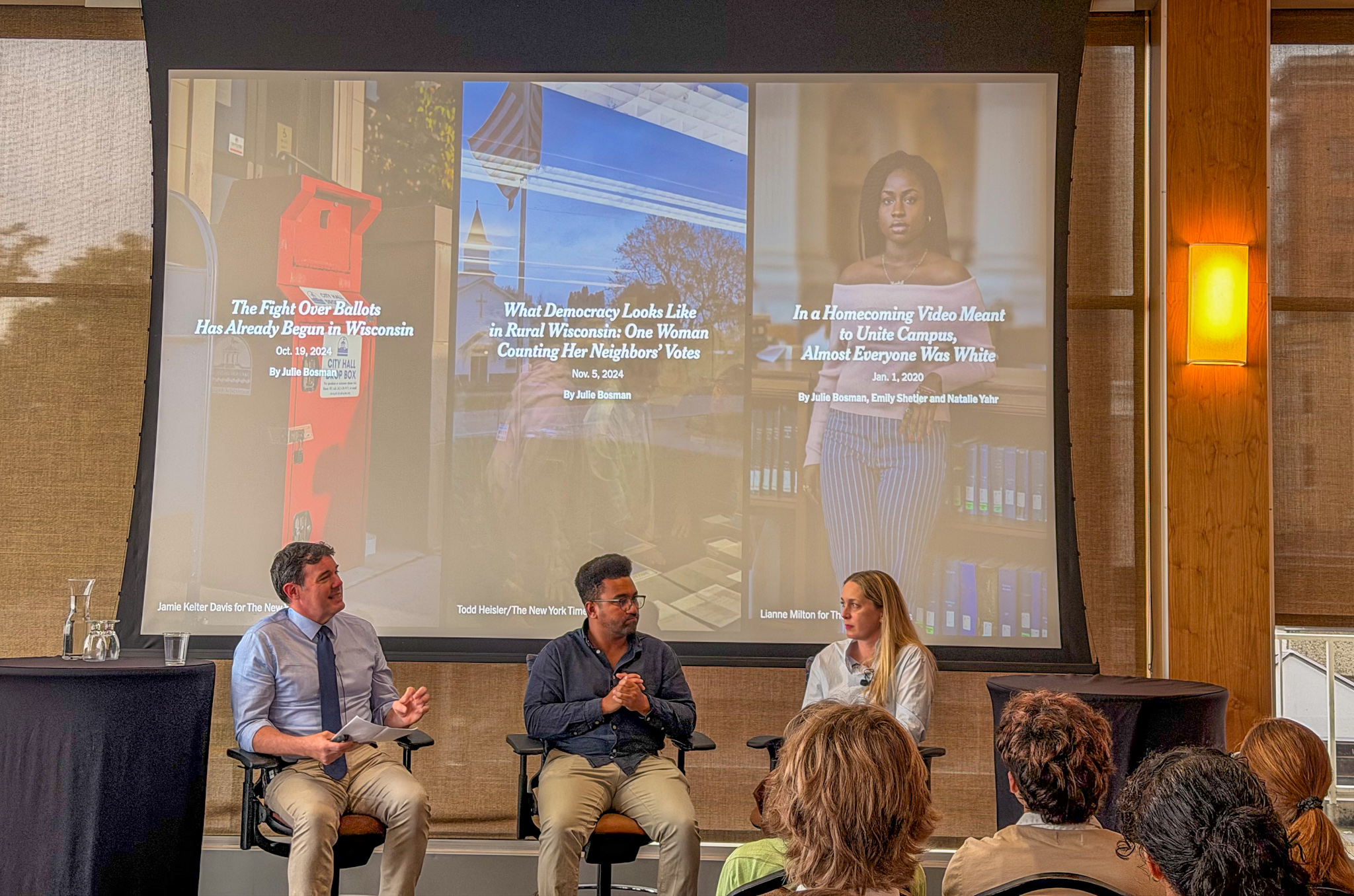
And, you know, you're based in Chicago, you know Wisconsin really well, but you don't have infinite time. You have to make choices about who or how you're, you're writing. Take us inside what that 00:21:30 was like for the, for the governor's, uh, primary in terms of how you decided... These are three of your stories, um, but, uh, but how you decided how to cover it.
This was a really tricky primary to cover. Uh, you know, you had this huge field on the Democratic side. You had candidates who were going in and out. Um, a governor who said he wasn't going to endorse, and then he endorsed. And then a candidate who was also a Democratic socialist, which was a 00:22:00 novel thing in a race like this.
And then all of that was coupled with, uh, an electorate that seemed not that into following the twists and turns as this was going. Mm-hmm. When you looked back at some of the polls, there were a ton of undecided voters fairly close to the primary. So it was difficult to grapple with that, and I think the answer for us was, you know, we did a deep profile from our politics desk, um, of 00:22:30 Francesca Hong.
You know, uh, Kellen Browning, our reporter, went up, you know, with her, um, I think it was to Hayward. They went all over the state, really a deep look at what her policies are and how voters, both Democrat and Republican, were responding to them, and I thought it was really revealing. And then you had, um, you know, so many of the things in that race were should we cover this?
Should we not cover this? Um, I think when the Thanksgiving, um, issue came up, 00:23:00 you know, we were not the first, uh, news organization to cover it or even the second, and I think that the way that we wrote about it in the end was I was out on the campaign trail with her, I think we were in Platteville- Mm-hmm and I was just tagging along as she was doing-- going from event to event. So we just rooted it in- Does this matter to voters? Are voters actually-- do they care about Thanksgiving and whether she likes Thanksgiving or not? And I think they really did. Um, and I was walking 00:23:30 around in downtown Platteville talking to people about this, and I would go up to people and just say, "I'm a New York Times reporter.
I'm writing about the Democratic primary. Can you talk to me about the race? What matters to you?" And very often people were like, "I don't know about the Thanksgiving thing. Like, it's, you know, it's a little off." And it was a proxy for bigger things, or you think it was just that? I think it wasn't. I think it was a number of things.
Like, I think that, um, a lot of people really tuned in to that primary very late. Like, they really didn't- 00:24:00 people in Wisconsin who I talked to about races, who are you voting for? What do you think? And a lot of people just said, "I don't like-- I don't know. Like, I'll think about that later." And then a lot of people really started to tune in right when David Crowley was back in the race, when Tony Evers was endorsing him, when there were, um, like old tweets, certainly they were small, but I think a lot of people just saw something that gave them pause about Francesca Hong 00:24:30 and made a decision that maybe they were playing it safe, maybe they were just being pragmatic.
But the whole race shifted at the last minute. Um, so it was definitely a challenge to cover it. Yeah. I mean, it was a wild race watching it from New York. I mean, I've, I've never quite seen like a, a, a top candidate drop out and then get back in a week later, the governor go from here to here. Uh, a top candidate, um, uh, sort of Hongs sort of coming on fast at the end and then an incredibly close, you know, race 00:25:00 between her and Crowley.
But I wanna dig into a kind of a key trust issue that comes up repeatedly. It came up with Graham Platner and his Maine Senate race, um, but Hong and, and Thanksgiving, and it's kind of a chicken and the egg thing. Mm-hmm. You know? It's, um, okay, the media is writing all about what Hong said about Thanksgiving because voters care about it, but voters are caring about it because the media is writing so 00:25:30 much about it.
Yeah. And we hear from readers all the time saying, "Hey, like this has become an issue because the media is making it an issue. Uh, my concern is really about like, can I pay, you know, my, my monthly rent? Uh, why aren't you writing far more about that than what someone said about a holiday?" Um, you know, how, how did you kind of think about your own, I'm just gonna use this word, but kind of responsibility there in terms of covering something that 00:26:00 maybe had become an organic issue, but also was, you know, something very much the media kept writing about?
Right. I mean, this is something that we wrestle with every day. Should we write about this? Should we not? Is this trivial, but do people care about it? And I often... I think it's a very case by case basis, but I often land on the idea that if our readers are hearing about something on CNN or reading about it on Twitter or wherever they get news- 00:26:30 They might be coming to us and saying, "Well, what is this thing?
Should I care about it?" If our readers are coming to us and looking for it, then I think, you know, we should be writing about what people are talking about. Yeah. And that's okay too, and then we can offer context, and we can send them... Like, we can write a 1,200-word story or a 400-word story. We can, you know, write the story in the way that we think is responsible and at least tell them about something that they're 00:27:00 talking about.
Yeah. I, I mean, I think what you're describing is, is a needle that we're threading all the time, and this goes again back to, to independence. We are... We're applying our news judgment to events. We cannot write about everything. We cannot cover everything. We are making choices. We're trying to understand, and we have a lot of editors, uh, back in New York and around the country, who are trying to understand what our audience is genuinely interested in. Um, but we're not, uh, I think, The New York Times of 00:27:30 50 years ago, which had a little bit of an attitude that was, "Well, it's not news unless it's in the Times. You know, we're going to tell you what to think in a very top-down way." So we're trying to kind of engage with our audience in that- I mean, many people in this room probably saw that Thanksgiving comment or, like, the Kaitlan Collins interview- Mm-hmm you know, maybe on their phones before they saw it in, in the Times, right? Yeah. And, and I do... Like, I tend to be sort of pro write it up too- 00:28:00 Mm-hmm ... because I just think, like, ignoring it- People are gonna see it. They're gonna see it. And, and if they're-- I mean, now in this kind of media landscape, I would rather our readers see it with, like, a couple paragraphs that I write, like, its context, than see it in isolation on Truth Social, TikTok, or Twitter.
I, I agr- I agree with you, but, like, this is something that we really grappled with with Zohran Mamdani's, uh, race, uh, you know, a 00:28:30 year ago in, in New York. As political reporters, part of our responsibility is to try to help readers understand all the different outcomes. You know, get you ready to be prepared for all the different outcomes.
So if, uh, Zohran Mamdani or Andrew Cuomo or Kamala Harris or Donald Trump is elected, if you've been reading The New York Times over those months, you'd have a general sense of what they would do as mayor, as president. I think you referenced a 00:29:00 lot of the, um, the work that we did on, on Trump and, uh, really kind of looking into what he has said he would do if he comes back- Sure to office. And- This was Charlie Savage's- This is Charlie Savage's ... with Maggie and Jonathan Swan. Yeah. And it really did, it really did come to pass. But these are things that kind of we, we kind of grapple with. We're trying to prepare readers, but then we also find ourselves writing a lot about Mamdani and Israel and Gaza, um, which was important to a lot of New York voters, 00:29:30 but affordability was also, like, a, a, a really key issue.
How do you two decide? I, I don't wanna use the word balance necessarily, but again, you can write about so many things. Um, how do you decide what to... When or when do you kind of know maybe when, uh, if you're writing too much about something, if you're thinking, uh, you know, uh, there's another sort of side to this or another dimension of this to cover?
How do you think 00:30:00 about that? Oh, that's so tough. I mean, these are, these are not easy questions. Um, I, working in the Chicago Bureau and the way that the national desk works is we cover what's happening out of the country, um, outside of governors and 11 state legislatures, and we have three reporters. So we're always making- Two of you in 00:30:30 Chicago, one in Minneapolis. Yes. Two in Chicago, one in Minneapolis. Um, and, you know, our, our goal is to cover everything that we think our readers need to read. We could never do that in the way that we want to, but, you know, we try to spread ourselves as thin as we can.
Um, I do think that very often our readers, we always have in mind the themes that they are interested in, the big national issues that pop up in, in the Midwest. 00:31:00 You know, we're covering a lot of immigration stories
A lot of these stories we keep returning to as we can because we know the, the readers have a huge Sentence breaks off; next speaker Also not just simply like a decision, right? Of like, we're gonna write a-- I'm gonna write about this or that today. I, I also need to get people to talk. Yeah. You know, at the end of the day, we're reporters.
00:31:30 We don't just write, like, essays. Yeah. And so, uh, I need... I mean, I can decide where to put, you know, my effort and sort of my time, which is, uh, always a challenge at the Times with that. But, uh, I also need that source to talk. Yeah. You know? I need that document to come through. Yeah. And sometimes it doesn't come when readers or public would, would, would like it, when I would like it to come, you know? Yeah. So like, it's also when, when do you crack it, you know?
Yeah. But as far as the 00:32:00 reporting, that can determine sort of when you, when it gets published. And you have to... The reporting has to stand up, you know? Yeah. I mean, ten years ago, we used to publish a lot more anonymous sources in the Times than we do now because we, uh, among other things, didn't like it ourselves.
It was one of the top things that readers hate about the news media, sort of these anonymous sources. How do you know, uh, that you can trust them? And so it's really like taking that time and, uh, and doing the reporting to get people to go on the record. I wanna pivot a 00:32:30 little bit and go to an interview that you did, uh, with your colleagues, uh, on the White House team, um, uh, with President Trump.
Inside the Oval Office interview
This was back in January. Uh, you knew you were gonna get some time with him. You ended up being at the White House for four hours. During the day, yeah. During the day. You had about two hour, two-plus hours of an interview. Yeah. But I wanna play, um, one of our reported videos that Zolan did. Uh, the Times is now 00:33:00 publishing, uh, twenty-five to thirty, uh, vertical videos, uh, each month, maybe thirty-five to forty actually.
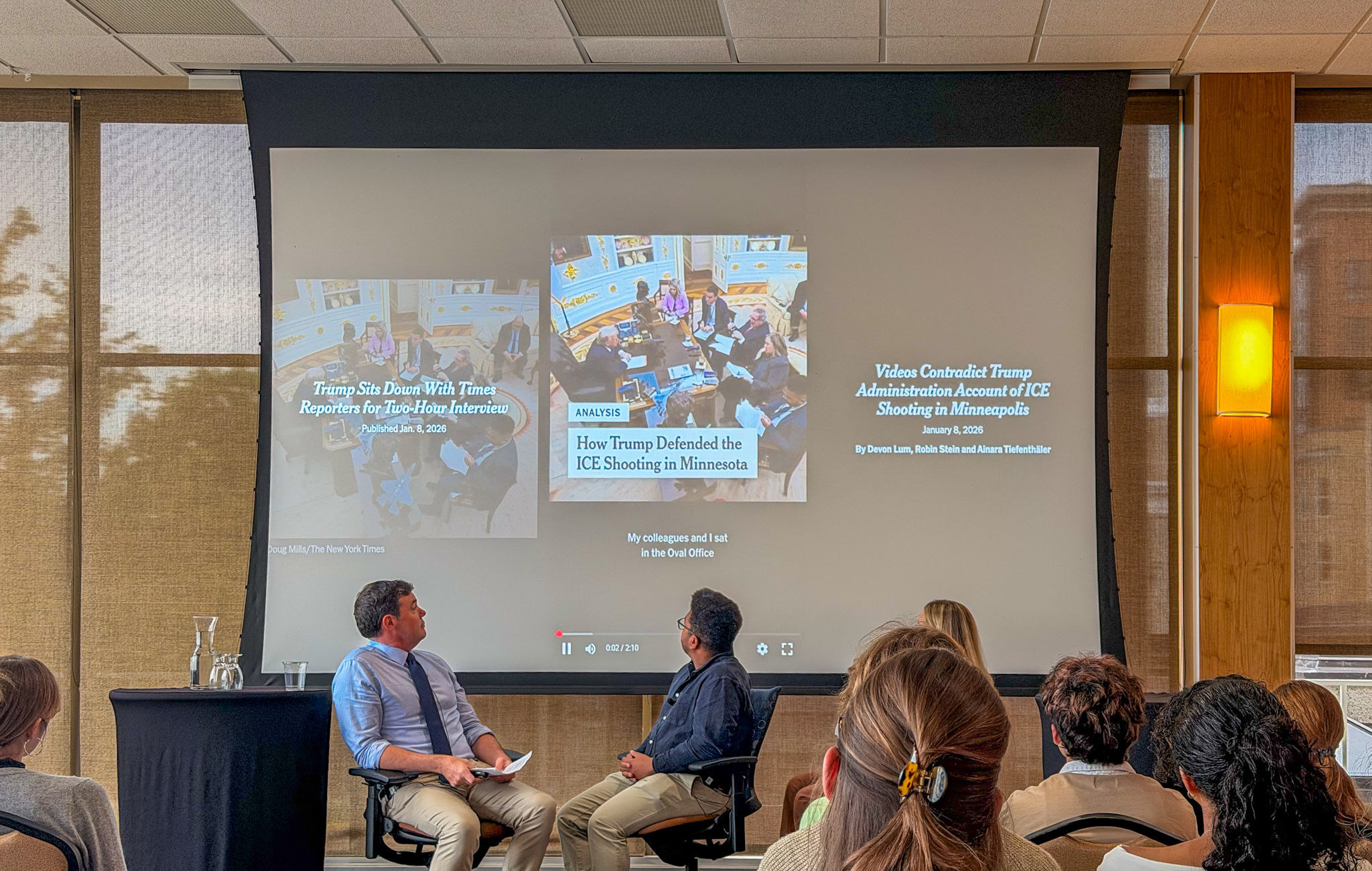
Uh, something that we weren't doing even, like, three years ago. We can talk a little bit more about the Times' push into video. Uh, but I wanna show this video that, uh, really, uh, captures, uh, frankly a lot of the work and the, those choices that we were talking about. Video clip plays My colleagues and I sat in the Oval Office with President Trump just hours after a 00:33:30 thirty-seven-year-old woman had been shot and killed by a federal agent As soon as we started to ask the president about this deadly shooting in Minneapolis, he at first acknowledged the tragedy of it all.
With all of it being said, no, I don't like that happening. But then almost immediately, he blamed the victim in this shooting. She behaved horribly, and then she ran him over. This echoes what we've heard from DHS and other federal officials. I noted that- That's disputed 00:34:00 by local officials ... the president responded by saying Well, I'd play the tape for you right now if you wanna just whip it up.
It really didn't take long then for a staffer to come over to the president's side right behind the Resolute Desk and actually hold up a laptop for myself and my colleagues playing a video of the incident. And as the video was playing, my colleague David Sanger actually said out loud Does 00:34:30 not look like the police officer was being run over there.
The president continued to watch the video and, you know, took a little bit of a softer tone. It's a terrible scene. He acknowledged that it was a tragedy, but once again blamed the victim of it. The woman in the car before she got shot, uh, was unbelievably bad, badly behaved. It was a remarkable moment where you have the president of the United States asserting that somebody was at fault in this incident just 00:35:00 as federal officials are calling for the public to refrain from making conclusions until an investigation is completed.
Let the investigation play out and, and hold people accountable based on the investigation. This whole moment just showed the president's reflexive defensiveness over a federal crackdown that has at times turned violent, and in this case 00:35:30 also impacted an American citizen as well. Clip ends So, so that, that video about Renee Good and your interview I think really gets at what the Times is trying to do, uh, around trust and truth.
It is showing, it is narrating, it is taking viewers, readers kind of inside rooms to show how in terms of AI era, you know, human reporters are 00:36:00 trying to engage with sources, including the President of the United States, uh, about issues that are, you know, deeply, uh, important and meaningful to a lot of Americans. And I'm, I'm curious if you could take us a little bit kind of inside, uh, the room as you were talking to the president, what you kind of wanted to get out of that, and as you were thinking about the, the video work, what kind of story you wanted to, to show, not just tell. Yeah. I mean, it's, 00:36:30 uh, to me, I'll start with the second one, right?
I mean, the, um, we, we did that video, uh, the, the, after the interview, like the night of the interview. Um, so we're... I mean, it was- You were kind of up almost all night, right? Yeah, almost. Right? Almost, yeah, yeah. Yeah, yeah. It was, it was pretty late. But I do think that sort of shows a change in the media landscape that hopefully I can say today is meant to...
I don't know. I, I think maybe when I was, like, younger, I, I would sometimes feel like there was an expectation 00:37:00 on the news media that maybe young people would go to them. Like, "You should be coming to read the print paper. You should be coming and reading in this certain way." And hopefully this is reflective of a change of we are still going to do the long investigations that, that are invaluable, but also we're trying to meet people where they're at too- Mm-hmm um, with still the foundation of, you know, balanced, fact-based reporting at the center of it. Um, so I just thought, like I remember that night we got back, 00:37:30 uh, this was sort of the new, the most immediate news to come out of the interview, um, his reaction to the Renee Good shooting. So I wrote a written piece, but then immediately did the vi- Um, there was only a certain amount of preparation we could really do just because, I mean, this thing kind of was down to the wire.
Um, uh, e-everything with the White House is, right? Uh, you know, whether or not something's gonna happen or not. But I, I knew going in that, um, me and my 00:38:00 colleagues had not sort of divided the topics up by you're gonna ask all the questions in this topic, but you'll sort of be like the ringleader, uh, take the lead on certain topics.
And I had ra- uh, I had immigration, uh, and domestic policy, right, sort of broadly. And, um, uh, my questions in the morning of that interview looked different than, than what I ended up leading with. That's because the Renee Good shooting happened that day, right? Um, 00:38:30 like a couple hours before we went into the White House.
So suddenly, you know, you've got all these questions that you've sort of been working on and what have you, and our, our, our... One of our most, you know, important jobs is to give people clarity and also ask tough questions to those in power about immediate news happening. Uh, so that news happened while we were walking into the White House.
He had posted on Truth Social sort of reflecting the answer that he would give, but he had- The onus on Renee Good- Put the onus on Renee Good. That's right 00:39:00 But he hadn't had anyone, um, push back against him- No ... uh, yet or, or say, "Hey, local official." There's just nothing that backs this up- Yeah, yeah ... um, at this time.
Also, we were-- I, I'm very lucky to work at The Times because we have our visual investigations department that had done an investigation of this already. So I-- That, that was an informed question. Yeah. I had some reporting to go off of by saying that. Even then, you still see I sort of leave it open to still see where he's gonna go.
When to push back, and when to let him talk
Well, I wanna, I wanna kinda 00:39:30 dig into that and play another clip because I wanna ask you about how you decide when to push back- Yeah ... like against President Trump, when to interrupt, when to fact-check. Mm-hmm. When to just let him speak, uh, for better or for worse, uh, because sometimes the, the unfiltered comments can actually be quite revealing.
But let's play this clip. This is another clip from, uh, from the interview, uh, that you all did with President Trump. Second clip plays I wanna ask if 00:40:00 part of your immigration agenda is also aimed at changing the racial makeup of this country. No, not at all. Is, is part of this, this agenda aimed at making- No. I just want people that love our country the country whiter as well? It's very simple. I want people that love our country. I want people that respect our country, respect the laws of our country, and, uh, I want people that can embrace our country. Because you've, you've shut the door to all refugees- I want people that, that can make their own communities besides African ones. You have a travel ban on majority African nations. Zolan raises an interesting point. The, the only 00:40:30 immigrants who can come in right now are white South Africans, right? Refugees. The way of, of refugees. Well, I haven't seen that. I mean, I certainly haven't seen that. But over the years, it's been very much the opposite of that.
Very, very much the opposite of that. Uh, people are coming into our country. Nobody's doing it based on race. Clip ends So there you have the president saying something that's untrue about refugees, uh, in that the way that that program's really been kind of overwhelmingly narrowed 00:41:00 toward kind of, uh, white South Africans.
But also, you found yourself in one moment, um, president's talking, you're trying to interject, uh, you both are kind of talking kind of over each other. What's that like in the moment? Do you know what you're, what you're doing? What are you trying to achieve? How, how... Take us inside the mind of a reporter during that moment.
Yeah, I mean, it's, um, uh, uh, I mean, for that question, I think it was very important to have follow-ups written down to back up why you're asking 00:41:30 that question, right? Um, that question isolation kind of comes with an expectation that everyone's been following every policy. Mm-hmm. So I think that, like, that question especially...
I mean, I'm asking the president if his immigration policies are aimed at making the country whiter, right? I mean, that's, that was the, the first follow-up I had, or that's when he started to talk over me. So that ended up being the final question. For that, I think it's really important that I knew that, one, that, uh, this wasn't just, like, that we had an audio going for the whole time.
So I knew that we- it would always be taped, 00:42:00 so you would hear the back and forth. Mm-hmm. One, that tells me sometimes in an interview, you don't just ask a question based off of what the answer will be. You also ask the question because- You're putting... It's important to put that question to the subject- Yeah.
Yeah ... and have people hear that, and have-- to hear how he'll respond. For that one though, especially, I think it was really important to say, "Why would I be asking this question?" Mm-hmm. Well, it's because he did shut, shut the door. He has a refugee ban on everyone, effectively, besides white 00:42:30 South Africans, right?
He's very much, I mean, in his first campaign and his second campaign, uh, put a travel ban on Muslim majority countries. Uh, he made it-- went further this year in making it harder to get green cards for specifically refugees from African and, and countries from the Middle East. Uh, a visa restriction on seventy-five countries, mostly in Africa and the Middle East.
So especially for that question, just not to have it in isolation, I don't want people to think I'm just making this up out of my head. I wanted to also ask the follow-ups to be like, "This is why I'm asking." I, I, I like that you're 00:43:00 emphasizing the questions- Yeah ... and the follow-ups because some of our readers want us to go into the Oval Office and just speak, like, truth to power.
Just give speeches. Get in his face. Call him adjectives or adverbs that- ... would make maybe some of our readers feel good. Yeah. That is not our role. And, and as much as some people, some Americans say, "Well, I would trust the media more, you know, if you guys called him a fascist or if you used certain words," our job is to ask questions. Yeah. 00:43:30 Like, throughout, I remember listening to the tape, but that two-plus hour interview, you never once got into sort of shouting matches or, you know, trying to kind of one-up in a debate. That is not your role. Yeah. It's to ask questions. I, I think my question in, in, in a way for you is i-in those moments, does it take a certain amount of, like, restraint, self-editing?
How are you thinking about being kind of nimble in the moment? Not self-editing. Yeah. I mean, I'm very much a believer that, 00:44:00 uh, my sort of role that I... I just think there's plenty of people calling him names and calling other, like, presidents names in this country. And especially in this day and age where now the White House has changed sort of how the White House press pool is set up.
Mm-hmm. And they can pick more- Yeah ... uh, uh, than in previous administrations which reporters go into the Oval, which reporters will be in press conferen- I just feel like I have more impact by asking a question that can result in an answer that people then can go use. Yeah. 00:44:30 Like, I'm-- I don't really feel the impulse to, uh, go into a shouting match.
And look, they are... He's very different depending on the environment- Yeah ... that you're asking questions in. I've had moments where it gets much more testy. I mean, I was in the briefing room a couple months ago, and I asked if he was concerned that his social media posts effectively amounted to war crimes.
Mm-hmm. And, um, he, he got pretty mad. Yeah. Right? Um, that was another thing where he was, you know, very much yelling at us, and I remember he, 00:45:00 he brought up, uh... As soon as I asked about war crimes, he was like, "Who are you with?" This was after this interview, so I, I assumed he knew who I was, but, like, he said, "Who are you with?"
And then he said, "Oh, the New York Times. Your subscriber count is down." I responded by asking the war crime question again. Right. He then said, "No, wait, but did you hear me? Your subscriber count is down." Yeah. Like, no one's reading you. I asked the war crime question again, right? And the president lays bait like nobody I've seen since, uh, since Bush.
I think-- I really do think that-- I think that it makes it a little bit easier if 00:45:30 you make it a media versus the president- Yeah ... which I don't think it is. Yeah. Rather than I'm just asking you a question. Right. We cannot take the bait. No, I think that's right. Julie, I wanna go, um, back to, uh, back to Wisconsin and talk a little bit, uh, sort of following on my question for Zolan about how you, uh, sort of how you telescope into issues.
Um, so thinking about... Let's see if I can- 00:46:00
Telling election stories through people
Um, as we try to figure that out, um, but you have written about Wisconsin now for years, and particularly about, um, elections twenty twenty-four, ballot integrity, um, how ballots get counted. You did profiles of, I, I know kind of like one, uh, there we go, kind of one woman who's counting her neighbor's votes.
Um, and then even going back kind of further, writing about, uh, the University of Wisconsin, Madison, and kind of a 00:46:30 controversy that happened on campus. Like take us inside a little bit your own kind of judgment about the questions that lead to stories for you, how you decide kind of what to, to zero in on.
Yeah. So, um, this-- back in fall of twenty twenty-four, we did something a little different. So the way that, um, the national desk is set up, we, you know, cover our regions or our cities, but, um, we decided that I was just going to be detached, 00:47:00 um, from the desk sort of, and only focus on Wisconsin for about, I think it was six weeks before the election.
So I was just here all the time, and it was kind of great. I was-- like really got to talk to a ton of people. I got to do a bunch of stories that were really centered on what the big issues were and what people were really thinking about. And as so often in Wisconsin, I find that it is like a microcosm of the country.
Ballot, um, boxes were a huge 00:47:30 issue here. You had, um, both Republicans and Democrats talking about election integrity, which was this really loaded kind of weaponized phrase on its own. So, um, so we did a story, and I ended up talking to, I mean, the seventy-two counties of Wisconsin. I think I talked to about half of the county clerks about how they ran elections.
Um, and- Just that trust in elections that people might- Yeah. Like what, what were they hearing? How... You know, Wisconsin is 00:48:00 really unique in that it has more, um, local municipal election clerks than any other, um, state. So then that story led to this story, which was, um, a story about a woman named Graceanne Toberman, who lives in Magnolia, which is, um, south of You know, we've written so much about the policy of what counties were doing, what municipalities were doing, how elections are run, trying to explain it, um, from a policy 00:48:30 perspective.
But then we thought, "Well, let's just write about this lady who is a farmer, um, a longtime farmer in Rock County, lives on this absolutely stunning farm, and she's also the town election clerk in Magnolia, which has, like, fewer than 1,000 people." So it was just a way of writing about an issue, do people trust elections or not, but telling it through one woman who, 00:49:00 um, was incredibly gracious and open and said, "Yeah, you know, you can come over."
And we spent really a few days kind of popping in and out and talking to her. And then on Election Day, she agreed to let us come over, um, as she, uh, fed the chickens and did her chores around the farm before going over to, um, the town hall where elections are held. And it was just a way of, you know, using her as 00:49:30 a way to just tell a story. Like, this is how elections are actually, um, administered in Wisconsin.
Yeah. It really does, it really does bring it to life. And just to be very candid, I mean, we often choose characters, but sometimes that involves characters choosing us a little bit too. To, to Zolan's point about getting documents, getting sources, like, having people who are willing to talk, that has become harder over the years, I have to say.
Like, the... whether it's a mistrust in the media, mistrust in the Times, and I wonder how you do get people 00:50:00 to talk. And even I'm, I'm wondering about this University of Wisconsin story. You know, it's just, uh, something that is a, a, a tough story on campus. People might be like, "Ah, I don't wanna, you know, talk about that."
But what, what goes into that, getting people to frankly to trust you with, uh, with their view, their story? Yeah. It's not easy. I think it has, um, gotten a lot harder. I've been a national correspondent for 12 years now, and it's gotten significantly harder to get someone who doesn't know you to open up and tell 00:50:30 you what they think.
What... Can I ask why is that? Because on social media, people are more and more open compared to when I was young. But with the news media, it seems a lot easier
Gap in the recording
Part of the conversation was not captured. The transcript resumes below; its timestamps restart at 00:00:00.
Answering attacks, and the long work of trust
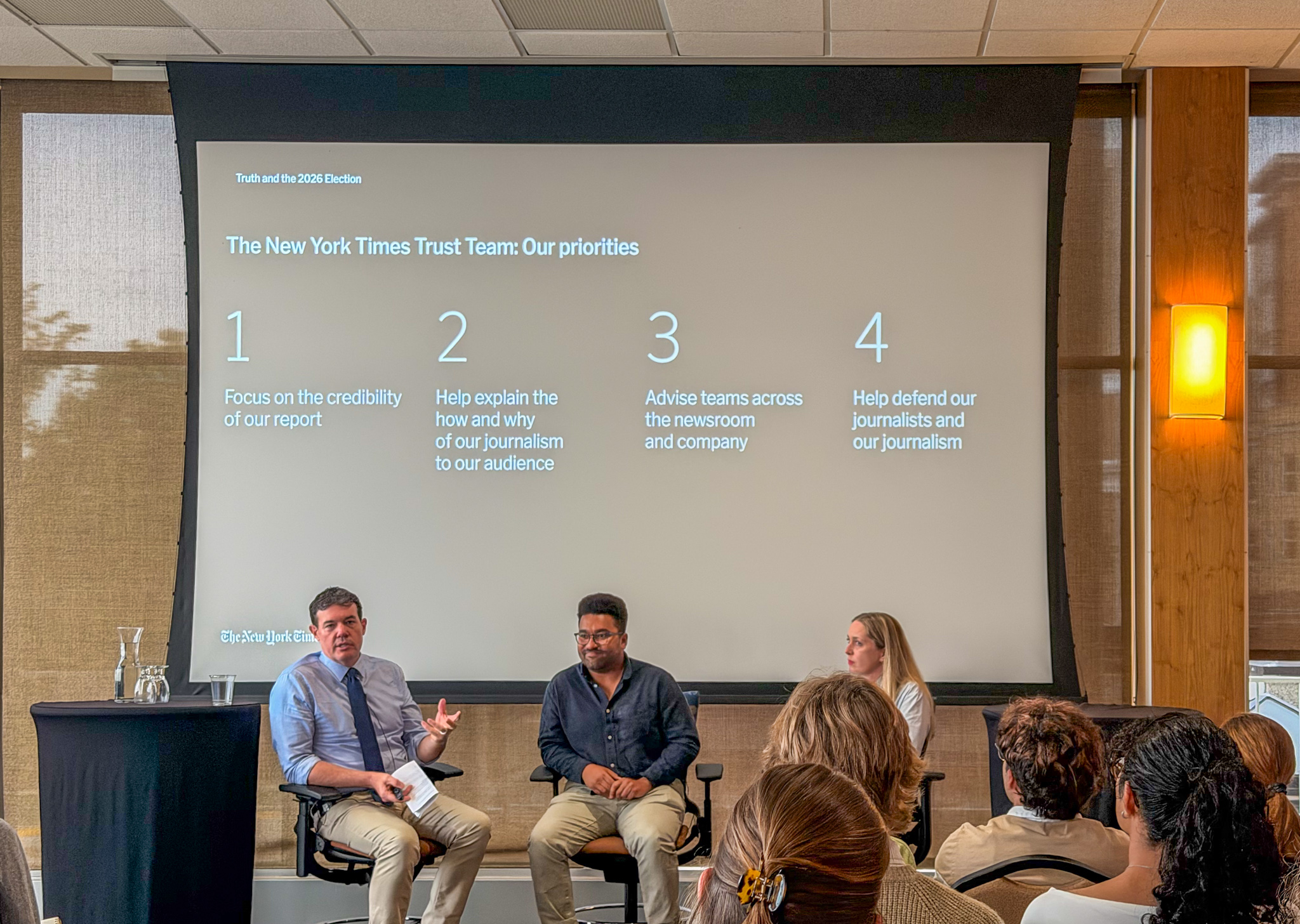
00:00:00 We've never had a, a president who uses, uh, phrases like maggot to describe one of our own colleagues, uh, who uses language about the news media, uh, that he sometimes says is, uh, just for, uh, uh, for laughs, uh, but really does, uh, weaken trust. And so we've become, I think, a lot more aggressive in pushing back against attacks on our journalists and our journalism.
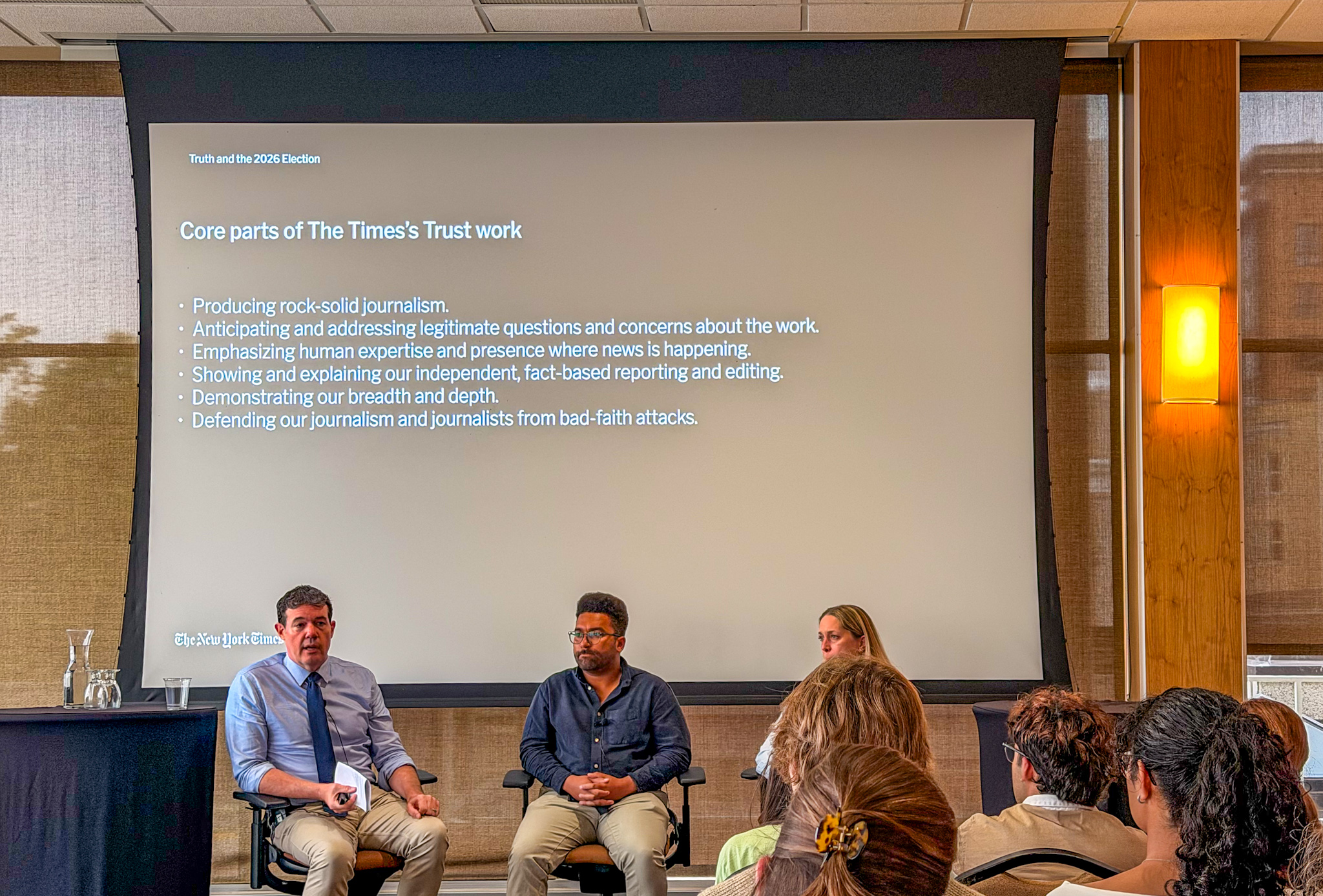
I just think the era of sort of stand-- the, the journalism speaks for itself, 00:00:30 uh, that era is really, is really over. Um, and then just looking at kind of, uh, some of the core parts of, of the trust team's work. Um, it's really the journalism. We can't do sidebars with Zolan about how he decided, uh, his questions for President Trump if you're not getting, uh, the core journalism right about what's happening, uh, in the White House, so sort of supporting that.
Uh, it's also dealing with legitimate questions and concerns about our work. We've got a lot of 00:01:00 questions over the last few years about how we've covered, uh, the war in Gaza, how we covered, uh, October 7th and the aftermath A lot of readers on all sides of that conflict who had questions or concerns were even angry about some of that coverage.
So trying to engage with readers directly, uh, about their questions and not just say, you know, we're in a, you know, a, an ivory tower, uh, and we're gonna let the journalism speak for itself. And then it really is 00:01:30 sort of, uh, trying to explain fact-based journalism. I mean, that is our bread and butter. You know, we're not in, uh, the opinion journalism, uh, business, uh, full-time.
Uh, we're not into sort of subtle commentary. It's about fact-based journalism. You count on us to go to places around the country, around the world, confirm and verify facts, and bring that to you with, uh, with- without spin, you know, 00:02:00 without a slant, without an agenda. Do we get it right all the time? We do not.
We do not pretend to be perfect people. But in this AI era, we deeply want people to, to believe in and trust fact-based reporting that's done by human beings. Um, and then it's really demonstrating the, the breadth and depth of our journalism, and again, sticking up, uh, for the journalism from, from bad faith attacks.
This is work that we see as, like, five, 00:02:30 10, 20-year work into how we build trust, gain trust, how we regain trust from people who may, uh, who may doubt us or may think that we are complicit in one thing or against this group or that group. Uh, it's long work, um, and a lot of it is, again, something we may not persuade people on.
But we really believe that if we spend these years showing kind of what we do as human 00:03:00 beings, uh, that we can have the trust that, uh, frankly, at least I personally believe, um, AI will never have. So that's, that's just some of the work. That's kind of what brought us here is to, to try to get, again, uh, to different places in the country to talk a little bit about what we do.
Um, and, and now I think we do wanna kind of turn it over to you to hear some of your questions, grill us, push us, call bullshit on things that you might think, "Hmm, 00:03:30 not quite believing that." Um, we'd love to get into your questions. So yeah. Sure.
Audience questions
I have a question regarding the twenty twenty-six elections. Uh, I've been, like, listening to the ads in Iowa, and it seems like no candidate is actually forthcoming if they're Republican or Democrat. Like, I have-- on my own, I have to do my own research to 00:04:00 figure out who to decide this early on because it seems like it's a lot of negative stuff and I don't know, am I wrong about this, do you think?
Are you thinking of the Iow-Iowa governor's race? Is that what you- Yeah. Um, yeah. Like with Zach Lahn and Rob Sand or- It's such an interesting race because, um, I was just talking with my editor about this the other day. I've written a little bit about this race, and it does feel like the labels have been muddled a little bit. You know, Rob Sand, who's the, uh, Democratic, uh, nominee, has really tried 00:04:30 to redefine what a Democrat is by shying away completely from the label by saying he doesn't want Are well known to come campaign Unclear in recording with him. Um, you know, when I-- when you go to his campaign events, it's all blaze orange and hunter green signs.
It does not look like you've walked into a, you know, a Democrat asking for your vote. It's also a reflection of the fact that he's a bow hunter. And when you go 00:05:00 into his office in, um, the Capitol in Des Moines, there's like heads everywhere, like taxidermy- -heads of animals, like a huge, like, bison pelt on the wall.
Like, so I think that he's trying to do something really, really different. Mm-hmm. And then on the other side, you have Zach Lahn, who's the Republican, and he's also a different kind of Republican. He's not shying away from the fact that he's a Republican. But in his acceptance 00:05:30 speech, he talked about big ag and how he was gonna take on big ag.
Well, that's not really the kind of language that you hear from Republicans in Iowa. Like, big ag is their friend. Um, and then you have issues like cancer rates, which are sky high in Iowa, and water pollution. And like, these are things that Democrats have talked about for decades and have, y-you know, tried to get policy changes to, um, you know, protect 00:06:00 land and water.
And now the Republican, Zach Lahn, is also talking about those issues the same way, uh, because he's the, um, MAHA candidate. So you have a real muddled sense of who's who. Thank you for saving my sanity. Because I'm like, "What's going on?" I don't see the same dynamic in Wisconsin, though. Do you? I mean, I feel like they're both-- Tom Tiffany is very proud of being a Republican and- Yeah is not shying away from that. And David Crowley is pretty clear about his 00:06:30 partisan affiliation. You know, it is interesting, though, because some people really, uh, mistrust the media when they feel like we're trying to put people in boxes. Like Democrats- Yeah ... act like this, Republicans act like this, and politicians like nothing more than to sometimes complicate those images.
Um, they're trying to sort of grow their base as much as possible. And a lot of people look to us to say like, "Well, what is the truth of the matter? Like who is this person?" I remember when I was politics editor in twenty nineteen, we did a story that was to find what does Kamala Harris 00:07:00 believe. This is when she was running for president.
And part of it was getting at the fact that she was like a bit of a shape-shifter on, on policy, so. Well, and this is why I think it's really useful that when you're writing about a campaign or an election, it's so much kinder and more precise to readers to just say what they believe rather than saying, "Well, this is a progressive and this is a moderate."
Well, what does that mean exactly? Yes. Like talk about what it- What their policy position is rather 00:07:30 than trying to make readers figure out what a moderate centrist is. Like who, who- What does that mean? Right. Yeah, but that's getting away from labels and shorthand. I think you're so right. I think that, you know, people want... frankly, they want just more detail, more context. Yeah. More... Uh, another question. Come on down. Yes, right here. In the front row. Um, it times out 00:08:00–00:09:00audio not captured political discourse, but it feels like a 00:09:30 I just feel like the coarsening is going up, down, side to side. I mean, it's, it's something I'm not sure where or who it necessarily started with, but it does feel like something we're grappling a lot with and even during this panel, I cursed a couple of times. The Times has really strict standards on cursing, uh, but some of my colleagues find those standards to be a little fusty, and they don't reflect, um, uh, the way that a lot of 00:10:00 people talk today.
But civility is frankly one of the, the standards that gets a vote when we don't publish a lot of the profanity that President Trump, uh, uses sometimes to effect on, on social media. Um, so it's, it's definitely something that, that we're grappling with. Are you also curious about it from the standpoint of like receiving it as a journalist?
As a student journalist, I, I wonder how it is for you 00:10:30
Do you feel like you've experienced less civility since you've been posting your interviewing? Not necessarily just when interviewing. Also, like, post-publication and- ... you know, just existing. But, uh, like- It's... But I, I... One anecdote I would give you is I, yeah, I think it's just a reality when you're a journalist that often a lot of your, um, uh, your, your, the, your inbox may not be sort of on the positive side, right?
Um, uh, and, and I think it's even 00:11:00 worse on social media for my colleagues who are women and especially when it comes to sort of the political world that we're in right now. But I, I get, like, also a good amount of sort of hate, you know, in the inbox and what have you, and I, I find it interesting pro- so much of the time I actually will read and take the time to respond sometimes to some of these and even just send, like, a one-liner like, "I appreciate you reading," you know, even to some stuff that's really bad.
Mm-hmm. And oftentimes that reader will reply and 00:11:30 be like, "Oh man, I'm... Thank you for responding." So embarrassed. Like- Almo- almost, like, shocked that there's a human being behind the internet profile or the byline that they've been reading. So I think maybe some of this has to... I, I don't study this or anything, but some of this has to do with maybe forgetting that there's humans behind these social media accounts and bylines and what have you, too.
And I think that's what we're kind of trying to do with some of these videos and putting the photo by our byline and sort of remind people, like, this is a human practice. It's imperfect, but there's people 00:12:00 behind this. And it... I, I find that, like, I get a lot of, a lot of emails from readers. I also read all of them, unless the subject line is so off-putting and personal that I, you know, have to protect my sanity and not read further, but I usually read all of my emails, and you never know what people are going to say.
Maybe they'll have an interesting tip or comment or, um, or information that would be useful. So I do read all of them, and I, I've had the same experience as Zolan. Like, sometimes if you 00:12:30 respond- Very embarrassed and apologized, um
And then it's okay. Yeah. We all send nasty emails. Yeah. No, I've had the same experience. But it's interesting, a few years ago, our executive editor at the time, Dean Baquet, uh, put out a directive to the staff encouraging, uh, us to get off of social media, to get off of Twitter, to get off Facebook. No more Twitter wars, no more fight.
Like, and, 00:13:00 and people at the time were not sure how that would go over, but like a lot of reporters were very relieved to get that, that in an era where we might assume you need to cultivate an online personality to be successful in the news business, it's... Your success is reporting. It's getting stories that nobody else can get.
It's showing things that no one else has gotten. Uh, it's not being on X yelling and being incivil to, uncivil to 00:13:30 people. Thank you. Uh, yeah, go ahead.
I'm a student journalist with the Mass Feminist. Um, I kinda wanna talk more about like how do you sort of report like more nuanced- You know, you mentioned like the Supreme Court's decision The original decision was based on, like, um, judicial, like, judicial standing, who had the right to sue. That's probably something not a lot of people wanna read about.
Yeah. Probably something more nerdy. 00:14:00 Yeah. Um, and then, so, like, how are you gonna deal with that? Like, like, do you report on that, but then how does, like, the headline look as well? It's like, how do you sort of balance, like, the... You want it to be interesting, but then you also wanna make sure readers understand what's actually happening.
Really good question. I mean, um, and I appreciate it. One, I should say, the story that they showed there, that wasn't the, um, the, like, main news story. Mm-hmm. Right? Like, that was... We had a separate Supreme Court reporter that did sort of the more, like, standard nuts and 00:14:30 bolts, here's what was said, here's the legal reasoning, what have you.
That story publishes after to sort of give you a forward-looking, sort of bigger picture beyond just this, uh, uh, decision sort of story, right? So I guess one answer is which story am I actually writing? Like, have that clarity, and make sure that I'm not going with an analytical story or a sort of big picture story or what have you, assess that we might call it, when really what the readers need is also that hard 00:15:00 news, nuts and bolts, right?
Um, so that's sort of a big, uh, uh, one thing for it. Uh, this is a challenge though. I'll be honest with you. Like, um, this stuff is really complicated. Uh, I think I'm lucky to be at a place that doesn't have sort of these, um, like, ingrained rules of this story has to be a certain amount of words, right? Um, uh, that hasn't, like, always been the case.
We like them short though. There's some pressure, right, these days, uh, it's short- And I'll push back- Yeah. -on that 00:15:30 too, like, if we need it to. Like, uh, uh, e-especially 'cause, you know- Yeah ... like what you're saying, I mean, if, if there's needed context in there, it's worth the extra couple graphs, right? Um, a good way to also ensure...
And I don't always get this right, to be honest, but, like, a good way to try and make sure... I talk, I don't, I talk about this at the top, but I do try and have, like, some preparation done before the case 00:16:00 hits, in this case, the, the decision drops, um, before the news hits. I might, like, have a Google Doc where I'm pre-- I have some mock graphs going of context, you know.
And if it's a higher court decision, right, then I can already start writing what the lower courts have said, which would be, make sure that I'm more prepared so that we can include that context once, once the decision hits. But it's hard. Like, it is hard. Um, I do think that one thing that's helping us out a little bit is the changing sort of 00:16:30 way that we present the news now.
Like, you, you don't need to just go to that six-hundred-word piece that you might only get in the print paper, uh, years ago. Instead now, you might... I mean, the way you might initially consume it is through, like, a live briefing on the website, where you have our Supreme Court reporter giving you, like, line-by-line analysis of this thing.
Or we now annotate like decisions too, right? Um, or maybe the daily is giving you something too. So, so that, that can kind of help. But because all of those story 00:17:00 formats exist, something I need, that I need as a reporter is like, with my, my editor, okay, what, what am I like actually? I'll just add with, uh, with headlines, um, two of the kind of most popular formats for headlines are the how and the why headlines.
So, uh, why the Supreme Court did what it did, or how, uh, the, uh, plaintiff's standing affected the outcome of this case. Like, just tell readers directly kind 00:17:30 of what happened, but also, uh, be taking them, um, behind the scenes. I think that as Zolan mentioned our, our podcast, The Daily, The Daily is really meant to be that kind of explanatory form.
It's a reporter really kind of taking you inside, uh, kind of the how and why of, of what they did. Um, another- What I've heard, though, is that this is one person advocating for long stories. I know. Noted. Noted. Okay. Maybe-- Yeah, in the glasses.
00:18:00 Yes. Uh... Yeah Hi, um, my name is Syd. I'm also a student journalist at the Daily Cardinal. You talked a lot earlier about, um, kind of blocking out the noise and hearing stuff on social media. How do you decide what is actual constructive criticism of your reporting and what is just, um, like kind of people bashing it or not understanding what you're doing? Yeah, I mean, I've been at The Times since two thousand and five, and I 00:18:30 take constructive criticism really seriously. Maybe that's partly why I'm kind of in my job, is to, is to really think through, um, how readers and viewers and listeners are experiencing the most deeply felt and contested, uh, issues.
I've spent a lot of time over the last year and a half, uh, particularly dealing with issues around the Trump administration, uh, Israel-Gaza, uh, you know, immigration, crime, 00:19:00 antisemitism, Islamophobia, issues that readers have some real constructive criticism around. And what we try to do is... This may sound a little boring, but it's, uh, maybe a little earnest, but it's very true.
We talk about these things so much. We're not agonizing about them, but we're talking about them because we don't see just sort of one solution or one way to cover something. Um, we're not seeing just sort of one voice on one side, 00:19:30 uh, having like the capital T Truth. We're trying to understand how our readers are experiencing something.
So, um, you know, a year ago August, we were writing, uh, quite a lot about starvation in Gaza, and we ran a very, very large photo on the front page of the print paper of a starving child in Gaza. And it turned out that we got, uh, some things wrong about that story and that photo. 00:20:00 Um, and we heard a lot of constructive criticism.
We also heard bad faith criticism, you know, that we were Hamas propaganda. Uh, we, uh, we heard sort of criticism three hundred and sixty degrees. But that criticism, really, it, it, constructive criticism helps. I think it helps keep us, keep us honest. It helps us think about transparency. When we make a mistake, we run a correction.
We sort of grapple with it. But we also, you know, and I think Julie and Zolan spoke to this really 00:20:30 well. It helps us think, how can we cover this subject better? A lot of the things we cover, we're covering for months or years, and it helps us kind of think, I think, more deeply about, uh, about our choices. Any thoughts on your end? I will just say, when you get constructive criticism, you know it. You know, if your mind is open to facts and possibilities. Like, if you get an email from a reader and you think, "Okay, that, that reader had a good point," like there's no hiding from that. 00:21:00
That's why we welcome emails, honestly And it's, it's interesting because people, this is something that, you know, is, is frankly just upsetting about, I think America and the world today. We again, we're not perfect people up here, but we are nothing if not pretty open. Like, give us feedback. And when people come to us with feedback, and it's the most racist, sexist, anti-Semitic, Islamophobic, vulgar, like 00:21:30 it's just what point are you making?
Hmm. It's just to, just to attack. And the reality is, if they have an actual point- Yeah ... uh, good faith, maybe it's even bad faith, but they wanna make a point, like we are, we are unusually open to it because again, we think this place has been around for a hundred and seventy-five years. We want it to be around for a hundred and seventy-five more.
And if people just think you're not listening to us, you're closed off to 00:22:00 constructive criticism, um, you know, we're gonna be in a lot of trouble. So I sometimes wish people- Well, a lot- ... you know, made those points clearly. Yeah. A lot of it comes, I don't know if you all read the comments in stories, but because they're moderated, um, it can be an incredibly civil, wonderful place to hang out in the comment sections of stories, and very often reporters jump in and- We'll reply to it now. Yeah. Yeah. We reply to them. Like, and, uh, it's encouraging when you- Yeah ... look at what the comment sections can be 00:22:30 because I think it's also helpful for readers to be reminded that there's a real human being who wrote that story, and now here she is, and she's jumping into the replies and, you know, responding to what people are saying.
Yeah. Including people pushing back or challenging. So we've just time for a few more questions. Um, yeah, right here. I think, like, with all the election stuff and all the distrust around news, one thing that I think about a lot is what is the bias in 00:23:00 news? And I, you know, I think most news sources in the New York Times are doing a very good job, and it's in very good faith.
You know, you're a reporter, that's what you, what you do as your career, as your passion. But I do think I wonder, like, how does the money influence that as far as like a viewership? If your viewership leans a certain way, does that start to impact, you know, the ways that you phrase things, the ways that, the, the ways that you, you know, format headlines?
And then when you... if and when you see that happening, how do you kind of avoid that? And while also 00:23:30 kee-kee-keeping viewership? It's a business. Yeah. I mean, maybe I'll start. You know, we're thrilled that we have like a, a thriving business. The business is now pretty much a subscriber business. We have, you know, uh, about fourteen million, uh, subscribers, uh, at The Times.
But boy, whether it's, uh, in the opinion section, whether it's in the news section, there are a lot of those subscribers who aren't, you know, happy in any given day. And we know people can, you know, vote with their money. Um, but they, they do 00:24:00 keep coming, like the business keeps growing, which is, which is really heartening.
I think our bet is that people like to be challenged, that people like to read about, uh, different viewpoints maybe than, than their own. If they get frustrated, you know, sometimes, yes, they, they cancel. Um, but I think in, in some ways, um, you know, we do live in a capitalist economy. Uh, the degree to which, uh, we're not beholden to 00:24:30 advertisers or to, to corporate interests is something, uh, that I think is really important, uh, for us. And, and at least in the newsroom, uh, you know, no, no BS. In twenty-one years, I mean, I-- and I've covered a lot of different beats, including in arts, which is very advertiser heavy.
I never had an editor or someone come over and say, "Hey, we gotta write the story this way," or, "We wanna get that interview with that CEO. We gotta take it easy on Chase Bank." I mean, you know, we were kicked out of China, you know, some years 00:25:00 ago in terms of, um, the blocking of our, our website in China because of tough coverage there, so.
I would, I would just echo that. Like as a... Uh, one, I appreciate the question, too. Just as a reporter, I... I mean, the newsroom takes that firewall stuff seriously, right? I mean, I like barely know people on our business side. I'm sure they're great. I appreciate them and the, the work that they do, but I, I just have never had, uh, reporting disrupted, um, by, by folks on the business side.
Really few guys, you know, as far 00:25:30 as that goes. I work with the editors and-
Maybe one last question, maybe in the back, 'cause we've gotten a lot up front. Uh, okay. A hand went up
So I'm glad you have an opinion page, but I'm wondering, um, the editorial board at least is pretty progressive. Does that make your job of trying to say you're not biased 00:26:00 harder? Great question. I spent four years as the deputy in the opinion section under… a rare person, I think, who's gone from the newsroom to opinion and back.
So it's, it's an interesting experience. Look, um, I worry a little bit less about that and a little bit more about making sure there's not opinion in the news pages. You know, making sure, uh, that the news stories, uh, don't feel like, uh, there's any unconscious bias or, or slant. 00:26:30 Um, the, the editorial board kind of, you know, is, is what it is.
And we do live in a, in a society, in a world where people will say like, "Well, The New York Times endorsed Kamala Harris," uh, which the editorial board did in tw- twenty twenty four. The New York Times endorsed Joe Biden. Well, the editorial board did that in twenty twenty. I-- it's a, it's a losing battle for me to try to go out and say, "Well, it's the editorial board that, that does it."
But, but hopefully, um, through our kind of 00:27:00 journalism, I think in the newsroom, it's, it's very clear that, uh, as kind of one of our mottos goes, we, we kind of cover the world without fear or favor. We don't, we don't take one side. But again, people are going to come to conclusions, uh, that they're going to.
As much as we may have, uh, had the editorial board endorse, uh, Joe Biden, uh, I have not in my life seen a president who was more frustrated, uh, with The New York 00:27:30 Times than, than President Biden. So, uh, I don't think he necessarily felt like he was getting anything through. I, I would also add that as a reporter, I don't read opinion in The New York Times.
I don't... It doesn't help me. I-I'm afraid it'll give 00:28:00
It is tricky though, because we do live... Uh, again, when I was in the opinion section, we, uh, we covered news events like President Trump's trial in Manhattan, and a lot of people came to the opinion section because they wanted to experience the news through kind of an opinion lens. Um, I think Bari Weiss and her creation of The Free Press and now a little bit of what she's doing at, at CBS, uh, there is some audience for that, that they, they kind 00:28:30 of want to experience the news through an opinion lens.
We don't do that. I get why those business models, uh, kind of exist. But, um, uh, but again, I think with the newsroom, it's really about the questions, the facts that, uh, we were talking about. Um, I just wanna thank all of you for coming out on a Tuesday afternoon. You could have been doing other stuff. We really appreciate it.
We appreciate the questions, your time, um, and your support for, for The 00:29:00 Times, for fact-based journalism. It really matters to us. So thank you so much for coming today.